
SAFe Best Practices: A Practical Guide to Scaling Agile Successfully
Updated on Sep 13, 2026 | 4 min read | 12.49K+ views
Share:
Table of Contents
View all
Quick Overview
- SAFe best practices help scale Agile by aligning teams, strategy, and value delivery.
- Key practices include PI Planning, ARTs, backlog refinement, dependency management, and continuous delivery.
- SAFe also emphasizes built in quality, team empowerment, outcome based measurement, and Inspect and Adapt.
- This guide covers 12 SAFe best practices and role specific practices for key SAFe roles.
Build enterprise Agile leadership skills with AI-Empowered Leading SAFe® 6.0 Training and learn to lead successful SAFe transformations.
Master the Right Skills & Boost Your Career
Avail your free 1:1 mentorship session
What are SAFe best practices?
SAFe best practices are practical approaches that help organizations apply Lean Agile principles across multiple teams, programs, and business functions. Unlike team level Agile, SAFe focuses on creating alignment between strategy, product development, delivery, and business outcomes.
A strong approach helps organizations:
- Align strategy with execution
- Improve collaboration across teams
- Manage dependencies earlier
- Deliver value continuously
- Improve quality and predictability
- Shorten feedback loops
- Make decisions closer to where the work happens
The goal is not to add more processes. SAFe best practices are most effective when they help teams reduce waste, improve flow, and stay connected to customer and business value.
Also Read: How SAFe Works.
12 SAFe best practices to follow
The following SAFe best practices focus on the areas that have the greatest impact on coordination, delivery, quality, and business alignment. Organizations do not need to adopt every practice at once. The better approach is to identify the areas creating the most friction and improve them first.
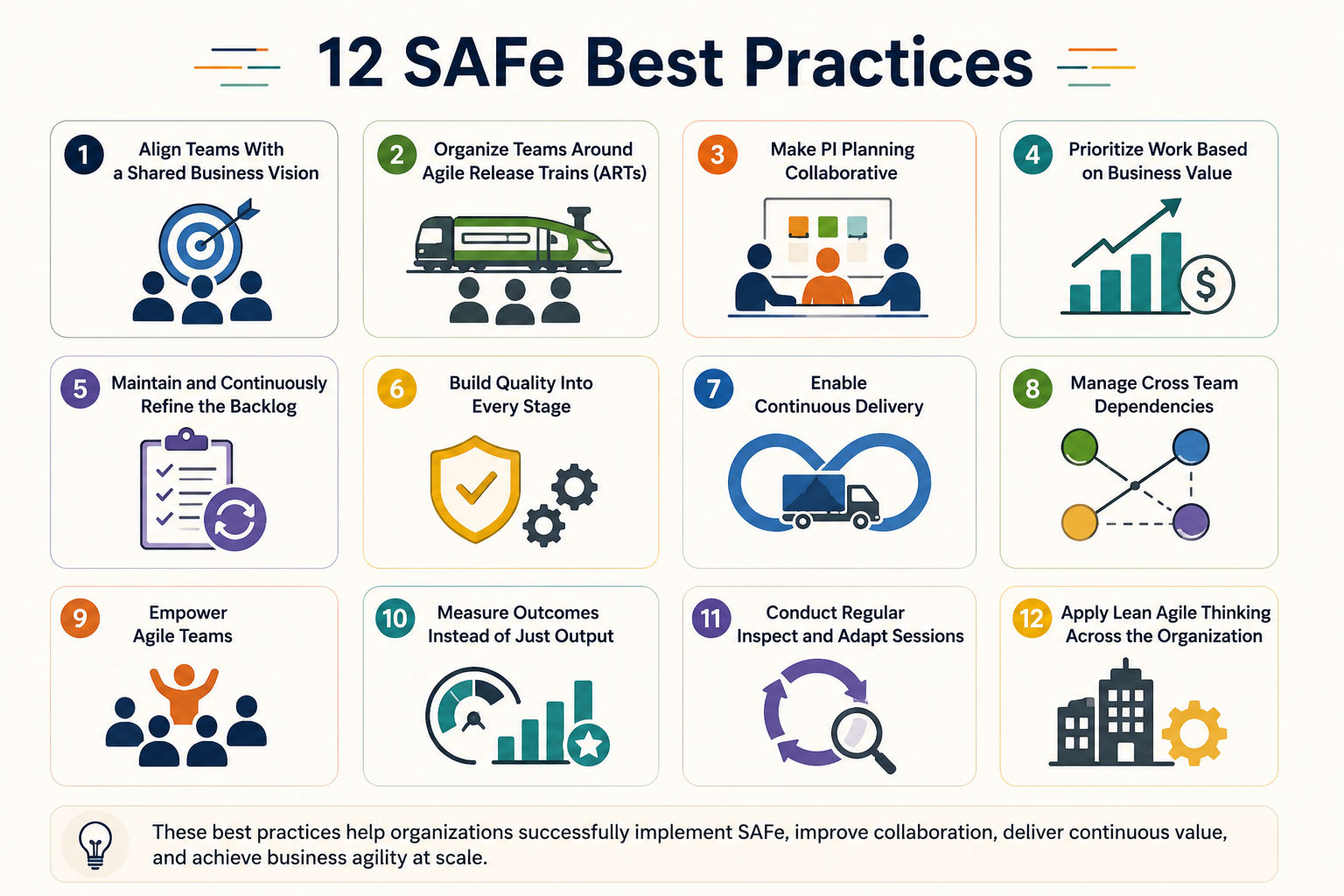
1. Align Teams With a Shared Business Vision
Teams work more effectively when they understand what the organization is trying to achieve and how their work contributes to it.
A shared vision should connect:
- Product direction
- Strategic objectives
- Customer needs
- Business priorities
- Expected outcomes
2. Organize Teams Around Agile Release Trains
Agile Release Trains provide a structure for coordinating multiple Agile teams around a shared mission.
Effective ARTs benefit from:
- Stable teams
- Cross functional capabilities
- Shared objectives
- Regular coordination
- A common delivery cadence
3. Make PI Planning Collaborative
PI Planning should be treated as a collaborative planning activity rather than simply a scheduling exercise.
Good preparation includes:
- Clear business context
- Product priorities
- Available capacity
- Dependencies
- Known risks
- Draft objectives
4. Prioritize Work Based on Business Value
One of the most important SAFe best practices is making prioritization visible and connected to value.
Teams can consider:
- Business value
- Cost of Delay
- Job size
- Risk
- Technical effort
5. Maintain and Continuously Refine the Backlog
A healthy backlog gives teams greater clarity about what matters next.
Backlog refinement should address:
- Features
- Stories
- Acceptance criteria
- Priorities
- Dependencies
- Unclear requirements
6. Build Quality Into Every Stage
Quality should not be treated as an activity that happens only after development is complete.
Teams can build quality into the workflow through:
- Automated testing
- Continuous integration
- Clear acceptance criteria
- Definition of Done
- Early validation
- Frequent feedback
7. Enable Continuous Delivery
Continuous delivery helps organizations move smaller changes through the development pipeline more frequently.
Key practices can include:
- Automation
- Continuous integration
- Frequent validation
- Smaller releases
- Release on demand
8. Manage Cross Team Dependencies
Dependencies can slow down large Agile programs when they are discovered too late.
Teams should make dependencies visible through:
- Dependency mapping
- Program Board discussions
- Regular coordination
- Early risk identification
- Clear ownership
9. Empower Agile Teams
SAFe best practices also emphasize giving teams enough autonomy to make decisions close to the work.
Empowered teams can:
- Make delivery decisions
- Manage their own work
- Identify problems early
- Improve their processes
- Respond faster to changing information
10. Measure Outcomes Instead of Just Output
Counting completed stories or released features does not necessarily show whether a product created value.
Teams should also look at:
- Business outcomes
- Customer outcomes
- Quality
- Flow
- Time to market
- Product usage
Outcome based measurement helps organizations understand whether delivery activity is producing meaningful results.
11. Conduct Regular Inspect and Adapt Sessions
Inspect and Adapt creates a structured opportunity to evaluate results and improve the system.
Teams can:
- Review outcomes
- Identify recurring problems
- Analyze systemic issues
- Run problem solving workshops
- Create an improvement backlog
The important part is turning observations into specific improvements rather than simply discussing what went wrong.
12. Apply Lean Agile Thinking Across the Organization
Scaling Agile successfully requires more than changing team ceremonies. Lean Agile thinking should also influence leadership, portfolio decisions, and business processes.
Organizations can focus on:
- Eliminating waste
- Limiting work in progress
- Improving flow
- Shortening feedback loops
- Decentralizing decisions
- Continuously improving processes
Build practical Agile expertise with the Best Agile Management Certification Training Courses and prepare for career growth in Agile management.
SAFe best practices vs traditional agile practices
Both traditional Agile and SAFe aim to deliver value iteratively, but their scope and coordination needs can be very different.
The comparison helps explain where SAFe best practices add structure for larger environments:
Area |
Traditional Agile |
SAFe |
| Scope | Individual teams | Multiple teams and enterprise |
| Planning | Sprint planning | Sprint planning and PI Planning |
| Coordination | Mostly team level | ART level and broader |
| Prioritization | Product backlog | Portfolio, program, and team backlogs |
| Dependencies | Usually limited | Explicitly identified and managed |
| Strategy | May have a loose connection | More directly linked to execution |
| Delivery | Iterative delivery | Continuous delivery and release on demand |
Take the next step toward becoming an SPC with the Implementing SAFe Course
SAFe best practices for different roles
Different roles contribute to scaling Agile in different ways. Applying SAFe best practices effectively means understanding what each role needs to focus on while maintaining alignment across the organization.
1. For Product Owners
Product Owners should focus on:
- Backlog management
- Story prioritization
- Acceptance criteria
- Customer value
- Team alignment
2. For Scrum Masters and Team Coaches
Scrum Masters and Team Coaches help teams improve how they work.
Key areas include:
- Facilitation
- Removing impediments
- Supporting team collaboration
- Coaching Agile practices
- Encouraging continuous improvement
Their role is especially important when teams struggle with dependencies, delivery flow, or collaboration.
3. For Product Managers
Product Managers connect customer and market needs with broader product strategy.
Important areas include:
- Product strategy
- Feature prioritization
- Roadmaps
- Customer needs
- Business outcomes
They should ensure that product decisions remain connected to strategic objectives.
4. For Release Train Engineers
Release Train Engineers help coordinate the Agile Release Train and create alignment across teams.
Their focus can include:
- ART coordination
- PI Planning
- Dependency management
- Risk management
- Inspect and Adapt
- Cross team facilitation
They help keep teams aligned without becoming a central decision maker for every issue.
5. For Business Owners and Leaders
Business leaders provide direction and help connect Agile delivery with business priorities.
Their responsibilities can include:
- Strategic alignment
- Business value decisions
- Governance
- Investment priorities
- Outcome measurement
Explore the SAFe Scrum Master Role: SAFe Best Practices and Certification to understand key responsibilities, best practices, skills, and certification requirements.
Conclusion
SAFe best practices help organizations align teams, improve delivery, manage dependencies, maintain quality, and focus on business outcomes.
They are most useful for organizations scaling Agile across multiple teams. The key is to focus on business value, collaboration, flow, and measurable results rather than adding unnecessary processes.
Have A Query? Get in Touch With Our Customer Support | upGrad KnowledgeHut
Frequently Asked Questions (FAQs)
1. How long does it take for SAFe best practices to show results?
The timeline varies based on the organization's size, Agile maturity, and the practices being implemented. SAFe best practices can show improvements in planning, collaboration, or flow relatively quickly, while broader changes in quality, predictability, and business outcomes may take longer.
2. What are the biggest reasons SAFe best practices fail in an organization?
Common reasons include weak leadership support, poor team alignment, excessive process, unclear objectives, and treating SAFe as a set of ceremonies. SAFe best practices work better when teams understand the purpose behind each practice and connect it to measurable business and customer outcomes.
3. How can organizations avoid adding too much process when applying SAFe best practices?
Organizations should adopt practices that solve specific delivery or coordination problems rather than implementing every process by default. SAFe best practices should simplify work, improve flow, and support value delivery, not create unnecessary meetings, approvals, or documentation.
4. Can SAFe best practices work for remote and distributed Agile teams?
Yes. SAFe best practices can be adapted for distributed teams using virtual PI Planning, digital Program Boards, shared backlogs, and collaboration tools. Clear communication, visibility, and consistent coordination become especially important when teams work across locations.
5. How should an organization decide which SAFe practices to adopt first?
Start by identifying the organization's biggest challenges, such as poor planning, dependency issues, weak alignment, or slow delivery. Then prioritize the SAFe best practices that directly address those problems and introduce additional practices as maturity develops.
6. How can leaders measure whether SAFe best practices are actually improving business outcomes?
Leaders should track outcomes such as time to market, predictability, quality, customer results, flow, and business value. SAFe best practices should be evaluated based on measurable improvements rather than simply checking whether Agile ceremonies are being completed.
7. How can teams maintain autonomy while following SAFe best practices?
Teams can remain autonomous by controlling how they execute their work while aligning with shared product and program objectives. SAFe best practices support coordination through common goals and visibility without requiring every team decision to be approved centrally.
8. What should an organization do when teams resist SAFe practices?
First, understand why the resistance exists instead of simply enforcing new processes. Explain the purpose, involve teams in improvements, remove unnecessary practices, and show measurable value so that SAFe best practices become useful rather than perceived as additional bureaucracy.
9. How can SAFe best practices be adapted for smaller organizations?
Smaller organizations can apply only the practices that address their actual coordination and scaling needs. SAFe best practices can be adapted without introducing enterprise level structures that are unnecessary when teams have fewer dependencies and simpler delivery environments.
10. How do SAFe best practices change when an organization adopts AI?
AI can increase the need for faster experimentation, shorter feedback loops, and continuous learning. SAFe best practices may need to evolve around changing customer needs, AI capabilities, governance, and faster planning cycles while maintaining alignment and responsible decision making.
1639 articles published
KnowledgeHut is an outcome-focused global ed-tech company. We help organizations and professionals unlock excellence through skills development. We offer training solutions under the people and proces...
Get Free Consultation
By submitting, I accept the T&C and
Privacy Policy
Ready to learn about Agile Certifications Roadmap?