
- Blog Categories
- Project Management
- Agile Management
- IT Service Management
- Cloud Computing
- Business Management
- BI And Visualisation
- Quality Management
- Cyber Security
- DevOps
- Most Popular Blogs
- PMP Exam Schedule for 2026: Check PMP Exam Date
- Top 60+ PMP Exam Questions and Answers for 2026
- PMP Cheat Sheet and PMP Formulas To Use in 2026
- What is PMP Process? A Complete List of 49 Processes of PMP
- Top 15+ Project Management Case Studies with Examples 2026
- Top Picks by Authors
- Top 170 Project Management Research Topics
- What is Effective Communication: Definition
- How to Create a Project Plan in Excel in 2026?
- PMP Certification Exam Eligibility in 2026 [A Complete Checklist]
- PMP Certification Fees - All Aspects of PMP Certification Fee
- Most Popular Blogs
- CSM vs PSM: Which Certification to Choose in 2026?
- How Much Does Scrum Master Certification Cost in 2026?
- CSPO vs PSPO Certification: What to Choose in 2026?
- 8 Best Scrum Master Certifications to Pursue in 2026
- Safe Agilist Exam: A Complete Study Guide 2026
- Top Picks by Authors
- SAFe vs Agile: Difference Between Scaled Agile and Agile
- Top 21 Scrum Best Practices for Efficient Agile Workflow
- 30 User Story Examples and Templates to Use in 2026
- State of Agile: Things You Need to Know
- Top 24 Career Benefits of a Certifed Scrum Master
- Most Popular Blogs
- ITIL Certification Cost in 2026 [Exam Fee & Other Expenses]
- Top 17 Required Skills for System Administrator in 2026
- How Effective Is Itil Certification for a Job Switch?
- IT Service Management (ITSM) Role and Responsibilities
- Top 25 Service Based Companies in India in 2026
- Top Picks by Authors
- What is Escalation Matrix & How Does It Work? [Types, Process]
- ITIL Service Operation: Phases, Functions, Best Practices
- 10 Best Facility Management Software in 2026
- What is Service Request Management in ITIL? Example, Steps, Tips
- An Introduction To ITIL® Exam
- Most Popular Blogs
- A Complete AWS Cheat Sheet: Important Topics Covered
- Top AWS Solution Architect Projects in 2026
- 15 Best Azure Certifications 2026: Which one to Choose?
- Top 22 Cloud Computing Project Ideas in 2026 [Source Code]
- How to Become an Azure Data Engineer? 2026 Roadmap
- Top Picks by Authors
- Top 40 IoT Project Ideas and Topics in 2026 [Source Code]
- The Future of AWS: Top Trends & Predictions in 2026
- AWS Solutions Architect vs AWS Developer [Key Differences]
- Top 20 Azure Data Engineering Projects in 2026 [Source Code]
- 25 Best Cloud Computing Tools in 2026
- Most Popular Blogs
- Company Analysis Report: Examples, Templates, Components
- 400 Trending Business Management Research Topics
- Business Analysis Body of Knowledge (BABOK): Guide
- ECBA Certification: Is it Worth it?
- Top Picks by Authors
- Top 20 Business Analytics Project in 2026 [With Source Code]
- ECBA Certification Cost Across Countries
- Top 9 Free Business Requirements Document (BRD) Templates
- Business Analyst Job Description in 2026 [Key Responsibility]
- Business Analysis Framework: Elements, Process, Techniques
- Most Popular Blogs
- Best Career options after BA [2026]
- Top Career Options after BCom to Know in 2026
- Top 10 Power Bi Books of 2026 [Beginners to Experienced]
- Power BI Skills in Demand: How to Stand Out in the Job Market
- Top 15 Power BI Project Ideas
- Top Picks by Authors
- 10 Limitations of Power BI: You Must Know in 2026
- Top 45 Career Options After BBA in 2026 [With Salary]
- Top Power BI Dashboard Templates of 2026
- What is Power BI Used For - Practical Applications Of Power BI
- SSRS Vs Power BI - What are the Key Differences?
- Most Popular Blogs
- Data Collection Plan For Six Sigma: How to Create One?
- Quality Engineer Resume for 2026 [Examples + Tips]
- 20 Best Quality Management Certifications That Pay Well in 2026
- Six Sigma in Operations Management [A Brief Introduction]
- Top Picks by Authors
- Six Sigma Green Belt vs PMP: What's the Difference
- Quality Management: Definition, Importance, Components
- Adding Green Belt Certifications to Your Resume
- Six Sigma Green Belt in Healthcare: Concepts, Benefits and Examples
- Most Popular Blogs
- Latest CISSP Exam Dumps of 2026 [Free CISSP Dumps]
- CISSP vs Security+ Certifications: Which is Best in 2026?
- Best CISSP Study Guides for 2026 + CISSP Study Plan
- How to Become an Ethical Hacker in 2026?
- Top Picks by Authors
- CISSP vs Master's Degree: Which One to Choose in 2026?
- CISSP Endorsement Process: Requirements & Example
- OSCP vs CISSP | Top Cybersecurity Certifications
- How to Pass the CISSP Exam on Your 1st Attempt in 2026?
- Most Popular Blogs
- Top 7 Kubernetes Certifications in 2026
- Kubernetes Pods: Types, Examples, Best Practices
- DevOps Methodologies: Practices & Principles
- Docker Image Commands
- Top Picks by Authors
- Best DevOps Certifications in 2026
- 20 Best Automation Tools for DevOps
- Top 20 DevOps Projects of 2026
- OS for Docker: Features, Factors and Tips
- More
- Agile & PMP Practice Tests
- Agile Testing
- Agile Scrum Practice Exam
- CAPM Practice Test
- PRINCE2 Foundation Exam
- PMP Practice Exam
- Cloud Related Practice Test
- Azure Infrastructure Solutions
- AWS Solutions Architect
- IT Related Pratice Test
- ITIL Practice Test
- Devops Practice Test
- TOGAF® Practice Test
- Other Practice Test
- Oracle Primavera P6 V8
- MS Project Practice Test
- Project Management & Agile
- Project Management Interview Questions
- Release Train Engineer Interview Questions
- Agile Coach Interview Questions
- Scrum Interview Questions
- IT Project Manager Interview Questions
- Cloud & Data
- Azure Databricks Interview Questions
- AWS architect Interview Questions
- Cloud Computing Interview Questions
- AWS Interview Questions
- Kubernetes Interview Questions
- Web Development
- CSS3 Free Course with Certificates
- Basics of Spring Core and MVC
- Javascript Free Course with Certificate
- React Free Course with Certificate
- Node JS Free Certification Course
- Data Science
- Python Machine Learning Course
- Python for Data Science Free Course
- NLP Free Course with Certificate
- Data Analysis Using SQL
Product Owner Resume: Examples, Templates, and Writing Tips for 2026
Updated on Sep 30, 2026 | 15 min read | 12.51K+ views
Share:
Table of Contents
View all
Quick Overview
- A strong Product Owner Resume should clearly present product experience, measurable achievements, relevant skills, certifications, and education in an easy-to-scan format.
- Entry-level candidates can highlight Agile knowledge, user stories, projects, requirements gathering, and certifications, while mid-level and senior candidates should emphasize product ownership, strategy, prioritization, and business outcomes.
- Strong Product Owner experience bullets should follow an action + activity + method/tool + measurable outcome structure instead of simply listing Scrum responsibilities.
- Relevant product management, Agile, collaboration, technical, and tool-based skills should match the target job description without unnecessary keyword stuffing.
- This guide covers Product Owner resume formats, examples by experience level, resume writing tips, skills and keywords, certifications, and ATS-friendly practices.
Build skills for the evolving product landscape with the Applied Agentic AI Certification Course [Best in 2026] and learn how AI can support smarter product decisions and workflows.
Master the Right Skills & Boost Your Career
Avail your free 1:1 mentorship session
What Should a Product Owner Resume Include?
A good Product Owner resume must be precise, clear and easy to scan. The recruiter should be able to easily find the relevant experience, skills, certifications, and achievements from the resume without searching through lengthy paragraphs.
Recommended Product Owner resume format
The following sections cover the information normally expected in a Product Owner resume.
Resume section |
What to include |
| Contact information | Name, phone, email, LinkedIn, location |
| Headline | Product Owner + relevant specialization |
| Summary | Experience, domain, strengths, and measurable impact |
| Experience | Responsibilities and quantified achievements |
| Skills | Product, Agile, technical, and collaboration skills |
| Certifications | Relevant Product Owner or Agile certifications |
| Education | Degree, institution, and relevant education |
Product Owner Resume Examples by Experience Level
The resume for a Product Owner can vary based on experience. A fresher should emphasize on skills, projects, and understanding of Agile. An experienced Product Owner, on the other hand, should pay more attention to their product achievements and strategic responsibilities.
Entry-level Product Owner resume example
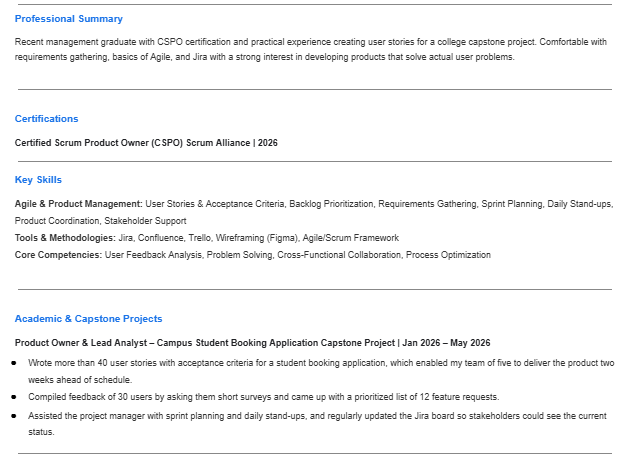
A resume for an entry-level Product Owner position does not necessarily need to include prior experience in the same role as a Product Owner. The applicant may have experience in such roles as business analyst, project coordinator, developer, Scrum user, and others.
Focus on:
- Product or project coordination
- Agile and Scrum knowledge
- User stories and acceptance criteria
- Requirements gathering
- Stakeholder support
- Academic or personal projects
- Relevant certifications
Sample summary: Recently management graduated with CSPO certification and practical experience of creating user stories for a college capstone project. Comfortable with requirements gathering, basics of Agile, and Jira with a strong interest in developing products that solve actual user problems.
Sample bullets:
- Wrote more than 40 user stories with acceptance criteria for a student booking application, which enabled my team of five to deliver the product two weeks ahead of schedule.
- Compiled feedback of 30 users by asking them short surveys and came up with a prioritized list of 12 feature requests.
- Assisted the project manager with sprint planning and daily stand-ups, and regularly updated the Jira board so stakeholders could see the current status.
Here is a sample for a Product Owner entry level Product Owner resume.
Mid-level Product Owner resume example
A mid-level Product Owner candidate must show product ownership or significant ownership of parts of the product. A mid-level resume should go beyond merely describing activities associated with the Scrum framework and display decision making, prioritizing, delivery and measurable achievements.
A mid-level Product Owner Resume must clearly highlight the decision-making skills and the results achieved.
Focus on:
- End-to-end product ownership
- Backlog prioritization
- Product roadmaps
- Cross-functional collaboration
- Product metrics
- Feature releases
Sample achievement bullets
- Prioritized and managed product backlog containing 200+ product features and enhancements, which improved predictability of sprint delivery by 22%.
- Participated in launching three new product releases in collaboration with development/design/business teams, which improved user adoption rate by 18%.
- Established the priorities for product roadmap according to customer feedback and analytics, leading to a 15% growth in customer retention rate.
Senior Product Owner resume example
The resume for a senior level position needs to reflect more ownership and influence. A senior Product Owner resume should not emphasize on individual backlog items but rather on strategy, leadership, alignment of stakeholders, and business impact.
A senior-level Product Owner resume must place less emphasis on activities and more on leadership and strategy.
Focus on:
- Product strategy
- Multiple stakeholders and teams
- Business outcomes
- Product portfolio or major product areas
- Leadership
- Strategic prioritization
Sample achievement bullets
- Led strategy development for multiple digital products, driving a 20% growth in annual recurring revenue.
- Coordinated prioritization initiatives in five Agile teams, ensuring that roadmaps were aligned with organization’s objectives.
- Partnered with executive stakeholders to define portfolio strategy, resulting in faster product delivery and improved customer satisfaction scores.
Here is a sample of a senior Product Owner resume.
How to Write Each Section of a Product Owner Resume
After selecting the proper format, each component needs to be customized for the respective Product Owner position. Do not use the same summary and skill set in all applications.
Write a Product Owner resume headline
Not all skills need to be included in the headline. It is important to pick up the appropriate specialization based on the targeted position. A useful structure is:
Role + specialization/domain + value
Examples include:
- Product Owner | SaaS | Agile Product Development
- Technical Product Owner | Digital Products | Data-Driven Product Strategy
- Product Owner | FinTech | Product Strategy and Agile Delivery
Write a Product Owner resume summary
The resume summary should help the recruiter quickly gauge the experience and strengths of the candidate. Do not use phrases like “hard worker,” “team player,” “result-driven,” etc. unless there is some proof of that.
A simple structure is:
Years of experience + product/domain expertise + core strengths + measurable result
For example:
Product Owner with over 6 years of experience managing digital products in both SaaS and fintech industries. Skilled in product strategy, backlog management, stakeholders communication, and agile methodology implementation. Successfully delivered customer-oriented product features, leading to product adoption.
Write Product Owner experience and achievement bullets
Experience is usually the most valuable component in a Product Owner resume. The description in the bullet should be about actions that were done and their result, if possible.
A useful formula is:
Action + Product Owner activity + method/tool + measurable outcome
Weak vs Strong Example
| Weak Bullet | Stronger Bullet |
| Managed the product backlog | Prioritized 150+ backlog items using customer feedback and business value, improving feature delivery time by 25% |
Instead of writing:
- Organized sprint planning
- Managed user stories
- Interacted with stakeholders
Try writing:
- Organized sprint planning sessions and helped improve sprint success rate from 82% to 94%.
- Organized user stories which cut down reworks by 20%.
- Collaborated with business stakeholders and prioritized high-value features which increased customer engagement.
Strengthen your AI skills with the Generative AI and Prompt Engineering Course for Professionals and learn to use GenAI tools and prompting techniques in everyday product work.
Product Owner Resume Skills and Keywords
The skills section should reflect the actual job description and the candidate's real experience. Adding every possible keyword can make a resume look unnatural and does not demonstrate practical knowledge.
Product management skills
Important product management skills can include:
- Product strategy
- Product roadmap
- Backlog management
- Prioritization
- Requirements gathering
- User stories
- Acceptance criteria
- Product lifecycle management
- Product analytics
- Customer discovery
Agile and collaboration skills
A Product Owner often works across business, design, engineering, and customer-facing teams. Relevant skills include:
- Scrum
- Agile
- Sprint planning
- Stakeholder management
- Cross-functional collaboration
- User research
- Conflict resolution
- Backlog refinement
- Release planning
Product Owner tools and technical skills
The tools listed should reflect actual experience. Common examples include:
- Jira
- Confluence
- Aha!
- Productboard
- Figma
- SQL
- Product analytics platforms
- Collaboration and documentation tools
Product Owner Certifications and Education on a Resume
Certification can help a Product Owner resume, but only when they are applicable to the job and backed by experience.
Relevant certifications include:
- Professional Scrum Product Owner (PSPO)
- Certified Scrum Product Owner (CSPO)
- SAFe Product Owner/Product Manager
- Relevant Agile or Product Management certifications
Where to put them: A separate "Certifications" heading following "Skills" is the ideal location for most candidates. Freshers and career changers may put it closer to the top of their resume, even directly below the summary, since it compensates for lack of experience. The complete certification name, the abbreviation of it, and year of completion need to be included, e.g. "Certified Scrum Product Owner (CSPO), 2026."
Education: This should include your degree, institute name, and the year of graduation. Freshers can also include some coursework or academic projects. Experienced professionals should keep this portion brief.
Take your product skills further with the AI-Powered Product Management Certification with Microsoft and build practical skills for AI-driven product strategy and decision-making.
How Can You Make Your Product Owner Resume ATS-Friendly?
Many companies use Applicant Tracking Systems (ATS) to filter resumes before a recruiter reviews them. An ATS-friendly Product Owner Resume improves your chances of reaching the interview stage.
Keywords recruiters commonly search for
- Product Backlog
- User Stories
- Scrum
- Roadmap
- Product Strategy
- Stakeholder Management
These should appear naturally in the summary, skills and experience sections, in the same wording the job posting uses.
ATS Formatting Best Practices
Follow these simple formatting rules:
- Use a clean and simple layout
- Use standard section headings
- Follow a reverse-chronological format
- Use clear bullet points
- Keep fonts professional and readable
- Save the file in the requested format
ATS Mistakes That Lead to Rejection
Avoid these common mistakes:
- Keyword stuffing
- Graphics-heavy resume designs
- Missing job-specific keywords
- Unclear job titles
- Overly complex formatting
Conclusion
A strong Product Owner Resume should make it easy for recruiters to see the candidate’s product ownership, decision-making ability, and measurable impact. Entry-level candidates can build credibility through Agile projects, relevant skills, and certifications, while experienced professionals should focus on product outcomes, strategy, and leadership.
Tailoring the resume to each job description also helps highlight the most relevant skills and keywords. A clean, ATS-friendly format combined with specific achievement-based bullets can make the resume more effective.
Have A Query? Get in Touch With Our Customer Support | upGrad KnowledgeHut
Product Owner Resume: FAQs
1. What skills should be included on a Product Owner resume?
Include product skills such as product strategy, roadmap planning, backlog management, prioritization, user stories, acceptance criteria, and product analytics. Also mention Agile and Scrum skills such as sprint planning, stakeholder management, and cross-functional collaboration. Add tools such as Jira, Confluence, Figma, or SQL only when you have practical experience with them.
2. How do I write Product Owner experience on a resume?
Write each experience bullet around an action, Product Owner activity, method or tool, and measurable outcome. For example, instead of “Managed the product backlog,” write “Prioritized 150+ backlog items using customer feedback and business value, reducing feature delivery time by 25%.” This shows both responsibility and impact.
3. What are the best Product Owner resume examples?
Useful examples should show how the resume changes based on experience level. Entry-level examples should emphasize Agile knowledge, projects, user stories, and transferable experience, while mid-level examples should show backlog ownership, roadmaps, and product metrics. Senior examples should focus more on product strategy, leadership, stakeholder alignment, and business outcomes.
4. What format is best for a Product Owner resume?
A reverse-chronological format is generally suitable because it puts the most recent and relevant experience first. Use clear sections for contact information, headline, summary, experience, skills, certifications, and education. Keep the design simple, consistent, and easy for both recruiters and ATS software to read.
5. How is a Product Owner resume different from a Product Manager resume?
A Product Owner resume usually gives more emphasis to backlog management, user stories, sprint priorities, acceptance criteria, and delivery with Agile teams. A Product Manager resume typically places greater emphasis on product vision, market research, product strategy, business goals, and portfolio-level decisions. The exact responsibilities can overlap depending on the organization.
6. How can a Scrum Master transition into a Product Owner role on a resume?
A Scrum Master should highlight transferable experience such as stakeholder collaboration, backlog discussions, requirements clarification, sprint planning, and team coordination. Add relevant product projects or responsibilities where applicable, and show how these experiences supported product decisions. A relevant Product Owner certification can also strengthen the transition when combined with practical evidence.
7. How should senior Product Owners showcase leadership?
Senior Product Owners should demonstrate leadership through product strategy, cross-team prioritization, stakeholder alignment, roadmap ownership, and business results. Instead of only stating that they led teams, show the scope of leadership, such as coordinating multiple Agile teams or aligning product priorities with business objectives. Quantified outcomes make these leadership examples stronger.
8. What keywords should I use on a Product Owner resume?
Use keywords that match the target job description and accurately reflect your experience, such as Product Backlog, User Stories, Product Roadmap, Scrum, Agile, Product Strategy, Stakeholder Management, Acceptance Criteria, Prioritization, and Product Analytics. Add relevant tools such as Jira or Confluence when applicable. Avoid adding keywords that you cannot support through your experience.
9. How should a Senior Product Owner resume differ from an entry-level one?
An entry-level resume should focus on Agile knowledge, relevant projects, transferable skills, user stories, requirements gathering, and certifications. A senior resume should give more space to product strategy, business impact, leadership, complex stakeholder management, and ownership across products or teams. Senior candidates should rely less on basic task descriptions and more on measurable achievements.
10. What mistakes lead to Product Owner resume rejection?
Common mistakes include keyword stuffing, unclear job titles, generic responsibility-based bullets, missing job-specific keywords, graphics-heavy formatting, and unsupported skills. A resume can also become less effective when it lists Scrum ceremonies without showing decisions or outcomes. Keep the format simple and tailor the experience and keywords to each Product Owner job.
1668 articles published
KnowledgeHut is an outcome-focused global ed-tech company. We help organizations and professionals unlock excellence through skills development. We offer training solutions under the people and proces...
Get Free Consultation
By submitting, I accept the T&C and
Privacy Policy
Ready to learn about Agile Certifications Roadmap?