
- Home
- Blog
- Business Intelligence And Visualization
- Business Intelligence Analyst Job Description and Roles
Business Intelligence Analyst Job Description and Roles
Updated on Jun 26, 2025 | 13 min read | 12.71K+ views
Share:
Table of Contents
View all
- Business Intelligence Analyst Importance
- Business Intelligence Analyst Career Path
- Business Intelligence Analyst Job Description
- Business Intelligence Analyst Responsibilities and Duties
- Business Intelligence Analyst Qualifications and Skills
- Business Intelligence Analyst Job Description with Examples
- Business Intelligence Analyst Salary Information
- Business Intelligence Analyst Jobs
- Conclusion
Last Few Days to Save Up To 90% on Career Transformation
Ends December 1 – Don't Miss Out!
Business Intelligence Analyst Importance
The proliferation of IoT-connected objects, IoT-based sensors, rising internet usage, and sharp increases in social media activity are all enhancing businesses' ability to gather enormous amounts of data. Many business analysts view data as the "new oil" that fuels organizational efficiency in the information age and enhances experiences, performance, and profitability. However, having a lot of data is useless if businesses can't use it to make informed, data-driven decisions by analyzing it to extract useful insights. Business intelligence (BI) is becoming more important as a result of the growing need to use data to further organizational objectives.
Data processing tools and systems, such as data visualization tools, data modeling tools, decision-support systems, database management systems, and data warehousing systems, are all included in the Power BI Course. In this article, we'll discuss the role of a business intelligence analyst, the job description of a business intelligence analyst and the business intelligence analyst's job duties.
Business Intelligence Analyst Career Path
Executives in business and technology departments at companies across all sectors are aware of how critical it is to be able to extract value from data by looking for trends in the data and using the insights gained to improve operations, boost sales, enhance customer satisfaction, or achieve other goals. This is accomplished by using BI tools and software to mine complex data, comparing it to competitors' data and industry trends, and producing visualizations that explain findings to other organization members.
As you advance in your career, you may find yourself taking on more responsibilities or assuming a leadership role. A business intelligence analyst can use our career map to determine their career objectives by following the career progression. For instance, they might begin with a position like "business intelligence developer," advance to "business consultant," and finally receive the title "reporting manager."
Business Intelligence Analyst Job Description
It's crucial to have the proper blend of professional experience, technical skills, and education to access and analyze data properly. Business intelligence analysts handle a large portion of the daily employment involved in the data analysis process. They collaborate with executives and other business users to determine what information is required to respond to their inquiries, and they then collect that information, run BI queries, and produce data visualizations, reports, and dashboards to assist their business colleagues in deriving insight from the data sets under analysis.
What Does a Business Intelligence Analyst Do?
A business intelligence role typically consists of data collection, analysis, and dissemination to the appropriate audience. These elements can be divided into more specific tasks, all of which let you have a positive influence on an organization's performance as a whole. Any particular data collection project may follow the following procedure, so let's check the business intelligence analyst's job responsibilities:
- Gather information for business intelligence from sources, such as market research reports, public records, field reports, or purchased findings. In addition to gathering information about customers and the market, this may entail updating your knowledge of pertinent technological trends or emerging markets in your industry.
- Keep the information in your company's computer database, which might need updates frequently. In order to use the database and provide tech assistance or software maintenance for any special programs, you might also need to establish operational procedures.
- Analyze the information to find any trends that might have an effect on the business's strategies.
- Create analytical summaries of your findings and distribute them to the proper company stakeholders using established communication channels.
- Sharing findings can involve anything from presenting reports to other teams or clients to visualizing data in graphs and charts. Based on their findings, business intelligence analysts will also suggest ways to expand or improve the company.
To stay on top of trends in your own company and the industry at large during this process, you'll need to collaborate with a variety of people on both an internal and external level. In order for data to be analyzed, summarized, and sent promptly to the appropriate stakeholders, you'll also need to manage the flow of information.
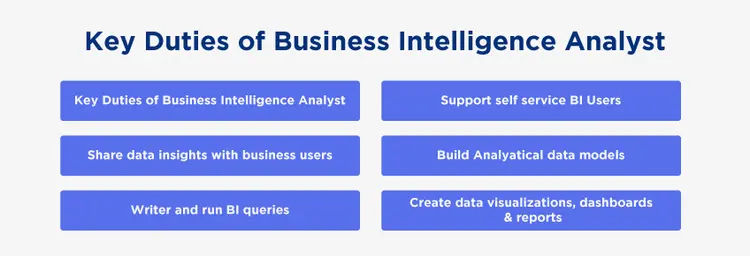
Business Intelligence Analyst Responsibilities and Duties
The most significant portion of the BI Analyst job description is the section on responsibilities and duties. Here, we should describe the regular responsibilities of the position, its role within the company, and the name of the manager to whom the employee will be reporting. Some common business intelligence analyst roles and responsibilities are:
- Examining business operations
- Assembling and studying organizational information, such as financial, expenditure, work opportunities, and revenue reports
- Data validation and review for customers
- Analyzing and reviewing competitor data
- Gathering information on issues and making recommendations for fixes to improve system performance and process efficiency
- Assessing the success of strategies
- Generating the company's performance through project cost-benefit analyses
- Creating processes and plans for data collection and analysis
- Identifying business tactics and procedures to increase the effectiveness of the company
Let's the junior and senior BI analyst's roles and responsibilities.
A junior business intelligence analyst job description mainly comprises management of data retrieval and analysis within an organization. They are in charge of collecting data points, coordinating with the IT department and higher management, and evaluating data to identify a company's needs.
A senior business intelligence analyst job description comprises data analytics and additional support of performance measures, data collection, data visualizations and information dissemination, ongoing measurement, and reporting to higher authorities about various business insights.
Business Intelligence Analyst Qualifications and Skills
The following are the qualifying degrees required to become a Certified Business Intelligence Analyst:
Bachelor's degrees: You can acquire the technical and analytical skills required for a BI analyst role with a bachelor's degree. Concentrate your research on a quantitative area, such as data science, finance, or mathematics.
Master's degrees: You can transition into a position as a business intelligence analyst by building on your prior experience and education with a master's degree. It's a smart idea to think about your prior experience when selecting the best master's field.
Business intelligence analysts frequently bridge the gap between IT and business operations. As a result, depending on the enterprise structure, business requirements, and other factors, these positions may be located in different places within an organization.
Practitioners and consultants cited the following abilities as essential for success in the role:
- Database development tools: Your job will involve working with data regularly. It is crucial to understand how to manage data using common data tools like SQL and Excel. Among BI analysts, proficiency with data analysis tools that provide machine learning solutions has also grown in demand.
- Data Visualization: The ability to use services like Tableau and Power BI is frequently listed as a requirement in job descriptions. These tools aid in the production of graphs and other data visualizations.
- Programming languages: As a BI analyst, you might be asked to develop procedures or systems that support data analysis and the tracking of important business metrics. In job postings, experience with coding languages like Python, Java, or R is usually needed.
- Knowledge of finances and business: Advising on how to improve the business will require a solid grasp of business procedures and finance.
- Communication: A business intelligence analyst regularly presents findings to groups of people or writes reports in order to do so. The ability to communicate effectively, orally and in writing, is frequently essential to the job.
Look for KnowledgeHut Business Intelligence Courses online to get skilled and gain expertise in BI and visualization and be prepared for a job in the domain.
Business Intelligence Analyst Job Description with Examples
Review the list of responsibilities and requirements before applying to join as a business intelligence analyst. Let's check the business intelligence analyst JD.
Responsibilities:
- Identify, automate, and validate the extraction of new metrics from a variety of data sources for use in upcoming analyses and reports by working closely with the business intelligence and technology team.
- Support daily reporting requirements for business.
- Create BI reporting tools and dashboards for the organization using any significant BI applications.
- Creating and maintaining reports based on various potential data sources as requested by the Services organization.
- Taking part in reporting and application testing.
- Continuously support the team and centralized reporting systems.
- Examine data-processing workflows and deal with data inconsistencies.
Qualifications:
- An advantage would be using tools for data integration and preparation.
- knowledge of the supply chain, particularly sourcing and procurement.
- 3 to 5 years of expertise in data analytics or supply chain.
- Flexible team member capable of working in a multinational organization.
- Knowing data visualization and dashboard prompts would be an advantage.
- You are knowledgeable about small business data and analytics and, ideally, have experience with them.
Acquire the essential skills to thrive in today's fiercely competitive world with premier top business management courses. Gain expertise and confidence to effectively lead and achieve triumph.
Business Intelligence Analyst Salary Information
A business intelligence analyst's job salary depends on various factors and conditions. Location, skills and years of experience are some of the major factors that affect the salary of a business intelligence analyst. Thus, a business intelligence analyst's salary can vary based on their location, specific skills they possess and the years of experience they have working in the field. The positive outlook for BI analysts' careers reflects the growing value that businesses place on the data's capacity for revealing business insights, which is a major responsibility of BI analysts.
Entry Level Salary
An entry-level business intelligence analyst's primary responsibility is supporting more experienced staff. The average entry-level salary of a business intelligence analyst is $59,092 yearly.
Average Salary
The Business Intelligence Analyst is accountable for supporting businesses in leveraging data to identify opportunities for improvement, identifying trends, recognizing potential issues, and offering solutions. Their efforts are aimed at increasing efficiency, increasing productivity, and driving profits for the company. The average salary of a business intelligence analyst is $80,897 yearly.
Business Intelligence Analyst Jobs
One of the best careers in the Mathematics, Science, Engineering, and Technology fields is the role of a business intelligence analyst.
How To Get Business Intelligence Analyst Jobs?
Prepare your resume with the updated skills to look for a new job. Keep in mind the following for a fruitful job search:
- Check out job boards to find relevant postings.
- Use your professional network as a resource.
- Directly contact the businesses you're interested in working for.
- Beware of job scams.
Business Intelligence Analyst Job Titles
This list of titles should get you started in further broadening the options available to you as a business analyst. However, once you find a career opportunity in one of these titles, you'll want to examine the actual responsibilities to have a better understanding. Let's examine the various business intelligence analyst job requirements.
- Business Analyst
- Business Process Analyst
- Functional Analyst
- Product Owner
- IT Project Coordinator
- Data Analyst
- Business Architect
- Operations Specialist
- Information Architect
- Business Intelligence Analyst
Unlock the Power of Data: Dive into cutting-edge data science courses that unravel the mysteries of data analysis, machine learning, and AI. Discover your potential today!
Conclusion
You can refer to this article as a business intelligence analyst job description sample. A business intelligence analyst significantly influences the development of a company. They employ their abilities to gather and analyze data, look for trends that might help a company's operations, and then communicate their discoveries to their team or clients. A career in this industry might be right for you if you enjoy business, enjoy growth, and are also good with numbers. You can be sure that working as a business intelligence analyst will give you plenty of career opportunities because the job market is currently booming, and the high pay is always a bonus. You can opt for the KnowledgeHut Power BI Course to gain an in-depth understanding of extracting and sharing meaningful insights from data and build in-demand data analysis skills. With this course, you will be well-prepared to launch a career in the domain.
Frequently Asked Questions (FAQs)
1. What qualifications do you need to become a Business Intelligence Analyst?
The most typical entry-level requirement for BI analysts is a bachelor's degree. Some BI analysts might later pursue a graduate degree in data science or a Master of Business Administration (MBA).
2. How can people find work as Business Intelligence Analysts?
The following are the points to follow to get work as a Business Intelligence Analyst:
- Check out the business intelligence courses
- Develop Skills
- Obtain certifications for business intelligence analysts.
- Create a resume.
- Apply for a Job as a Business Intelligence Analyst
3. What are the job prospects like for a Business Intelligence Analyst?
A position as a data analyst or business analyst can be the first step toward a job in business intelligence. As a BI analyst, as you advance in knowledge and experience, you may decide to pursue a career in management or leadership, or you may decide to become a data scientist or data engineer to concentrate more on data.
4. What skills should a business intelligence analyst have?
The following are some instances of skills for business intelligence analysts:
- Data Analysis
- Data Tools
- Programming
- Domain Knowledge
- Communication
5. Is business intelligence the same as business analysis?
Business intelligence is raw data computed in the traditional manner that the system was taught to do in the absence of consistent innovation. This includes gathering all raw data relevant to business operations. Business analytics can provide the how and whys that can spur future innovation. Business intelligence concentrates on descriptive analytics, whereas business analytics concentrates more on predictive analytics.
103 articles published
Mansoor Mohammed is a dynamic and energetic Enterprise Agile Coach, P3M & PMO Consultant, Trainer, Mentor, and Practitioner with over 20 years of experience in Strategy Execution and Business Agility....
Get Free Consultation
By submitting, I accept the T&C and
Privacy Policy