Domains
Artificial Intelligence
Harness AI to create smarter workflows and scalable growth.
View All Artificial Intelligence Coursesicon-aiCertifications
Certification
100+ Hours
Trending
Post Graduate Certification Program in Data Analytics and Applied AI
Certification
140+ Hours
Trending
Executive Post Graduate Certificate in Data Science and Applied AI
Certification
140+ Hours
Trending
PG Certificate in Applied Generative Engineering & LLM Applications
Certification
150+ Hours
Trending
PG Certificate in AI Powered Product and Design Thinking
Certification
15 Weeks
Trending
AI Masters Program
Certification
6 Weeks
Trending
Vibe Coding 101: No-code AI Programming.svg)
Certification
48 Hours
Trending
Applied Agentic AI - No Code
Certification
16 Hours
Trending
Generative AI and Prompt Engineering
Certification
8 Weeks
Trending
AI-Powered Product Management
Certification
8 Weeks
Trending
Applied Agentic AI Certification
Certification
16 Hours
Generative AI Course for Scrum Masters
Certification
16 Hours
Generative AI Course for Project Managers
Certification
16 Hours
Generative AI Course for POPM
Certification
16 Hours
Gen AI Course for Business Analysts
Certification
16 Hours
AI Powered Software Development
Certification
16 Hours
AI-Data Analytics with Power BI
Certification
16 Hours
AI-Driven Digital Marketing Training
Certification
16 Hours
Gen AI for Enterprise Agilist
Advanced Certifications
Masters
Executive Diploma
Executive Diploma in Machine Learning and AI
Executive Diploma
Executive Diploma in Data Science & Artificial Intelligence from IIITBCertification
Chief Technology Officer & AI Leadership ProgrammeMaster's Degree
Master of Science in Machine Learning & AI
Dual Certification
Executive Programme in Generative AI for LeadersCertification
Executive Post Graduate Programme in Applied AI and Agentic AIExecutive PG Program
IIT KGP-Executive PG Certificate in Gen AI and Agentic
Self-Learning Courses
Universal AI by MIT Open LearningAgile Management
Master Agile methodologies for efficient and timely project delivery.
View All Agile Management Coursesicon-refresh-cwCertifications
Scrum Alliance
16 Hours
Best Seller
Certified ScrumMaster (CSM) Certification
Scrum Alliance
16 Hours
Best Seller
Certified Scrum Product Owner (CSPO) Certification
Scaled Agile
16 Hours
Trending
Leading SAFe 6.0 Certification.svg)
Scrum.org
16 Hours
Professional Scrum Master (PSM) Certification
Scaled Agile
16 Hours
AI-Empowered SAFe® 6.0 Scrum Master
PMI
21 Hours
Best Seller
PMI Agile Certified Practitioner (PMI-ACP) Certification
Advanced Certifications
Scaled Agile, Inc.
32 Hours
Recommended
Implementing SAFe 6.0 (SPC) Certification.svg)
Scaled Agile, Inc.
24 Hours
AI-Empowered SAFe® 6 Release Train Engineer (RTE) Course
Scaled Agile, Inc.
16 Hours
Trending
SAFe® AI-Empowered Product Owner/Product Manager (6.0)
IC Agile
24 Hours
ICP Agile Certified Coaching (ICP-ACC)
Scrum.org
16 Hours
Professional Scrum Product Owner I (PSPO I) Training
Masters
32 Hours
Trending
Agile Management Master's Program
32 Hours
Agile Excellence Master's ProgramOn-Demand Courses
Agile and ScrumRoles
Scrum MasterAccreditation Bodies
Scrum Alliance Scaled Agile, Inc.
 Scrum.org
 ICAgile
 PMI
PMI
Top Resources
Scrum TutorialProject Management
Gain expert skills to lead projects to success and timely completion.
View All Project Management Coursesicon-standCertifications
PMI
36 Hours
Best Seller
Project Management Professional (PMP) Certification
Axelos
32 Hours
PRINCE2 Foundation & Practitioner Certification
Axelos
16 Hours
PRINCE2 Foundation Certification
Axelos
16 Hours
PRINCE2 Practitioner Certification
PMI
23 Hours
Best Seller
Certified Associate in Project Management (CAPM)®
PMI
24 Hours
Best Seller
Program Management Professional (PgMP®)
PMI
24 Hours
Best Seller
Portfolio Management Professional (PfMP)®
PMI
30 Hours
Best Seller
Project Management Institute-Risk Management Professional (PMI-RMP)®
Skills
Change ManagementMasters
Job Oriented
45 Hours
Trending
Project Management Master's Program
On-Demand Courses
PRINCE2 Practitioner CourseRoles
Project ManagerAccreditation Bodies
PMIAxelos Scrum Alliance
Top Resources
Theories of MotivationCyber Security
Understand how to protect data and systems from threats or disasters.
View All Cyber Security Coursesicon-refresh-cwCertifications
CompTIA
40 Hours
Best Seller
CompTIA Security+
EC-Council
40 Hours
Certified Ethical Hacker (CEH v13) Certification
ISACA
40 Hours
Certified Information Systems Auditor (CISA) Certification
ISACA
40 Hours
Certified Information Security Manager (CISM) Certification
(ISC)²
40 Hours
Certified Information Systems Security Professional (CISSP)
(ISC)²
40 Hours
Certified Cloud Security Professional (CCSP) Certification
16 Hours
Certified Information Privacy Professional - Europe (CIPP-E) Certification
ISACA
16 Hours
COBIT5 Foundation
16 Hours
Payment Card Industry Security Standards (PCI-DSS) Certification
On-Demand Courses
CISSPTop Resources
Laptops for IT SecurityCloud Computing
Learn to harness the cloud to deliver computing resources efficiently.
View All Cloud Computing Coursesicon-cloud-snowingCertifications
AWS
32 Hours
Best Seller
AWS Certified Solutions Architect - Associate
AWS
32 Hours
AWS Cloud Practitioner CertificationAWS
24 Hours
AWS DevOps CertificationMicrosoft
16 Hours
Azure Fundamentals Certification
Microsoft
24 Hours
Best Seller
Azure Administrator CertificationMicrosoft
45 Hours
Recommended
Azure Data Engineer CertificationMicrosoft
32 Hours
Azure Solution Architect CertificationMicrosoft
40 Hours
Azure DevOps CertificationAWS
24 Hours
Systems Operations on AWS Certification TrainingAWS
24 Hours
Developing on AWSMasters
Job Oriented
48 Hours
New
AWS Cloud Architect Masters Program
Roles
Cloud EngineerOn-Demand Courses
AWS Certified Developer Associate - Complete GuideAuthorized Partners of
AWSMicrosoft
Top Resources
Scrum TutorialIT Service Management
Understand how to plan, design, and optimize IT services efficiently.
View All ITSM Coursesicon-git-commitCertifications
Axelos
16 Hours
New
ITIL Foundation (Version 5) Certification
Axelos
16 Hours
Best Seller
ITIL 4 Foundation Certification
Axelos
8 Hours
New
ITIL Foundation Bridge Course (Version 5)Axelos
16 Hours
ITIL Practitioner Certification
PeopleCert
16 Hours
ISO 14001 Foundation Certification
PeopleCert
16 Hours
ISO 20000 CertificationPeopleCert
24 Hours
ISO 27000 Foundation CertificationAxelos
24 Hours
ITIL 4 Specialist: Create, Deliver and Support Training
Axelos
24 Hours
ITIL 4 Specialist: Drive Stakeholder Value TrainingAxelos
16 Hours
ITIL 4 Strategist Direct, Plan and Improve TrainingOn-Demand Courses
ITIL 4 Specialist: Create, Deliver and Support ExamTop Resources
ITIL Practice TestData Science
Unlock valuable insights from data with advanced analytics.
View All Data Science Coursesicon-dataOur Courses
Data Science with PythonRoles
Data ScientistOn-Demand Courses
Data Analysis Using ExcelTop Resources
Machine Learning TutorialDevOps
Automate and streamline the delivery of products and services.
View All DevOps Coursesicon-terminal-squareCertifications
DevOps Institute
16 Hours
Best Seller
DevOps Foundation Certification
CNCF
32 Hours
New
Certified Kubernetes Administrator
Devops Institute
16 Hours
Devops LeaderSkills
KubernetesRoles
DevOps EngineerOn-Demand Courses
CI/CD with Jenkins XGlobal Accreditations
DevOps Institute
Top Resources
Top DevOps ProjectsBI And Visualization
Understand how to transform data into actionable, measurable insights.
View All BI And Visualization Coursesicon-microscopeBI and Visualization Tools
Certification
24 Hours
Recommended
Tableau Certification
Certification
24 Hours
Data Visualization with Tableau Certification
Microsoft
24 Hours
Best Seller
Microsoft Power BI Certification
TIBCO
36 Hours
TIBCO Spotfire Training
Certification
30 Hours
Data Visualization with QlikView CertificationCertification
16 Hours
Sisense BI Certification
On-Demand Courses
Data Visualization Using Tableau TrainingTop Resources
Python Data Viz LibsWeb Development
Learn to create user-friendly, fast, and dynamic web applications.
View All Web Development Coursesicon-codeOur Courses
ReactOn-Demand Courses
Angular TrainingTop Resources
Top HTML ProjectsBlockchain
Understand how transactions and databases work in blockchain technology.
View All Blockchain Coursesicon-stop-squareBlockchain Certifications
40 Hours
Blockchain Professional Certification
32 Hours
Blockchain Solutions Architect Certification
32 Hours
Blockchain Security Engineer Certification
24 Hours
Blockchain Quality Engineer Certification
5+ Hours
Blockchain 101 Certification
On-Demand Courses
NFT Essentials 101: A Beginner's GuideTop Resources
Blockchain Interview QsProgramming
Learn to code efficiently and design software that solves problems.
View All Programming Coursesicon-codeSkills
Python CertificationInterview Prep
Career Accelerator
3 Months
Software Engineer Interview Prep
On-Demand Courses
Data Structures and Algorithms with JavaScriptTop Resources
Python Tutorial



Big Data Course Prerequisites and Eligibilities
- Candidates do not need to fulfil any prerequisites for beginner-level courses.
- Both, freshers and the experienced can attend these courses.
- Understanding of programming basics will be an advantage.
- A basic interest in problem solving is essential.
- Logical reasoning and creativity are beneficial.
- Check specific eligibility criteria for each course.

Explore Our Big Data Certification Courses

Apache Storm

Apache Spark and Scala

Apache Kafka

Comprehensive Pig

Comprehensive Hive

Hadoop Administration Course

Big Data and Hadoop Course

Big Data Analytics Course
Big Data Industry Trends






Talk to a Learning Advisor
Big data is booming! Leading organizations across the world are investing in Big Data and Data analytics. This creates a goldmine of opportunities if you have the right skills.
Mastering skills like Apache Kafka, Hadoop Administration, Machine Learning, opens up doors to highly lucrative job and growth opportunities across a variety of industries such as Software, Technologies, Marketing, Finance, eCommerce, Infrastructure, Aerospace, Insurance, Food, Tourism, Telecommunication, Medicine, EdTech, and more.
There is practically no industry that is untouched by Big Data or doesn’t rely on it in some way or the other. What this also means is that the demand for these specialized skills is growing even faster than the number of qualified professionals available.
Are you ready to unlock your big data potential? Explore our Big Data courses and become an in-demand data pro!
And if you wish to dive into big data market insights to get a clearer picture of what the big data job market holds, our piece on Big Data insights will throw light on some key industry stats.
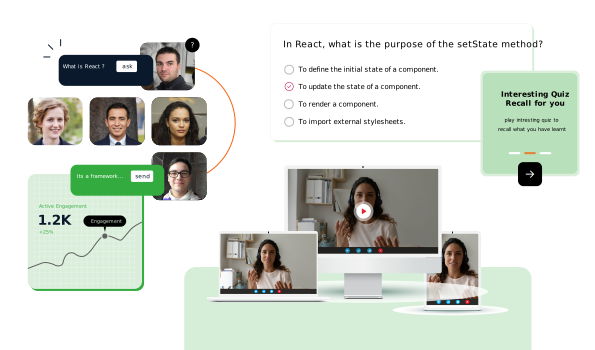
Immersive Learning for Big Data Courses
- Expert-led training
- On-demand learning videos
- Smart flashcards and interactive eBooks
- Recall quizzes and more!

Talk to our Learning Advisor today
and unlock success with specialized Big Data skills.
Big Data Certifications and Exams
1. What are the top big data certification programs available?
here are numerous big data certification programs available in the market today to the increase in demand for Big Data professionals. Having said that, finding the right big data course depends on varying factors such as your prior experience, whether you come from a technical background and even the time frame you are looking to get certified in.
Here are a few of the best big data online courses according to us:
While selecting the right Big Data classes for you, it is imperative that you consider your career goals, current skills and the tools and technologies that you would like to master.
2. How can completing multiple big data courses enhance my skillset?
Completing multiple Big Data courses from a reputed accreditation can have many positive effects on your Big Data career. Here are just a few.
- Staying Current with Industry Trends: Staying up to date with the current market trends is pivotal to your career growth as a Big Data professional.
- Adaptability: Mastering multiple tools involved in big data can grow your career like nothing else. Companies are always looking for Big Data professionals who are versatile and can adapt to a dynamic work environment and system architecture.
- In-Depth Understanding: Completing multiple big data online courses allows you to see the bigger picture and gain an in-depth understanding of topics and identify patterns in data that you would normally have missed otherwise.
3. What are the benefits of enrolling in accredited big data courses?
In the last decade, Big Data has seen an immense increase in job growth and in parallel the number of courses that provide Big Data certifications have also grown. If you’re looking to learn big data online, enrolling in accredited Big Data courses provides various advantages. Let us explore a few in detail:
- Credibility: Due to the increase in the number of Big Data certifications out there, companies look for professionals who have completed accredited Big Data courses since they add credibility and recognition to your resume.
- Structured Learning: Accredited Big Data courses provide a structured curriculum making it easier for you to comprehend advanced concepts and helping you grow your skill and knowledge in an organized and supervised manner.
- Resources and Support: Accredited Big Data courses often provide many reading material and other resources to streamline your learning and provide you with the most up to date skills needed to start your Big Data Career.
4. How do big data courses differ from traditional data science courses?
Big Data involves studying and collecting large sets of data to find hidden patterns that assist in making business decisions. While Data Sciences is the study of large amounts of data for the function of building predictive and analytical models. And so, the courses also focus on building these very different skillsets and the use of various tools for the same. Here is a table to help you understand the differences between them.
Aspect | Big Data Courses | Traditional Data Science Courses |
Focus | Volume, variety, velocity | Statistical analysis, predictive modeling |
Technologies | Hadoop, Spark, NoSQL | Python, R, SQL |
Applications | Scalability, real-time processing | Analytical techniques, machine learning projects |
Career Roles | Big Data Engineer, Data Architect | Data Scientist, Business Analyst |
Industries | Tech, finance, healthcare | Marketing, e-commerce, consulting |
Content Examples | Data ingestion, distributed computing | Data cleaning, statistical inference |
5. How can completing a big data course enhance my career prospects?
Due to the technical nature of the job, acquiring a Big Data certification will greatly benefit you in your career, especially if you’re just starting off. Let’s have a look at some of the main benefits:
- Enhanced Skillset: Enrolling for a Big Data certification online will you with a plethora of skills that would be difficult to attain if you were self-taught. This gives you an advantage in the very competitive job market, making it relatively simple for you to land your first job as a Big Data Specialist.
- Career Advancement: If you’re looking to further your Big Data career through a promotion or by applying for a higher position, a Big Data certification showcases to employers that you have the required skill and are qualified for that position. It also showcases you dedication to stay updated to the trends of the field of study which further increases your credibility.
- Higher Salary: Studies show that professionals who have completed a Big Data Certification from a reputed recognized certification body such as KnowledgeHut receive higher remuneration than their non-certified counterpart. Check out the various job roles that you will be eligible for and the average salary of the same here.
6. Can I pursue a big data certification without a technical background?
The eligibility and prerequisites of Big Data courses vary depending on the courses themselves. If you are a fresher or not from a technical background, KnowledgeHut offers various big data courses for beginners that you can check out, here are a few of them:
Check out the more detailed list here to compare all the courses and pick the one that’s right for you.
7. How can a big data certification benefit my career?
Big Data is an up-and-coming field, and the global Big Data and Analytics market is worth $274 Billion. And so, there are various benefits that you can reap by enrolling for a big data training course.
- Job Security and Demand: By completing a Big Data online course with certification, you are showcasing to your employer that you are dedicated to the field and possess in-depth understanding of all the necessary tools and skills that you need to perform well at your job function.
- Networking Opportunity: If you enroll for some of the best big data courses, you will be able to mingle and learn from leading industry experts who will also be your mentors and instructors.
Who Should Attend
- Data Architects
- Data Scientists
- Developers
- Data Analysts
- BI Analysts
- BI Developers
- SAS Developers
- Project Managers
- Mainframe and Analytics Professionals
- Anyone interested in Big Data

Big Data Courses Duration and Fees
Our Big Data certification courses are powered by hands-on training conducted by top Big Data experts who have played a big part in driving the Big Data revolution. Attend our live training, get hands-on practice, master critical concepts, acquire top skills, and impress top recruiters.
We provide the best Big Data courses to help you become a proficient Big Data expert. From Machine Learning with Apache Mahout to Big Data and Hadoop course and many more Big Data credentials, we have you covered.
Want to know more about our courses? Here is an overview of our Big Data courses.
Course Name | Start Date | Duration | Fee |
|---|---|---|---|
Apache Storm | Announcing Soon | 18 Hrs | - |
Apache Spark and Scala | Announcing Soon | 24 Hrs | - |
Apache Kafka | Announcing Soon | 24 Hrs | 830 |
Comprehensive Pig | Announcing Soon | 24 Hrs | - |
Comprehensive Hive | Announcing Soon | 16 Hrs | - |
Hadoop Administration Course | Announcing Soon | 24 Hrs | - |
Big Data and Hadoop Course | Announcing Soon | 30 Hrs | 997 |
Big Data Analytics Course | Announcing Soon | 16+ Hrs | - |
DEMAND FOR BIG DATA CERTIFICATION COURSES
Leading organizations across the world are investing in Big Data and Data analytics. Professionals with a solid understanding of Apache Kafka, Hadoop Administration, Machine Learning, experience lucrative job and growth opportunities across a variety of industries such as Software, Technologies, Marketing, Finance, eCommerce, Infrastructure, Aerospace, Insurance, Food, Tourism, Telecommunication, Medicine, EdTech, and more.
There is not an industry that has remained untouched by Big Data or doesn’t rely on it in some way. The demand for professionals skilled in Big Data specializations is growing at a faster pace than the availability of these professionals.
Let’s explore Big Data insights to find out how the Big Data job market looks like. Here are some key stats from the industry.
Big Data Certifications
Level up your career with in-demand Big Data certifications! Not only will you gain mastery in hot areas like Apache Kafka and Hadoop, but you'll also stand out from the crowd. These credentials validate your skills to potential employers, giving you a competitive edge in the booming big data job market. This translates to increased earning potential and access to exciting opportunities across various industries. Ready to take your future to the next level?

Big Data FAQs
Intro to Big Data
Big Data Courses
Career Benefits
1. What is Big Data?
Large and complicated datasets that are beyond the capabilities of conventional data processing technologies are referred to as "big data." It includes all techniques, tools, and technologies required to handle, process, and evaluate these enormous volumes of data to get insightful knowledge and facilitate decision-making.
If you're interested in diving deeper into the concept, check out our blog about “What is Big Data — An Introductory Guide”.
2. Is Big Data easy to learn?
Learning Big Data can be a rewarding yet cumbersome task if you don’t have the right guidance. It requires fundamental knowledge of programming languages like Python and of databases like NoSQL. We suggest enrolling for a Big Data online training course like the one KnowledgeHut provides to streamline your learning journey and get you job ready from the get-go.
3. Is learning Big Data worth it?
Learning Big Data, though difficult, can be a very rewarding endeavor for various reasons.
- High Demand: Big Data professionals are in high demand and companies are willing to pay high remunerations to meet said demand.
- Job Security: Big Data is the future and acquiring a Big Data Certification will not only make you future proof but will also ensure your job security.
4. Is big data in demand?
Big Data is one of the best tech skills to have as of 2024. There has been a huge rise in the number of companies that require professionals who possess a Big Data Certification. The global Big Data Market is projected to reach $665.7 billion by 2033 which will only further increase the need for skilled and able Big Data professionals throughout various businesses.
If you’re still unsure of shifting your career into Big Data, check out our blog about “Why a Career in Big Data Is the Right Choice for You?”.
5. What is Big Data for beginners?
Big Data courses for beginners are programs that are designed to instill in you all the necessary skills and knowledge that you will need to land your first job in Big Data. KnowledgeHut provides various such courses that include portfolio projects and hands-on exercises that will help you put your skills to the test and drastically increase your confidence.
Get started on your Big Data journey today and check out our beginner courses here.
6. What are the 3 types of Big Data?
Depending on the type, source, and structure of the data, big data can be separated into three categories. These are the three categories of big data.
- Structured: It is characterized by consistency and a clearly defined structure.
- Unstructured: This refers to data that is inconsistent and lacks structure, with no discernible pattern.
- Semi-structured: It adheres to certain patterns but does not follow any data models.
If you want to dive deeper into the types of Big Data, check out our blog on “What is Big Data: Types, Characteristics and Benefits”.
7. What are big data principles?
Big Data principles are best practices that experienced Big Data practitioners have put together for the effective management, processing and analysis of large data sets. Understanding the 5Vs of Big Data is crucial to developing systems that can handle large sets of data with grace.