
CSM vs PSM: Which Certification to Choose in 2026?
Updated on Sep 13, 2026 | 7 min read | 41.2K+ views
Share:
Quick Overview
- CSM (Certified ScrumMaster) is a Scrum certification offered by Scrum Alliance that provides structured, instructor-led learning and builds foundational Scrum Master skills.
- PSM (Professional Scrum Master) is a Scrum certification offered by Scrum.org that validates Scrum knowledge through an assessment and does not require mandatory training.
- The key difference is that CSM requires mandatory multi-day live training from an authorized provider before the exam, while PSM requires no training. You can self-study and purchase the exam directly.
- This guide explains CSM and PSM certifications, their key differences, eligibility, skills developed, certification levels, benefits, exam requirements, and which certification may be the better choice in 2026.
Build Agile expertise with CSM® Certification Training and develop the skills needed to lead effective Scrum teams.
Master the Right Skills & Boost Your Career
Avail your free 1:1 mentorship session
CSM and PSM Certification: Key Differences
The table below compares the two certifications across these important factors to make the differences easier to understand:
Factor |
CSM Certification |
PSM Certification |
| Accreditation Body | Scrum Alliance | Scrum.org |
| Focus Area | Scrum fundamentals and Scrum Master responsibilities | Scrum framework, Scrum Master accountability, and practical application |
| Training Requirement | A 16 hour approved CSM course is required | Training is recommended but not required to take PSM I |
| Certification Validity | 2 years | Lifetime |
| Renewal | Renewal every 2 years with SEUs and a fee | No renewal required |
| Exam Difficulty | Foundational assessment | More rigorous knowledge-based assessment |
| Exam Details | 50 multiple choice questions, 60 minutes | 80 questions, 60 minutes |
| Passing Score | 74% | 85% |
| Intended Audience | Beginners and professionals seeking structured Scrum training | Professionals who want to demonstrate Scrum knowledge through assessment |
| Credibility in Industry | Widely recognized Scrum credential | Widely recognized Scrum credential |
| Cost Range | ₹17,000 to ₹30,000 in India, and $250 to $2,495 globally | PSM I: $200 USD per attempt PSM II: $250 USD per attempt PSM III: $500 USD per attempt
|
What Is CSM Certification?
CSM certification is a Scrum Alliance credential designed to build foundational Scrum knowledge and understanding of the Scrum Master role. It follows a structured learning path that includes approved instructor led training.
Eligibility of CSM
There is no requirement to hold prior Scrum experience or another Scrum certification to take the CSM route. However, candidates must complete an approved 16-hour CSM course with a Certified Scrum Trainer before accessing the certification test.
Skills Which You Will Learn
CSM training can help develop understanding of:
- Scrum roles and accountabilities
- Scrum events
- Scrum artifacts
- Scrum values
- Facilitation
- Coaching
- Team collaboration
- Scrum Master responsibilities
Certification Level of CSM
CSM is the starting certification level in the Scrum Alliance pathway.
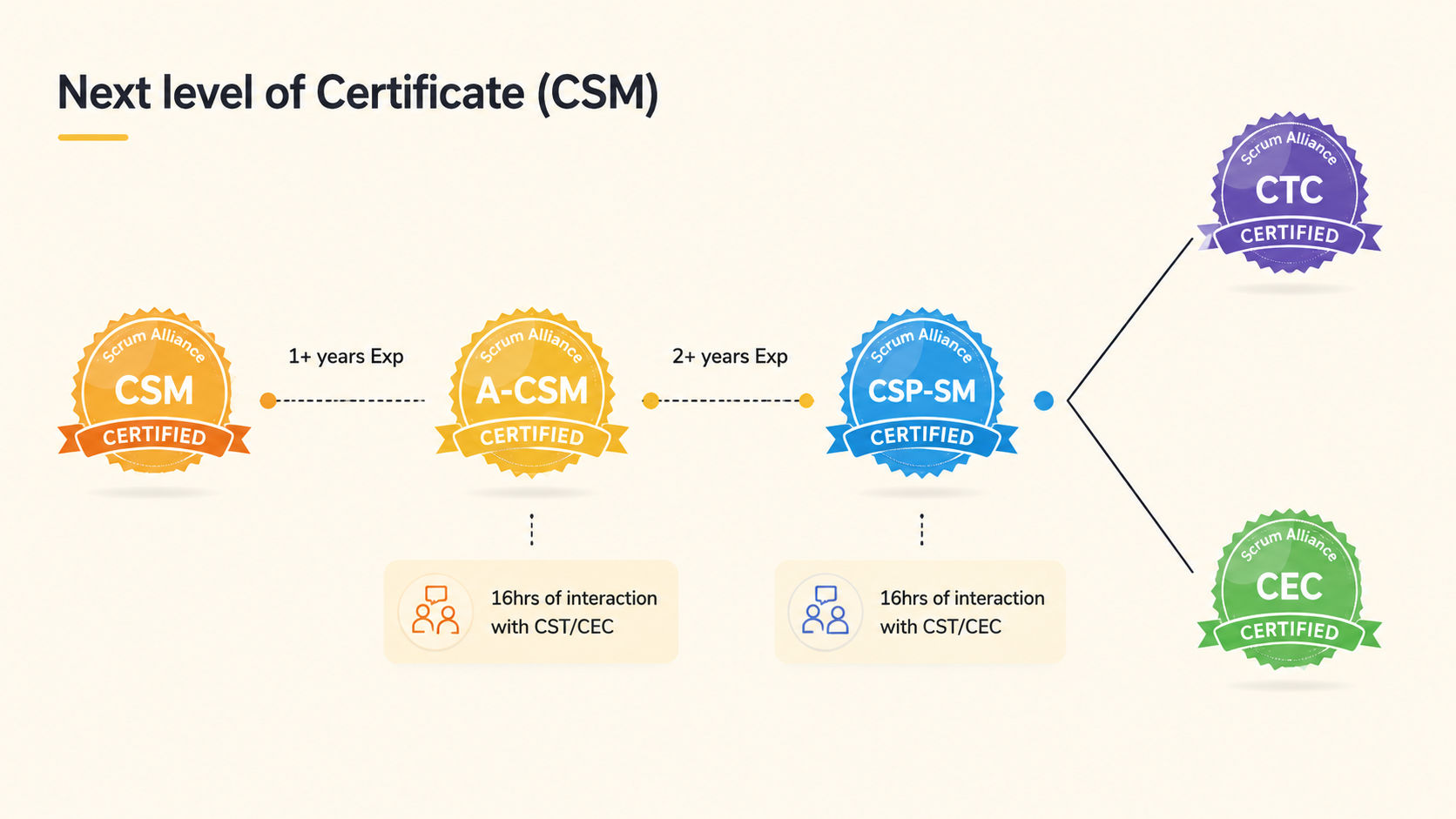
The certification progression shown in the provided reference includes:
- CSM: Starting level
- A-CSM: After 1+ years of experience and 16 hours of interaction with a CST/CEC
- CSP SM: After 2+ years of experience and another 16 hours of interaction with a CST/CEC
- CTC or CEC: Advanced pathways available after CSP SM
Build practical Agile skills with the Best Agile Management Certification Training Courses and advance in Agile project management.
What Is PSM Certification?
PSM certification is a Scrum.org certification path that validates knowledge of Scrum and the Scrum Master accountabilities. PSM I focuses on demonstrating knowledge and the ability to apply Scrum principles.
Eligibility Of PSM
Unlike CSM, Scrum.org does not require candidates to attend a training course before attempting the PSM I assessment. Training can be useful, but the assessment can be purchased and taken independently.
Skills Which You Will Learn
PSM preparation can strengthen knowledge of:
- Scrum theory
- Empiricism
- Scrum values
- Scrum events
- Scrum artifacts
- Definition of Done
- Self-managing teams
- Scrum Master leadership
- Applying Scrum in complex environments
Scrum.org's PSM learning objectives emphasize Scrum theory, empiricism, values, product delivery, self-management, and the Scrum Master's role.
Certification Level of PSM
PSM certifications are offered at different levels based on the depth of Scrum knowledge and experience:
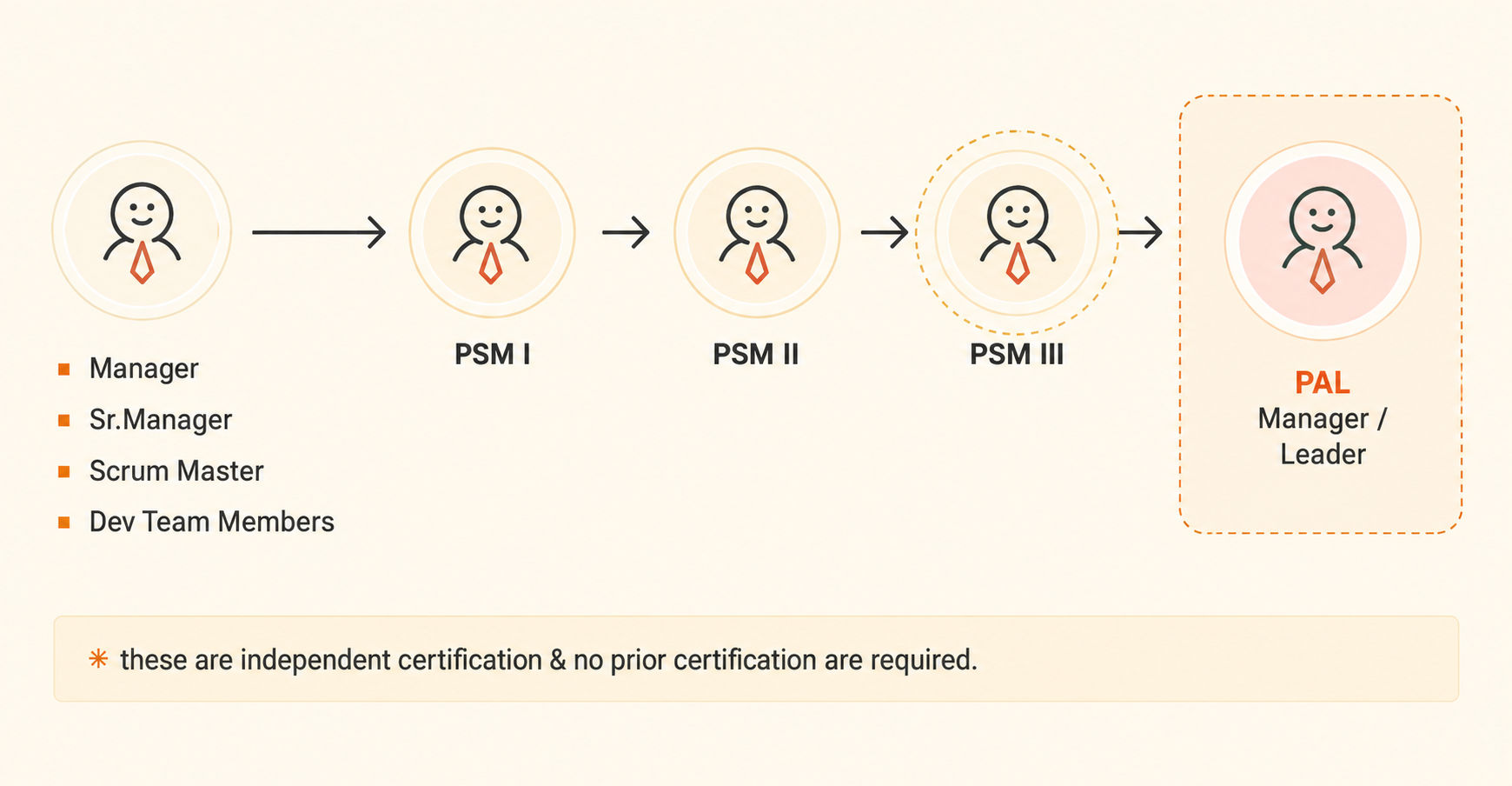
- PSM I: Validates foundational knowledge of Scrum and the Scrum Master role.
- PSM II: Focuses on advanced Scrum Master practices and applying Scrum effectively.
- PSM III: Demonstrates advanced knowledge and the ability to apply Scrum principles in complex situations.
- PAL: Focuses on applying Agile and Scrum principles from a management and leadership perspective.
Explore The History of Professional Scrum Master (PSM) to understand how the certification and Scrum Master role have evolved over time.
Benefits of CSM Certification
The CSM certification can be useful for candidates who prefer structured, instructor led learning and want to build Scrum fundamentals before taking the assessment.
1. Builds Strong Scrum Fundamentals
CSM provides structured learning around:
- Scrum framework
- Scrum values
- Roles and accountabilities
- Events
- Artifacts
- Scrum Master responsibilities
2. Develops Practical Scrum Master Skills
The learning experience can help candidates understand how Scrum is applied in team environments, including facilitation, coaching, and collaboration.
3. Supports Entry into Scrum Master Roles
CSM can strengthen a candidate's Scrum profile when applying for entry level or early career Agile roles. Scrum Alliance also notes that some employers request CSM as part of Scrum Master qualifications.
4. Improves Facilitation and Team Collaboration
The CSM learning path focuses on skills that help Scrum Masters support teams, facilitate Scrum events, and improve collaboration.
5. Provides Structured Instructor Led Learning
This can be a major advantage for learners who prefer guided training. CSM requires the approved course before the assessment, creating a defined learning path.
Explore Who Should Do Scrum Master Certification? to understand who can benefit from Scrum Master training and certification.
Benefits of PSM Certification
The PSM certification is well suited to candidates who want to demonstrate Scrum knowledge through a demanding assessment and prefer a certification that does not require renewal.
1. Validates In Depth Scrum Knowledge
PSM I assesses knowledge of Scrum theory, principles, values, accountabilities, events, and artifacts. The passing threshold is 85%, making the assessment more demanding than the CSM test in terms of the required score.
2. Strengthens Scrum Master Competencies
PSM preparation can strengthen understanding of:
- Scrum application
- Empiricism
- Facilitation
- Self-management
- Leadership
- Product delivery
3. Supports Career Growth in Agile Roles
PSM can be relevant for professionals working toward Scrum Master and other Agile roles. The certification demonstrates knowledge of Scrum and its application.
4. Demonstrates Independent Scrum Expertise
Because training is not mandatory, candidates can prepare independently and demonstrate knowledge by passing the assessment. Scrum.org states that Professional Scrum certifications require proof of knowledge through the assessment.
5. Offers Progressive Certification Levels
Scrum.org provides a progression from PSM I to PSM II and PSM III, allowing professionals to continue developing Scrum knowledge at higher levels. PSM certifications do not expire or require renewal fees.
Also Read: CSM, PSM, SSM, SASM - What Scrum Master Course Do I Choose?.
Conclusion
The choice in CSM vs PSM certification depends on learning style and career goals. CSM suits candidates who prefer structured instructor-led training, while PSM I is better for those comfortable with independent preparation and a rigorous assessment.
The key is to choose the certification that best matches the candidate's experience, preparation style, and career goals.
Have A Query? Get in Touch With Our Customer Support | upGrad KnowledgeHut
Frequently Asked Questions (FAQs)
1. Can CSM and PSM certifications be used together for career growth?
Yes. CSM PSM certification can be used together to demonstrate Scrum knowledge through different learning and assessment approaches. Professionals comparing CSM vs PSM may choose both when they want broader exposure to Scrum practices and certification systems.
2. Which certification is better for a career switch into Scrum Master roles?
When comparing PSM vs CSM, the better option depends on learning preferences and career goals. CSM suits candidates who prefer structured instructor-led training, while PSM can suit those comfortable with independent preparation and assessment.
3. Which certification is more suitable for experienced Agile practitioners?
For experienced professionals comparing PSM I vs CSM, PSM I can be suitable for those who already have strong Scrum knowledge and want to validate it through a rigorous assessment. CSM may suit those who prefer guided instructor led learning.
4. Does CSM or PSM certification help with international Scrum Master opportunities?
Both certifications can strengthen a Scrum Master profile in international markets. When comparing CSM certification vs PSM, candidates should also consider practical experience, employer preferences, and the certification commonly requested in their target market.
5. How should candidates prepare differently for CSM and PSM assessments?
Preparation differs significantly when comparing PSM vs CSM certification. CSM requires approved instructor-led training, while PSM I allows independent preparation. Candidates should focus on Scrum theory, values, principles, roles, events, and practical application.
6. What happens if a candidate fails the CSM or PSM assessment?
The next step depends on the certification provider's retake policies. Candidates should review the relevant rules, identify weak areas, and strengthen Scrum knowledge before attempting the assessment again. This is also important when budgeting for the PSM exam cost or CSM training.
7. Can CSM or PSM certification help without previous Scrum Master experience?
Yes. Both certifications can help demonstrate foundational Scrum knowledge without prior Scrum Master experience. For candidates comparing csm psm, practical Agile exposure can further strengthen the value of either certification when applying for entry level Scrum roles.
8. Which certification offers better long term value for Scrum Masters?
There is no universal answer to which is better, PSM vs CSM which is better. CSM may suit professionals who prefer structured learning, while PSM offers a certification without renewal. Long term value depends on experience, skills, career goals, and employer expectations.
9. Should candidates choose CSM or PSM based on employer requirements?
Yes. Employer expectations can be an important factor when deciding between CSM or PSM. Reviewing Scrum Master job descriptions can help determine whether CSM, PSM, or broader Scrum expertise is more relevant to the target role.
10. Can professionals switch from CSM to PSM or PSM to CSM later?
Yes. Professionals can pursue either certification regardless of which one they completed first. Someone who initially earns CSM can later pursue PSM, while a PSM holder can add CSM based on career goals, employer requirements, or learning preferences.
1639 articles published
KnowledgeHut is an outcome-focused global ed-tech company. We help organizations and professionals unlock excellence through skills development. We offer training solutions under the people and proces...
Get Free Consultation
By submitting, I accept the T&C and
Privacy Policy
Ready to learn about Agile Certifications Roadmap?