
- Home
- Blog
- Project Management
- Most Recent Updates In PMBOK® Guide And PMP® Classes By KnowledgeHut
Most Recent Updates In PMBOK® Guide And PMP® Classes By KnowledgeHut
Updated on Aug 14, 2026 | 4 min read | 10.79K+ views
Share:
Table of Contents
View all
- What Is the Latest PMBOK® Guide Update?
- Does the PMBOK® Guide Update Affect the PMP® Exam?
- What Are the Latest PMP® Exam Updates in 2026?
- Current vs Updated PMP® Exam
- PMBOK® Guide and PMP® Exam Update Timeline
- What Should PMP® Candidates Do After the Updates?
- Which PMP® Study Materials Should You Use?
- How KnowledgeHut's Updated PMP® Classes Address the Changes?
- Current PMP® Exam vs Updated PMP® Exam
- Conclusion
Quick Overview
- The PMBOK® Guide Eighth Edition introduces updated guidance around value delivery, governance, sustainability, AI, and modern project management practices.
- The PMP® exam update in 2026 brings changes to the exam structure, content emphasis, question formats, and areas candidates need to prioritize.
- PMP candidates should align preparation with the latest PMBOK® Guide, current Exam Content Outline (ECO), official PMI resources, and updated practice materials.
- This guide covers the latest PMBOK® and PMP® updates, exam transition timeline, study resources, preparation guidance, and how KnowledgeHut’s updated PMP classes address the changes.
Build project management expertise with PMP® Certification Training and prepare for the PMP® exam.
Ultimate PMP Formula Cheat Sheet
Get a quick, exam-ready PMP cheat sheet with all essential formulas and key concepts in one place.
What Is the Latest PMBOK® Guide Update?
The PMBOK® Guide Eighth Edition builds on the Seventh Edition while making the guidance more practical and actionable. PMI retains the principles and performance domains foundation but simplifies and clarifies it, while expanding coverage of AI, PMOs, and procurement.
PMBOK® Guide Eighth Edition Overview
The Eighth Edition includes:
• Six core principles
• Seven performance domains
• Expanded AI coverage
• Expanded PMO and procurement guidance
• Reintroduced process guidance in a nonprescriptive form
• Greater emphasis on value, adaptability, and accountability
The guide is designed to support different project environments rather than prescribe one fixed delivery method.
PMBOK® 7th vs 8th Edition
The major difference is the stronger practical orientation of the Eighth Edition.
The Seventh Edition emphasized:
• Principles
• Performance domains
• Tailoring
• Models, methods, and artifacts
The Eighth Edition retains that foundation but provides clearer practical guidance and reintroduces process guidance in an evolved, nonprescriptive format.
This makes the PMBOK update more useful for professionals who want to connect project management principles with day-to-day applications.
Key New or Expanded Concepts
The Eighth Edition expands attention to:
• Artificial intelligence
• PMOs
• Procurement
• Governance
• Finance
• Sustainability
• Quality
• Communications
• Value delivery
The emphasis is increasingly on applying project management practices according to project context rather than following rigid procedures.
Predictive, Agile and Hybrid Approaches
The PMBOK® Guide continues to support predictive, adaptive, and hybrid approaches. The focus is on tailoring the approach to the project's environment, requirements, risks, and organizational needs.
This is important for PMP® candidates because the updated examination also assesses different delivery approaches throughout its domains.
Explore the PMBOK Guide to understand key project management principles, practices, and approaches.
Does the PMBOK® Guide Update Affect the PMP® Exam?
The PMBOK update and PMP® exam refresh are related, but the PMBOK® Guide is not simply a question-by-question exam syllabus. PMI uses the Exam Content Outline to define what is tested.
Candidates should therefore use the current Exam Content Outline, along with PMI's exam preparation resources and relevant references, rather than studying only the PMBOK® Guide. PMI specifically directs candidates taking the exam from July 9, 2026 onward to the updated ECO.
Relationship Between PMBOK® and PMP® Exam
The PMBOK® Guide provides PMI's project management standard and guidance. The PMP® Exam Content Outline defines the domains, tasks, and areas assessed on the certification examination.
The two resources complement each other but serve different purposes.
Exam Content Outline
The July 2026 ECO contains three domains:
• People: 33%
• Process: 41%
• Business Environment: 26%
Approximately 40% of the exam represents predictive approaches, while the remaining 60% is divided between adaptive or Agile and hybrid approaches.
What Candidates Should Prioritize
Candidates preparing for the current exam should prioritize:
• Updated ECO content
• Scenario based decision making
• People and stakeholder skills
• Process and delivery practices
• Business environment and governance
• AI and sustainability contexts
• Predictive, Agile, and hybrid approaches
• Value and outcome focused thinking
Build practical project management skills with the Best Project Management Certification Courses and choose a path that fits career goals.
What Are the Latest PMP® Exam Updates in 2026?
The updated PMP® exam launched on July 9, 2026. Since that date, candidates take the updated version rather than the previous exam.
The PMBOK update is therefore no longer a future transition for current candidates. Preparation should now be based on the updated examination requirements.
Exam Launch and Transition Timeline
Key dates include:
• PMBOK® Guide Eighth Edition: November 2025
• Updated PMP® learning resources: April 2026
• Previous PMP® exam: available through July 8, 2026
• Updated PMP® exam: launched July 9, 2026
Exam Domains and Weightage
The updated exam uses the following weighting:
| Domain | Weightage |
| People | 33% |
| Process | 41% |
| Business Environment | 26% |
The biggest change is the Business Environment, which increased from 8% under the earlier exam structure to 26%.
Explore what’s new in PMP 6.0 and understand the latest changes shaping project management certification in 2026.
Eligibility and Training Requirements
Current PMP eligibility includes different pathways based on education and project leadership experience.
For example:
• A bachelor's degree or higher with three years of project leadership experience
• An associate degree or vocational qualification with four years of experience
• A high school diploma with five years of experience
• 35 hours of project management training, subject to PMI's requirements
PMI has also announced a planned change to live training eligibility in late Q4 2026. From the effective date, qualifying live training will need to come through an approved provider pathway, such as a PMI Authorized Training Partner.
New or Expanded Content Areas
The updated examination gives greater attention to:
• AI
• Sustainability
• Stakeholder engagement
• Governance
• Business value
• Compliance
• Organizational context
• Adaptive project environments
AI is not presented as a requirement to become an AI developer. Instead, candidates should understand AI related project scenarios, decision making, governance, and responsible use.
Current vs Updated PMP® Exam
The previous PMP® exam ended on July 8, 2026. The updated examination began on July 9, 2026.
| Exam Element | Previous Exam | Updated Exam |
| Exam status | Retired July 8, 2026 | Current from July 9, 2026 |
| Questions | 180 | 180 |
| Duration | 230 minutes | 240 minutes |
| People | 42% | 33% |
| Process | 50% | 41% |
| Business Environment | 8% | 26% |
| Focus | Project management delivery | Value, outcomes, leadership, and business context |
| Approach | Predictive, Agile, and hybrid | Predictive, Agile, and hybrid with approximately 40% predictive and 60% Agile and hybrid |
| Emerging themes | Limited | Greater AI and sustainability emphasis |
The current examination also uses a more interactive and scenario-oriented experience designed to reflect real project environments.
Understand the PMP Exam Changes in 2026 including the updated exam pattern, duration, and breaks, to prepare with confidence.
PMBOK® Guide and PMP® Exam Update Timeline
The changes have occurred in stages rather than all at once.
| Timeline | Update |
| November 2025 | PMBOK® Guide Eighth Edition published |
| April 2026 | Refreshed PMP® learning resources introduced |
| July 8, 2026 | Previous PMP® exam ended |
| July 9, 2026 | Updated PMP® exam launched |
| Late Q4 2026 | Planned update to live PMP® training eligibility |
PMI recommends candidates use the applicable ECO and current preparation resources based on their exam date.
What Should PMP® Candidates Do After the Updates?
The right preparation approach depends on where a candidate is in the certification journey. Because the updated PMP® exam is already active, current preparation should use the July 2026 ECO.
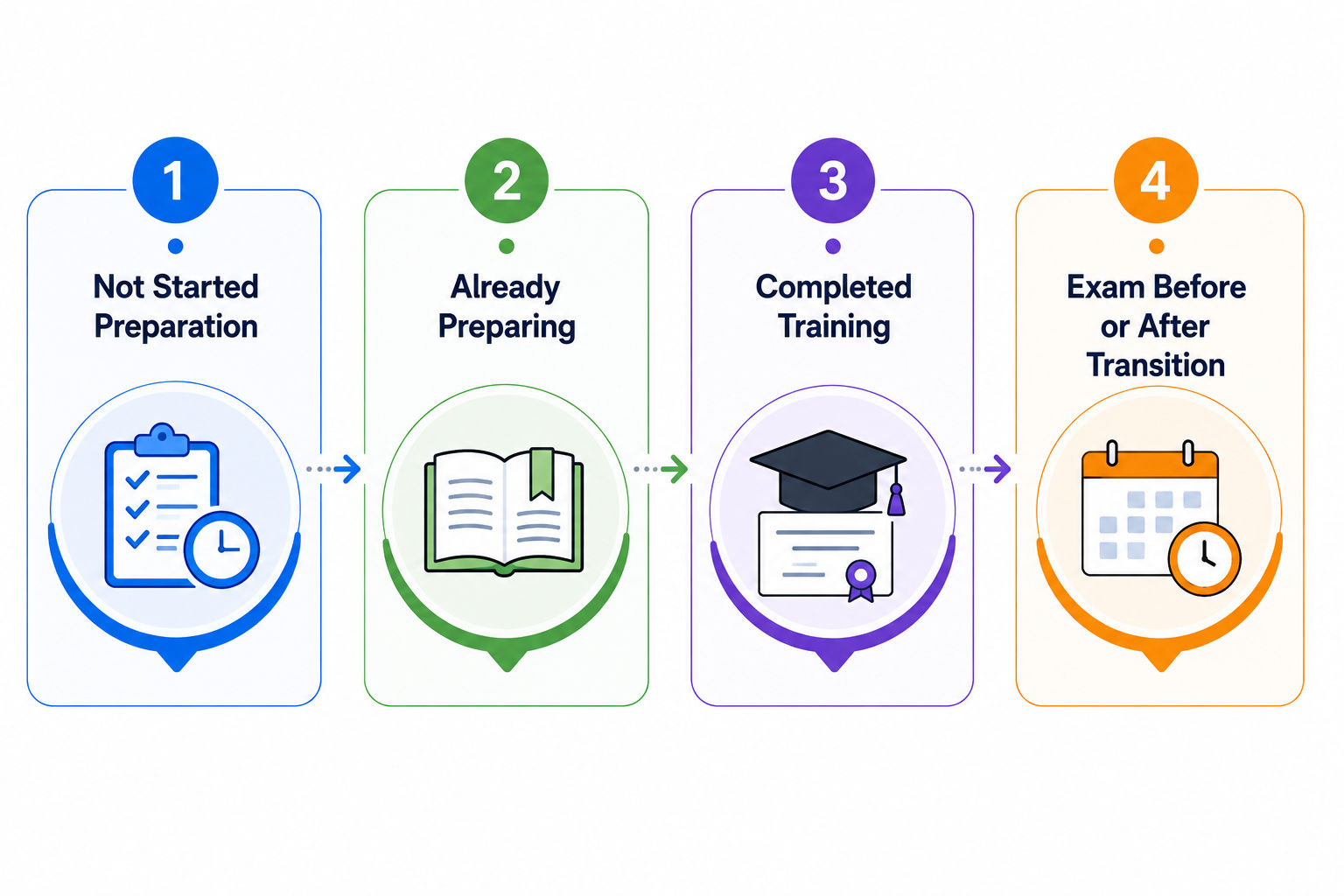
Not Started Preparation
Candidates starting now should:
• Study the updated ECO
• Use current PMP® preparation resources
• Understand the new domain weightings
• Practice scenario-based questions
• Study predictive, Agile, and hybrid approaches
Already Preparing
Candidates already studying should not discard their entire preparation. PMI states that the core principles and approaches remain consistent, while updated resources place greater emphasis on areas such as AI, sustainability, value delivery, and business context.
The priority should be identifying gaps against the current ECO.
Completed Training
Candidates who have already completed the required training generally do not need to repeat the training simply because the exam has changed. PMI specifically advises checking current requirements and notes that previously completed qualifying training remains relevant.
The key step is updating study materials and practicing questions to match the current examination.
Exam Before or After Transition
The transition has already occurred.
Those taking the exam from July 9, 2026, onward should prepare for the updated PMP® exam using the new ECO.
Explore Projects in Business Environments to understand how projects operate within organizational, market, and strategic contexts.
Which PMP® Study Materials Should You Use?
The PMBOK update should be studied alongside the current PMP® Exam Content Outline rather than treated as the only exam preparation source.
1. Official PMI Resources
Prioritize:
• PMBOK® Guide Eighth Edition
• July 2026 PMP® Exam Content Outline
• PMI Study Hall and current practice resources
• PMI's current certification guidance
2. Current ECO
The ECO should be the main reference for understanding what the examination evaluates.
It identifies the domains, tasks, and enablers used to structure the exam.
3. PMBOK® Guide
The Eighth Edition provides updated standard and broader project management guidance.
It is particularly useful for understanding principles, performance domains, value delivery, tailoring, governance, and emerging topics.
4. Practice Resources
Practice questions should reflect the current examination structure.
Focus on:
• Scenario based questions
• Decision making
• Business context
• Agile and hybrid situations
• Stakeholder scenarios
• Governance and risk
5. Training
Training can help candidates organize their preparation, understand difficult concepts, and practise exam style scenarios.
For live training planned after PMI's late Q4 2026 eligibility change, candidates should verify that the provider meets the applicable requirements.
How KnowledgeHut's Updated PMP® Classes Address the Changes?
KnowledgeHut currently states that its PMP® course is aligned with the newest PMP® exam objectives and the PMBOK® Guide Eighth Edition. Its course page also identifies KnowledgeHut as a Premier PMI Authorized Training Partner.
Course Coverage
The current KnowledgeHut PMP® course states that the curriculum aligns with the latest PMP® exam objectives and PMBOK® Guide Eighth Edition.
Updated Materials
KnowledgeHut lists PMI licensed learning resources, including videos, an eBook, assessments, and related preparation material.
Practice and Mocks
The course page lists premium question bank, mock tests, and PMP® exam simulation resources to support practice.
Instructor Support
KnowledgeHut highlights instructor led training, mentor guidance, doubt clearing, and exam application assistance as part of its PMP® preparation offering.
Only Verified Claims
Course features can change by location, delivery format, and enrollment package. Candidates should therefore verify the current course page for the exact materials, training format, practice access, and support included with a specific enrollment.
Learn the fundamentals with an Introduction to Project Management with Reference to PMBOK 6, covering key concepts, processes, and practices.
Current PMP® Exam vs Updated PMP® Exam
The current exam is the updated July 2026 version, so candidates preparing today should focus on the current format rather than the retired examination.
| Exam Element | Current Exam | Updated Exam |
| Exam date | From July 9, 2026 | July 2026 version |
| Domains | People, Process, Business Environment | People, Process, Business Environment |
| Weightage | 33%, 41%, 26% | 33%, 41%, 26% |
| Questions | 180 | 180 |
| Duration | 240 minutes | 240 minutes |
| Content emphasis | Value, outcomes, business context, leadership, AI and sustainability | Same current structure |
| Eligibility | Current PMI requirements | Current PMI requirements |
| Training requirement | 35 hours | 35 hours, with planned late Q4 2026 live training changes |
PMI confirms that the current exam has 180 questions, 240 minutes, two 10-minute breaks, and 33%, 41%, and 26% domain weighting.
Conclusion
The PMBOK update and 2026 PMP® exam refresh emphasize value, business context, adaptability, AI, sustainability, and practical decision making.
Candidates should use the PMBOK® Guide Eighth Edition, current PMP® ECO, and updated study resources. KnowledgeHut states that its PMP® training is aligned with the current exam and PMBOK® Guide Eighth Edition.
Contact our upGrad KnowledgeHut experts for personalized guidance on choosing the right course, career path, and certification to achieve your goals.
Frequently Asked Questions (FAQs)
1. How is the PMP exam different from the PMBOK Guide Eighth Edition?
The PMBOK® Guide Eighth Edition provides project management standards and guidance, while the PMP® Exam Content Outline defines what the exam assesses. The exam tests the application of project management concepts rather than simply asking candidates to recall the guide.
2. Are PMP exam questions based directly on the PMBOK Guide Eighth Edition?
Not directly. PMI uses the Exam Content Outline to define exam content, while the PMBOK® Guide is one of the broader reference's candidates can use for preparation. Questions are designed to apply knowledge in project situations.
3. What types of scenario based questions should candidates expect after the 2026 update?
The updated exam places greater emphasis on realistic project situations and decision making. Candidates can encounter scenarios involving project artifacts, graphics, tools, data, and practical workplace situations rather than only direct knowledge of questions.
4. How much of the updated PMP exam focuses on AI and sustainability?
PMI has expanded AI and sustainability within the updated exam and related project management guidance. However, PMI does not assign a separate percentage specifically to AI or sustainability in the published domain weighting.
5. Does the 2026 PMP exam require more business and strategic knowledge?
Yes. Business Environment accounts for 26% of the updated exam, making organizational context, governance, compliance, value, and business considerations more prominent than in the previous version.
6. Can candidates still use older PMP practice questions after the 2026 update?
Older questions may help reinforce fundamental concepts, but they should not be the only practice source. Candidates should prioritize practice materials aligned with the July 2026 Exam Content Outline and updated exam format.
7. What changes should candidates make to their PMP study plan after the PMBOK update?
Study plans should be aligned with the current ECO and place greater emphasis on scenario-based decision making, Business Environment, AI, sustainability, value, and predictive, Agile, and hybrid approaches. Updated practice questions should also be included.
8. Are Agile and hybrid questions more important in the updated PMP exam?
Yes. PMI states that approximately 60% of the updated exam represents adaptive or Agile and hybrid approaches, while approximately 40% represents predictive approaches. Candidates should therefore prepare across all three delivery approaches.
9. How do the new PMP exam question formats differ from the previous exam?
The updated exam includes a more interactive and scenario-focused experience. PMI indicates that candidates may encounter cases, project artifacts, graphics, tools, and data as part of the assessment.
10. What should candidates do if their existing PMP course was based on the previous exam?
Candidates should compare the course content with the current July 2026 ECO and identify gaps. Existing knowledge can still be useful, but outdated practice questions, domain weightings, and exam format coverage should be updated before taking the current exam.
1639 articles published
KnowledgeHut is an outcome-focused global ed-tech company. We help organizations and professionals unlock excellence through skills development. We offer training solutions under the people and proces...
Get Free Consultation
By submitting, I accept the T&C and
Privacy Policy