
- Home
- Blog
- Project Management
- Is PMP Certification Worth it in 2026
Is PMP Certification Worth it in 2026
Updated on Jan 19, 2026 | 10 min read | 22.1K+ views
Share:
The Project Management Professional (PMP) certification has been offered by the Project Management Institute (PMI) since 1984. The importance of being able to manage projects has only grown since then. As industries evolve, the question arises: PMP is it worth it in 2026? It stands out as the preeminent certificate amidst changing industries and business models. Earning a Project Management Certification is a wise investment in one's development and career success, augmenting competencies and boosting confidence. Certified project managers can expect a stable increase in salary. But is PMP certification worth it in 2026?
In this blog, we will look at the ROI involved with the PMP certification, the various career options available, and hurdles to obtain it.
Ultimate PMP Formula Cheat Sheet
Get a quick, exam-ready PMP cheat sheet with all essential formulas and key concepts in one place.
Is PMP Certification Worth It: A PMP Salary Survey?
Is it worth getting a PMP certification? To address this question, let us look at some data. Employers will require 88 million workers for project management positions over the next two years, which is excellent news for job seekers but also a sign of a highly competitive environment. To keep their competitive advantage, project managers of all ranks and lengths of service should actively pursue education and Project Management Professional (PMP) certification.
According to the Project Management Institute (PMI), by 2035, there will be a need for approximately 30 million new project professionals globally to meet demand. While it is not required, having this certification can make you stand out in a very competitive job market.
According to the Project Management Institute (PMI) salary survey, project managers with the Project Management Professional (PMP) certification typically have higher median salaries than their non-credentialed counterparts.
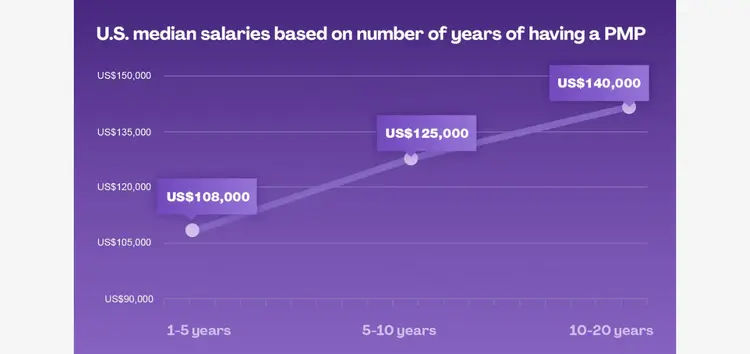
Let us look at the mean salaries of PMP-certified vs. non-PMP-certified professionals across the top 5 countries:
| Country | Mean Salary | Increase | % Increase | |
| PMP Certified | Non-PMP | |||
| USA | $120,000 | $93,000 | $27,000 | 29.03% |
| Brazil | R$170,000 | R$140,000 | R$30,000 | 21.42% |
| India | ₹1,800,000 | ₹1,327,026 | ₹471,974 | 35.64% |
| Malaysia | RM172,9000 | RM133,000 | RM39,931 | 30% |
| Germany | €101,840 | €80,000 | €21,400 | 27.3% |
Source: PMI
The median salary of project managers with PMP certification is typically 33% higher than that of their non-certified peers. The influence of the PMP certification on pay is significant and often reflects the abilities, know-how, and recognition that accompany this certification.
It is true that earning a Project Management Professional (PMP) certification has many advantages, including the possibility of higher pay and a significant return on investment (ROI). The benefits of earning a PMP certification go well beyond quick financial gains. If you're wondering how valuable is PMP certification, consider the long-term career growth, salary boost, and global recognition it offers. The immediate pay increase is one obvious advantage of becoming a certified PMP, but the long-term effects are extensive and varied.
Look at Earning Potential vs. Certification Cost
Considering the time and effort involved in preparing for the PMP, another question that arises is whether it is worth the cost involved. Let us look at the potential financial benefits of obtaining the PMP certification in various countries.
Cost of PMP Certification:
| Cost Head | Expense in USD |
| Exam Fee | $425 – $675 Note: Exam fees have increased since August 6, 2025 |
| Training Fee | $500 – $3,500 |
| Practice Tests | $60 – $300 |
| PMBOK Guide | $0 – $50 |
| PMI Membership | $139, with an annual renewal fee of $129 |
| Other Books | $50 – $100 |
| Total | $1,200 – $5,500 |
Source: PMI
Earning Potential for PMP Certified Professionals:
| Country | Salary Difference (PMP & Non-PMP) | Investment | ROI= Salary Difference /Investment |
| USA | $27,000 | $1000 | 27 times |
| Brazil | R$30,000 | R$4700 | 6.38 times |
| India | ₹471,974 | ₹77500 | 6.1 times |
| Malaysia | RM39,900 | RM4300 | 9.27 times |
| Germany | €21,400 | €900 | 23 times |
Source: pmexperto
The data in the table above demonstrates the significant pay disparities in each country between professionals who hold the PMP certification and those who do not. The computed ROI percentage shows how quickly professionals can recover this investment through higher salaries. The investment represents the cost of earning the PMP certification.
It is crucial to remember that these numbers are averages and could change based on factors like industry, job role, and experience. Beyond financial gain, the PMP certification also contributes to career advancement, improved project management abilities, and increased marketability. So, the question "Is PMP certification worth it?" extends far beyond monetary considerations, encompassing valuable professional growth and enhanced opportunities in the field.
PMP Certification Cost
Aspiring PMP candidates should ask is PMP certification worth it, analyze costs when planning to obtain the certificate, and factor in additional expenses such as study materials, books, and membership fees (if applicable).
| Cost Component | Cost Range |
| Exam Fee | $425 - $675 |
| Training Fee | $500-$3,500 USD |
| PMBOK Guide | $0 – $50 |
| Other Study Materials | $50 – $200 |
| Practice Tests | $60-$300 USD |
| Total | $1,200 – $5,500 |
1. Exam Fee:
- Before taking the PMP exam, candidates must register on the PMI website and pay the required PMP certification fee.
- Applicants can choose to apply for the PMP exam as a non-member or as a PMI member, giving them two options for the exam.
- If someone chooses to join PMI, there is a $10 joining fee in addition to a $129 membership fee. Although there is an initial fee, there are many benefits to joining PMI. PMI members only need to pay $425 for the exam, in comparison to $675 paid by non-members.
- Members also receive discounts on fees associated with retaking exams and renewing their PMP certification.
- Additionally, PMI members can download the PMBOK Guide for free.
2. Training Fee:
- The PMP certification training course, which is an essential step in the preparation process, accounts for a sizeable portion of the total cost. A quality PMP certification training program can run anywhere from $300 to $2000.
There are three prerequisites that candidates must meet to apply for the PMP exam.
For Individuals with a Secondary Degree:
- Completion of 35 hours of project management education.
- A minimum of 60 months (about 5 years) of professional project management experience.
For Individuals with a Four-Year Degree:
- Completion of 35 hours of project management education.
- At least 36 months (about 3 years) of professional project management experience.
3. Practice Tests:
- Although there are a lot of free practice exams available online, it is strongly advised to purchase a well-paid PMP exam simulator because of concerns about the quality of many freely available exams.
- An essential tool for anyone hoping to pass the exam on their first try is a PMP exam simulator.
- Good PMP exam simulators can cost anywhere from $60 to $300. The features provided, the complexity of the question bank, and the simulator's reputation are some of the variables that affect this price difference.
How Does PMP Certification Boost Careers?
Is getting your PMP worth it? Since the PMP certification is widely regarded as the gold standard in project management, it is an invaluable tool for professionals looking to succeed in their respective fields and advance their careers. Project and program managers who successfully complete the PMP exam and obtain official PMP certification frequently see large pay increases. Is getting a PMP worth it, and how obtaining the Project Management Professional (PMP) certification can boost your career:
1. Increases Credibility: Being certified as a PMP increases your professional credibility and indicates that you are an expert in your field. A PMP-certified professional is frequently regarded as an authority, which enhances your resume's professional image and wins you respect from colleagues and potential employers.
2. Facilitates Employability: The lack of qualified talent is a significant opportunity, with 87.7 million people expected to be employed in project management-oriented roles by 2027. Getting certified as a PMP increases your employability by making you stand out as a desirable candidate in this cutthroat market.
3. Career Growth: Becoming certified as a PMP is not only a significant accomplishment but also a springboard for ongoing professional growth. This certification increases your ability to learn and develop by giving you a plethora of new skills in your field.
4. Global Recognition: The PMP certification has gained widespread recognition in the international business arena due to its worldwide accreditation. Having this certification makes you much more marketable because it is widely recognized proof of your project management proficiency.
5. Adds Value to Organizations: Certified project managers are an asset to any company, offering an array of specialized knowledge and experience. They are invaluable assets because they can effectively navigate obstacles and setbacks, organize teams more efficiently, and produce desired results.
6. Networking Opportunities: With the PMP certification, professionals can connect with like-minded people worldwide and take advantage of beneficial networking opportunities. This network provides a forum for teamwork and the sharing of best practices among project managers.
Top Cities Where KnowledgeHut Conduct PMP Certification Training Course Online
Evaluate Your Career Trajectory
Your career path can be significantly impacted by the PMP (Project Management Professional) certification, which offers chances for advancement, higher earning potential, and more recognition in the project management industry. For professionals who obtain the PMP certification, the following is a typical career path:
1. Project Coordinator/Assistant Entry-Level Positions: A lot of people start out in project management as assistants or coordinators. People who work in these roles learn the fundamentals of project scheduling, coordination, and documentation.
2. Project Manager: Professionals frequently move into project management roles after earning the PMP certification. This entails managing resources, supervising projects from start to finish, and ensuring that projects achieve their goals on schedule and within budget.
3. Senior Project Manager: Professionals may progress to the Senior Project Manager position as they accumulate more experience and show that they can effectively oversee challenging projects. People in this role frequently manage more complex and strategic projects, supervising several teams and guaranteeing alignment with company objectives.
4. Program Manager: Individuals with a PMP certification can advance to this position, which entails overseeing a portfolio of connected projects. To accomplish overarching organizational goals, program managers concentrate on organizing and prioritizing projects.
5. Portfolio Manager: The position of Portfolio Manager may be filled by individuals at the highest levels of project management. This entails managing a broad range of projects and initiatives, coordinating them with organizational strategy, and ensuring they all support the organization's goals.
6. Project Management Office (PMO)/Director of Project Management: Many PMP-certified professionals, like PMOs or project management directors, hold leadership roles in organizations. In these positions, one's duties include supervising, establishing project management guidelines, and coordinating project operations with corporate goals.
7. Executive Leadership Positions: Professionals with PMP certifications may advance to executive leadership roles like chief information officer (CIO), chief operating officer (COO), or chief executive officer (CEO) with continued career advancement. An individual can be positioned for strategic leadership roles within organizations by combining their extensive leadership experience with their PMP certification.
It is important to note that your career trajectory can differ according to your personal objectives, industry, and organizational structure. A flexible and well-recognized foundation for success in various roles and industries is offered by the PMP certification, which helps professionals succeed in project management over the long term.
Delve into the most popular KnowledgeHut's Project Management Courses
Transform your team's capabilities with Agile Management. Join our Agile certification course online now and revolutionize your project management approach.
How Does PMP Certification Work?
The certification process for the PMP certification is quite simple. Let us break down the process in steps and see:
Meet Eligibility Criteria: The first thing before you apply for the PMP certification is to check if you match the education and work experience requirements set by the PMI for the PMP certification. There are options for three education levels which we have covered in the earlier part of this blog.
Complete Application: After ascertaining that you meet the eligibility requirements, you can start the application process. Be sure to document this information, as it will be handy.
- Domain Education: Document all the subjects and courses you’ve undertaken successfully, along with the institutes, the start and end dates, and the hours you have put in, etc.
- Domain Experience: Next, document the projects you have worked on, make sure to get the names of the organizations you were with, and the duration of the projects, and the hours on each.
- Education Details: This step is quite simple, you document the all the levels up to highest level of education that you have completed, along with institutions, start and end dates.
- Contact Information: Lastly, document your contact details with your email address, contact address, contact number, etc.
- Application Review: Your application will then be reviewed. This process generally takes up to 10 days. You will receive a communication from the PMI once your application has been reviewed.
- Payment: If your application is accepted, you will be asked to make the payment to take the PMP exam.
- Schedule Exam Appointment: Hooray! You’ve cleared all the steps and are ready to take the exam. Make sure to schedule the exam and follow the exam instructions you receive from PMI, along with your eligibility code.
The Project Management Professional (PMP)® is the world's leading project management certification. There are currently more than a million PMP credential holders globally. The PMP certification is awarded by the Project Management Institute (PMI).
Challenges of Obtaining a PMP Certification
Even though the PMP certification has a lot of benefits, it isn’t an easy path. There are some hurdles in earning the coveted certification.
Understanding these challenges and preparing to face them can make your PMP preparation a lot easier. Here are some key challenges:
1. Eligibility Requirements & Documentation:
Candidates need to meet a few educational and professional experience benchmarks to be qualified for attempting the exam. Typically, candidates need to have a 4-year degree along with 36 months of project leadership experience. Another option is for candidates to have a secondary diploma with 60 months of experience. Apart from these, candidates need to also have undergone 35 hours of formal project management education. Gathering the documentation to claim your eligibility is often time-consuming, and a meticulous task,
2. Financial and Time Investment:
The certification process includes various costs such as the exam fees, study materials, training programs, and potentially a PMI membership. This could add up to around $5,000. Apart from the financial costs, candidates also need to invest substantial amounts of time to prepare for the exam.
3. Exam Difficulty and Stress:
The extensive PMP exam has 180 multiple-choice questions covering the People, Process, and Business Environment domains. The continuous evolution of the exam’s pattern makes it stressful for candidates.
4. Maintaining the Certification:
PMP-certified professionals need to earn 60 Professional Development Units (PDUs) every three years to renew the certification. Earning these PDUs through training, professional contributions, or educational activities requires ongoing commitment to grow professionally. It also leads to further expenses at times.
5. Perception vs. Practical Impact:
While PMP is a strong resume differentiator, it doesn’t always guarantee a salary boost or job. Professionals also need to meet other performance criteria. As one hiring director reflected, “The value of a PMP is an indicator that you are a candidate that has invested time in the profession"
In short, the PMP journey demands preparation, discipline, and resources—but when navigated thoughtfully, its returns can be substantial for those aiming to advance in project leadership.
Summing Up
Many professionals ponder the question, 'Is PMI certification worth it?' before pursuing the accreditation. The increasing importance of project management across a wide range of industries, certainly makes it a valuble investment. Those who have earned their PMP certification find that they can profit from their expertise and proficiency. Because of its high earning potential, the PMP credential is highly valued in today's competitive job market, making it the certification of choice for individuals hoping to succeed in project management roles.
The PMP certification highlights a professional’s knowledge about the various nuances of project management. This ensures that certificate-holders are well-informed and have what it takes to handle intricate projects. The initial requirements also prove that they have experience managing projects in the past.
Frequently Asked Questions (FAQs)
1. How much does a PMP certification add to your salary?
The average salary range for a qualified professional with a PMP certification is between $111,000 - $121,000. The actual numbers will depend on your geographic location and your experience.
2. How long does it take to receive PMP certificate after the exam?
If you have cleared the PMP exam successfully, you will receive a congratulatory message from the PMI on your email address, immediately after. You can officially use the PMP title on your work profiles and CV.
3. Is PMP still in demand?
Yes, PMP is highly sought after across industries. Wherever there are projects, there is a need for qualified and skilled project management professionals. As the world gets more connected and industries grow and expand, this demand is only set to increase.
4. Is PMP worth it in India?
Is PMP certification worth it in India? Absolutely. PMP boosts your credibility and opens doors to higher-paying roles. In India, certified project managers are in demand across IT, construction, healthcare, and finance. It’s a smart investment for long-term career growth.
5. Is it worth getting PMP certified?
Yes, getting PMP certified is worth it for professionals aiming to advance their careers in project management. It not only boosts salary potential but also enhances credibility, opens global opportunities, and demonstrates your ability to lead and deliver successful projects.
454 articles published
Kevin D. Davis is a seasoned and results-driven Program/Project Management Professional with a Master's Certificate in Advanced Project Management. With expertise in leading multi-million dollar proje...
Get Free Consultation
By submitting, I accept the T&C and
Privacy Policy