
PSM vs PSPO: Cracking the Scrum Code in 2026
Updated on Sep 06, 2026 | 8 min read | 15.35K+ views
Share:
Table of Contents
View all
Quick Overview
- In the PSM vs PSPO comparison, PSM is best for professionals who want to lead Agile teams, while PSPO is ideal for those who want to drive product value and business outcomes.
- PSM focuses on Scrum mastery, team effectiveness, coaching, and Agile delivery, while PSPO focuses on Product Ownership, strategy, stakeholder management, and product value.
- Choose PSM for Scrum Master or Agile Coach roles, and PSPO for Product Owner or Product Manager roles.
- Both paths have three levels, from Level I to III, with exam fees ranging from $200 to $500 per attempt.
- This guide covers the key differences, certification levels, exam fees, career paths, and how to choose between PSM and PSPO.
Ready to advance your Product Ownership skills? Explore upGrad KnowledgeHut PSPO Certification Training to master product strategy, prioritization, and value delivery.
Master the Right Skills & Boost Your Career
Avail your free 1:1 mentorship session
PSM vs PSPO: Key differences
Both PSM PSPO Certifications are associated with Scrum, but they focus on different responsibilities. PSM certification deals with Scrum practices and facilitating Scrum teams, whereas PSPO certification deals with product value and product backlog management.
Here is a quick comparison of PSM vs PSPO.
Basis of comparison |
PSM |
PSPO |
| Full Form | Professional Scrum Master | Professional Scrum Product Owner |
| Primary Focus | Scrum effectiveness | Product value |
| Core Role | Scrum Master | Product Owner |
| Main Responsibility | Enable effective Scrum | Maximize product value |
| Focus Area | Team and process | Product and business |
| Key Stakeholders | Scrum Team and organization | Customers and stakeholders |
| Core Skills | Coaching and facilitation | Strategic planning & Prioritization |
| Best For | Aspiring Scrum Masters | Aspiring Product Owners |
| Career Direction | Agile Leadership & Team leadership | Product and business leadership |
What are PSM and PSPO certifications?
Scrum.org has introduced both PSM and PSPO certifications, and both are based on accountabilities that include Scrum Master and Product Owner.
Though PSM certification is focused on Scrum practice, team efficiency, and coaching, PSPO certification is concerned with product value, stakeholders' requirements, and product management.
What is PSM?
The PSM full form is "Professional Scrum Master." It is an accreditation program for individuals who would like to gain understanding about Scrum and Scrum Master.
The duties of Scrum Masters go beyond managing meetings and tracking tasks. Scrum Masters need to help Scrum Teams learn how to use Scrum. They have to promote collaboration and continuous improvement within the team while assisting in overcoming any potential barriers to success.
Scrum Masters have to lead teams without directing them and promote improvements without turning into conventional project managers.
Some key concepts covered by PSM include:
- Scrum framework comprehension
- Applying Scrum principles in practice
- Self-managing teams support
- Organizing Scrum events
- Collaboration promotion
- Barrier and impediment removal
- Effective Scrum adoption by organizations
Also Read: CSM vs PSM: Which Certification to Choose in 2026?
What is PSPO?
PSPO means Professional Scrum Product Owner. This certification is aimed at those professionals who would like to know more about Product Ownership and how to create the maximum value using their product.
The Product Owner does not perform the same functions as the Scrum Master. Contrary to the Scrum Master, who cares most about how the team works, the Product Owner concentrates on what the team should build and for what purpose.
PSPO certification can be particularly valuable for aspiring Product Owners, Product Managers, business analysts, and other professionals entering product-oriented positions.
Here is what PSPO concentrates on:
- Knowledge of Product Ownership
- Product Backlog management and prioritization
- Alignment of product and business objectives
- Stakeholders' interaction
- Value-driven prioritization of tasks
- Customer's requirements comprehension
- Better product decision making
PSM vs PSPO: A detailed comparison
Below is a comprehensive comparison that will help you in identifying the certification that suits your professional needs best.
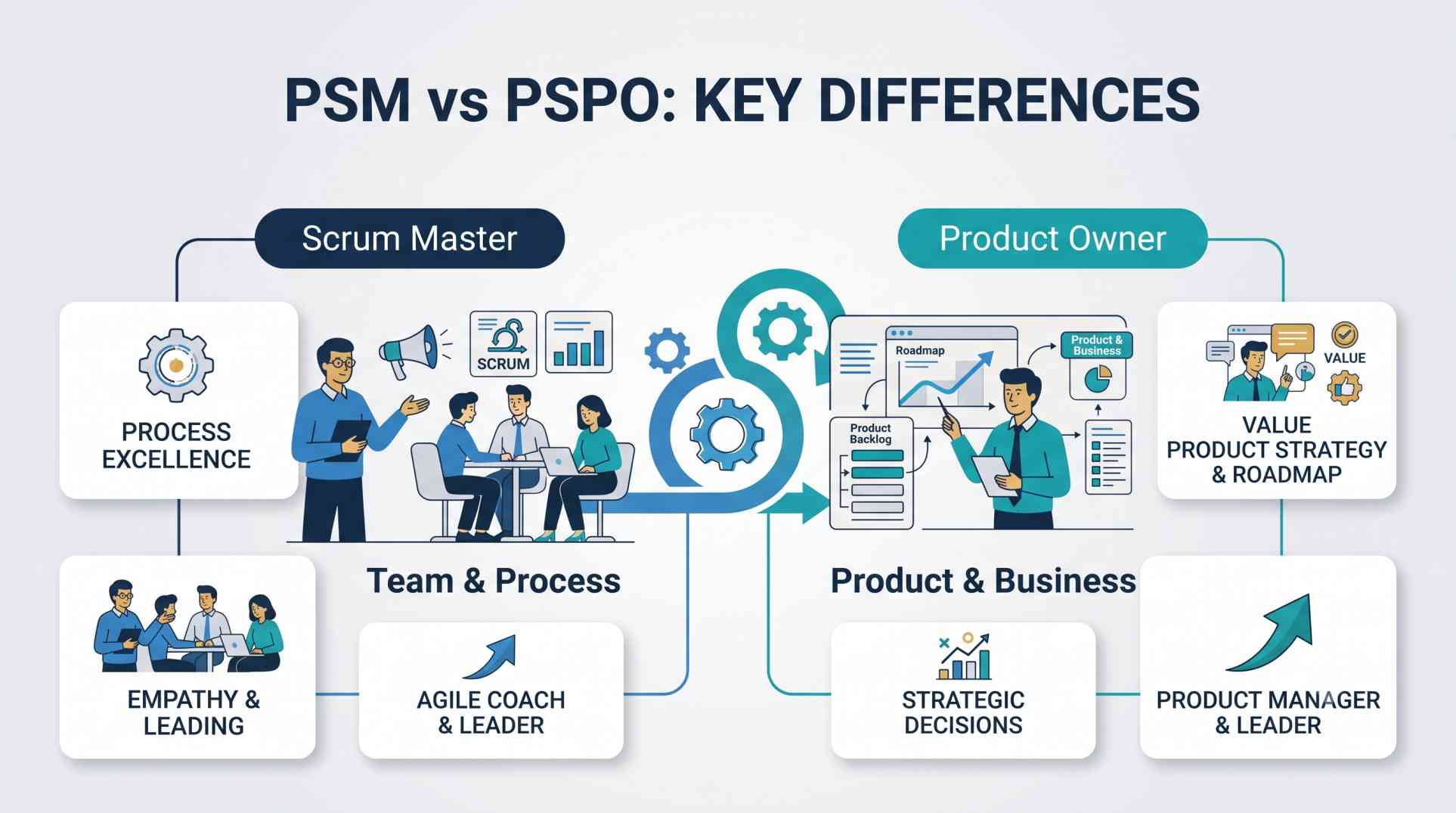
1. Purpose and focus
One of the main differences between PSPO and PSM is the purpose of each certification.
PSM:
- It is focused on Scrum proficiency, teamwork, and the role of Scrum Master.
- Aims to apply Scrum correctly for the whole team.
PSPO:
- It is focused on Product Ownership, maximizing the value, and product decisions.
- Helps professionals to make strategic decisions concerning products.
2. Roles and responsibilities
Responsibilities of such roles differ greatly depending on Scrum context.
PSM:
- Concerned with efficient Scrum implementation.
- Helps the Scrum Team.
- Eliminates impediments that impede team’s effectiveness.
- Facilitates Scrum events and ensures continuous improvement.
PSPO:
- Concerned with product value maximization.
- Is responsible for Product Ownership.
- Manages product backlog.
- Meets stakeholders’ expectations with business objectives.
3. Skills that you’ll learn
PSM and PSPO assist professionals in acquiring different skills.
Through PSM, you are able to learn skills concerning:
- Facilitation
- Coaching
- Servant leadership
- Collaboration
- Conflict management
- Scrum implementation
- Continuous improvement
A PSPO certification would involve learning skills such as:
- Product strategy
- Stakeholder management
- Prioritizing value
- Managing Product Backlog
- Customer knowledge
- Decision making
- Business alignment
4. Target audience
PSM is usually appropriate for professionals wanting to work close to Agile Teams.
This course would be good for:
- Aspiring Scrum Masters
- Agile Professionals
- Project managers
- Delivery professionals
- Team leaders
On the other hand, PSPO would be appropriate for professionals interested in product/business aspects.
This course would be relevant for:
- Aspiring Product Owners
- Product Managers
- Business Analysts
- Product professionals
- Professionals working on product strategy
5. Certification levels
There are various levels of certifications available in both the PSM and PSPO tracks. All these levels show that there is a growing knowledge and awareness of the Scrum process and responsibilities of Scrum Master/Product Owner.
Levels of PSM Certifications
PSM Level I:
This is the first level of PSM certification, and it is meant to validate one’s understanding of the Scrum framework and the duties of a Scrum Master. This is a good choice for novices as well as professionals who wish to gain knowledge about Scrum.
PSM Level II:
It is the second level of certification, and it requires one to understand how to apply the Scrum framework in practical life scenarios. This is meant for those experienced Scrum Masters who wish to showcase their advanced level of expertise in Scrum and teamwork.
PSM Level III:
PSM III is the highest certification in the Professional Scrum Master track. It represents mastery of Scrum practices, skills in handling difficult situations and enabling organizations to enhance their Scrum practices.
PSM exam fee:
| Certification level | Exam fees |
| PSM I | $200 (per attempt) |
| PSM II | $250 (per attempt) |
| PSM III | $500 (per attempt) |
Also Read: What is the Difference Between PSM I and PSM II?
Levels of PSPO Certification
PSPO I:
PSPO I is the basic certification for Product Owners and individuals who wish to be Product Owners. It is based on the knowledge of product value, Product Backlog and the role of a Product Owner.
PSPO II:
PSPO II is the certification for experienced Product Owners. It allows one to learn more about product strategy and delivery of value. It focuses on Product Ownership in complicated business and product scenarios.
PSPO III:
PSPO III is the highest certification in the Professional Scrum Product Owner track. It shows mastery of Product Ownership, creation of value, stakeholder management, etc.
PSPO exam fee:
| Certification level | Exam fees |
| PSPO I | $200 (per attempt) |
| PSPO II | $250 (per attempt) |
| PSPO III | $500 (per attempt) |
6. Examination focus and assessment
One other factor to consider when comparing the two examinations is their areas of focus.
PSM examination focus
- Knowledge of and usage of Scrum
- Accountabilities of a Scrum Master
- Scrum Values
- Team effectiveness
- Agile practices
PSPO examination focus
- Maximizing product value
- Product Ownership
- Product Strategy
- Backlog management
- Stakeholder engagement
Candidates need to verify their assessment criteria every time they register for the test. These include the present format, the study material available and the PSPO exam fee, as certification details can change over time.
7. Career opportunities
The career opportunities available to you post-certification are the other crucial factors in evaluating PSPO vs PSM .
Career Opportunities for PSMs
- Scrum Master
- Agile Coach
- Agile Delivery Manager
- Scrum Consultant
Career Opportunities for PSPOs
- Product Owner
- Product Manager
- Product Strategist
- Business Analyst
Looking to build a successful career in Agile? Explore upGrad KnowledgeHut Agile Management Courses and choose a certification that aligns with your career goals.
PSM vs PSPO: Which one should you choose in 2026?
The decision between PSM and PSPO mostly depends on the professional field you wish to engage in. Even though both certifications will teach you a lot about Scrum, they train you for different things.
Choose PSM if:
- You would like to become a Scrum Master.
- You like coaching and team facilitation.
- You are interested in developing team collaboration skills.
- You like solving problems that arise in teams and promoting their development.
- You seek positions of a Scrum Master or Agile Coach.
- You want to have knowledge of Scrum and Agile practices.
Choose PSPO if:
- You wish to be a Product Owner.
- You have an interest in Product Management.
- You love prioritization and strategic decision-making.
- You are good at working with customers and stakeholders.
- You wish to concentrate on product value maximization.
- You aspire for Product Owner or Product Manager positions.
Choose both PSM and PSPO if:
- Your job includes both delivery and product aspects.
- You need to know more about Scrum methodology.
- You collaborate with both Scrum Masters and Product Owners.
- You are going to take up leadership roles in Agile.
- You would like to know the relation between effective teamwork and product value.
Discover the leading Agile Category Courses
Conclusion
When comparing PSPO vs PSM, the most appropriate option will depend on individual career plans and aspirations. PSM would be more suitable for those wishing to foster teamwork and act as Scrum Masters or Agile Coaches.
PSPO would be more fitting for those with an interest in Product Ownership and strategizing. Both certifications offer valuable Scrum knowledge, and pursuing both can provide a broader understanding of product delivery and Agile practices.
Have A Query? Get in Touch With Our Customer Support | upGrad KnowledgeHut
Frequently Asked Questions (FAQs)
1. What is the main difference between PSM and PSPO?
PSM focuses on Scrum mastery, team effectiveness, and helping teams apply Scrum successfully. PSPO focuses on Product Ownership, product strategy, and maximizing product value. In simple terms, PSM improves how teams work, while PSPO focuses on what teams should build and why.
2. Which is better for beginners, PSM or PSPO?
Neither is universally better for beginners, as the right choice depends on your career goals. PSM is suitable for those interested in Scrum Master and Agile roles, while PSPO is better for aspiring Product Owners and Product Managers. Choose the path that aligns most closely with the type of work you want to do.
3. What is the difference between PSPO vs CSPO?
PSPO is a Scrum.org certification that validates Product Ownership knowledge through an assessment. CSPO certification is offered by Scrum Alliance and follows a different certification and training approach. Both focus on Product Ownership, but their learning requirements, assessment methods, and certification bodies differ.
4. What are the roles of a Scrum Master and Product Owner?
A Scrum Master helps the Scrum Team work effectively by supporting collaboration, removing impediments, and promoting Scrum practices. A Product Owner focuses on maximizing product value by managing priorities and aligning work with business needs. Together, they support effective product delivery from different perspectives
5. What is the difference between PSM I and PSPO I?
PSM I is a foundational certification focused on the Scrum framework and Scrum Master accountabilities. PSPO I focuses on foundational Product Ownership knowledge, including product value and Product Backlog management. Both assess Scrum knowledge but apply it to different responsibilities.
6. How many questions are there in the PSM and PSPO exams, and what is the passing score?
Both PSM I and PSPO I assessments include 80 questions to be completed within 60 minutes, with question types such as multiple choice, multiple answer, and true or false. Candidates must score at least 85% to pass, but the exam focus differs based on Scrum Master and Product Owner responsibilities.
7. Does PSM certification expire?
No, PSM certifications from Scrum.org do not expire and do not require renewal fees. Once you pass the assessment, the certification remains valid for life. However, continuing to update your Scrum knowledge is important as professional practices evolve.
8. Does PSPO certification expire?
No, PSPO certifications from Scrum.org also do not expire and have no renewal requirements. Professionals can retain their certification after successfully passing the assessment. However, ongoing learning and practical experience remain important for effective Product Ownership.
9. How difficult are the PSM and PSPO exams?
The difficulty of PSM and PSPO depends largely on your Scrum knowledge and professional background. PSM may feel more familiar to those with Agile team experience, while PSPO may suit professionals with product or business experience. Both require a strong understanding of Scrum concepts rather than simple memorization.
10. Does PSM or PSPO have better career opportunities?
Both certifications can support strong career opportunities, but they lead to different professional paths. PSM aligns with roles such as Scrum Master and Agile Coach, while PSPO supports Product Owner and Product Management careers. The better option depends on your skills, interests, and long-term career goals.
1639 articles published
KnowledgeHut is an outcome-focused global ed-tech company. We help organizations and professionals unlock excellence through skills development. We offer training solutions under the people and proces...
Get Free Consultation
By submitting, I accept the T&C and
Privacy Policy
Ready to learn about Agile Certifications Roadmap?