
Agile Coach vs Scrum Master: Detailed Comparison 2026
Updated on Sep 05, 2026 | 12 min read | 16K+ views
Share:
Table of Contents
View all
- What is the difference between an Agile Coach and Scrum Master?
- What does an Agile Coach do?
- What does a Scrum Master do?
- Agile Coach vs Scrum Master: A detailed comparison
- What are the similarities between an Agile Coach and Scrum Master?
- Agile Coach vs Scrum Master: Skills and certifications
- Agile Coach vs Scrum Master: Which role should you choose?
- Conclusion
Quick Overview
- Agile Coach vs Scrum Master: An Agile Coach typically works across multiple teams and the organization, while a Scrum Master primarily focuses on helping a Scrum Team use Scrum effectively.
- Agile Coaches address broader Agile adoption, leadership, and systemic issues; Scrum Masters focus on team effectiveness, impediments, and continuous improvement.
- Scrum Masters need strong Scrum, facilitation, coaching, and communication skills, while Agile Coaches also need systems thinking, leadership coaching, and change management skills.
- Scrum Master is often a practical starting point for Agile professionals, while Agile Coach generally suits professionals with broader Agile and coaching experience.
- This guide covers the differences in scope, responsibilities, influence, frameworks, skills, certifications, similarities, and career suitability.
Ready to build your Scrum expertise? Explore upGrad KnowledgeHut Certified Scrum Master (CSM) Certification Training and develop the practical skills needed to step into a Scrum Master role.
Master the Right Skills & Boost Your Career
Avail your free 1:1 mentorship session
What is the difference between an Agile Coach and Scrum Master?
The table below presents the difference between an Agile Coach and a Scrum Master based on scope, focus, framework and many more.
| Factor | Agile Coach | Scrum Master |
| Primary scope | Multiple team or the entire organization | Generally one scrum team |
| Main focus | Wider Agile adoption and organizational improvements | Effective use of Scrum and team improvement |
| Framework | Works in the context of different Agile methodologies like Scrum, Kanban, etc. | Primarily Scrum |
| Stakeholders | Teams, management, leaders, and departments | Scrum team, product owner, and relevant stakeholders |
| Time perspective | Long-term development of Agile capabilities and change | Continuous team-level improvement and effective delivery |
| Coaching Approach | Coaches teams, leaders, managers, and organization | Mainly coaches the Scrum team |
| Typical impact | Helps organizations become more agile | Increase effectiveness of the Scrum team |
| Career stage | Often more experienced or specialized | Common entry or mid-level Agile role |
What does an Agile Coach do?
An Agile Coach works at a wider level than a Scrum Master. It helps individuals, leaders, and organisations improve the way they work by using Agile principles and practices.
Key responsibilities of an Agile Coach
The role of an Agile includes the following responsibilities:
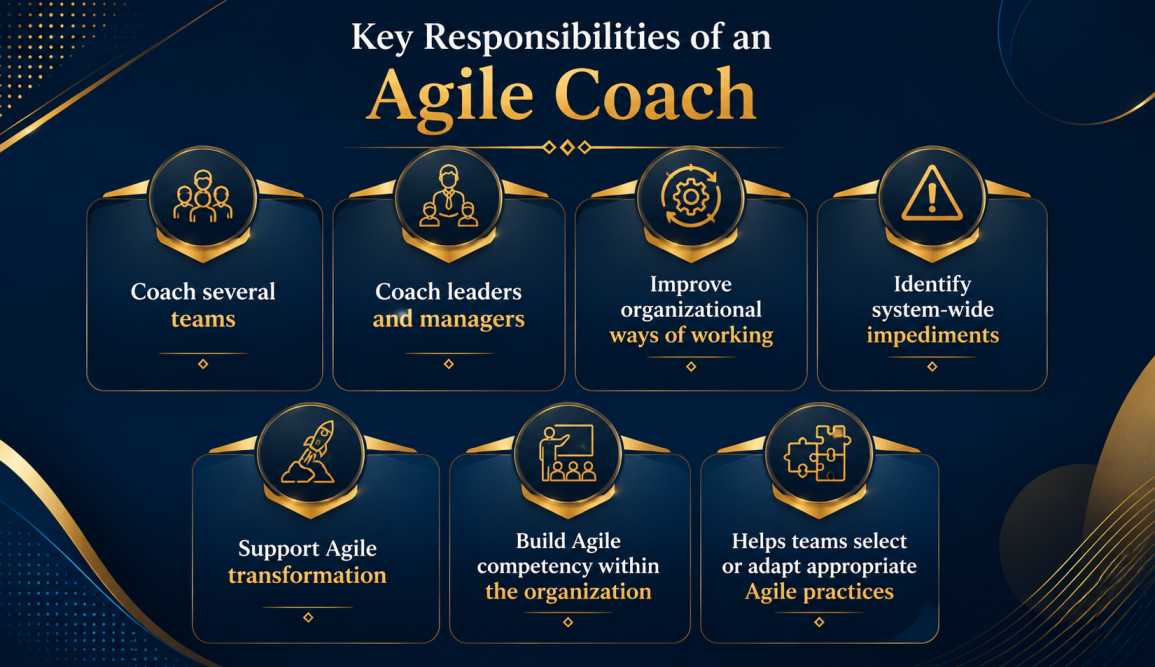
Coach several teams
Its main responsibility is to coach several teams at the same time. It also helps each team adopt Agile methodology according to their needs.
Coach leaders and managers
As Agile change leads to changes in leadership behaviour, an Agile coach helps managers and leaders to understand Agile principles, improve decision-making, and create an environment for teams where they can work efficiently.
Improve organizational ways of working
An Agile Coach not only focuses on practices at the team level but also evaluates organizational processes and suggests improvements so that the team can improve their effectiveness.
Identify system-wide impediments
Agile Coach helps in discovering and solving challenges such as outdated policies or unclear reporting lines, that cannot be solved by the team itself.
Support Agile transformation
An Agile coach supports and designs step-by-step transition of the organization from traditional methods to Agile methodologies. This includes evaluation of the existing way of working, transition process, etc.
Build Agile competency within the organization
An Agile Coach is responsible for building Agile competency inside the organization by providing training and mentoring programs for the teams.
Helps teams select or adapt appropriate Agile practices
An Agile Coach is responsible for helping teams to choose Agile practices that are best suited for the team from Scrum, Kanban, or any other Agile framework, because all teams may not fit into Scrum properly.
Also Read: How to become Agile Coach: Step-by-step Guide for 2026
What does a Scrum Master do?
It acts as a facilitator and coach for the Scrum team, which helps teams improve continuously and deliver value to the organization. A Scrum Master facilitates the proper adoption of Scrum practices which helps the team to work efficiently.
Also Read: What is SAFe Advanced Scrum Master?
Key responsibilities of a Scrum Master
The role of a Scrum Master includes the following responsibilities:
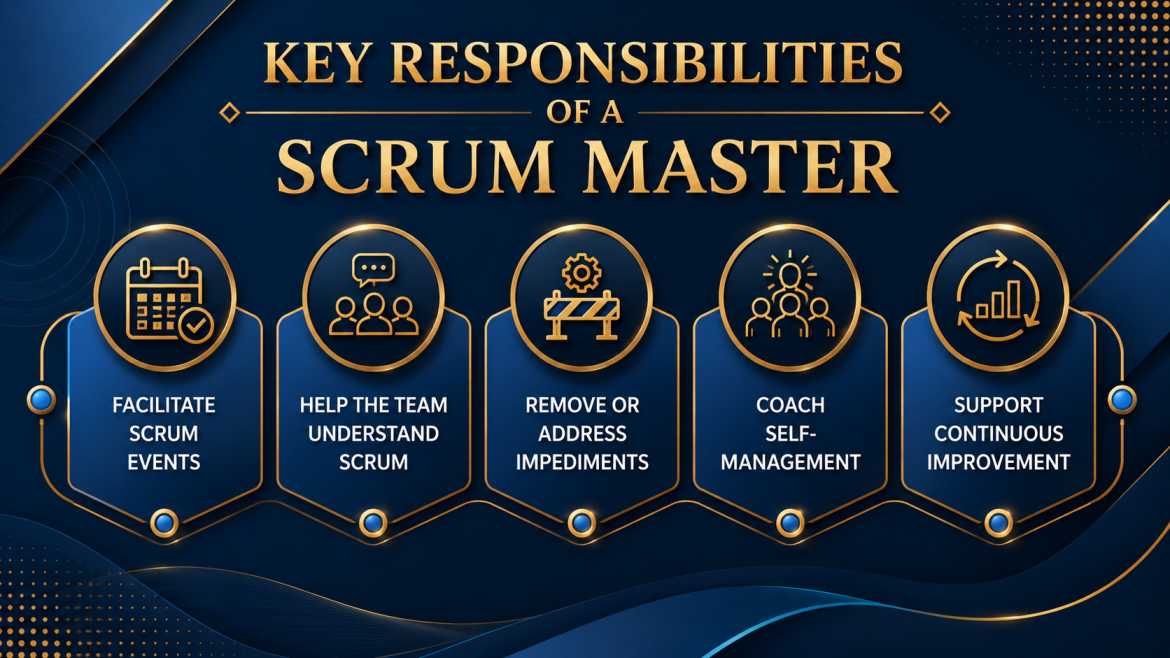
Facilitation of Scrum events
The Scrum Master is responsible for organising Scrum events such as sprint planning, daily scrum or stand-ups, sprint reviews, and sprint retrospectives effectively.
Helping the team understand Scrum
Scrum Masters help team members, product owners, and relevant stakeholders understand Scrum principles and their practical implementation.
Removing or addressing impediments
Scrum Masters help the teams deal with some technical, organizational, communicational, or procedural impediments. They also help the teams to connect with the right people when the issue cannot be handled within the team.
Coaching self-management
The Scrum Master is responsible for encouraging the team to be self-managing in planning their tasks, finding solutions together, and being responsible for results rather than waiting for orders.
Supporting continuous improvement
With the use of retrospective meetings and daily discussions, the Scrum Master can help the team identify areas of improvement and areas that work for the team.
Also Read: Roles of Scrum Master
Agile Coach vs Scrum Master: A detailed comparison
Below is a detailed comparison of Agile Coach vs Scrum Master across key areas.
Scope of work
An Agile Coach works on multiple teams or on the whole department level, thereby making the scope of work of an Agile Coach very broad compared to that of a Scrum Master.
The role of a Scrum Master is generally limited to one team. He focuses on the sprint objectives and tasks of his team alone. Scope of work becomes one of the most distinct differences when comparing Scrum Master vs Agile Coach.
Also Read: Agile Coach Jobs
Level of influence
While a Scrum Master generally influences decision making at team level, for example how a team conducts its sprints, an Agile Coach may influence the decision making at the leadership level.
Framework expertise
An Agile Coach is mostly agnostic of any framework and is comfortable with frameworks like Scrum, Kanban, SAFe etc.
A Scrum Master is an expert at Scrum framework and has knowledge of the events, roles and artifacts of Scrum.
Primary problem solved
An Agile Coach deals with solving issues which are affecting the performance of several teams in the company or even the company as a whole, such as lack of communication between departments and resistance to change.
The Scrum Master deals with solving issues which are affecting the performance of one team only, such as lack of clarity about the tasks and blockers.
Stakeholders
The broader stakeholder base is among the major elements of the Agile Coach vs Scrum Master comparison.
Agile Coach interacts with a broader audience, including senior management, department managers and multiple Product Owners from different teams.
The Scrum Master's interactions are limited to the Scrum Team and Product Owner.
Approach to coaching
The Agile Coach coaches people on a team, leadership and organization level; besides, an Agile Coach mentors other Scrum Masters.
The Scrum Master coaches people on a team level, paying attention to daily activities and Scrum practices.
Timeframe
While an Agile Coach focuses on long-term changes, which may take months or even years to take effect, a Scrum Master focuses on short sprints and short cycles.
Experience expectations
An Agile Coach role usually expects more years of Agile experience, since it involves guiding other Agile practitioners and senior stakeholders.
A Scrum Master role is often suitable for professionals early or midway through their Agile career.
Build the skills to succeed in Agile roles with upGrad KnowledgeHut Agile Management Courses, designed to help you apply Agile practices confidently in the workplace.
What are the similarities between an Agile Coach and Scrum Master?
When comparing an Agile Coach to a Scrum Master, it is easy to find many points which differ in these two positions. Nevertheless, there are also common points which make them similar.
Agile values
Both these professions base their work on Agile values like cooperation, openness, adaptability, and continuous value delivery. No matter how many teams a person works with, both these positions are meant for implementing Agile ideas.
Coaching practices
Both these professions require using coaching techniques, such as asking deep questions, provoking self-reflection and helping a person to discover himself, not just instructing him.
Mutual goal of continuous improvement
Both these roles are designed to make people work more effectively through time. Retrospectives, feedback sessions, and experiments are the typical methods utilized by both an Agile Coach and a Scrum Master.
Also Read: Is Scrum Master Course Worth It in 2026?
Agile Coach vs Scrum Master: Skills and certifications
The requirement of effective interpersonal skills is common to both roles, but the organization-related skills required by Agile Coaches are more extensive.
Key skills for an Agile Coach
The most common skills required from Agile Coaches include the following:
- Organization coaching
- Leadership coaching
- Change management
- Systems thinking
- Strategic facilitation
- Transformational expertise
- Collaboration among multiple teams
Also Read: Top 10 Agile Coach Skills
Key skills for a Scrum Master
The important skills that Scrum Masters should possess include the following:
- Scrum
- Facilitation
- Conflict resolution
- Communication
- Coaching
- Servant leadership
- Team development
Also Read: Top 15 Scrum Master Skills
Popular Agile Coach certifications
The following certifications for Agile Coaches exist:
- ICAgile Certified Coach (ICP ACC)
- CAL (Certified Agile Leadership)
- SAFe Agilist certification
Common Scrum Master certifications
The following are popular Scrum Master certifications:
- Certified Scrum Master (CSM)
- Professional Scrum Master (PSM)
- SAFe Scrum Master
Also Read: Top Scrum Master Certification
Agile Coach vs Scrum Master: Which role should you choose?
This depends on your objectives, interests, and experience level.
Choose an Agile Coach if:
An Agile Coach job can be right for you if you:
- Appreciate cross-functional work with teams
- Wish to contribute to organizational changes
- Are ready to coach leaders and executives
- Have considerable Agile experience
- Are interested in Agile transformations
Also Read: Agile Coach Salary
Choose a Scrum Master if:
A Scrum Master job can be more attractive if you:
- Appreciate close work with a team
- Want to specialize in Scrum
- Are interested in facilitating Agile ceremonies
- Are just starting in Agile
- Wish to engage in improving teams directly
Also Read: Career Benefits of Scrum Master Certification in 2026
Conclusion
Agile Coach vs Scrum Master differs mainly in scope, focus, and level of influence. A Scrum Master focuses on improving one Scrum team, while an Agile Coach supports multiple teams and broader organizational change.
Choose a Scrum Master role if you prefer team-focused work, or an Agile Coach role if you want to drive wider Agile transformation. Both roles offer strong opportunities to build a career in Agile.
Have A Query? Get in Touch With Our Customer Support | upGrad KnowledgeHut
Frequently Asked Questions (FAQs)
What is the main difference between Agile Coach and Scrum Master?
The main difference is the scope of their work. A Scrum Master primarily focuses on helping a Scrum Team work effectively, while an Agile Coach often supports multiple teams and leaders. Agile Coaches generally work on broader organizational improvement.
What does a Scrum Master do daily?
A Scrum Master helps the team resolve impediments, improve collaboration, and follow Scrum practices effectively. They facilitate discussions and support self-management rather than assigning tasks. Their daily work depends on the team's challenges and needs.
What does an Agile Coach do?
An Agile Coach helps teams, leaders, and organizations improve their Agile ways of working. They identify larger challenges, coach people across different levels, and support continuous improvement. Their work often extends beyond a single team or framework.
When does an organization need a Scrum Master?
An organization may need a Scrum Master when a team is adopting or using Scrum and requires guidance. The Scrum Master helps improve team collaboration, address impediments, and ensure effective use of Scrum. They are particularly valuable when teams are still developing Agile practices.
When does an organization need an Agile Coach?
An organization may need an Agile Coach when multiple teams face common challenges or broader changes are required. Agile Coaches help address organizational barriers, leadership practices, and cross-team dependencies. They are especially useful during large-scale Agile adoption or transformation.
What is the role of an Agile Coach in an Agile transformation?
An Agile Coach helps guide the transition from traditional ways of working toward Agile practices. They work with teams and leaders to identify challenges, introduce suitable practices, and encourage behavioral change. Their focus is on building long-term Agile capability across the organization.
What is the difference between Agile Coach and Scrum Master skills?
Both roles require communication, coaching, facilitation, and problem-solving skills. Scrum Masters need deep knowledge of Scrum and team dynamics, while Agile Coaches typically need broader organizational and leadership coaching skills. Agile Coaches may also require experience with multiple Agile frameworks.
How do I become an Agile Coach after Scrum Master?
Start by gaining experience beyond a single Scrum Team and developing stronger coaching skills. Learn about different Agile frameworks, systems thinking, leadership, and organizational change. Working with multiple teams and mentoring other Agile practitioners can also prepare you for the transition.
Is an Agile Coach higher than a Scrum Master?
An Agile Coach is often considered a more experienced role because it can involve working across multiple teams and leadership levels. However, this does not mean an Agile Coach is always hierarchically above a Scrum Master. The structure and responsibilities vary between organizations.
Are Agile Coach and Scrum Master the same?
No, they are not exactly the same, although their responsibilities can overlap. Both coach teams and promote continuous improvement, but their scope and focus usually differ. A Scrum Master focuses more on Scrum effectiveness, while an Agile Coach typically supports broader Agile improvement.
1639 articles published
KnowledgeHut is an outcome-focused global ed-tech company. We help organizations and professionals unlock excellence through skills development. We offer training solutions under the people and proces...
Get Free Consultation
By submitting, I accept the T&C and
Privacy Policy
Ready to learn about Agile Certifications Roadmap?