
- Home
- Blog
- Project Management
- How Hard Is the PMP Exam and How to Crack It?
How Hard Is the PMP Exam and How to Crack It?
Updated on Apr 24, 2026 | 10 min read | 21.69K+ views
Share:
Table of Contents
View all
- How Hard Is the PMP Certification Exam?
- Why Is the PMP Exam Difficult?
- Is it Difficult to Get the PMP Certification?
- What Makes the PMP Exam Difficult?
- What Materials Need to be Covered?
- Complexity of Exam Structure
- Difficulty of Questions
- PMP Exam Format
- What Is the PMP Pass-Failure Rate?
- How Long Would It Take to Prepare PMP Exam?
- How to Pass New PMP Exam 2024/25?
- Conclusion
The PMP exam is known to be quite demanding, especially for first time test takers, as it focuses more on real world application than simple theory. It includes a large set of scenario based questions that test your understanding of Agile, Hybrid, and Predictive approaches, with a strong emphasis on Agile practices. Instead of memorizing concepts, success in PMP exam preparation comes from truly understanding how to apply them in different situations. Many candidates rely on mock tests, practice scenarios, and structured learning to build confidence. With proper Project Management trainings like PMP, candidates must clear the PMP exam to earn the elite PMP title, making consistent preparation and hands on learning essential for success.
Get to know more about Project Description.
Ultimate PMP Formula Cheat Sheet
Get a quick, exam-ready PMP cheat sheet with all essential formulas and key concepts in one place.
How Hard Is the PMP Certification Exam?
The PMP Certification exam is difficult. It is designed to test your knowledge across the breadth of project management concepts and practices. If you are not prepared for the level of questions you would face in the exam you would find it hard to score well. Getting familiar with the PMP exam format is also essential apart from mastering the concepts and practices surrounding project management.
Why Is the PMP Exam Difficult?
The PMP Certification is a validation of the skills and ability of its holder. To maintain credibility for this certification, PMI ensures that only those professionals who have experience in project management and have an excellent understanding of project management concepts are awarded the PMP certification.
PMP does not publish the required percentage to pass the PMP exam. The percentage required to pass the exam is based on the difficulty level of that individual exam. So, you could pass even if you score below what you target and pass, or you could score high and still fail to meet the passing percentage.
Get to know more about characteristics of Project Management.
Is it Difficult to Get the PMP Certification?
The PMP Certification is undoubtedly a step in the right direction if you want to build a career in project management. The first step is to check if you meet the PMP eligibility criteria. You need at least an associate degree, high school diploma, or an equivalent qualification, you will also need to have at least three years of experience in a project leadership role. You will also need to attend 35 hours of trainer-led PMP training. If you hold a valid CAPM certification, the training is optional.
Once you have met all the eligibility criteria, you will still need to take the PMP exam and clear it. So, how hard is the PMP exam? The short answer is it is hard enough to require serious preparation that could take a few months. So, if you are well prepared and have practiced taking mock exams, then the PMP exam will not be hard for you.
If you are not well prepared and you are not familiar with all the contents included in the syllabus, you will find it hard to clear the PMP Exam.
Know more about importance of Project Charter.
What Makes the PMP Exam Difficult?
The material that you need to prepare for PMP is comprehensive and in depth. Hence it requires a significant amount of time and effort to prepare for the exam in a reasonable manner. If your preparation is not complete, you will find it hard to pass the exam.
The syllabus is based on Exam Content Outline that includes ‘A Guide to the Project Management Body of Knowledge (PMBOK ® Guide)’ which is published by PMI as a reference. This publication covers ten knowledge areas in project management apart from different methods, tools, models, and content related to how you could implement learning in live projects.
The PMP Exam need not have questions only based on the guide, there could be questions from any project management-related area. By enrolling in a top PMP Bootcamps can provide you with valuable resources, expert guidance, and focused training to enhance your chances of success
What Materials Need to be Covered?
Preparing for the PMP exam requires a thorough understanding of a broad range of topics in project management. One of the most essential resources is the PMBOK® Guide (Project Management Body of Knowledge), which is currently in its seventh edition. This comprehensive 370-page guide is a key reference published by PMI (Project Management Institute) and is divided into four primary sections.
The first section provides an overview and foundational understanding of project management principles and concepts, establishing the context for the rest of the guide. The second section dives into the eight project performance domains—such as stakeholders, team, development approach and life cycle, and project work—each of which plays a vital role in the effective delivery of projects. These domains are less about rigid processes and more focused on performance outcomes and value delivery.
The third section is particularly important for modern project environments as it focuses on tailoring and adapting project management practices to suit different types of projects. Since no two projects are the same, this section teaches you how to customize your approach based on project size, complexity, industry, and other contextual factors. The fourth section introduces various models, methods, and artifacts—tools and techniques that support the domains and guide project decision-making.
Additionally, the appendices and glossary are valuable for quick reference and deeper insights. The appendix includes helpful summaries, frameworks, and expanded definitions that provide clarity on key concepts. It also links PMBOK content with real-world application, making it easier to relate theory to practice.
However, relying solely on the PMBOK Guide may not be enough. Successful PMP candidates typically supplement their studies with a variety of other learning resources. These include textbooks, reference books by PMP-certified authors, industry articles, case studies, and blogs that interpret PMBOK concepts through practical examples. Online forums, study groups, and YouTube tutorials also serve as excellent tools to gain additional perspectives.
A structured training program, like the one offered by KnowledgeHut, enhances preparation by offering mock exams, quizzes, and scenario-based practice questions. These tools help learners gauge their understanding, identify weak areas, and build exam-taking confidence. Given the breadth and depth of knowledge required, the PMP exam is widely regarded as challenging—but with the right resources, consistent effort, and a strategic study plan, it is definitely achievable.
Complexity of Exam Structure
The PMP Exam is nearly four hours long or 230 minutes to be exact. In this timeframe you will be expected to answer 180 questions. If you are taking the exam from a Centre, you will not get a chance to take a break.
PMI also allows you to take the PMP Exam online. In the online format, you are allowed to take two breaks of ten minutes each. The total time without including the break time to finish the exam would be 230 minutes.
There is an optional tutorial before the exam starts and an optional survey once you complete the exam.
There are three broad categories under which the questions will be based on. People, process, and business environment.
PMP covers project management under three different approaches: Predictive (Waterfall), Agile, and Hybrid.
Difficulty of Questions
The difficulty of the PMP Exam will depend on the level of preparation you have done. Your project related experience and understanding of concepts will decide how difficult the exam will be for you. The actual difficulty of the exam can also vary a bit with the individual exam. You can expect a PMP Exam to comprehensively test your understanding of concepts, practices and tools used in project management.
The good news is that if you are well prepared and your exam is difficult you may still clear it because PMI decides the percentage required to pass an exam based on its difficulty level.
PMP Simulation Exams, mock tests, and PMP practice tests will help you get an idea of how to manage your time and make sure that you are ready for the actual exam.
Engage with the top trending KnowledgeHut's Project Management Courses:
PMP Exam Format
PMP Exam format includes multiple choices, multiple responses, and a few fill-in-the-blank questions. There are two new formats of questions introduced matching, and hotspot.
PMI has also provided examples of the new formats.
Matching question:
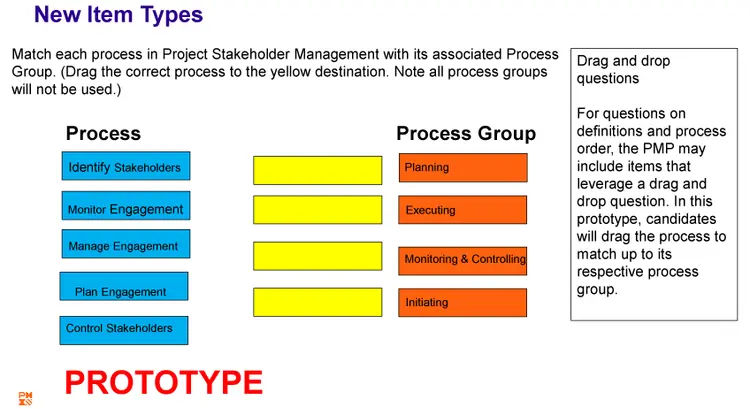
pmi
Hot spot question:
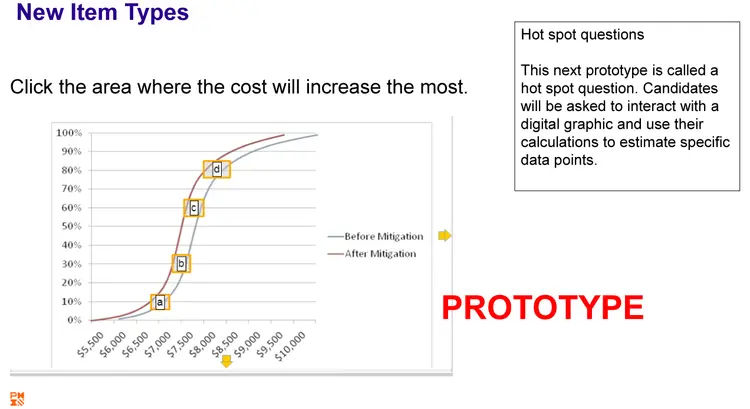
pmi
Out of the three domains people, process, and business environment, 50% of the questions would be based on the process domain, 42% on the people domain and the remaining 8% on the business environment. You can find the detailed document on the PMP Exam content outline on the PMI page. There is also classification based on the approach. Half of the questions will be based on the predictive approach and the other half will focus on Agile or hybrid approaches.
What Is the PMP Pass-Failure Rate?
The answer to this question is rather subjective as there isn’t a rate of success and failure in the PMP Exam. PMI does not publish data regarding how many candidates succeed or fail. Though, secondary sources estimate the rate of failure to be around 50%. The exam needs thorough preparation and taking mock tests would help in preparing yourself for the actual exam.
Top Cities where KnowledgeHut Conduct PMP Certification Training Course Online
Boost your team's productivity with Agile Methodology training. Discover the game-changing methodology now.
How Long Would It Take to Prepare PMP Exam?
To comprehensively prepare for a PMP Exam you need consistent preparation for a few months. The syllabus is comprehensive and requires an extensive preparation. It would help if you made a schedule and stick to it to ensure that you spend enough time on every topic that is to be covered. Apart from the lack of preparation, lack of familiarity with the exam format may also lead to an unfavorable result. You should try to take a mock test and practice answering questions in the PMP exam format to make sure that you are ready for the exam.
How to Pass New PMP Exam 2024/25?
How hard is it to pass the PMP exam? PMI recommends a 5-step process to follow to make sure you get PMP certified in your first attempt.
- Create a schedule for preparation: Having dedicated time to prepare for your exam could be important in ensuring that you stay on course in terms of covering all the topics. Let others in your life know about it so that they do not disturb or distract you during this time. You can even see if you can take permission from your employer to prepare for the exam.
- Get used to the format: Take time to familiarize yourself with the format of the PMP exam. There are a few new question formats as well that could surprise you in the exam if you aren’t prepared for it.
- Rely on professionals: Connect with your local PMI chapter for guidance and help with preparing for the exam. You may also find a group that you could study and practice with. Make sure that you are trained by an Authorized Training Partner of PMI. Rely on the training partner and see if you can get support for practice tests.
- Other resources: Apart from the PMBOK Guide you would need to rely on other books to get a thorough understanding of project management concepts. You can refer to a variety of PMP PPTs provided by PMI, and a few popular textbooks that will help in your exam prep.
- Online resources: Apart from PMI Chapters you can also find groups where you could get help online. PMI LinkedIn Page and groups where you could clarify your doubts. PMI Blog discusses plenty of project management topics.
Conclusion
The PMP Exam has a reputation of being difficult. That only means that it shouldn’t be taken lightly. Once you have ensured that the preparation is completed as per the schedule, and you have had enough practice with the format you could pass the exam in your first attempt. There is a large range of resources you have at your disposal to make sure that your preparation is complete. You can also rely on the experience and expertise of other project managers who have been certified.
Once you clear the exam and become PMP certified you can add on to your credentials by attempting to do a certification like PgMP®, PfMP®, PMI-ACP® etc. to maintain your credential and build on your current skillset. We hope this article answers your query about how hard is the PMP test and how you can pass the PMP exam.
Contact our upGrad KnowledgeHut experts for personalized guidance on choosing the right course, career path, and certification to achieve your goals.
Frequently Asked Questions (FAQs)
How difficult is the PMP certification exam for beginners?
The PMP exam can be quite challenging for beginners because it requires both theoretical knowledge and practical understanding of project management. Without prior exposure to concepts or frameworks, candidates may struggle initially. However, with structured learning and consistent practice, even beginners can clear it successfully.
Why is the PMP exam considered tough?
The exam is designed to test real world project management scenarios rather than just theory. It evaluates decision making, situational judgment, and application of concepts across predictive, agile, and hybrid approaches. This makes it more complex than standard certification exams.
What makes the PMP exam harder than other certifications?
Unlike many exams that focus on memorization, PMP emphasizes application based questions. It covers a wide syllabus including people, process, and business environment domains. The inclusion of agile and hybrid methodologies also adds to its complexity.
4. Is 70% enough to pass PMP?
Yes, many candidates pass on their first attempt with proper preparation. Success depends on understanding concepts deeply, practicing mock exams, and managing time effectively. A strategic study plan increases your chances significantly.
What is the format of the PMP exam?
The PMP exam consists of 180 questions to be completed in about 230 minutes. It includes multiple choice, multiple response, matching, and hotspot questions. The exam tests knowledge across predictive, agile, and hybrid project management approaches.
Do I need to study only the PMBOK Guide to pass the PMP exam?
No, relying solely on the PMBOK Guide is not enough. While it is a core reference, candidates should also use additional resources like practice tests, study guides, and real-world case studies. These help in better understanding and application.
How important are mock tests for PMP preparation?
Mock tests are extremely important as they simulate the actual exam environment. They help improve time management, identify weak areas, and build confidence. Regular practice can significantly increase your chances of passing.
Is time management important during the PMP exam?
Time management is critical because you need to answer 180 questions within a limited timeframe. Practicing timed mock tests helps you pace yourself and avoid spending too much time on difficult questions.
What are the three domains covered in the PMP exam?
The exam focuses on three domains: people, process, and business environment. These domains evaluate your leadership skills, technical project management knowledge, and ability to align projects with organizational goals.
What happens if I fail the PMP exam?
If you fail the PMP exam, you can retake it after paying the reexamination fee. PMI allows multiple attempts within a year, giving candidates enough opportunity to improve and succeed.
454 articles published
Kevin D. Davis is a seasoned and results-driven Program/Project Management Professional with a Master's Certificate in Advanced Project Management. With expertise in leading multi-million dollar proje...
Get Free Consultation
By submitting, I accept the T&C and
Privacy Policy