
What is the Cycle Time Formula? Calculations & Example
Updated on Dec 09, 2024 | 8 min read | 3.75K+ views
Share:
Table of Contents
View all
The cycle time is the measure of productivity in business processes and is mostly applied in manufacturing, IT, and service sector companies. The average cycle time quantifies the time it takes for a process to go through one complete cycle from inception to conclusion. It is crucial for an organization to understand this concept and strategize ways to reduce their cycle time with the aim of conforming to their customers’ expectations. By simply working on reducing the cycle time, the organization can address the bottlenecks, increase productivity, and achieve a set production cycle.
In this article, we will help you identify what cycle time is, the formula for cycle time, and how to calculate it. We will also discuss the advantages of Cycle time analysis and its relationship to other similar concepts as lead time.
Master Right Skills & Boost Your Career
Avail your free 1:1 mentorship session
What is Cycle Time?
Cycle time refers to the time required to manufacture a product or to finish any process right from beginning to end. It includes the period where the work is going on and where there is no work happening throughout the flow of the process. You can rightfully say it is a measure of operational productivity, which allows organizations to track how fast it takes them to satisfy customer needs or deliver on expected production targets.
For example, in the manufacturing unit, the cycle time may cover the time taken to assemble a single unit of a particular product. In software development, it could measure the time that is taken in the development and delivery of a feature. Moreover, the cycle time calculator allows you to identify process wastage to increase organizational efficiency.
What is an Effective Cycle Time?
Optimal cycle time is the benchmark that every process or a particular task on the assembly line should take. It stands for the minimum amount of time for which a system is capable of functioning to its full potential with reference to restrictions such as the acquisition of resources or the capability to manufacture a particular amount of product.
Optimization of the cycle time sometimes requires the elimination of elements like idle time, duplication, and time-wasting processes. For example, companies can guarantee quality and boost productivity if they attain an effective cycle time in production and treat it as a benchmark for the entire production.
Source: machinemetrics
What is a Cycle Time Formula?
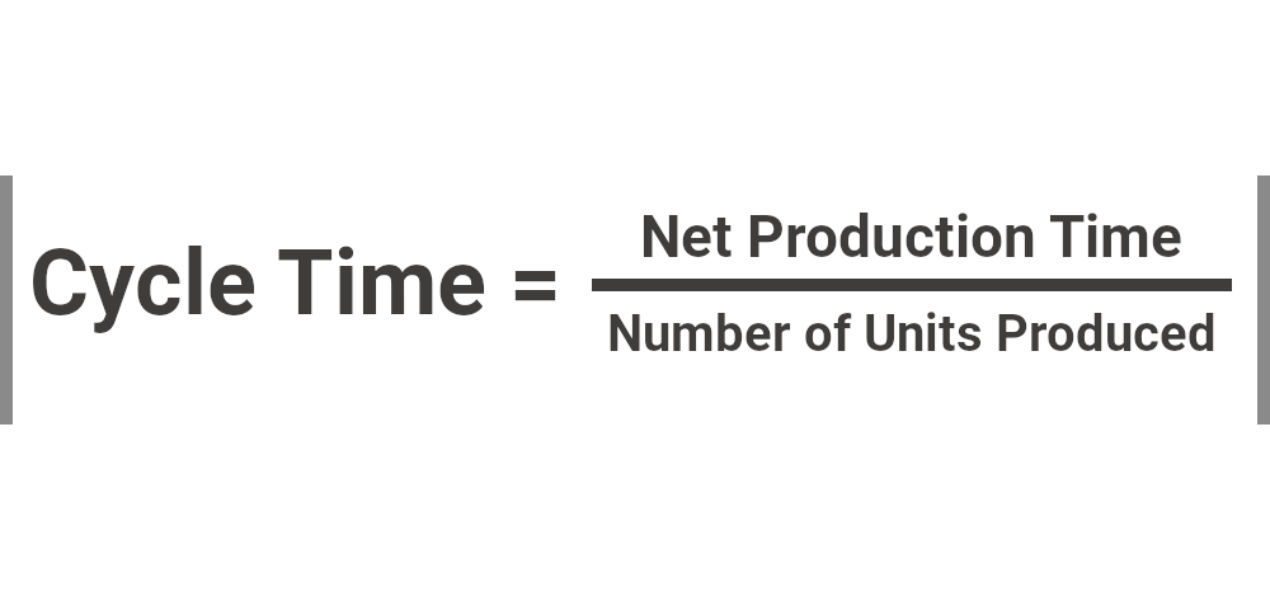
Cycle time calculator formula:
Cycle Time = Total Time Taken on the Processing of the Units / Number of Units Affect
By simply putting the values in this formula, you can get the average cycle time. For instance, if a production line completes 100 units in 8 hours, the cycle time per unit is:
Total working hours = 8 hours
Number of units = 100
Subtotal allocations = 480 units per minute
Number of units per minute = 8 hours ÷ 100 = 4,8minutes
This formula enables strategists and planners in an organization to evaluate its operational time. It also helps them compare performances and do proper capacity planning. It is significant to note here that for accurate cycle time calculations, you should have reliable data, and documentation is essential for actionable insights.
Who Calculates Cycle Time?
The purpose of cycle time calculation is to understand how much time each production stage is taking. Hence, it is the people who are responsible for monitoring the workflow efficiency who calculate it. In any organization, it is the process managers, production supervisors, or operational analysts who work on calculating the cycle time.
In manufacturing units, cycle time is used by the production managers to evaluate the efficiency of equipment and workforce. In the same manner, in software development, project managers track the cycle time for fixing the bugs. Furthermore, the cycle time is also important for service-oriented businesses such as logistics whereby the various shipments ‘need to be got to their destinations within the right time.
Benefits of Calculating Cycle Time
Let us dig deeper and discuss the enormous perks of calculating cycle time for different industries.
Improved Productivity
It helps identify the areas where there is a scope for change. By simply eliminating those inefficiencies, you can get faster output and improved productivity levels.
Better Resource Allocation
It helps minimize waste and puts an end to overproduction. Hence, it is an effective way to align workforce and equipment usage, improving the resource allocation process many folds.
Higher Customer Satisfaction
Fixed and optimum cycle time ensures uniformity in the product quality, and the best part is that it allows the organization to meet deadlines conveniently. Both these factors attract more customers by increasing their satisfaction levels.
Helps In Decision Making
Cycle time provides actionable insights into production efficiency. Using this data, the production managers can build data-driven strategies that facilitate company growth.
Foster Continuous Improvement
When a company tracks its cycle time more frequently, it can track any big or small change in the performance over time. Thus, it is one of the best ways to foster continuous improvement.
How do You Calculate Cycle Time?
We have discussed the significance and benefits of cycle time. Now, let's move on to discuss how to calculate cycle time. Here's a step-by-step approach that you can follow to get accurate data.
Step 1: Select the production cycle or a workflow that you wish to track for the time it takes.
Step 2: Measure the total time that goes into this process, including the working hours and idle time.
Step 3: Measure the units completed or the tasks done during this time frame that you measured in the above step.
Step 4: Use the cycle time formula, and you will have the value you are looking for!
Note: Make sure all the inputs you measured are accurate and true to your knowledge to get the right cycle time.
Example of Calculating Cycle Time
Let us take a real-life example of a chair manufacturing factory to better understand the calculation of cycle time. Imagine that the factory produces 240 chairs in a day with 8 working hours. Now, the cycle time will be:
Total Time: 8 hours = 480 minutes.
Output: 240 pens
Cycle Time Formula:
Cycle Time = Total Time / Output
Cycle Time = 480 minutes ÷ 240 pens = 2 minutes per chair.
This calculation signifies that the factory makes one chair in two minutes. In case there are any delays or downtimes, the cycle time will increase accordingly.
Cycle time vs. takt time vs. lead time
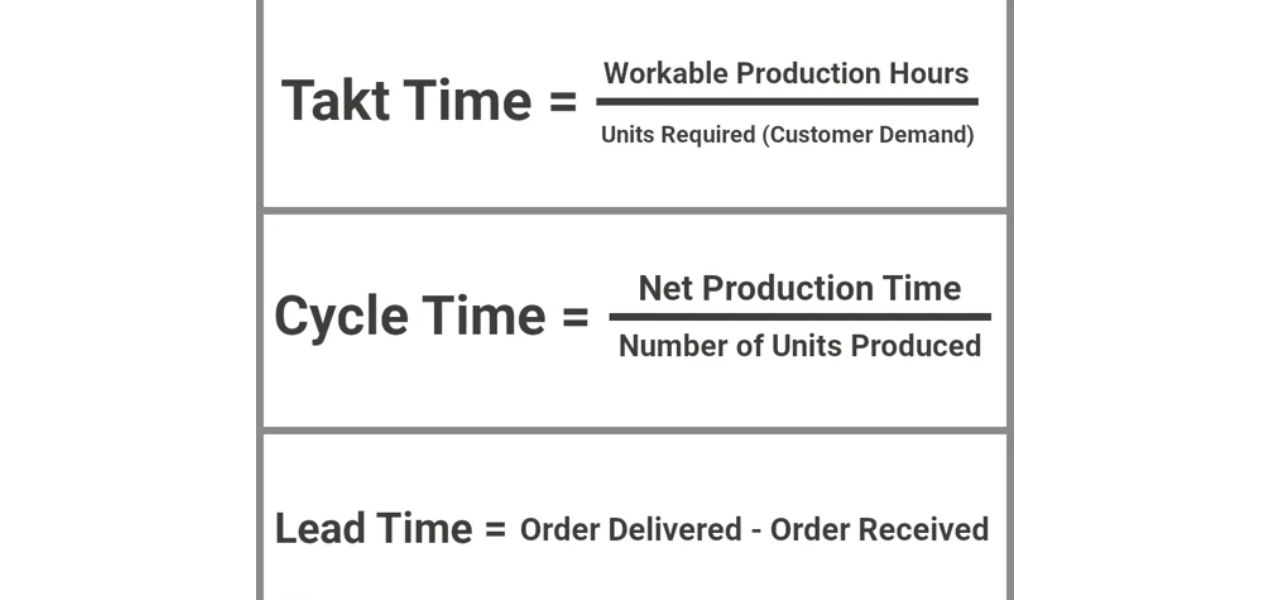
Many people confuse the cycle time with lead time or takt time.
Source: machinemetrics
Here’s a tabular comparison of cycle time vs lead time vs takt time to better understand where they vary.
Metric |
Definition |
Formula |
Focus
|
Cycle Time |
Time taken to complete the manufacturing of single unit. |
Total Time Spent / Number of units completed |
Production Efficiency |
Takt Time |
The time within which the production should be completed to meet the end user requirements. |
Available Time / Customer Demand |
Aligning with Customer requirements. |
Lead Time |
Total time taken from order placement to final delivery.
|
End time – Start time |
Achieve Delivery Efficiency. |
Conclusion
Cycle time measurement is an essential aspect that promotes improvements in operations responsiveness and satisfies customer needs. By calculating cycle time and analyzing it properly, organizations can identify inefficiencies in the supply chain, and eliminate them. It will help them add value to their deliverables. Moreover, they can gain shorter cycle times, better resource management, and, ultimately, inch closer to their revenue goals. So, if you own a business that deals with manufacturing, it is time you start calculating the downtime and see how it improves your business exponentially.
Frequently Asked Questions (FAQs)
1. How do you calculate cycle time?
Cycle Time = Total Time Spent on Process ÷ Number of Units Completed.
For example, if a process takes 8 hours to produce 100 units, the cycle time is 8 hours ÷ 100 = 0.08 hours (4.8 minutes) per unit.
2. Is cycle time a KPI?
Yes, cycle time it’s a key performance indicator that helps measure the production efficiency of an organization.
3. What is cycle time vs lead time to change?
Cycle time is the measure of time taken to produce one unit. It usually focuses on bringing operational efficiency within an organization. On the other hand, lead time to change is the measure of time taken to implement a change after encompassing it through all the stages.
4. What is the order cycle time?
It is the total time taken from receiving the customer order to delivering it, meeting all the end user requirements. It typically covers the stages, processing, production, shipping, ad delivery.
5. How to reduce cycle time?
To reduce the cycle time, you should eliminate bottlenecks, automate repetitive tasks, and ensure efficient resource allocation.
144 articles published
Shivendra Sharma, an accomplished author of the international bestseller 'Being Yogi,' is a multifaceted professional. With an MBA in HR and a Lean Six Sigma Master Black Belt, he boasts 15 years of e...
Get Free Career Counselling
By submitting, I accept the T&C and
Privacy Policy