
What is Social Learning Theory and How it Works?
Updated on Dec 09, 2024 | 2.01K+ views
Share:
Table of Contents
View all
Learning is a wide concept that can happen in multiple ways. You do not necessarily have to sit in a classroom to learn something new. Sometimes, it can happen through observations and peer interactions. This concept of learning is widely known as social learning theory. It is a powerful framework that explains how an individual can gain specific skills and expertise by mere observation of the environment around them. It has largely influenced organizational training programs, psychology sessions, and education practices and has received global appreciation.
Let us learn more about this concept and understand how social learning theory works in different fields.
Master Right Skills & Boost Your Career
Avail your free 1:1 mentorship session
What Is Social Learning Theory?
Proposed by Albert Bandura in the 1960s, social learning theory is a framework that emphasizes how individuals and teams can learn by simply the way they interact with their environment. Albert Bandura's social theory revolves around the significance of imitation, modeling, and observation, and argued that people do learn by observing the actions of people around them and seeing the consequences that follow.
Social Learning Theory tries to amalgamate two theories, behaviorism and cognitive psychology. Where behaviorism concentrates on conditioned behavior and reinforcements, the Social Learning Theory is more inclusive and includes mental actions, specifically, attention, reinforcement, and motivation. These processes make it easy for any individual to assess behaviors that are observed and then determine whether or not they should be copied. These are the factors that make this theory apt for real-life situations.
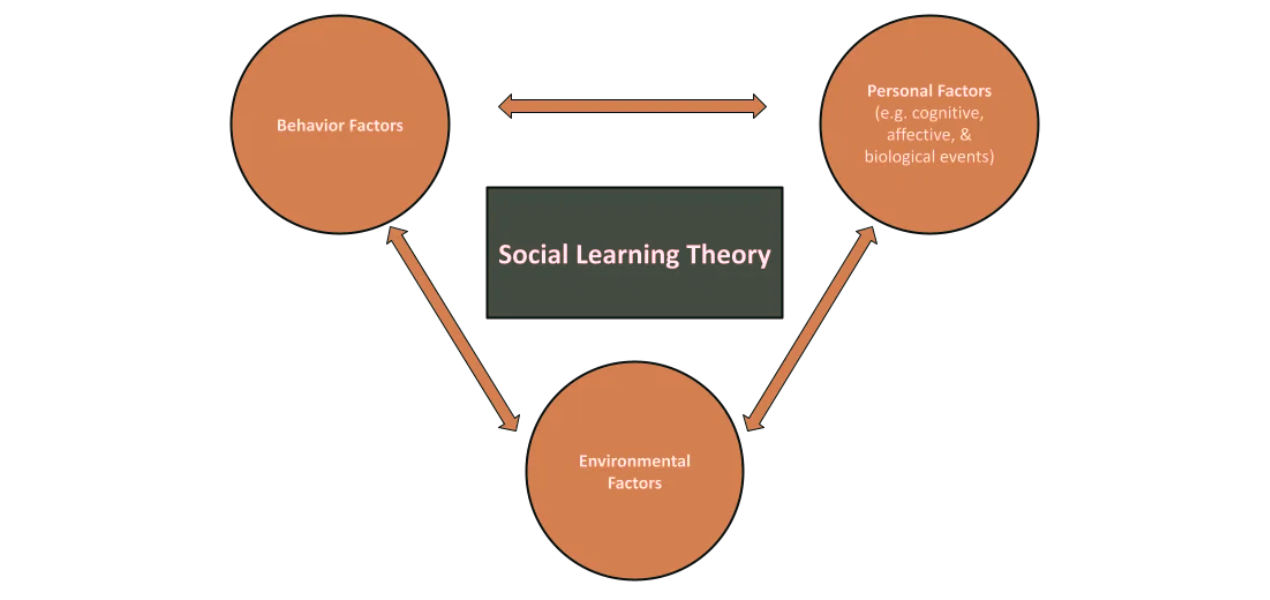
Source: Positive Psychology
Key Features of Social Learning Theory
Observational Learning: Individuals learn by observing the behavior of other people and the consequences of their actions.
Modeling: Explains behaviors that can be imitated, and influenced by the model’s credibility and relatability.
Cognitive Factors: Focusing on attention, memory, and motivation are crucial in this process.
Reciprocal Determinism: signifying that learning can be influenced by the interaction of behaviors, personal factors, and the surrounding conditions.
Self-Efficacy: Trust in the individual’s ability to replicate behaviors they observed.
Key Contributors to Social Learning Theory: Albert Bandura and Others
The primary person behind the inception of Social Learning Theory is Albert Bandura. He revolutionized the learning mechanism by driving attention toward the fact that individuals can learn by just observing their surroundings. It was his famous Bobo doll experiment that explained how children mimic the behaviors even when they are not doing direct reinforcement. Through this experiment, he stressed the significance of modeling and cognitive learning aspects. Other than this, Bandura also emphasized the connection between individual behaviors, environmental factors, and personal attributes.
Other than Albert Bandura, there is another contributor, Julian Rotter, who elaborated on this framework and added a few more concepts. He added the locus of control, signifying the individuals’ control of their actions. Though Rotter never really worked on extending this framework, it was his concept that aligned with the idea and sort of extended the social learning theory.
These two together shaped a theory that perfectly acted as the bridge between the ideas of psychology, education, and sociology.
Core Concepts of Social Learning Theory
The Bandura social theory is an amalgamation of various interconnected concepts, each explaining how one can acquire knowledge and skills through observations and interactions. Here are the core concepts of social learning theory by Bandura.
Observational Learning
It is the heart of the entire social learning theory that speaks about how an individual learns by watching other’s actions and the consequences drawn from them. It is different from traditional classroom learning as it enables people to grasp new behaviors before having an actual experience. For example, a child can learn to climb stairs by simply observing the elders in his house.
Modeling
This concept is about imitating the behaviors of a model! Now, the model here can refer to a real-life individual, like a teacher, or a symbolic figure, like a character from a storybook. You must have seen children speaking and behaving exactly how their favorite cartoon character speaks. It is a perfect example of modeling.
Vicarious Reinforcement
Vicarious reinforcement is the observation of the consequences of an individual’s actions. If a particular action has yielded positive outcomes, it might motivate others to imitate those behaviors. On the other hand, the negative consequences can also help discourage the wrong actions. For example, observing a classmate getting praised for punctuality will motivate others to be on time.
Cognitive Process
Albert Bandura emphasized four key steps involved in observational learning that influenced the entire social learning framework.
Attention: The entire focus should be on the model and his actions with absolutely no distractions at all.
Retention: The observer should remember the behavior he observed and encrypt it into his core memory.
Reproduction: The ability to imitate the observed actions.
Motivation: There should be a reason behind behavior imitation, whether it is intrinsic or extrinsic.
Reciprocal Determinism
This core concept emphasizes that learning is an interplay of Behaviour, personal factors, and the environment. It highlights that individuals are always active participants in their environment, and they subconsciously learn a lot of things even from simpler interactions.
Self Efficacy
It refers to an individual’s belief in his own abilities to succeed in a particular task. Stronger self-efficacy boosts motivation and persistence in learning. Only when a person is willing to interact he can learn through the events happening around him.
Application of Social Learning Theory in Different Fields
Social learning theory gained a lot of popularity and traction around the globe, and its applications can be seen in different fields. Listed below are a few social learning theory examples to help you understand their real-life applications.
Education
Social learning theory has shaped modern teaching methodologies by focusing on active learning. Teachers opt for multiple practical experiments and act as role models to develop required behavioral patterns in children. It helps develop a collaborative environment where students learn effortlessly from each other.
Organizational Training
In an organizational culture as well, training becomes much more interesting and productive through social learning practices. A mentorship program or induction is the perfect example of it. New joinees or junior employees work closely with a senior and observe his actions to get along with the company operations. The seniors act as role models and guide them about their roles and responsibilities.
Media Campaigns
Another example of the social learning framework is media, be it television, movies, or print. You must have seen how advertisements are made relatable enough to shape the audience’s behavior. For example, a detergent powder ad often features a housewife who gets relief after finding a perfect washing powder that removes all stains. It will attract the same audience as they can relate to it.
Public Health
Public health departments also use this theory to motivate people to adopt health habits. They promote behavioral changes, like quitting smoking or exercising regularly through public figures who have greater influence on the viewers.
Psychology
This learning practice is also helpful in CBT (cognitive behavioral therapy). The therapists use various activities that push their subjects towards healthier patterns to manage their stress levels and develop assertiveness in them. It is also helpful for children who suffer from social withdrawal and other psychological symptoms.
Conclusion
Social learning theory by Albert Bandura has changed the way learning happens. It widened the concept, bringing it out of the classroom setup, and turning the surrounding environment into a learning platform. Using the concepts of observational learning, modeling, and Vicarious Reinforcement, can enable the individuals to gain skills without even getting a personal experience before. This concept has efficient applications in not just the educational domain, but in healthcare and multimedia campaigns as well. It empowers individuals, organizations, and businesses to achieve meaningful cognitive changes in the most organic manner.
Frequently Asked Questions (FAQs)
1. What are the 5 principles of social learning theory?
The 5 principles of social learning theory are: observational learning, modeling, vicarious reinforcement, cognitive processes, and reciprocal determinism.
2. What are the 4 elements of social learning theory?
The 4 elements of social learning theory are: attention, retention, reproduction, and motivation.
3. What are the 4 pillars of education theory?
The 4 pillars of education theory are: learning to know, learning to do, learning to be, and learning to live together.
4. What are the two limitations of social learning theory?
Two limitations of Social Learning Theory are:
- Its underestimation of biological influences on behavior
- Its reliance on observable behavior
5. What are the 4 concepts of social learning theory?
The four concepts of Social Learning Theory are attention, retention, reproduction, and motivation. They describe how individuals observe, remember, practice, and are incentivized to replicate behaviors.
144 articles published
Shivendra Sharma, an accomplished author of the international bestseller 'Being Yogi,' is a multifaceted professional. With an MBA in HR and a Lean Six Sigma Master Black Belt, he boasts 15 years of e...
Get Free Career Counselling
By submitting, I accept the T&C and
Privacy Policy