
- Blog Categories
- Project Management
- Agile Management
- IT Service Management
- Cloud Computing
- Business Management
- BI And Visualisation
- Quality Management
- Cyber Security
- DevOps
- Most Popular Blogs
- PMP Exam Schedule for 2025: Check PMP Exam Date
- Top 60+ PMP Exam Questions and Answers for 2025
- PMP Cheat Sheet and PMP Formulas To Use in 2025
- What is PMP Process? A Complete List of 49 Processes of PMP
- Top 15+ Project Management Case Studies with Examples 2025
- Top Picks by Authors
- Top 170 Project Management Research Topics
- What is Effective Communication: Definition
- How to Create a Project Plan in Excel in 2025?
- PMP Certification Exam Eligibility in 2025 [A Complete Checklist]
- PMP Certification Fees - All Aspects of PMP Certification Fee
- Most Popular Blogs
- CSM vs PSM: Which Certification to Choose in 2025?
- How Much Does Scrum Master Certification Cost in 2025?
- CSPO vs PSPO Certification: What to Choose in 2025?
- 8 Best Scrum Master Certifications to Pursue in 2025
- Safe Agilist Exam: A Complete Study Guide 2025
- Top Picks by Authors
- SAFe vs Agile: Difference Between Scaled Agile and Agile
- Top 21 Scrum Best Practices for Efficient Agile Workflow
- 30 User Story Examples and Templates to Use in 2025
- State of Agile: Things You Need to Know
- Top 24 Career Benefits of a Certifed Scrum Master
- Most Popular Blogs
- ITIL Certification Cost in 2025 [Exam Fee & Other Expenses]
- Top 17 Required Skills for System Administrator in 2025
- How Effective Is Itil Certification for a Job Switch?
- IT Service Management (ITSM) Role and Responsibilities
- Top 25 Service Based Companies in India in 2025
- Top Picks by Authors
- What is Escalation Matrix & How Does It Work? [Types, Process]
- ITIL Service Operation: Phases, Functions, Best Practices
- 10 Best Facility Management Software in 2025
- What is Service Request Management in ITIL? Example, Steps, Tips
- An Introduction To ITIL® Exam
- Most Popular Blogs
- A Complete AWS Cheat Sheet: Important Topics Covered
- Top AWS Solution Architect Projects in 2025
- 15 Best Azure Certifications 2025: Which one to Choose?
- Top 22 Cloud Computing Project Ideas in 2025 [Source Code]
- How to Become an Azure Data Engineer? 2025 Roadmap
- Top Picks by Authors
- Top 40 IoT Project Ideas and Topics in 2025 [Source Code]
- The Future of AWS: Top Trends & Predictions in 2025
- AWS Solutions Architect vs AWS Developer [Key Differences]
- Top 20 Azure Data Engineering Projects in 2025 [Source Code]
- 25 Best Cloud Computing Tools in 2025
- Most Popular Blogs
- Company Analysis Report: Examples, Templates, Components
- 400 Trending Business Management Research Topics
- Business Analysis Body of Knowledge (BABOK): Guide
- ECBA Certification: Is it Worth it?
- Top Picks by Authors
- Top 20 Business Analytics Project in 2025 [With Source Code]
- ECBA Certification Cost Across Countries
- Top 9 Free Business Requirements Document (BRD) Templates
- Business Analyst Job Description in 2025 [Key Responsibility]
- Business Analysis Framework: Elements, Process, Techniques
- Most Popular Blogs
- Best Career options after BA [2025]
- Top Career Options after BCom to Know in 2025
- Top 10 Power Bi Books of 2025 [Beginners to Experienced]
- Power BI Skills in Demand: How to Stand Out in the Job Market
- Top 15 Power BI Project Ideas
- Top Picks by Authors
- 10 Limitations of Power BI: You Must Know in 2025
- Top 45 Career Options After BBA in 2025 [With Salary]
- Top Power BI Dashboard Templates of 2025
- What is Power BI Used For - Practical Applications Of Power BI
- SSRS Vs Power BI - What are the Key Differences?
- Most Popular Blogs
- Data Collection Plan For Six Sigma: How to Create One?
- Quality Engineer Resume for 2025 [Examples + Tips]
- 20 Best Quality Management Certifications That Pay Well in 2025
- Six Sigma in Operations Management [A Brief Introduction]
- Top Picks by Authors
- Six Sigma Green Belt vs PMP: What's the Difference
- Quality Management: Definition, Importance, Components
- Adding Green Belt Certifications to Your Resume
- Six Sigma Green Belt in Healthcare: Concepts, Benefits and Examples
- Most Popular Blogs
- Latest CISSP Exam Dumps of 2025 [Free CISSP Dumps]
- CISSP vs Security+ Certifications: Which is Best in 2025?
- Best CISSP Study Guides for 2025 + CISSP Study Plan
- How to Become an Ethical Hacker in 2025?
- Top Picks by Authors
- CISSP vs Master's Degree: Which One to Choose in 2025?
- CISSP Endorsement Process: Requirements & Example
- OSCP vs CISSP | Top Cybersecurity Certifications
- How to Pass the CISSP Exam on Your 1st Attempt in 2025?
- Most Popular Blogs
- Top 7 Kubernetes Certifications in 2025
- Kubernetes Pods: Types, Examples, Best Practices
- DevOps Methodologies: Practices & Principles
- Docker Image Commands
- Top Picks by Authors
- Best DevOps Certifications in 2025
- 20 Best Automation Tools for DevOps
- Top 20 DevOps Projects of 2025
- OS for Docker: Features, Factors and Tips
- More
- Agile & PMP Practice Tests
- Agile Testing
- Agile Scrum Practice Exam
- CAPM Practice Test
- PRINCE2 Foundation Exam
- PMP Practice Exam
- Cloud Related Practice Test
- Azure Infrastructure Solutions
- AWS Solutions Architect
- IT Related Pratice Test
- ITIL Practice Test
- Devops Practice Test
- TOGAF® Practice Test
- Other Practice Test
- Oracle Primavera P6 V8
- MS Project Practice Test
- Project Management & Agile
- Project Management Interview Questions
- Release Train Engineer Interview Questions
- Agile Coach Interview Questions
- Scrum Interview Questions
- IT Project Manager Interview Questions
- Cloud & Data
- Azure Databricks Interview Questions
- AWS architect Interview Questions
- Cloud Computing Interview Questions
- AWS Interview Questions
- Kubernetes Interview Questions
- Web Development
- CSS3 Free Course with Certificates
- Basics of Spring Core and MVC
- Javascript Free Course with Certificate
- React Free Course with Certificate
- Node JS Free Certification Course
- Data Science
- Python Machine Learning Course
- Python for Data Science Free Course
- NLP Free Course with Certificate
- Data Analysis Using SQL
- Home
- Blog
- Cloud Computing
- Cloud Native Analytics: Benefits, Types & How It Works?
Cloud Native Analytics: Benefits, Types & How It Works?
Updated on Nov 18, 2025 | 1.4K+ views
Share:
For years, organizations have wrestled with the same data dilemma - massive volumes stored in silos, slow insights, and even slower decisions. The rise of cloud native analytics changes that equation. By fusing modern cloud-native technologies with intelligent analytics workflows, businesses can now analyze data as it flows - not hours or days later. For project managers and data leaders, this shift means less firefighting and more foresight. To fully grasp this evolution, professionals are now looking to learn Cloud Computing as a foundational skill that connects architecture, analytics, and scalability in one ecosystem.
Master the Right Skills & Boost Your Career
Avail your free 1:1 mentorship session
What is Cloud Native Analytics?
Cloud native analytics refers to data analytics systems that are built, deployed, and scaled natively within cloud environments - not just hosted on the cloud. Unlike traditional analytics tools that were simply moved to cloud servers, cloud native analytics platforms are architected using microservices, containers, and Kubernetes to dynamically manage data workloads.
In practical terms, these systems are elastic. When data volume spikes during quarter-end reporting or during high-traffic events, a cloud native system automatically scales compute and storage resources. When demand drops, it scales down - cutting costs and optimizing performance. This architectural agility gives teams continuous access to real-time insights without infrastructure bottlenecks.
Simply put, cloud native analytics isn’t just analytics on the cloud - it’s analytics of the cloud, for the cloud.
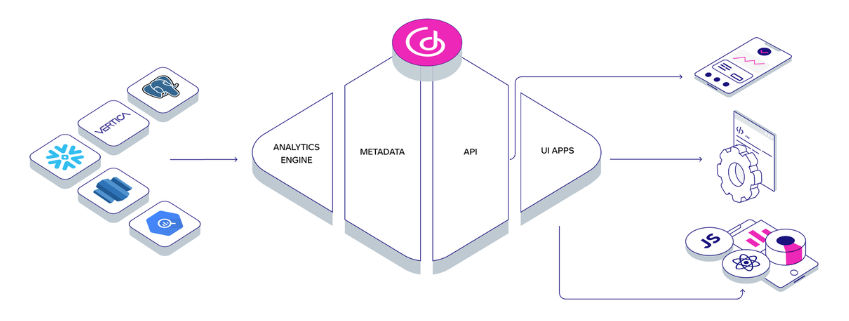
Source: GoodData
Key Characteristics of Cloud Native Analytics
Before diving into architectures and tools, it’s worth understanding what truly defines a cloud native analytics system. These features align closely with the broader cloud native technologies list - including containers, Kubernetes, and serverless frameworks - that enable scalable and automated analytics.
Containerized Microservices:
Each analytics function - data ingestion, transformation, visualization - runs as an independent container. This modularity allows - continuous deployment and faster troubleshooting.
Elastic Scalability:
Compute and storage resources scale automatically - based on workload intensity. Because the platform adapts on demand - you no longer plan capacity months in advance.
API-Driven Integrations:
To connect with data lakes, CRMs, IoT feeds, and machine learning models - Cloud native analytics relies on APIs. This makes sure there's smooth interoperability - across systems.
Automation-First Design:
From provisioning to deployment - automation pipelines minimize manual overhead. DevOps and DataOps teams collaborate more efficiently - using CI/CD principles.
Resilience and Self-Healing:
Built with redundancy and fault tolerance, these systems continue functioning even when specific services fail - which is very important for mission-critical dashboards.
Together, these traits create an analytics ecosystem that’s agile, cost-efficient, and engineered for change - a perfect fit for organizations operating in unpredictable markets.
How Do Cloud Analytics Work?
At its essence - a cloud native application platform functions as a distributed system that orchestrates the flow of data from multiple sources into actionable insights. This type of cloud native analytics platform brings together storage, processing, and visualization components under one scalable architecture.
1. Data Ingestion:
Structured, semi-structured, and unstructured data are collected from multiple sources - databases, APIs, IoT sensors, SaaS platforms - and funneled into a cloud data lake.
2. Data Processing:
Using tools like Apache Spark or Flink - the system processes data in batches or streams. Cloud-native platforms can scale processing clusters dynamically - and makes sure of smooth performance during heavy workloads.
3. Storage and Management:
Data is stored in scalable cloud storage - like Amazon S3, Google Cloud Storage, Azure Blob. Metadata management tools track schema changes and lineage automatically.
4. Analytics and Modeling:
Machine learning models and analytics queries run directly within the cloud environment. Modern solutions - like Snowflake, Databricks, or Google BigQuery - provide serverless computation and built-in optimization.
5. Visualization and Reporting:
Dashboards, predictive insights, and KPI trackers are rendered through tools - like Tableau, Power BI, or Looker. Stakeholders see real-time analytics - refreshed automatically as data updates.
This architecture eliminates the need for heavy on-premise ETL setups. The result? Faster decisions, lower costs - and analytics that evolve with your data landscape.
Types of Cloud Analytics
Before exploring platforms and architectures - it helps to understand the main categories of analytics that power modern, data-driven organizations. Each type serves a unique function. And together - they create a complete intelligence loop from raw data to strategic action.
1. Descriptive Analytics:
This is the foundation of all analytics. Descriptive models summarize what happened using historical data. Dashboards that show last quarter’s sales, project velocity charts, or monthly campaign performance reports all rely on this layer. It’s retrospective - but essential for context.
2. Diagnostic Analytics:
Once you know what happened - the next question is why. Diagnostic analytics identifies correlations and root causes by drilling into multidimensional data. For instance - a project manager might trace schedule delays back to specific resource constraints or dependency issues across teams.
3. Predictive Analytics:
Predictive analytics forecasts future outcomes - being powered by machine learning and statistical modeling. It helps anticipate demand fluctuations, project risks - or system failures before they occur. This allows for proactive planning - instead of reactive fixes.
4. Prescriptive Analytics:
Here, analytics moves from insight to recommendation. Prescriptive models suggest the optimal course of action - like reallocating budgets, adjusting delivery timelines, or tweaking production levels - by simulating different scenarios.
5. Streaming or Real-Time Analytics:
This type continuously processes live data feeds. Whether it’s tracking logistics in motion, monitoring IoT sensors, or updating project KPIs every minute - streaming analytics turns immediacy into a competitive edge.
Collectively, these analytics types transform raw cloud data into foresight, helping organizations respond faster, smarter, and with measurable impact.
Benefits of Cloud Analytics
The move toward cloud native analytics is beyond just a tech upgrade. It’s a shift in how organizations think about - data, agility, and innovation. Here’s how adopting a cloud-native model transforms everyday operations.
- Speed and Agility:
In fast-moving environments - waiting hours for reports can stall decision-making. Cloud-native platforms process and visualize data almost instantly - and allow project managers, analysts, and executives to respond in real time. A retail team can adjust inventory levels mid-day based on live sales data - a project office can spot delays the moment they start.
- Cost Optimization:
Traditional analytics infrastructure often locks organizations into - fixed capacity and sunk hardware costs. In contrast, cloud-native systems expand or contract resources automatically. You’re charged only for the compute or storage you actually use. This pay-as-you-go efficiency means budgets stretch further while performance stays consistent - even during unpredictable demand spikes.
- Security and Compliance:
Compliance and governance are built into into the architecture of modern cloud vendors. Sensitive data remains protected at every layer - with features like encryption, identity management, and audit trails. Whether your business operates under GDPR, HIPAA, or ISO standards - these controls simplify regulatory alignment.
- Seamless Collaboration:
With centralized data and shared dashboards - teams in different time zones can analyze the same metrics simultaneously. There’s no confusion about which file is the latest version - everyone works from a single, trusted data source.
- Continuous Innovation:
Organizations can experiment and deploy new capabilities quickly - because these platforms integrate effortlessly with AI, machine learning, and automation tools. Just steady evolution - no migrations, no downtime.
Ultimately, cloud native analytics turns data into a living system - responsive, cost-efficient, and always ready for the next strategic challenge.
If you want to go deeper into these principles, exploring Cloud Computing online courses can help you understand how elastic infrastructure and analytics pipelines work together in real-world projects.
Cloud Native Analytics Use Cases
Cloud native analytics has moved far beyond the realm of IT experiments - it’s now woven into the operational fabric of nearly every industry. The following cloud native applications examples demonstrate how organizations are transforming this technology into measurable business advantage.
- Financial Services:
In banking and fintech - milliseconds can decide whether a transaction is legitimate or fraudulent. Cloud-native analytics platforms allow institutions to process and analyze thousands of transactions in real time - and flag anomalies as they occur. By combining streaming data with predictive algorithms - financial teams can identify unusual spending behavior, prevent fraud, and refine credit risk models. And all of it - while maintaining compliance with stringent regulatory frameworks.
- E-commerce:
Retailers rely on rapid insights to adjust pricing, promotions, and stock levels. With cloud-native systems, e-commerce platforms can analyze millions of data points simultaneously - from browsing behavior to supply chain fluctuations. This agility allows dynamic pricing models that respond instantly to demand changes - and make sure of optimal margins and better customer experiences.
- Healthcare:
Hospitals and healthcare networks use cloud-native analytics - to improve patient care and operational efficiency. For example, data from wearable devices and electronic health records can be analyzed continuously - to predict patient deterioration or optimize bed allocation. Privacy standards like HIPAA and GDPR are made sure to be upheld - by built-in compliance features.
- Manufacturing:
To monitor machinery in real time - smart factories use IoT sensors and edge analytics. Cloud-native solutions identify early warning signs of equipment failure. This allows preventive maintenance - that minimizes costly downtime and boosts production output.
- Project Management:
Modern PMOs depend on cloud-native dashboards for unified visibility across global projects. These tools aggregate data from multiple sources - budget trackers, resource management systems, and progress logs. And this data collection helps leaders spot risks early and reallocate capacity where it matters most.
Together, these use cases reveal how cloud native analytics converts raw data into actionable intelligence across sectors - which drives faster, smarter, and more resilient decision-making.
Cloud Enabled vs Cloud Native
Many companies still confuse cloud-enabled solutions with cloud-native ones. Here’s how they differ:
Parameter |
Cloud-Enabled Analytics |
Cloud-Native Analytics |
| Architecture | Legacy applications moved to the cloud | Built natively using containers and microservices |
| Scalability | Manual scaling with limited elasticity | Automatic, on-demand scaling |
| Deployment | Monolithic updates and releases | Continuous deployment via CI/CD pipelines |
| Cost Efficiency | Fixed costs regardless of usage | Pay-as-you-go with resource optimization |
| Resilience | Prone to downtime during failures | Self-healing and fault-tolerant design |
In essence, cloud-enabled systems adapt to the cloud - cloud-native systems evolve with the cloud.
Final Thoughts
Cloud native analytics represents the next evolution of business intelligence - elastic, integrated, and built for the pace of modern enterprise data. Whether you’re a project manager trying to forecast delivery risks or a data leader architecting your next-generation analytics stack, embracing cloud-native principles will put you ahead of the curve.
If you’re ready to explore the technologies that make this possible - containers, Kubernetes, and serverless data architectures - take a look at upGrad KnowledgeHut’s Cloud Computing courses. They’re designed to help you master the tools and strategies behind cloud native success.
Frequently Asked Questions (FAQs)
1. What is a cloud-native data platform?
A cloud-native data platform is a system built entirely within the cloud using microservices, containers, and serverless architectures. It enables elastic scaling, continuous integration, and real-time data processing without relying on traditional on-premise infrastructure.
2. How is cloud-native different from cloud?
“Cloud” often refers to hosting existing applications on cloud servers, while “cloud-native” means designing applications specifically for the cloud. Cloud-native systems are modular, automatically scalable, and optimized for performance in dynamic environments.
3. What is cloud-native ETL?
Cloud-native ETL (Extract, Transform, Load) is a data integration process built to run natively in cloud environments. It leverages serverless computing, APIs, and automation to move and transform data efficiently, scaling resources based on workload demands.
4. What is the difference between cloud-native and DevOps?
Cloud-native is an architectural approach focused on how applications are built and deployed in the cloud, while DevOps is a cultural and operational methodology that unites development and operations teams. DevOps practices often support cloud-native development through automation and continuous delivery.
1639 articles published
KnowledgeHut is an outcome-focused global ed-tech company. We help organizations and professionals unlock excellence through skills development. We offer training solutions under the people and proces...
Get Free Consultation
By submitting, I accept the T&C and
Privacy Policy