
- Home
- Blog
- Project Management
- Top Project Management Failure Case Studies to Know 2026
Top Project Management Failure Case Studies to Know 2026
Updated on May 11, 2026 | 8 min read | 10.96K+ views
Share:
Table of Contents
View all
Project management failures provide some of the most valuable lessons for understanding what can go wrong when projects are not managed effectively. In 2026, many failed projects are linked to issues like poor risk planning, unclear requirements, shifting scope, and lack of coordination among stakeholders.
These challenges often lead to cost overruns, missed deadlines, and damage to an organization’s reputation. Examples from areas like AI implementations, IT systems, and large infrastructure projects show how quickly things can go off track without proper structure and communication.
Studying these failures helps project managers identify warning signs early and avoid repeating the same mistakes. To build stronger foundations in project management, you can explore upGrad KnowledgeHut PMP certification training
Ultimate PMP Formula Cheat Sheet
Get a quick, exam-ready PMP cheat sheet with all essential formulas and key concepts in one place.
What is a Project Management Failure Case Study and Importance
When we evaluate failed projects case studies in project management, we try to understand why a project did not meet its objectives. These failures can be either associated with significant flaws at crucial levels or an ultimate failure leading to project termination.
Therefore, industry experts prefer to explore case studies to identify decision-making mistakes and potential factors that could lead to similar consequences in the future.
A detailed case study can offer you the following takeaways:
- What mistakes led to inadequate risk management
- What decisions caused misinterpretation of the project’s scope thus leading to unnecessary delays and extra costs
- How monitoring and control aspects failed that resulted in a delay of preventive measures
- Why funding or resources were insufficient at a particular stage
- What caused poor leadership or what were the actual reasons behind negligible stakeholder involvement
Evaluating these pointers can help you spot project warning signs at a very early stage. After that, you can take the right steps to reduce the possibility of these risks while creating mitigation strategies.
Through KnowledgeHut's Project Management training courses it is now possible to gather these skills while you’re still working as a full-time professional. Our course curriculum is up-to-date with the latest industry trends. Thus, the content and training modules provide immense value even to the best of the Project Managers who are preparing for PRINCE2 or PMP examinations.
12 Project Management Failure Case Studies
Are you struggling to fetch failed projects case studies project management PDF files online?
We have got this aspect covered for you right here!
Make sure to go through these popular project management failures case studies for a complete understanding of what actually went wrong.
Case Study 1: IBM’s Stretch Project

Wikipedia
Who Failed?
The multinational tech brand headquartered in New York; IBM failed to drop the Stretch project at a pre-planned rate of $13.5 million.
Things They Were Trying to Achieve
From 1950 to 1956, IBM endeavored to launch the world's fastest processing supercomputer, the IBM 7030. The group of engineers hired for the project attempted to build a system that can operate at a 100-200 times greater speed compared to its nearest competitor.
Reasons Why the Project Failed
The team faced too many obstacles while designing and manufacturing the groundbreaking system. Also, there were several loopholes from the architectural perspective that contributed to IBM’s future developments.
Case Study 2: Ford Edsel
Who Failed?
C. Doyle, who was the Marketing Manager of the Ford Motor Company at the time, attributed the market failure of the Edsel model to American mid-budget car buyers.
Things They Were Trying to Achieve
The company fondly aimed towards launching a car that would attract luxury car enthusiasts all over the US.
Reasons Why the Project Failed
As per analysts, the vehicle had the right attributes to secure monopoly in the intended market segment. But it failed primarily because of a delay in project deployment. By the time it hit the market, the greater audience had already moved towards compact cars.
Many lessons are derivable from this instance making it one of the historical project management failures case studies. Some key learnings from this project include the importance of maintaining deadlines, timely communication, and keeping the project managers on the same page.
Case Study 3: Levi’s Type 1 Jeans
Who Failed?
Levi Strauss & Co., the world-renowned denim-jeans brand, tried to poach into the segment of exaggerated clothing in the early 2000s. As a result, they attempted running new ad campaigns which totally confused their audience and consequently the sales dropped.
Things They Were Trying to Achieve
The company’s approach was to introduce a new trend of jeans bottom wear that featured rivets, stitches, and buttons, much different from the contemporary style.
Reasons Why the Project Failed
The younger generation at that time was confused about the impression of the final product. As fashion statements are quite fickle and tend to change very quickly, the idea did not sit well with the end-users.
Case Study 4: Apple Lisa
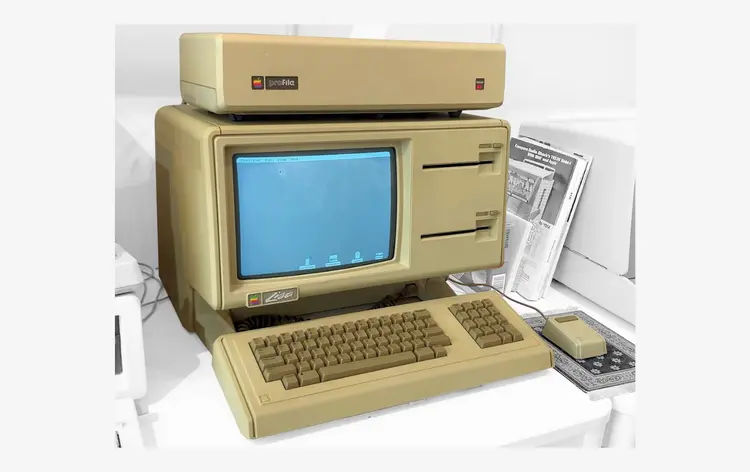
Wikipedia
Who Failed?
Apple, the tech giant that currently holds almost 24% of the global market share in consumer goods, initially failed while introducing the first-ever desktop with a mouse.
Things They Were Trying to Achieve
The company aspired to develop a compact personal device that could replace expensive minicomputers or mainframes at that time. For this, they hired trained software professionals and availed consultancy from various IC suppliers.
Reasons Why the Project Failed
The project apparently promised a lot of things but ultimately failed to deliver the results. Space constraints became prominent as the computer only offered 1 MB memory. Also, the Apple FireWare floppy disks seemed unreliable. As a result, just 10,000 Lisa computers could be sold over a span of 24 months.
Case Study 5: Crystal Pepsi
Who Failed?
Does the idea of clear Cola seem fascinating to you?
Probably not, right?
This concept was actually put into action in the 1990s when PepsiCo launched Crystal Pepsi as an effort to target health-minded customers. Unfortunately, this turned out to be one of the most spectacular project management failure case studies in the soft drink industry.
Things They Were Trying to Achieve
PepsiCo introduced a unique taste and marketed it through rampant advertisement campaigns. Also, they stressed the benefits of the drink which failed to gain the expected momentum.
Reasons Why the Project Failed
The product failed because at that time the market was starting to get inclined towards energy drinks. Also, traditional colas consumed a large section of the audience who preferred that taste over others.
Case Study 6: Sony Betamax
Who Failed?
The second-biggest supplier of cameras in modern times, Sony failed in the mid 1970s while they tried to compete with JVC’s VHS technology.
Things They Were Trying to Achieve
At that time, the company introduced a consumer-level analog recording device that was marketed as a video cassette recorder. Performance-wise, the average playback times and fast-forward features were working seamlessly for this innovation. But there were major drawbacks that resulted in the project's downfall.
Reasons Why the Project Failed
The VCR was compatible with other Sony products only. Also, the Betamax tapes came at a much higher price compared to VHS tapes. Furthermore, Betamax recordings were limited to a maximum of 1 hour, whereas VHS tapes allowed for recording durations of nearly 2 hours.
Case Study 7: Death March Project - Baggage System Disruption at Denver Int. Airport
Who Failed?
One of the busiest international airports in the world, Denver International Airport failed.
Things They Were Trying to Achieve
In 1991, the airport authority made a noble attempt to streamline the time-taking luggage transfer system. Their primary objective was to attach bar-coded tags to baggage in order to fully automate the process. The authorities anticipated reducing the aircraft turnaround time by half across three terminals.
Reasons Why the Project Failed
Unfortunately, DIA’s management couldn’t control the cost, risks, and time required to deal with the new system. As the body tied up with BAE to bring in the automated baggage handling system, both organizations assumed different deadlines. An unrealistic 2-year schedule was offered from DIA’s end that led to project underscoring and many detrimental situations followed due to lack of discussions.
Case Study 8: NHS’ Civilian IT Project
Who Failed?
Great Britain’s publicly funded healthcare system, the National Health Service (NHS) failed in the 2010s.
Things They Were Trying to Achieve
The body targeted to revolutionize the health sector through innovations like digital scanning, electronic recording methodologies, and integrated IT devices. In a nutshell, they aspired to build the greatest civilian digitized module around the globe.
Reasons Why the Project Failed
The three most prominent reasons that led to this project’s failure included supplier disputes, frequent changing of specifications, and external contractual disruptions.
You can learn about how to avoid these scenarios by joining ours PMP online course. It is a certified step-by-step curriculum to crack the exam on the first attempt.
Case Study 9: McDonald’s Arch Deluxe Burger
Who Failed?
The American QSR chain McDonald’s failed in 1996 after introducing a premium option in its menu - the Arch Deluxe Burger.
Things They Were Trying to Achieve
The brand tried to mold its menu to make it suitable for the more sophisticated class of audience.
Reasons Why the Project Failed
The company gave too much importance to customer data while redefining its new production strategy. Thus, they ended up spending $150 million on advertising. Contrarily, the management failed to track the returns minutely and the demand for the product never reached expectations.
Case Study 10: FoxMeyer Drugs Bankruptcy
Who Failed?
FoxMeyer Corporation went bankrupt in 1996 as the company misinterpreted software project risks at a latent stage.
Things They Were Trying to Achieve
They were trying to automate the supply chain of prescription drugs and toiletries in the wholesale segment.
Reasons Why the Project Failed
The project primarily failed while handling mass orders. As thousands of pharmacies depended on the company, they got over 500,000 orders per day which clearly crossed the bandwidth of the software at that time.
Case Study 11: The Delorean DMC
Who Failed?
The DeLorean Motor Company, founded by former GM executive John DeLorean, failed in its ambitious automotive venture during the early 1980s.
Things They Were Trying to Achieve
The company was aiming to create a futuristic, stainless-steel sports car to disrupt the automotive industry. The DMC-12 was backed by the British government and had a strong initial hype. DeLorean was hoping to create a premium, performance-driven vehicle that stood apart in design and technology.
Reasons Why the Project Failed
Despite a bold vision, the DMC-12 had a lot of hurdles in its execution. The car had poor build quality, while the project ran into frequent delays, cost overruns, and flawed production planning. The leadership was focused on publicity instead of running the necessary operations. External political pressures in the UK further complicated matters.
The final nail in the coffin was escalating concerns regarding fuel efficiency during the U.S. recession hit. This led to a plummeting demand for luxury sports cars. Combined with a controversial drug trafficking scandal involving John DeLorean, the company collapsed, leaving the DMC-12 a cautionary tale in poor execution and stakeholder misalignment.
Case Study 12: Polaroid Instant Home Movies
Who Failed?
Polaroid Corporation, a company known for iconic instant cameras, tried to launch “Polavision”, an instant movie system in the late 1970s.
Things They Were Trying to Achieve
Polaroid wanted to replicate its instant photo success in the home video space. The Polavision system was designed to let users shoot and instantly view short home movies using a proprietary format, aiming to revolutionize personal video recording before the advent of camcorders.
Reasons Why the Project Failed
Despite the innovation, Polavision was a commercial failure due to poor market timing and technological shortcomings. The product was plagued with issues such as the film’s low sensitivity to light, short duration for recordings, and required proprietary hardware. The Polavision launched at a time when video cassette recorders (VCRs) were gaining popularity, and offered far more flexibility.
Polaroid also failed to properly assess changing consumer needs and ignored signs that video technology was moving toward different formats such as tape and digital. The project drained resources and never achieved traction, ultimately contributing to Polaroid's long-term decline.
How to Spot Project Failures Before They Happen?
Lack of Clear Goals
When project goals are not clearly defined, teams often get confused about what they are working toward. This leads to delays and misaligned efforts. Setting clear, measurable objectives helps everyone stay focused on the same outcome.
Uncontrolled Scope Creep
If project requirements keep changing without proper approval, it can quickly derail timelines and budgets. A strong change management process ensures that every update is evaluated before being added to the project scope.
Resource Constraints
Limited budgets, insufficient staffing, or unrealistic deadlines can put heavy pressure on a project. Early feasibility checks and discussions with stakeholders help identify these risks before they affect delivery.
Poor Stakeholder Communication
When stakeholders are not regularly updated, important issues can go unnoticed until it is too late. Consistent communication ensures everyone stays informed and aligned throughout the project lifecycle.
Weak Risk Management
Without proper risk planning, teams are often unprepared for unexpected challenges. Regular risk assessments and contingency planning help projects stay flexible and reduce the chances of failure.
Conclusion
Most project management failure case studies show how delayed communication can seriously impact project outcomes. That is why it is important to streamline processes and introduce automation wherever possible from the start.
Clear performance metrics should also be defined across all levels of the organization to ensure alignment and efficient use of resources. At the same time, failures should not be seen as setbacks but as learning opportunities.
Many successful companies have improved by analyzing mistakes and making the necessary changes to move forward stronger.
Contact our upGrad KnowledgeHut experts and get personalized guidance on choosing the right course, career path, and certification for your goals.
Frequently Asked Questions (FAQs)
Why is it important to study failed projects instead of only successful ones?
Failed projects show us what can go wrong and why. They reveal blind spots we often miss, like unclear goals or poor communication. By understanding these mistakes, project managers can avoid them in future projects.
What early signs indicate that a project might be heading toward failure?
Some common red flags include confused team members, deadlines slipping without explanation, and stakeholders asking for constant changes. When these patterns appear, it is usually a sign that something deeper needs attention.
How do unclear requirements affect a project's success?
When requirements are vague or constantly changing, teams do not know what they are expected to deliver. This creates rework, frustration, and delays. Clear requirements are the foundation of a stable project.
What is scope creep and why is it so risky?
Scope creep happens when new tasks get added without proper review. These additions might seem small but can pile up and increase time, cost, and stress. Controlled scope keeps the project focused and manageable.
Can poor communication really cause a project to fail?
Yes, communication gaps are one of the biggest causes of failure. If updates are missed or assumptions are made, problems grow silently. Regular check-ins and transparent communication keep everyone aligned.
Why do large organizations struggle with coordination in big projects?
Big teams often work across different departments or locations, which makes alignment harder. If roles and responsibilities are not clear, teams might work in silos, leading to confusion and delays.
How does weak leadership contribute to project failure?
Weak leadership can create uncertainty, slow decision making, and demotivate teams. A strong project leader provides direction, removes obstacles, and ensures everyone stays on track.
Why do many projects go over budget?
Costs often rise when risks are not identified early or when tasks take longer than expected. Sudden requirement changes, resource shortages, or vendor issues can also drive-up expenses.
How can project managers improve risk planning?
They can start by listing possible risks, evaluating how likely they are, and preparing backup plans. Regularly reviewing this risk list helps the team respond faster when changes happen.
Are technology projects more likely to fail than others?
Tech projects often face extra challenges like evolving requirements, integration issues, and fast-changing technology. Without strong planning and coordination, these projects can drift off track quickly.
454 articles published
Kevin D. Davis is a seasoned and results-driven Program/Project Management Professional with a Master's Certificate in Advanced Project Management. With expertise in leading multi-million dollar proje...
Get Free Consultation
By submitting, I accept the T&C and
Privacy Policy