
What is Measurement System Analysis?
Updated on Dec 02, 2024 | 7 min read | 2.71K+ views
Share:
Table of Contents
View all
- What is Measurement System Analysis?
- Importance of MSA in Quality Improvement
- Why Would We Perform Measurement Systems Analysis?
- Measurement Systems Analysis Fundamentals
- Types of Measurement System Analysis
- Types of Measurement System Studies
- How to Perform Measurement System Analysis?
- What Kind of Organizations can Benefit From MSA?
- To sum up
Every manufacturing business gathers a ton of data about its systems and procedures every day. Decisions about recruiting, equipment requirements, and even environmental factors are subsequently influenced by this data. Reliability in data collecting is essential because there are so many important aspects involved. Using a measurement system is the sole method to determine this.
Measurement system analysis is a collection of connected metrics analysis that assists businesses in quantifying different aspects of a process and evaluating the correctness of those aspects. Many businesses quickly implement measuring systems, but many find it difficult to stay up to date, making them outdated after too much time of neglect. Professionals can upgrade themselves and learn the correct applications of measurement system analysis by enrolling in Quality Management certifications.
Master Right Skills & Boost Your Career
Avail your free 1:1 mentorship session
What is Measurement System Analysis?
Source: Six Sigma Study Guide
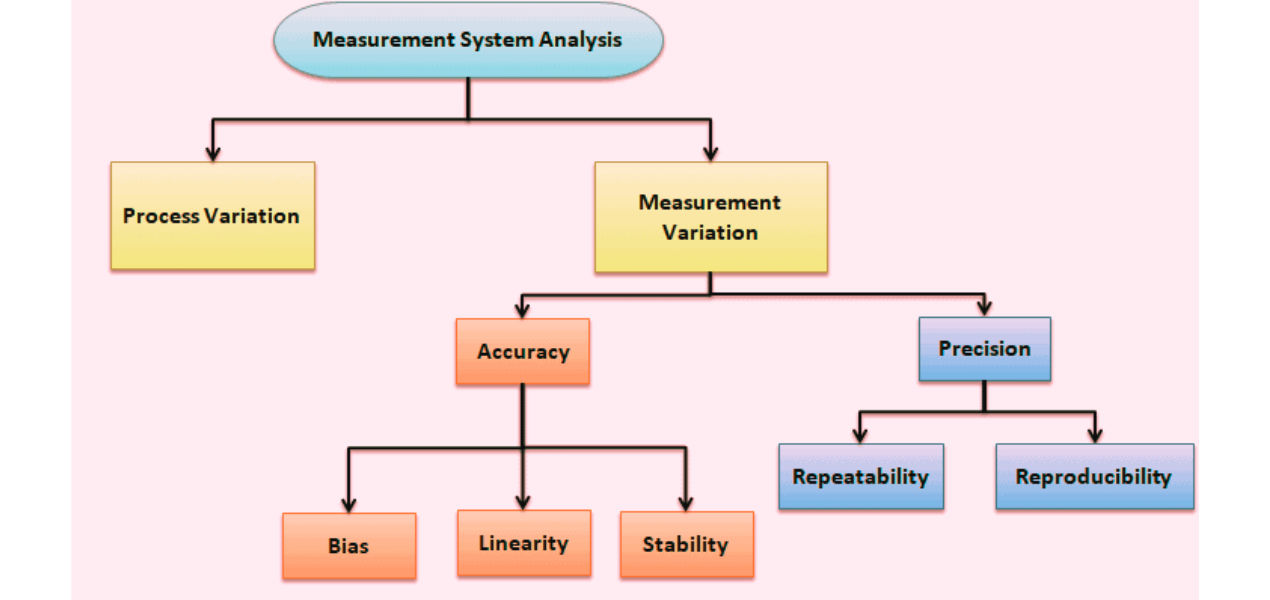
A measurement system's suitability for usage is assessed using MSA (Measurement System Analysis). To ensure accurate and exact data collection, an operational measurement system is essential. When performing an examination of a measuring system, there are numerous aspects to take into account.
A measurement system's suitability for use is assessed using the MSA method. Any combination of a data collecting system, display, recorder, signal conditioner, or transducer used to take a measurement can be referred to as a measuring system. A measurement system is appropriate if it satisfies the necessary technical performance requirements. A measuring system's origins of variation can be found and measured using Measurement System Analysis.
Importance of MSA in Quality Improvement
MSA aids in the quality improvement of a process through the following ways.
- Ensures Accuracy: MSA evaluates the measurement system's accuracy, ensuring data collected is precise and reliable.
- Reduces Variability: Identifies and minimizes errors in measurement, contributing to consistent quality outcomes.
- Supports Root Cause Analysis: Accurate data helps pinpoint the true causes of quality issues for effective corrective actions.
- Enhances Decision-Making: Reliable measurement systems provide trustworthy data for making informed quality improvement decisions.
- Compliance and Standards: Ensures adherence to industry standards and regulatory requirements by maintaining robust measurement practices.
- Improves Process Control: Validates that measurement tools align with process control needs, reducing defects.
- Boosts Customer Satisfaction: Reliable data leads to consistent quality, which increases customer confidence and satisfaction.
- Cost Efficiency: Prevents waste from incorrect measurements, reducing rework and associated costs.
Why Would We Perform Measurement Systems Analysis?
Measurement systems analysis's primary goals are to assess the validity of the measuring system and reduce the primary process variation brought on by the measurement system.
- It evaluates how well the instrument or measuring system is working.
- Measurement data is typically taken into account by organizations when making decisions about their operations or processes. Therefore, data must be accurate.
- In the DMAIC procedure, one of the essential needs is data accuracy. It facilitates the assessment of the measurement system's impact on the gathered data. We shall make our decision based on wrong data if the measurement system results are erroneous.
- Resource monitoring and measurement are crucial components of quality management systems like ISO 9001, AS9100, etc.
Measurement Systems Analysis Fundamentals
Let us go through the key fundamentals of Measurement System Analysis:
- Definition: MSA evaluates the accuracy, precision, and reliability of a measurement system.
- Purpose: Ensures data integrity for effective decision-making in quality improvement.
- Key Elements: Focuses on bias, linearity, stability, repeatability, and reproducibility.
- Types of Studies: Includes Gage R&R studies, bias analysis, and calibration. There is measurement system analysis software available for each type of tool.
- Variance Analysis: Identifies variability in measurements caused by instruments or operators.
- Error Detection: Highlights issues in the measurement process for corrective actions.
- Improves Reliability: Ensures measurement systems consistently produce reliable results. By using a measurement system analysis template it can be achieved.
- Standardization: Supports compliance with industry standards and quality frameworks.
- Supports Process Improvement: Provides accurate data for effective quality control and process optimization.
- Customer Satisfaction: Reliable measurements contribute to consistent product quality, enhancing trust.
You can learn these fundamentals in detail by enrolling in a credible six sigma green belt course.
Types of Measurement System Analysis
Attribute agreement, variable agreement, and stability are the three primary categories of measurement system analysis.
- A statistical technique called attribute agreement evaluates how consistently two or more raters' ratings match up.
- Variable agreement assesses how well two or more measuring methods that provide quantitative data agree with one another.
- Stability evaluates how consistently measures hold up over time.
Types of Measurement System Studies
The various measurement system analysis types ensure measurement accuracy, support process improvement, and maintain product quality.
1. Bias Study
- Evaluates the difference between measured values and a known reference.
- Identifies systematic error in the measurement system.
2. Linearity Study
- Tests accuracy across the measurement range.
- Identifies if error varies with the magnitude of measurement.
3. Repeatability Study
- Assesses variation when one operator uses the same instrument multiple times.
- Focuses on short-term consistency.
4. Reproducibility Study
- Evaluates variability when different operators measure the same item.
- Highlights operator-to-operator differences.
5. Gage Repeatability and Reproducibility (Gage R&R)
- Combines repeatability and reproducibility.
- Analyzes total measurement system variation.
6. Stability Study
- Determines if the measurement system maintains consistency over time.
- Identifies long-term performance issues.
7. Sensitivity Study
- Tests the ability to detect small variations in measurements.
- Ensures the system is responsive to changes.
8. Attribute Agreement Study
- Focuses on systems that classify data into categories.
- Assesses consistency across operators and conditions.
9. Calibration Study
- Compares instrument output against a known standard.
- Ensures the system is aligned with reference values.
10. ANOVA Study
- Uses statistical analysis to decompose variation.
- Identifies sources of measurement error.
11. Discrimination Study
- Evaluates the ability to distinguish between closely spaced measurement values.
- Ensures sufficient resolution for tasks.
12. Capability Study
- Verifies if the system meets requirements for intended tasks.
- Ensures adequacy for production environments.
How to Perform Measurement System Analysis?
Following the required steps ensures a robust and reliable measurement system for quality improvement.
1. Define the Objective
- Clearly state the purpose of the MSA study.
- Identify the type of measurement system to be analyzed.
2. Select the Measurement System
- Choose instruments and tools relevant to the process.
- Ensure proper calibration of equipment.
3. Choose the Study Type
- Select the type of MSA (e.g., Bias, Gage R&R, Linearity).
- Match the study type with the desired outcome.
4. Plan the Study
- Identify parts, operators, and repetitions.
- Decide on the number of trials to ensure statistical accuracy.
5. Collect Data
- Use consistent procedures to gather measurements.
- Ensure operators follow standardized methods.
6. Analyze the Data
- Calculate key metrics like repeatability, reproducibility, and bias.
- Use statistical tools like ANOVA for deeper insights.
7. Evaluate Variability
- Compare measurement system variation to process variation.
- Determine if the system is suitable for its intended use.
8. Identify and Address Issues
- Investigate sources of error if results are unsatisfactory.
- Implement corrective actions like recalibration or operator training.
9. Document Results
- Record findings and share with relevant stakeholders.
- Use results to improve process quality.
10. Review Regularly
- Perform MSA periodically to ensure long-term system reliability.
What Kind of Organizations can Benefit From MSA?
MSA offers numerous advantages to organizations. One measurement system analysis example of its benefit is that it boosts the productivity of the company. An organization's productivity might rise by about 40% with MSA. This is due to fewer typos and errors, which frees up more time for content creation and less time for editing.
Meeting KPIs is another way that MSA may help organizations. Because AI assistants can provide more material more quickly, businesses are more likely to reach their KPIs.
The following types of organizations can benefit from MSA:
- Manufacturing Companies: Ensure accurate quality control and reduce defects. Implementation of measurement system analysis six sigma is one example of that.
- Automotive Industry: Maintain compliance with strict quality standards like IATF 16949.
- Healthcare Organizations: Ensure precision in diagnostic tools and medical equipment
- Aerospace and Defense: Guarantee high levels of reliability in critical components. Lean six sigma measurement system analysis can be used to achieve that.
- Electronics Industry: Validate measurement systems for circuit boards and microchips.
- Pharmaceutical Companies: Ensure precise measurements in drug formulations and packaging. It is ensured using measurement system analysis in six sigma.
- Food and Beverage Companies: Maintain consistency in product quality and safety compliance.
To sum up
Anything that can be measured must first be improved in quality. We must, after all, be certain of the precise things that require improvement. When taking measures, it's crucial to keep in mind that the measurement apparatus itself might introduce mistakes, or, to put it another way, cause variation in the resultant measurements. We might have misinterpreted the results if this variance is excessively large.
When this happens, MSA helps by confirming that our measuring system can produce data that are reasonably dependable. We can ascertain through MSA analysis if we should concentrate on enhancing the production process or the measuring system itself. If you wish to make a career in this field enrolling in a Six Sigma Yellow Belt training would be a wise move.
Frequently Asked Questions (FAQs)
1. What are the objectives of MSA?
The MSA's objectives are to evaluate the measuring system's quality. The goal is to make sure that a measuring system meets internal demands, statutory and regulatory standards, and customer requirements while producing accurate findings.
2. Which tool is used for MSA?
There are multiple tools used for MSA including Cluster Omega, MAFFT, T-Coffee, WebPRANK, ClutalW and more.
3. How is MSA calculated?
Measurement Systems Analysis (MSA) is calculated by assessing variation in a measurement process. It involves evaluating precision, accuracy, repeatability, and reproducibility using statistical tools like Gage R&R, bias, and linearity studies.
4. How MSA works?
A statistical procedure called MSA determines the measuring system's integrity. MSA actively searches for process and product variability that deviates from allowable tolerances.
5. What is the R and R in MSA?
"R and R" in MSA stands for "Repeatability and Reproducibility," a statistical technique used to evaluate the variation in a measurement system, specifically the amount of variation attributable to the measuring device itself (repeatability) and the number attributable to various operators taking the measurements (reproducibility).
144 articles published
Shivendra Sharma, an accomplished author of the international bestseller 'Being Yogi,' is a multifaceted professional. With an MBA in HR and a Lean Six Sigma Master Black Belt, he boasts 15 years of e...
Get Free Career Counselling
By submitting, I accept the T&C and
Privacy Policy