
What is Lean Management? Benefits, Principles, Examples
Updated on Dec 02, 2024 | 7 min read | 2.64K+ views
Share:
Table of Contents
View all
In today’s competitive world, Lean management helps organizations stay ahead by maximizing resources and focusing on customer needs. It has become a widely used approach across industries to deliver value and streamline workflows. Lean, originating from the Toyota Production System, aims to eliminate waste, enhance efficiency, and create customer value. Its principles emphasize continuous improvement, resource optimization, and team-based problem-solving.
This approach is globally recognized for its adaptability across industries like manufacturing, healthcare, IT, and logistics. Lean emphasizes efficiency and value, helping businesses cut costs, improve quality, and speed up delivery. It empowers employees to identify inefficiencies and suggest solutions, fostering a holistic management approach.
In our blog, we dive deep into Lean management meaning, its origins, key benefits, and how businesses can implement Lean strategies to drive success.
Master Right Skills & Boost Your Career
Avail your free 1:1 mentorship session
What is Lean Management?
Lean management is a systematic approach to improving efficiency, reducing waste, and maximizing value in operations. Originating from the Toyota Production System, it focuses on delivering the best value to customers. This is done by streamlining workflows, optimizing resources, and eliminating non-essential activities. Lean management theory emphasizes continuous improvement, employee involvement, and customer satisfaction.
Lean focuses on reducing unnecessary activities and using resources wisely. It helps organizations provide high-quality products at lower costs. Lean also reduces waste in overproduction, excess inventory, and waiting time. By using Lean, businesses can improve productivity, deliver products faster, and enhance quality. Lean promotes continuous improvement by encouraging employees to find better ways to work. To support this, many pursue the Lean Management certifications, which enhances their ability to optimize processes. The Lean Six Sigma Black Belt certification cost varies by training provider and usually covers course fees, study materials, and exam charges.
Source: The Lean Way
History of Lean Management
Lean Management has its origins in the Toyota Production System (TPS), developed by Toyota in Japan during the mid-20th century. The primary goal of TPS was to improve efficiency, reduce waste, and ensure high-quality production. This system drew inspiration from Henry Ford's assembly line and the just-in-time production concept developed by Sakichi Toyoda, Kiichiro Toyoda, and Taiichi Ohno.
In the 1980s and 1990s, Lean principles gained widespread recognition and adoption. The book "The Machine That Changed the World" by James P. Womack, Daniel T. Jones, and Daniel Roos popularized the concept of Lean manufacturing and its potential to transform industries
Today, Lean management methods have expanded beyond manufacturing to industries like healthcare, software development, and logistics. They are used worldwide to improve processes, reduce waste, and deliver greater value to customers. It continues to evolve and adapt to new challenges and opportunities. Lean Six Sigma, a hybrid methodology combining Lean and Six Sigma, has emerged as a powerful tool for improving business processes and reducing costs.
Principles of Lean Management
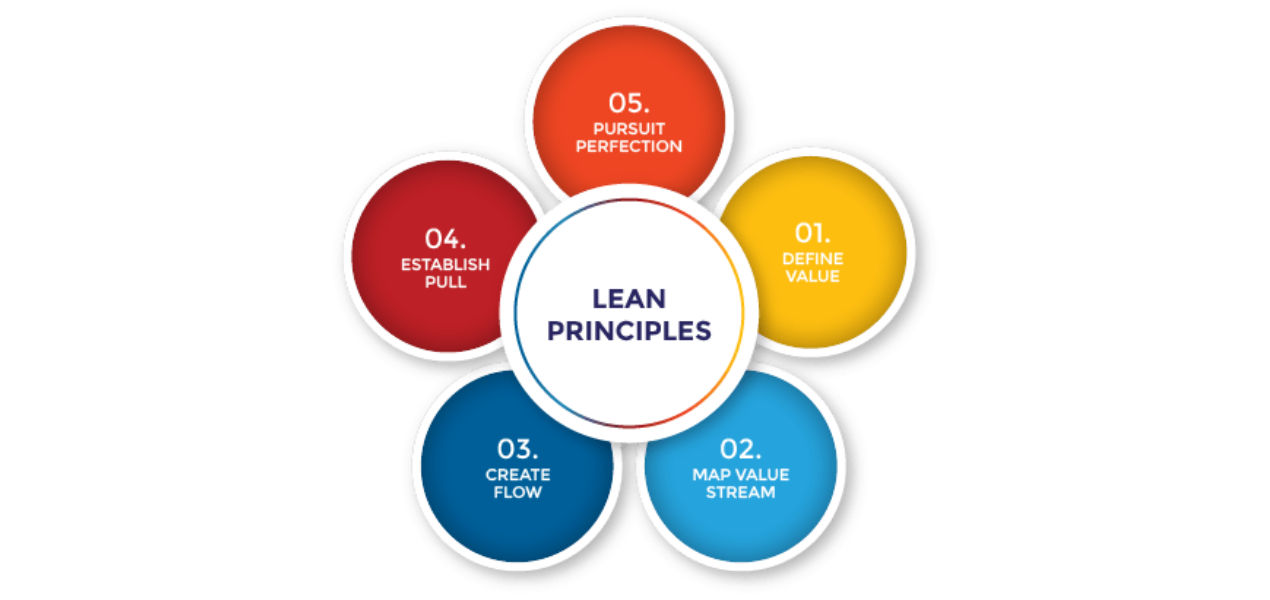
Lean Management is a way of improving how work is done by reducing waste and focusing on activities that add value for the customer. It helps organizations become more efficient and deliver better results. Let us look at the 5 Lean Management principles:
- Define Value
Value refers to what the customer needs and is willing to pay for. The first step in Lean Management is to understand the customer's expectations and identify what is important to them. For example, customers might value high quality, quick delivery, or affordable pricing. Anything in the process that does not contribute to meeting these needs is considered waste. - Map the Value Stream
This step involves analyzing the entire process, from the start (raw materials or inputs) to the final product or service delivered to the customer. By mapping the process, organizations can identify which steps add value and which ones are unnecessary. Non-value-adding activities, like delays or rework, are then targeted for elimination. - Create Flow
Once wasteful steps are removed, the process must flow smoothly without interruptions or delays. This ensures that tasks are completed efficiently, and resources are not wasted. For example, arranging tools and materials properly or removing bottlenecks can help improve the flow of work. - Establish Pull
In Lean Management, work is done based on demand, meaning products or services are created only when the customer needs them. This "pull" system avoids overproduction, reduces inventory costs, and ensures efficient use of resources. - Pursue Perfection
Lean is not a one-time activity; it’s a continuous process. Organizations should regularly analyze their processes, seek feedback, and implement improvements to reduce errors and deliver better value over time.
By following these principles, organizations can enhance productivity, minimize waste, and provide superior value to their customers. Also, obtaining Quality Management certifications enhance expertise in quality control and organizational improvement.
Lean Management Examples
Lean Management is widely used in various industries to improve processes and reduce waste. Here are some common examples:
- Automobile Industry
Ford is an excellent example of Lean Management in the automobile industry. While Toyota pioneered Lean principles, Ford adapted and refined them to improve its production processes significantly. Ford uses a highly efficient assembly line method, inspired by Lean principles. Each vehicle is produced in sequential steps, ensuring smooth workflows and minimal delays.
- Food Industry
The assembly line approach is a key Lean technique McDonald’s uses. Each worker is assigned a specific task, such as grilling, assembling, or packaging, to maintain a smooth flow of operations. This reduces delays, improves productivity, and ensures every order meets McDonald’s strict quality standards.
- Aerospace Industry
Boeing adopted Lean Management to improve its assembly processes. For instance, they implemented a moving assembly line for their 737 aircraft, which reduced production time and minimized inventory. By optimizing workflows and introducing standardized procedures, Boeing significantly improved productivity and reduced delays.
- Food and Beverages Industry
PepsiCo integrates Lean in its supply chain management. By optimizing routes, reducing transportation time, and improving delivery systems, PepsiCo ensures products reach the market faster, with less environmental impact. Through Lean Management, PepsiCo has successfully reduced costs, improved sustainability, and maintained high efficiency.
What Are the Benefits of Lean Management?
Lean management offers a multitude of benefits for organizations across various industries. By focusing on eliminating waste and improving efficiency, Lean can lead to:
- Reduced Waste:
With reduced waste, organizations can benefit from Lean project management. This, in turn, leads to better inventory control. Additionally, Lean management improves organizational efficiency and lowers operational costs. - Improved Productivity:
By streamlining processes and removing inefficiencies, Lean helps organizations boost productivity. Employees spend less time on non-value-adding activities. - Higher Quality:
Lean practices, such as standardizing work and continuous improvement, ensure consistent product and service quality. This leads to fewer defects and higher customer satisfaction. - Faster Delivery:
Lean reduces lead times by optimizing workflows and inventory management. It results in faster delivery of products or services to customers. By implementing a pull system, Lean management system ensures that work is delivered. This is done only when there is actual demand. - Cost Reduction:
With reduced waste, better inventory control, and improved efficiency, Lean management helps organizations lower operational costs. - Employee Engagement:
Lean encourages a culture of continuous improvement. In this culture, employees are empowered to identify problems and suggest solutions. Enrolling in courses like the Six Sigma Green Belt course helps them effectively analyze and improve business processes.
Different Tools of Lean Management
Lean Management approach uses various tools to identify inefficiencies, eliminate waste, and optimize processes. Here are some key tools commonly used:
- Value Stream Mapping (VSM):
This tool helps visualize the flow of materials and information through a process. It identifies value-adding and non-value-adding activities, helping to highlight areas for improvement. - 5S:
A workplace organization method that focuses on Sort, Set in order, Shine, Standardize, and Sustain. It aims to create an organized, clean, and efficient work environment, reducing waste and improving productivity. - Kaizen (Continuous Improvement):
Kaizen promotes small, incremental improvements by involving everyone in the organization. Employees are encouraged to suggest and implement changes that lead to better performance and efficiency. - Root Cause Analysis (5 Whys):
A problem-solving method that involves asking "Why" repeatedly to identify the root cause of an issue and implement lasting solutions.
- Just-in-Time (JIT):
JIT ensures that materials and products are produced only when needed, reducing overproduction and inventory costs. This approach helps minimize waste and improve delivery times. - Kanban:
A scheduling system that controls the flow of work and materials. It uses visual signals, like cards or boards, to manage tasks and inventory, ensuring that work is only done when there’s demand. - Poka-Yoke (Error Proofing):
This tool focuses on preventing errors by designing processes or equipment that automatically detect and correct mistakes before they occur, ensuring high-quality outcomes.
Conclusion
To summarize, Lean management is a powerful methodology that can transform organizations by eliminating waste and maximizing value. By focusing on continuous improvement, employee empowerment, and customer satisfaction, Lean can help businesses achieve sustainable growth and long-term success. As we move forward, it is essential to embrace Lean principles and adapt them to the ever-evolving business landscape.
By doing so, organizations can unlock their full potential and thrive in a competitive world. As John Shook wisely said, "Lean isn't Lean if it doesn't involve everyone." This emphasizes the importance of a whole-team approach to Lean implementation. When every team member contributes, Lean becomes a collaborative effort that drives sustainable improvements and ensures long-term success.
Frequently Asked Questions (FAQs)
1. What is the concept of lean?
Lean is a management philosophy focused on eliminating waste and maximizing value for the customer. It involves identifying and removing activities that do not add value to the product or service.
2. Who is a lean manager?
A lean manager is a leader who implements and promotes Lean principles within an organization. They are responsible for identifying waste, improving processes, and empowering employees to contribute to continuous improvement.
3. What is an example of Lean management?
A common example of Lean management is the Toyota Production System (TPS). TPS focuses on eliminating waste, reducing lead times, and improving quality through techniques like just-in-time production, Kaizen, and Jidoka.
4. What are the pillars of Lean?
The five pillars of Lean are:
- Specify Value: Clearly define what the customer values.
- Identify the Value Stream: Map the entire process from start to finish.
- Create Flow: Make the value-adding steps flow smoothly.
- Establish Pull: Produce only what is needed, when it is needed.
- Seek Perfection: Continuously strive to improve processes.
5. What is a lean environment?
A lean environment is a workplace that is organized, efficient, and focused on continuous improvement. It is characterized by a culture of problem-solving, employee empowerment, and a relentless pursuit of perfection.
144 articles published
Shivendra Sharma, an accomplished author of the international bestseller 'Being Yogi,' is a multifaceted professional. With an MBA in HR and a Lean Six Sigma Master Black Belt, he boasts 15 years of e...
Get Free Career Counselling
By submitting, I accept the T&C and
Privacy Policy