
What is Special Cause Variation? Definition, Examples, Importance
Updated on Aug 07, 2025 | 2.32K+ views
Share:
Table of Contents
View all
What would be the average sum if you threw 2 dice together? You would expect it to be around seven, while numbers around 2-3 or 11-12 would be considered outliers. But what would happen if the sum went above 12? An additional dice is something that you haven’t expected and is not something you have accounted for.
Such unexpected occurrences are considered special cause variation in any process. Identifying and mitigating these external factors is key to maintaining quality and sanctity of the process.
Let's look at what special cause variation is, examples, how to identify it and the difference between special cause and common cause variation. Read on to find out.
Master Right Skills & Boost Your Career
Avail your free 1:1 mentorship session
What is Special Cause Variation?
Any variation caused by an identifiable source that is not part of the usual process is considered as a special cause variation. Also known as assignable cause variation, these kind of variations usually tend to indicate that something unexpected has impacted the process. Such variations suggest the involvement of external factors or deviations that warrant a detailed investigation unlike common cause variation.
Sudden changes in raw material purity, malfunctioning machinery or errors by a new operator are all causes of special cause variations. Since these are not part of inherent changes in the process, they can generally be corrected once they’re identified.
Dr. W. Edwards Deming, a pioneer in quality management, was the one who coined the term "special cause variation”. He emphasized the importance of differentiating between the two types of variation as a crucial factor in effective management. Taking the incorrect approach to treating variations can lead to wastage of resources spurred by misinformed decision-making.
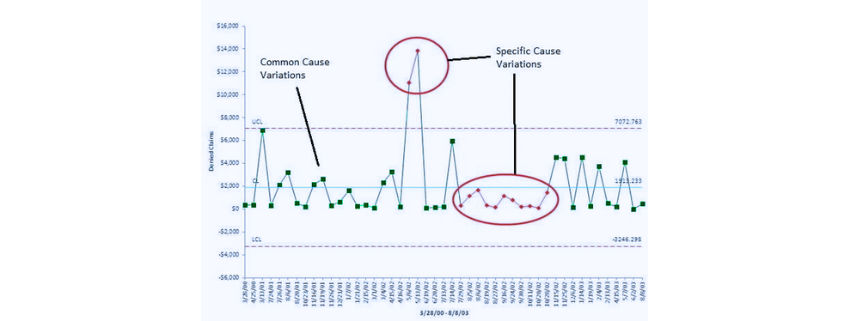
Let us look at the difference between special and common cause variation.
Improve your approach to quality management our courses on quality management. Stay ahead of the competition by using the right techniques to maintain quality.
Source: pmwares
Special Cause Variation vs Common Cause Variation
Differentiating between special and common cause variation is quite important to improving process efficiency.
| Special Cause Variation | Common Cause Variation | |
| 1. Definition | Any unusual variation caused by identifiable factors | Natural variations having a cause within limits of the process |
| 2. Predictability | Unpredictable and random | Predictable within identified control limits |
| 3. Frequency | Occasional and sporadic in nature | Identified to be consistent over the course of time |
| 4. Cause | External or assignable to something specific | Something that is built into the process |
| 5. Detection | Identifiable as outliers in control charts | Much more subtle and lie within the control limits |
| 6. Response Needed | Investigation and elimination of the root cause | Improvements on process capability |
| 7. Example | Machine malfunction halting production | Minor fluctuations in temperature or power |
| 8. Control Chart Signal | Trends that extend beyond control limits | Patterns that lie within control limits |
Now that we have seen the difference between the two kinds of variation, let us understand the importance of special cause variation in maintaining quality.
Importance of Special Cause Variation
It is vital to identify and address the root causes of special cause variation. It helps ensure that quality is maintained. These variations hint that there is something abnormal happening. Ignoring them and letting them continue leads to possibilities like deteriorated product/service quality, dissatisfied customers, and inefficient operations.
Understanding the reason behind special cause variations helps uncover any issues that were hidden previously. Let us look at that with a relevant example. Increased customer complaints could reveal device-specific bugs after the latest feature was released. This wouldn’t be revealed during the normal testing process. Organizations can quickly patch such issues by investigating and resolving them before they get out of hand. It also helps maintain brand reputation in the long run by addressing unseen issues.
Special cause variation also plays a tactical role. It acts as an early warning system which helps avoid larger deviations over time. This is extremely crucial in industries like pharmaceuticals, defense, or aerospace, where regulations are important. Ignoring such variations can lead to safety risks or compliance violations.
All of this also leads to a better data-driven decision-making process. Teams will learn to distinguish between common cause variations and special cause variations. Common cause variations can be given some leeway as they are often within the control limits. This is a crucial part of disciplined quality control initiatives like Six Sigma.
If you’re looking to improve your quality management skills, the Lean Six Sigma Green Belt certification is a good option for you.
Now that you’ve understood the importance of special cause variation, let’s look at different methods to identify them.
Identifying Special Cause Variation
There are different ways to identify special cause variations in a process. Let us look at a few of them in detail.
Control Charts
One of the most common ways to differentiate special and common cause variations is with the help of control charts. This is done by creating a plot of process data over time. Upper and lower control limits (UCL & LCL) are established based on historical data. These charts provide a visual signal of processes deviating from the norm.
If a single data point deviates from the control limits, it generally is caused by a common cause variation. On the other hand, if there are patterns like cycles, trends, or sudden shifts, it usually indicates a special cause variation. If consecutive data points show an increase, even within control limits could signify an assignable cause.
Keeping a well-documented control chart can help take corrective measures before things escalate. It also helps to avoid overreacting to common variation, leading to stable quality management practices.
Statistical Process Control (SPC)
Statistical Process Control (SPC) refers to using statistical methods to monitor and control processes. Using a continuous monitoring process allows for real-time detection and intervention of any special variation. A deeper analysis of any variation is done to identify and remove the root cause.
This method keeps strong emphasis on understanding variation with the help of statistical evidence. This kind of disciplined approach leads to better understanding of any fluctuations as well as guided decision-making.
Root Cause Analysis (RCA)
Conducting a Root Cause Analysis (RCA) is a crucial step to understanding what caused the variation. There are different ways to do this. Some techniques include the 5 Whys, utilizing fishbone diagrams (Ishikawa), Failure Mode and Effects Analysis (FMEA). This is done to trace the variation to its origin and understand how to resolve it.
A good combination of these tools helps form a comprehensive approach to identify and mitigate the cause of any special variation. Keeping a close eye on such variations ensures that quality is maintained and aligned with business objectives.
Examples of Special Cause Variation
Special cause variation can be seen in different industries. Let us look at how it presents itself in a few scenarios.
- Manufacturing: A company that creates silicon chips notices that the edges of the last few batches are uneven. On closer inspection, the mold has some residue due to overuse. Once the mold is replaced, production continues as normal, revealing an unassigned cause.
- Healthcare: A spike in wait times is observed on a specific weekend. It is traced to many doctors being on leave. This one-time event is resolved by creating a better schedule for doctor assignments.
- Call Centers: There is a significant drop in customer satisfaction on a day. It is found that a new script was implemented before reps were trained with it. Once proper training was done, it returned to normal.
- Food Service: One branch of a fast-food chain has been receiving unusually high complaints about all ice cream. Investigation reveals that the ice-cream machine’s internal thermostat was not working. Once it was fixed, complaints stopped.
- IT: Users began to report app crashes after a new feature was introduced. The root cause was identified as the service not being able to link with the account, which wasn’t the cause before it was added.
All of these highlight the random nature of unassigned variations. Since these were outside the normal processes, it required some action for the variation to be addressed. This highlights the need for vigilance and proactive response.
Now that we’ve understood how special variation occurs in different industries, let us look at the role it plays in quality management within the Six Sigma framework.
Role of Special Cause Variation in Six Sigma
Understanding and managing variation is key to improving quality within the Six Sigma framework. This is done by focusing on reducing defects and improving process efficiency. Distinguishing between common and special variance is crucial to this.
Special cause variation plays a critical role in the Measure and Analyze faces of the DMAIC (Define, Measure, Analyze, Improve, Control) framework. Teams in Six Sigma use tools like control charts and capability analysis to spot any anomalies. Once any special cause is identified, investigation for prioritized.
Addressing these variations helps stabilize the process and maintain quality. This ensures that outliers from one-time events aren’t included in data used to analyze process efficiency. Ignoring special cause variations can lead to misguided solutions due to distorted analysis.
Resolving these special variations will lead to quick wins by avoiding escalation. Eliminating these single outliers often leads to improved quality and efficiency without making large-scale changes.
Constand monitoring for special causes is a crucial part of the Control phase in Six Sigma. This kind of sustained monitoring is needed to manage special variations. A one-time effort isn’t what ensures improved quality in the Six Sigma framework.
Take the next step in your quality management career by earning the Six Sigma Black Belt certification.
Summing Up
Quality control and continuous improvement relies on identifying and mitigating any special cause variations. These specific and identifiable disruptions cause a greater impact on processes when compared to common cause variations.
Using tools like control charts, SPC, and RCA help analyze, detect, and eliminate special variation in an efficient manner. Managing special variation is also a crucial part of continuous quality improvement in the Six Sigma framework.
Frequently Asked Questions (FAQs)
1. What are the criteria for special cause variation?
There are a few key criteria to identify special cause variations. These variations have specific identifiable causes, are sporadic, show significant deviation, and can be identified by analyzing patterns on control charts that aren’t random.
2. What is a special cause variation run chart?
It is a type of run chart that is used to identify patterns that point to special cause variation. This is done by looking for trends that deviate from normal operating data.
3. Is special cause variation always present?
No, special cause variation isn’t always present. It happens only when there is an external impact on the process.
4. What is a special cause variation tool?
There are different tools to address and identify special cause variations. Some of them include control charts and lean tools like 5S, poka-yoke, and process mapping.
5. What is the special cause variation in QI?
In terms of Quality Improvement (QI), special cause variation refers to identifying external factors that impact the quality of the final product. It could refer to changes in raw material, the brief or tools used in the process.
1639 articles published
KnowledgeHut is an outcome-focused global ed-tech company. We help organizations and professionals unlock excellence through skills development. We offer training solutions under the people and proces...
Get Free Career Counselling
By submitting, I accept the T&C and
Privacy Policy