
Top Agile Prioritization Techniques: Methods & Tips
Updated on Aug 06, 2025 | 1.99K+ views
Share:
Table of Contents
View all
In Agile development’s constantly evolving world, knowing what to build - and when to build it - could play a key role between a product that will thrive and one that will likely fizzle out. With limited time, resources, and ever-changing customer needs, it’s highly impossible for teams to pursue every idea. Which is why prioritization has become absolutely critical.
Prioritization techniques help Agile teams keep their eye on the prize - delivering value. These are like your team’s North Star, seamlessly guiding them toward high-impact work and away from mere distractions. You could be a Product Owner deciding what goes into the next sprint, a Scrum Master facilitating planning sessions, or part of a cross-functional team - prioritization is your biggest superpower.
Unlike conventional project management, where plans are locked in early, Agile thrives on change. And that what that means is constantly reevaluating what the highest priority is. The good news? You don’t have to rely on your gut feeling alone.
In this blog, we’ll walk you through the most effective prioritization techniques used in Agile - and how you can utilize them in the best ways to make smarter and faster decisions that move your project forward.
Master the Right Skills & Boost Your Career
Avail your free 1:1 mentorship session
What are Agile Prioritization Techniques?
Prioritization is pretty simple. It’s just determining which tasks mean the most and tackling them in the order of most importance. Getting your priorities straight can ultimately help teams execute more efficiently and achieve important business objectives on time, in an Agile environment.
The whole goal of Agile prioritization techniques is to spend time, energy and resources on things that actually change something within the organization. Agile project management is significantly more dynamic and complicated than the traditional project management approaches, so a simple way to prioritize is essential to ensure work flows through the system with ease. Normally, we categorize the priorities into four levels - urgent, high, medium, and low - so that the team stays focused, and no one gets overwhelmed.
By knowing exactly what to work on first, Agile teams can deliver high quality products even when they’re under deadline or in an organization that lacks resources.
Why is the Agile Prioritization Technique Important?
Prioritization is an important decision-making ability in any context, but in an Agile environment, it becomes a catalyst for action. Agile prioritization methods provide frameworks for teams to hone what really matters to them and enable them to prioritize important tasks first – which is critical to their ability to maximize their outcomes based on their business and user objectives.
Agile prioritization methods can create a pace and spirit of collaboration, creativity, and adaptability. It encourages teams to share their information proactively, develop ideas with feedback built-in to enhance their chances for quality outcomes, and experiment relentlessly. By doing this, they reduce their rework risk, while also remarkably enhancing the quality of their product, and achieving the desired outcomes.
Prioritizing is not simply putting together a list of items to be accomplished. It is a responsible and intelligent action that links the product vision, customer needs, and business drivers. Product Owners can identify exactly which work will provide most value and likely provide feedback to ensure that the development teams take action which yield meaningful results - rather than taking up the developers’ time on low-impact work.
And by involving stakeholders in the prioritization process, you can ensure transparency and alignment across teams and help everyone move toward a common goal. Agile prioritization can turn a backlog into a roadmap for value-driven delivery.
To effectively implement Agile methodologies and stay ahead in today’s dynamic work environment, professionals must continuously upgrade their skills through structured Agile training programs.
Top Agile Prioritization Techniques
Since responsiveness and speed are of essence in an Agile development, knowing what to build next is key. And with rising demands, shifting customer preferences, and finite resources, teams are dependent on tried and tested prioritization methods to focus on the next high-value feature. Here are some popularly used Agile prioritization techniques, with their advantages and challenges, to help you identify which approach is apt for your team and product.
1. MoSCoW Method
Source: GlobalVox
Overview:
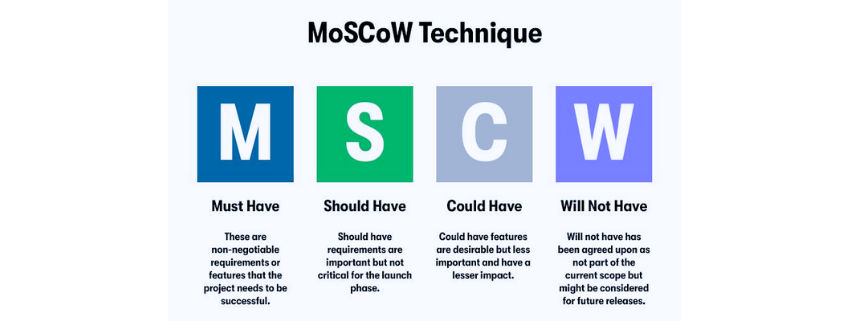
This technique categorizes features into four priority levels:
- Must Have: Non-negotiable for product delivery.
- Should Have: Valuable but not vital.
- Could Have: Nice additions, if time permits.
- Won’t Have: Not a focus for the current cycle.
Pros:
- Clear-cut and user-friendly.
- Aids in aligning the team and stakeholder expectations.
- Supports managing the scope in time-boxed iterations.
Cons:
- Can be open to interpretation.
- Could lead to debates over what qualifies as ‘must’ or ‘should’.
2. Kano Model
Source: Prodify
Overview:
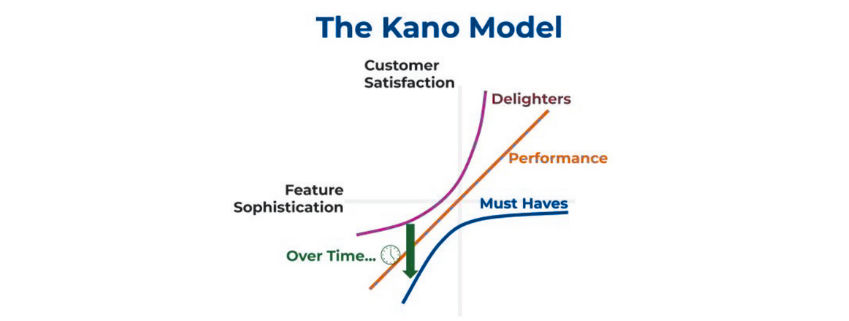
This model prioritizes features based on customer satisfaction. It includes:
- Basic Expectations: Must-haves - the absence of which causes dissatisfaction.
- Performance Features: Directly correlated to customer satisfaction.
- Exciters/Delighters: Unexpected features that exceed expectations.
Pros:
- Encourages a user-centric perspective.
- Points out impactful features that might otherwise be overlooked.
Cons:
- Relies on thorough customer research.
- Categorization can be subjective and nuanced.
3. RICE Scoring Model
Overview:
RICE stands for Reach, Impact, Confidence, and Effort. Every initiative is measured using:
- Reach: Potential users affected.
- Impact: The expected benefit.
- Confidence: Certainty in the data.
- Effort: Resources required.
Pros:
- Provides a numerical approach for comparison.
- Balances benefits with investment.
Cons:
- May be skewed by unreliable estimates.
- Requires consistent metrics across teams.
4. Relative Weighting Method
Overview: This technique evaluates each item based on benefit, cost, penalty, and risk. Scores are calculated to determine priority by weighing value against implementation cost.
Pros:
- Supports in-depth trade-off analysis.
- Promotes a comprehensive evaluation of potential work.
Cons:
- Resource-intensive to use on large lists.
- Needs clear agreement on scoring weights.
5. Opportunity Scoring
Overview: This method assesses how crucial a user's need is and how poorly it is currently met. Features that address important, unsatisfied needs are given top priority.
Pros:
- Focuses on resolving user pain points.
- Targets areas where the product underperforms.
Cons:
- Requires strong user insights.
- Subjective judgment can affect scoring.
6. Stack Ranking
Overview: Items are listed in order of importance, with each holding a distinct position. This forces product owners to make definitive choices and rank items comparatively.
Pros:
- Easy to understand and implement.
- Encourages decisive action.
Cons:
- May spark disagreement among team members.
- Doesn’t inherently account for cost or effort.
7. Priority Poker
Overview: A collaborative approach where team members vote on priorities using cards, followed by discussion to reach alignment. Inspired by the Planning Poker technique.
Pros:
- Promotes group decision-making.
- Reduces the influence of dominant voices.
Cons:
- Can take time with larger teams.
- May need facilitation to avoid conformity.
8. Cost of Delay
Overview: This method estimates the financial impact of postponing a feature. It helps determine which features bring the highest return when delivered sooner.
Pros:
- Highlights time-sensitive business value.
- Useful in aligning with strategic goals.
Cons:
- Requires accurate modeling of value loss.
- Can be difficult to quantify in dynamic markets.
9. 100 Dollar Test
Overview:
Participants are given a fictional $100 to distribute among features. How they allocate their "budget" reveals perceived priority.
Pros:
- Simple and engaging.
- Helps visualize stakeholder preferences.
Cons:
- Results may reflect opinions over logic.
- Doesn’t address technical dependencies or complexity.
10. Affinity Grouping
Overview:
Ideas or features are grouped by similarity, then teams prioritize the categories collectively. Ideal for brainstorming or early-stage planning.
Pros:
- Helps organize large, unstructured lists.
- Fosters team discussion and shared understanding.
Cons:
- Needs a moderator to stay effective.
- Prioritizing within groups is necessary.
No method by itself will fit every Agile team. The most effective product teams tailor these prioritization techniques to fit their workflow, goals, and challenges. By merging methods and being adaptable, teams can make sure that they’re investing in the work that brings the most value to users and stakeholders alike.
What are the Levels of Prioritization Techniques in Agile Development?
Let’s face it, not every task in Agile carries the same weight. Some are mission-critical. Others? Not so much. Which is why Agile teams use a ranked prioritization system to bring order to the chaos. This helps in more effectively managing time, energy, and resources.
The four popularly used levels are Low, Medium, High, and Urgent. Sounds simple, right? But this simple structure adds clarity to planning and helps in ensuring that the most impactful work rises to the top.
- Low-priority tasks are usually enhancements or 'nice-to-haves'. These are the items that refine the experience - maybe a visual tweak or a convenience feature. They’re valuable, but not vital. Your product still stands strong if you skip them.
- Medium-priority tasks bring noticeable improvements. They may not be deal-breakers, but they do make a difference on user satisfaction or backend efficiency. These usually come into play once higher priorities are out of the way.
- High-priority work is directly associated with user expectations or business objectives. It’s important, no doubt, and needs to be done soon. Just not necessarily right now. These items often drive major feature releases or improvements.
- Urgent-priority tasks? That’s a whole different ball game. These are the fires you can’t afford to ignore, commonly including critical bugs, system outages, or compliance risks. Here, immediate attention is non-negotiable, and teams must jump on these tasks ASAP to prevent damage.
By organizing tasks this way, Agile teams can stay focused, flexible, and move forward seamlessly. It’s a very simple yet powerful system that helps everyone to work smarter - not just harder.
How to Choose the Right Prioritization Technique?
Choosing the best prioritization technique in Agile isn’t as easy as choosing what is most popular. It’s about which technique syncs with your team’s context, goals, and difficulties. The best method is subjective to factors like the team's size, the product's complexity, stakeholder involvement, available data, and the time-sensitivity of the decisions to be taken.
If you’re working with limited data and need a fast, collaborative method, simple approaches like MoSCoW or Stack Ranking can help in getting to the crux of the matter. For teams dependent on customer insights, the Kano Model or Opportunity Scoring can highlight most impactful features that wow users. And in cases where metrics and objectivity are most critical, data-driven methods like RICE or Cost of Delay offer organized ways to weigh value against effort or urgency.
Consider your team’s maturity, decision-making approaches, and the strategic importance of the initiative. Quite often, combining techniques (like using RICE for roadmap planning and Priority Poker for sprint-level decisions) can give you the best of both worlds.
The right technique would be the one that brings clarity, encourages collaboration, and delivers value consistently. It’s important to keep experimenting, gather feedback, and refine your approach consistently as your team evolves.
Final Thoughts
In the swiftly moving world of Agile, knowing what to tackle first, and why, can make a world of difference between a product that’s just okay and one that truly hits bullseye. Whether you use classic prioritization techniques or dive deeper with backlog prioritization methods, the goal is simple - to focus on what's most important, when it matters most.
There’s no magic formula here. Some teams thrive on data while others lean on customer surveys or team-driven conversations. Whatever your approach, there’s a technique out there that fits your rhythm, your goals, and your culture.
Just remember: Agile isn’t static - and your prioritization process shouldn’t be either. The best teams tweak their methods as they grow. They adapt, experiment, and refine.
Make sure to use prioritization as more than a checklist. Make it a strategic compass. Because when done right, it helps you build high-value features, stay ready in the face of change, and move confidently toward outcomes that matter - for your users, your business, and your team.
Want to master the art of applying prioritization techniques in Agile?
Explore KnowledgeHut’s Agile management certifications and take the next step toward leading high-performing Agile teams.
Frequently Asked Questions (FAQs)
1. What is the 3-5-3 rule in Agile?
The 3-5-3 is the structure of 3 roles, 5 events, and 3 artifacts.
- 3 roles: Product Owner, Scrum Master, Development Team
- 5 events: Sprint, Sprint Planning, Daily Scrum, Sprint Review, Sprint Retrospective
- 3 artifacts: Product Backlog, Sprint Backlog, Increment.
2. How do you prioritize your work in Agile?
Work prioritization is done by evaluating value, risk, effort, and urgency. Techniques like MoSCoW, RICE, and the Kano Model aid teams in clearly narrowing down which features or tasks to focus on first to create optimal impact.
3. What is the best prioritization framework?
There’s no individual framework that rules them all. The best framework depends on a lot of factors. For example, RICE is apt for data-driven teams, MoSCoW is great for quick alignment, and the Kano Model is best for customer-focused prioritization.
4. What is Agile highest priority?
The Agile Manifesto suggests that the highest priority is ‘to satisfy the customer through early and continuous delivery of valuable software’. Customer value and rapid feedback loops dictate every decision.
1639 articles published
KnowledgeHut is an outcome-focused global ed-tech company. We help organizations and professionals unlock excellence through skills development. We offer training solutions under the people and proces...
Get Free Consultation
By submitting, I accept the T&C and
Privacy Policy
Ready to learn about Agile Certifications Roadmap?