
- Blog Categories
- Project Management
- Agile Management
- IT Service Management
- Cloud Computing
- Business Management
- BI And Visualisation
- Quality Management
- Cyber Security
- DevOps
- Most Popular Blogs
- PMP Exam Schedule for 2025: Check PMP Exam Date
- Top 60+ PMP Exam Questions and Answers for 2025
- PMP Cheat Sheet and PMP Formulas To Use in 2025
- What is PMP Process? A Complete List of 49 Processes of PMP
- Top 15+ Project Management Case Studies with Examples 2025
- Top Picks by Authors
- Top 170 Project Management Research Topics
- What is Effective Communication: Definition
- How to Create a Project Plan in Excel in 2025?
- PMP Certification Exam Eligibility in 2025 [A Complete Checklist]
- PMP Certification Fees - All Aspects of PMP Certification Fee
- Most Popular Blogs
- CSM vs PSM: Which Certification to Choose in 2025?
- How Much Does Scrum Master Certification Cost in 2025?
- CSPO vs PSPO Certification: What to Choose in 2025?
- 8 Best Scrum Master Certifications to Pursue in 2025
- Safe Agilist Exam: A Complete Study Guide 2025
- Top Picks by Authors
- SAFe vs Agile: Difference Between Scaled Agile and Agile
- Top 21 Scrum Best Practices for Efficient Agile Workflow
- 30 User Story Examples and Templates to Use in 2025
- State of Agile: Things You Need to Know
- Top 24 Career Benefits of a Certifed Scrum Master
- Most Popular Blogs
- ITIL Certification Cost in 2025 [Exam Fee & Other Expenses]
- Top 17 Required Skills for System Administrator in 2025
- How Effective Is Itil Certification for a Job Switch?
- IT Service Management (ITSM) Role and Responsibilities
- Top 25 Service Based Companies in India in 2025
- Top Picks by Authors
- What is Escalation Matrix & How Does It Work? [Types, Process]
- ITIL Service Operation: Phases, Functions, Best Practices
- 10 Best Facility Management Software in 2025
- What is Service Request Management in ITIL? Example, Steps, Tips
- An Introduction To ITIL® Exam
- Most Popular Blogs
- A Complete AWS Cheat Sheet: Important Topics Covered
- Top AWS Solution Architect Projects in 2025
- 15 Best Azure Certifications 2025: Which one to Choose?
- Top 22 Cloud Computing Project Ideas in 2025 [Source Code]
- How to Become an Azure Data Engineer? 2025 Roadmap
- Top Picks by Authors
- Top 40 IoT Project Ideas and Topics in 2025 [Source Code]
- The Future of AWS: Top Trends & Predictions in 2025
- AWS Solutions Architect vs AWS Developer [Key Differences]
- Top 20 Azure Data Engineering Projects in 2025 [Source Code]
- 25 Best Cloud Computing Tools in 2025
- Most Popular Blogs
- Company Analysis Report: Examples, Templates, Components
- 400 Trending Business Management Research Topics
- Business Analysis Body of Knowledge (BABOK): Guide
- ECBA Certification: Is it Worth it?
- Top Picks by Authors
- Top 20 Business Analytics Project in 2025 [With Source Code]
- ECBA Certification Cost Across Countries
- Top 9 Free Business Requirements Document (BRD) Templates
- Business Analyst Job Description in 2025 [Key Responsibility]
- Business Analysis Framework: Elements, Process, Techniques
- Most Popular Blogs
- Best Career options after BA [2025]
- Top Career Options after BCom to Know in 2025
- Top 10 Power Bi Books of 2025 [Beginners to Experienced]
- Power BI Skills in Demand: How to Stand Out in the Job Market
- Top 15 Power BI Project Ideas
- Top Picks by Authors
- 10 Limitations of Power BI: You Must Know in 2025
- Top 45 Career Options After BBA in 2025 [With Salary]
- Top Power BI Dashboard Templates of 2025
- What is Power BI Used For - Practical Applications Of Power BI
- SSRS Vs Power BI - What are the Key Differences?
- Most Popular Blogs
- Data Collection Plan For Six Sigma: How to Create One?
- Quality Engineer Resume for 2025 [Examples + Tips]
- 20 Best Quality Management Certifications That Pay Well in 2025
- Six Sigma in Operations Management [A Brief Introduction]
- Top Picks by Authors
- Six Sigma Green Belt vs PMP: What's the Difference
- Quality Management: Definition, Importance, Components
- Adding Green Belt Certifications to Your Resume
- Six Sigma Green Belt in Healthcare: Concepts, Benefits and Examples
- Most Popular Blogs
- Latest CISSP Exam Dumps of 2025 [Free CISSP Dumps]
- CISSP vs Security+ Certifications: Which is Best in 2025?
- Best CISSP Study Guides for 2025 + CISSP Study Plan
- How to Become an Ethical Hacker in 2025?
- Top Picks by Authors
- CISSP vs Master's Degree: Which One to Choose in 2025?
- CISSP Endorsement Process: Requirements & Example
- OSCP vs CISSP | Top Cybersecurity Certifications
- How to Pass the CISSP Exam on Your 1st Attempt in 2025?
- Most Popular Blogs
- Top 7 Kubernetes Certifications in 2025
- Kubernetes Pods: Types, Examples, Best Practices
- DevOps Methodologies: Practices & Principles
- Docker Image Commands
- Top Picks by Authors
- Best DevOps Certifications in 2025
- 20 Best Automation Tools for DevOps
- Top 20 DevOps Projects of 2025
- OS for Docker: Features, Factors and Tips
- More
- Agile & PMP Practice Tests
- Agile Testing
- Agile Scrum Practice Exam
- CAPM Practice Test
- PRINCE2 Foundation Exam
- PMP Practice Exam
- Cloud Related Practice Test
- Azure Infrastructure Solutions
- AWS Solutions Architect
- IT Related Pratice Test
- ITIL Practice Test
- Devops Practice Test
- TOGAF® Practice Test
- Other Practice Test
- Oracle Primavera P6 V8
- MS Project Practice Test
- Project Management & Agile
- Project Management Interview Questions
- Release Train Engineer Interview Questions
- Agile Coach Interview Questions
- Scrum Interview Questions
- IT Project Manager Interview Questions
- Cloud & Data
- Azure Databricks Interview Questions
- AWS architect Interview Questions
- Cloud Computing Interview Questions
- AWS Interview Questions
- Kubernetes Interview Questions
- Web Development
- CSS3 Free Course with Certificates
- Basics of Spring Core and MVC
- Javascript Free Course with Certificate
- React Free Course with Certificate
- Node JS Free Certification Course
- Data Science
- Python Machine Learning Course
- Python for Data Science Free Course
- NLP Free Course with Certificate
- Data Analysis Using SQL
Agile Sales Management: Importance, Benefits, and Incorporation
Updated on Sep 18, 2025 | 1k+ views
Share:
Table of Contents
View all
The sales landscape in today’s world is changing at a rapid pace. Informed buyers extend the decision-making cycle, and markets are changing too fast. Traditional sales patterns that follow rigid scripts and linear funnels aren't performing today.
The Agile framework has slowly evolved to help different parts of the organization. Sales is one of them. Agile Sales is based on the Agile software development process. It combines adaptability, collaboration, and continuous improvement into existing sales models,
In this blog, we will explore Agile Sales, its importance, benefits, and implementation.
Master the Right Skills & Boost Your Career
Avail your free 1:1 mentorship session
What is Agile Sales?
Agile Sales refer to applying Agile principles in sales operation. This brings the iterative nature of Agile along with adaptability and collaboration. It transforms sales into a customer-centric tradition. It tries to eliminate the usage of rigid and linear scripts. Agile Sales fosters experimentation and adjust based on what they learn.
It borrows the Agile principles used in software development. Flexibility and feedback loops are emphasized. Sales cycles are now given the sprint treatment. They are short and iterative efforts for teams to test messaging, refine outreach efforts, and analyze results quickly. This helps teams avoid using tactics that don’t work.
Transparency is another key factor of Agile sales. Sales teams can align priorities, spot bottlenecks, and adapt in a real-time manner. This is done with the help of stand-ups, shared dashboards, and collaborative tools.
Agile sales changes sales from a rigid, one-size-fits-all model to a dynamic and responsive process. This allows continuous delivery of value by adapting to customer behaviors and shifts in the market.
Improve your organization’s Agile transformation with the right Agile training.
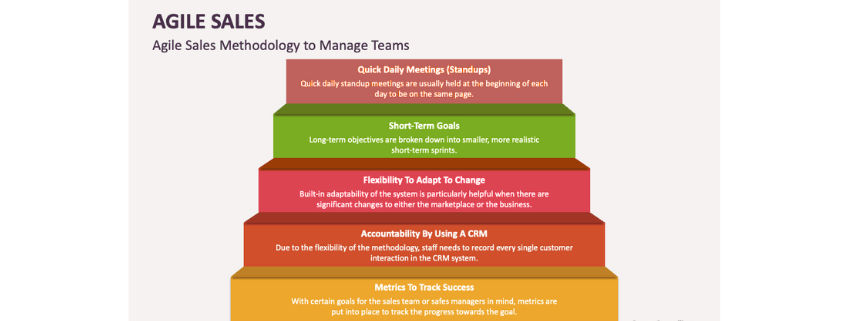
What is Agile Sales Management?
Agile Sales Management applies the Agile methodology in sales management. Teams are empowered with autonomy without straying from organizational goals.
Managers in the Agile sales framework act as facilitators and coaches. They are no longer supervisors. They help team members remove roadblocks by fostering collaboration and allowing experimentation. Managers and teams can reflect on what worked, what didn’t and methods of improvement. This is done through regular retrospectives.
Agile sales management also focuses on the importance of data. Managers monitor KPIs and feedback continuously instead of relying on quarterly reports. This enables quick pivots in strategy wherever required.
Source: Collidu
Why is Agile Sales Important for an Organization?
Agile sales is not just another methodology. It is a strategic response that can cater to a dynamic and evolving market. Traditional sales frameworks find it difficult to manage customer complexity and unpredictability. Agile sales help organizations to be resilient and succeed instead of barely thriving.
Here are a few reasons why Agile sales is important to an organization:
- Customer Expectations: Today’s customers expect personalized and fast engagement. The customer-first mindset of Agile helps sales teams in effectively meeting these demands.
- Market Volatility: Organizations can’t afford slow pivots in shifting economic conditions. Agile sales enables teams to adapt rapidly, protecting revenue streams.
- Team Engagement: Agile frameworks encourage collaboration. This leads to higher team moral and reduced turnover.
- Cross-Functional Alignment: Agile eliminates departments from working in isolated silos. The gap between sales, marketing, and product is bridged with Agile sales. The customer journey is seamless built across all touchpoints.
Agile sales help organizations remain competitive, reduce risks, and build stronger, trust-based customer relationships.
Agile Sales vs Traditional Sales
| Parameters | Agile Sales | Traditional Sales |
| 1. Approach | Iterative and customer-centric | Linear and target-driven |
| 2. Decision-Making | Data-driven and adaptive | Script-basic and hierarchical |
| 3. Collaboration | Cross-functional transparency | Siloed from other functions |
| 4. Feedback Cycle | Continuous feedback from customers | Periodic reviews either monthly or quarterly |
| 5. Flexibility | Embraces change | Resists change |
Core Principles of Agile Sales
Agile sales is built around 4 core principles:
- Customer-Centricity: Every action focuses on creating and delivering value to each customer.
- Iterative and Feedback-Oriented: Any sales strategy is tested in short cycles and refined based on real-time feedback.
- Collaboration and Transparency: Teams collaborate across functions by sharing data and working towards the same goals.
- Adaptability: Agile sales embraces change as an opportunity for growth and innovation.
Agile sales focuses on these principles to ensure teams can work efficiently.
Benefits of Agile Sales
Agile sales provides a lot of organizational benefits beyond closing deals quicker. Thes methodology brings a transformation to how sales teams operate.
Let’s look at a few key benefits of implementing the Agile methodology in sales.
1. Faster Response to Market
Agile sales teams work in short cycles. This helps them make changes based on real-time responses from the market. This allows teams to implement and change tactics as the market changes.
2. Improved Customer Engagement
Agile’s iterative nature helps quick incorporation of customer feedback. This continuous incorporation allows Sales representatives to create personalized and meaningful interactions.
3. Higher Win Rates
By embracing experimentation, teams can identify what is effect, and what isn’t. Pitches, channels, and touchpoints are chosen based on effectiveness. This leads to increased conversion rates and a consistent growth of revenue.
4. Cross-Functional Alignment
Agile bridges the gap between different functions. Consistent and regular sync with marketing and product improve the customer experience. Consistent messaging is used everywhere and customers receive an elevated experience.
5. Boosted Transparency and Accountability
Shared dashboards, stand-ups, and retrospectives enable transparency. Stakeholders gain real-time visibility into team performance. This boost accountability and ensure goals are on track.
Agile sales builds customer-centricity and adaptability into the sales team of an organization.
6. Incorporating the Agile Methodology into Sales
Making the transition to Agile sales isn’t about adopting new practices. It involves reshaping entire culture and process of the sales function. Taking a structured approach ensures long-term success.
Let’s look at how to make this transformation.
7. Educate and Align Teams
Introduce Agile values to the team with workshops. It teaches values like adaptability, collaboration, and iteration. This helps leadership and frontline staff understand the reason behind this transition. It also aligns everyone towards the Agile mindset.
8. Start Small with Pilots
Start small by launching a pilot project. Use sprint cycles for a single campaign or product line. This low-risk approach clarifies areas for improvement. Scaling can be done once refined.
9. Implement Stand-Ups and Reviews
Hold short, regular meetings on a consistent basis. This daily or weekly meeting can have a lot of benefits. Priorities can be aligned, obstacles identified, and small wins celebrated. Pairing stand-ups with retrospectives and sprint reviews leads to continuous improvement.
10. Integrate Customer Feedback Loops
Collecting insights should be done after every interaction with clients and prospective customers. This can be done with surveys, CRM data, and call notes. Improvements in messaging and conversion strategies can be done with the collected feedback.
11. Adopt the Right Tools
There are various tools like CRMs, Kanban, and analytic platforms. They provide visibility into workflows and performance. The right tools can also aid in data-driven decision making,
12. Foster a Culture of Experimentation
Sales representatives should be encouraged to test different approaches to increase conversion. Changes in messaging, outreach channels, or pricing shouldn’t be discouraged. Innovation happens in an environment where trying, failing, and quick learning is valued.
Using incremental steps is a good way to embed Agile into the sales team.
Empower your organization with the help of UpGrad KnowledgeHut Agile training courses.
Tools to Implement Agile Sales
Every successful Agile implementation requires support from the right tools. These tools enable visibility, collaboration, and flexible adaptation. They also help in sustainability and scalability.
Let’s look at some tools used in every successful Agile implementation.
1. CRM Platforms
Customer data should be available in a centralized database. CRM platforms are the best option for a database. Apart from tracking customer data, it also helps in workflow automation, and real-time insights. They are crucial for tracking interactions and outcomes across the sales cycle.
Example – Salesforce, HubSpot, Pipedrive
2. Kanban Boards
Workflow visualization is crucial to transparency in any Agile system. Kanban boards help teams with sprint planning, task prioritization, and bottleneck identification. Accountability becomes part of every stage in the sales cycle.
Example – Trello, Jira, Monday.com
3. Communication Platforms
Agile works best only if there is a common communication platform. These platforms facilitate instant updates, sharing files, and cross-departmental discussions. Everyone is aligned and can be easily contacted using these platforms.
Example – Slack, Microsoft Teams
4. Analytics Platforms
Raw data becomes valuable only once they turn into insights. Stales teams need relevant information to measure experiments and track KPIs. They also help confidently refine strategies backed by data.
Example – Power BI, Tableau, Google Data Studios
5. Sales Automation Tools
Automation software help reduce the time spent on repetitive tasks. These tools help with sending follow-up emails, scheduling meetings, and other such tasks. Representatives now have time to focus on other high-value activities.
Example – Outreach, Salesloft
Integrating these tools and education the team on their usage is important. The Agile methodology can be effortlessly integrated with the right usage.
Summing Up
Agile sales transforms the rigid sales model into a flexible and adaptable one. This methodology empowers teams to build stronger customer relationships and increases morale. The end result goes beyond better conversion rates and creates an accountable sales unit.
The Agile sales methodology allows organizations to be resilient and responsive in a changing market. It becomes a blueprint for long-term growth.
Frequently Asked Questions (FAQs)
1. What are the 4 concepts of Agile?
The four concepts are customer collaboration, responding to change, iterative delivery, and continuous improvement.
2. What is agility in sales?
Agility in sales means adapting quickly to customer needs, market changes, and feedback while maintaining focus on value delivery.
3. What is an example of Agile work?
Examples include sales teams running sprints to test pitches or using Kanban boards to manage deal pipelines.
4. Which is the best sales methodology?
There’s no one-size-fits-all, but Agile Sales is among the most effective for dynamic markets, complementing models like Solution Selling or Challenger Sales.
5. What jobs use Agile?
Agile is used in sales, marketing, IT, product management, customer success, and operations—essentially any role requiring adaptability and collaboration.
1639 articles published
KnowledgeHut is an outcome-focused global ed-tech company. We help organizations and professionals unlock excellence through skills development. We offer training solutions under the people and proces...
Get Free Consultation
By submitting, I accept the T&C and
Privacy Policy
Ready to learn about Agile Certifications Roadmap?