
PSPO Job and Salary Scope to Expect in 2026
Updated on Sep 15, 2026 | 8 min read | 12.34K+ views
Share:
Table of Contents
View all
Quick Overview
- PSPO Job and Salary Scope in 2026 includes Product Owner, Senior Product Owner, Product Manager, Agile Product Manager, and product leadership roles.
- PSPO I supports foundational Product Owner roles, while PSPO II focuses on advanced product strategy, outcomes, and stakeholder management.
- Product Owner salaries in India increase with experience and location, with the blog covering experience based and city wise salary figures.
- Product Ownership offers career growth, competitive salaries, business impact, transferable skills, and opportunities to transition from Agile or business roles.
- This guide covers PSPO jobs, salaries, career growth, reasons to become a Product Owner, and ways to maximize your PSPO Job and Salary Scope in 2026.
Ready to take your Product Owner career to the next level? Explore upGrad KnowledgeHut Professional Scrum Product Owner (PSPO) Training and build the skills to unlock stronger career opportunities in 2026.
Master the Right Skills & Boost Your Career
Avail your free 1:1 mentorship session
What are the PSPO job and salary scope in 2026?
The PSPO Job and Salary Scope in 2026 include a number of Product Owner and product-focused jobs. Having a PSPO certificate will help you boost your chances of applying for a Product Owner job and may also help you move into Senior Product Owner, Product Manager, and product leadership jobs.
The scope of PSPO jobs does not focus on one specific position only. This depends on your experience and your ability to practically implement the principles of Product Ownership. A fresh candidate may find his/her way through an associate or junior product position, whereas an experienced individual may apply to Product Owner and Senior Product Owner positions.
According to Scrum.org, PSPO I is a certificate indicating the basic knowledge of a Product Owner. PSPO II proves advanced knowledge of Product Ownership which includes product vision, Product Backlog, business strategy, and stakeholders.
PSPO Level |
Typical Career Positioning |
Main Scope |
| PSPO I | Product Owner, Associate Product Owner, Agile Product roles | Product value, Product Backlog, stakeholders |
| PSPO II | Senior Product Owner, Product Manager | Product strategy, outcomes, stakeholder management |
| PSPO III | Product leadership and expert Product Ownership | Complex products, strategy, organizational influence |
Also Read: How to Pass the PSPO Exam
What Jobs Can You Get With PSPO Certification?
The PSPO Job and Salary Scope has a variety of job positions within such areas as technology, finance, healthcare, retail, SaaS, consulting, etc. It depends on your prior experience and what kind of responsibilities you have.
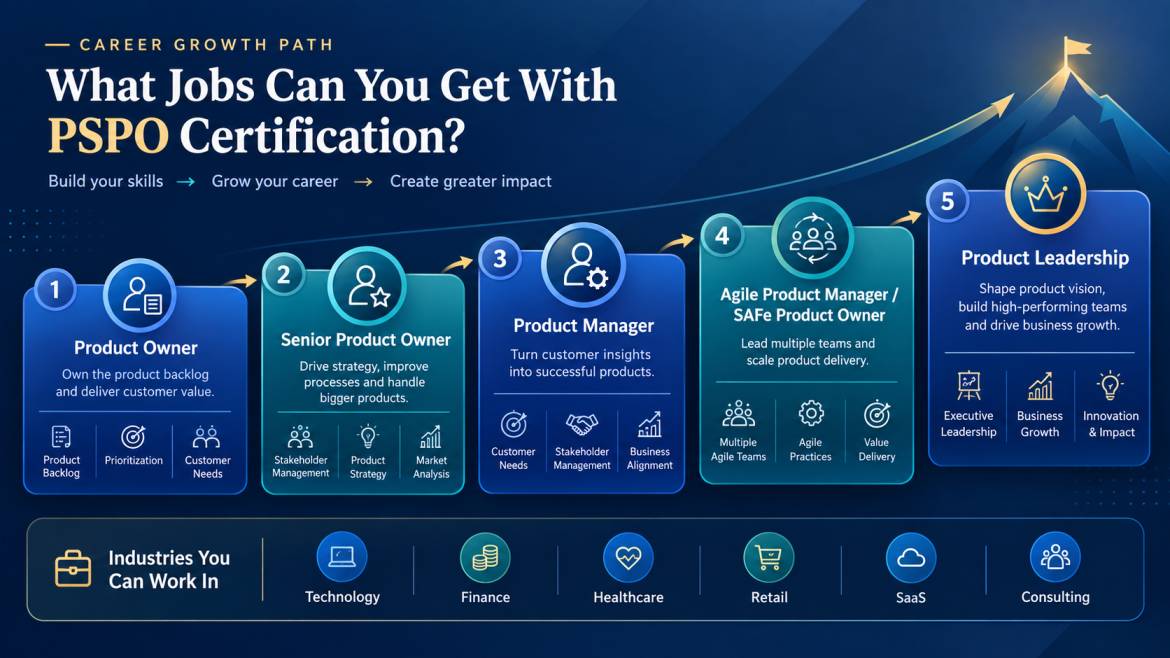
Product Owner
Product Owner is the most relevant profession for certified PSPO individuals. The role entails Product Backlog management, task prioritization, comprehension of customers' needs, interaction with stakeholders, and contribution to adding value to the product by the Scrum Team. One can start their career in Product Ownership as a certified PSPO I.
Senior Product Owner
A Senior Product Owner is responsible for more significant product-related tasks. Such a position includes strategic backlog management, achieving product outcomes, leading stakeholders, customer needs, and coordinating with different teams.
Product Manager
Product Owners can also become Product Managers. But Product Managers normally have larger responsibilities towards product strategy, market analysis, positioning, business objectives, growth, and product lifecycle management.
PSPO can contribute to this career progression through developing Product Ownership competency, but more product strategy, market analysis, analytics, and business competencies will be required.
Agile Product Manager and SAFe Product Owner Roles
Large organizations with scaled Agile processes may recruit individuals for the positions of an Agile Product Manager, Product Owner, Product Manager, and alike. Such positions may include collaborating with multiple teams and aligning product objectives with business ones.
This is another crucial aspect of the PSPO career path, especially for individuals who already have relevant experience in Agile or enterprise settings.
Product Leadership Roles
Individuals having significant product experience will be able to move up into positions like Lead Product Owner, Head of Product, Product Director, or even Chief Product Officer.
These are not guaranteed by having PSPO certification; instead, they demand good leadership skills, product strategy, business insight, customer awareness, and success records.
PSPO Salary in 2026: What to Expect?
The salary is often considered one of the major reasons for the attraction towards the PSPO Job and Salary Range. The certification allows getting a better paying job due to increased chances of employment.
Product Owner Salary by Experience in India
Experience is considered one of the most important criteria that affects Product Owner Salary in India. With increased experience, people usually have to bear greater responsibilities in the context of products, make more complicated decisions and communicate with more stakeholders.
The figures below show the average base pay across different experience levels:
| Experience | Average Base Pay |
| 0 to 1 year | ₹11.0L per year |
| 1 to 3 years | ₹12.3L per year |
| 4 to 6 years | ₹16.4L per year |
| 7 to 9 years | ₹18.0L per year |
| 10 to 14 years | ₹20.0L per year |
| 15+ years | ₹30.0L per year |
Source: Glassdoor
Highest Paying Cities for Product Owners in India
Location can create noticeable differences in Product Owner Salary. The available Indeed figures show variation across major cities in India.
| City | Average Annual Salary |
| Pune, Maharashtra | ₹19,92,176 |
| Gurgaon, Haryana | ₹18,62,872 |
| Noida, Uttar Pradesh | ₹18,43,949 |
| Kochi, Kerala | ₹16,86,917 |
| Mumbai, Maharashtra | ₹15,73,416 |
| Chennai, Tamil Nadu | ₹15,34,166 |
| Hyderabad, Telangana | ₹13,52,457 |
| Bengaluru, Karnataka | ₹11,85,482 |
| Coimbatore, Tamil Nadu | ₹10,84,264 |
Source: Indeed
Top Reasons to Become a Product Owner in 2026
The PSPO scope of work makes the role of the Product Owner an appealing one to many professionals who want to integrate technology, business, customer needs and decision making.
1. Growing Demand for Product Focused Professionals
Organizations need professionals who can align customer needs, business goals and development. Product Owner is a key figure in guiding teams on what to develop and why. Therefore, demand for them remains consistent across various industries.
2. Opportunity to Build a High Growth Product Career
Product Owner career growth allows you to get into positions such as Senior Product Owner, Product Manager, Group Product Manager and even more product leadership roles. Such career growth is the core part of long term PSPO career scope.
3. Competitive Salary and Career Growth Potential
Salaries of Product Owners can increase through increasing responsibility on larger products, harder decisions, greater number of stakeholders and measurable business results.
4. A Role With Direct Business Impact
Product Owner affects product priorities, customer value, feature priorities and business results. Therefore, the job can be very appealing to professionals looking for involvement in strategic decision making rather than implementation of decisions.
5. Transferable Skills Across Industries
Some examples of transferable skills that can be used in different industries include product prioritization, stakeholder management, customer knowledge, product strategy, and data-driven decision-making.
6. Strong Pathway From Agile and Business Roles
Anyone who is working as a Scrum Master, Business Analyst, Project Manager, Quality Assurance Specialist, or a developer can make use of the knowledge of Product Ownership to transition into a product-based career path.
Want to move faster in your Agile career? Explore upGrad KnowledgeHut Agile Management courses and gain the skills employers look for in 2026.
How to Maximize PSPO Job and Salary Scope in 2026
The steps below are designed to help maximize the PSPO Job and Salary Scope through a simple yet systematic process.
1. Build PSPO knowledge: Gain familiarity with Scrum basics, Product Owner responsibilities, product value and backlog management prior to certification.
2. Gain hands-on product experience: Take responsibility for managing a backlog, feature development, a product experiment or any other tangible product-related initiative, even within a non-product role in your organization.
3. Develop business and customer skills: Learn discovery, customer research, prioritization frameworks and basic product metrics along with Scrum.
4. Build an outcome focused resume: Demonstrate tangible results of increased adoption rate or reduced cycle time instead of only stating attendance at Scrum ceremonies.
5. Progress from PSPO I toward advanced Product Ownership when experience supports it: Scrum.org designates PSPO II as an advanced Product Ownership certification, while PSPO III designates distinguished Product Ownership expertise.
Conclusion
The PSPO Job and Salary Scope in 2026 offers opportunities across Product Owner, Senior Product Owner, Product Manager, Agile Product Manager, and product leadership roles. The certification can strengthen your knowledge and credibility, but it does not set your salary.
The PSPO career scope becomes broader as you gain practical experience, business knowledge, customer insight, and product strategy skills. If you combine PSPO certification with measurable product results and continuous skill development, you can build a strong and flexible product career.
Have A Query? Get in Touch With Our Customer Support | upGrad KnowledgeHut
Frequently Asked Questions (FAQs)
1. What is the scope of PSPO in 2026?
PSPO offers career opportunities in Product Ownership, Agile Product Management, and related product roles. Professionals can progress from Product Owner to Senior Product Owner, Product Manager, and product leadership positions. The PSPO career scope is strongest when certification is combined with practical product experience.
2. Is PSPO certification worth it for a Product Owner career?
Yes, PSPO can be valuable if you want to enter or grow in Product Ownership. It validates your understanding of Product Owner responsibilities, product value, Scrum, and Product Backlog management. However, certification alone does not guarantee a job or salary increase; practical experience remains essential.
3. What are the career options after PSPO?
After PSPO, you can target roles such as Product Owner, Associate Product Owner, Senior Product Owner, Agile Product Manager, and Product Manager. With experience and leadership skills, the path can extend toward Lead Product Owner, Head of Product, or Product Director. Your previous experience will influence which role you can enter.
4. What is the PSPO salary in India in 2026?
A PSPO certification does not have a separate salary range because PSPO is a certification, not a job title. In 2026, Product Owners in India will earn an average base salary of ₹11,97,724 per year, with typical salaries ranging from ₹7,66,870 to ₹18,70,647, depending on experience, location, and employer.
5. What skills do companies expect from PSPO professionals?
Companies typically expect Product Owners to understand Product Backlog management, prioritization, customer needs, stakeholder management, and product value. Product strategy, analytics, communication, discovery, and business understanding are also important for higher level roles. Technical awareness can be an advantage, especially in technology companies.
6. Can a Scrum Master transition to Product Owner with PSPO?
Yes, a Scrum Master can transition to Product Ownership with PSPO, particularly if they develop product focused skills. They need to move beyond facilitating Scrum and build experience in prioritization, customer discovery, Product Backlog management, and business decisions. PSPO can support the transition, but hands-on product experience makes the move stronger.
7. How can I increase my Product Owner salary?
Build skills that directly improve product outcomes, such as product strategy, analytics, customer discovery, prioritization, and stakeholder management. Take ownership of larger or more complex products and show measurable results on your resume. Moving to higher responsibility roles or organizations with stronger product teams can also increase compensation.
8. Is PSPO II worth pursuing after PSPO I?
PSPO II can be worthwhile for experienced Product Owners who want to demonstrate advanced Product Ownership knowledge. It is more relevant when you already handle product strategy, stakeholder complexity, and outcome focused decisions. For beginners without practical Product Owner experience, gaining hands-on experience may provide more immediate career value.
9. What is the difference between PSPO I and PSPO II?
PSPO I focuses on foundational Product Owner knowledge, including Scrum, product value, and Product Backlog management. PSPO II goes deeper into applying Product Ownership in complex situations, including product strategy, business decisions, and stakeholder management. Therefore, PSPO II is better suited to professionals with stronger practical Product Ownership experience.
10. Does AI knowledge affect Product Owner career scope in 2026?
Yes, AI knowledge can strengthen Product Owner career scope in 2026 by helping professionals identify AI use cases, understand customer insights, support data driven decisions, and collaborate effectively with technical teams. However, AI skills work alongside core Product Owner skills such as product strategy, backlog management, customer understanding, and stakeholder management.
1639 articles published
KnowledgeHut is an outcome-focused global ed-tech company. We help organizations and professionals unlock excellence through skills development. We offer training solutions under the people and proces...
Get Free Consultation
By submitting, I accept the T&C and
Privacy Policy
Ready to learn about Agile Certifications Roadmap?