
SAFe vs LeSS: Comprehensive Comparison of Agile Scaling Frameworks
Updated on Oct 29, 2025 | 2.19K+ views
Share:
Table of Contents
View all
There are different challenges that organizations encounter when scaling Agile across huge teams. Maintaining alignment, dependency, and customer focus are a few of these challenges. There are a few frameworks that help scale Agile in scale.
Scaled Agile Framework (SAFe) and Large-Scale Scrum (LeSS) are two such common frameworks. Both of them enable agility at scale, but they take entirely different approaches.
In this blog, we will look at both of these frameworks in detail and help you choose the right one to scale Agile in your organization.
Master the Right Skills & Boost Your Career
Avail your free 1:1 mentorship session
What is the SAFe Framework?
The Scaled Agile Framework (SAFe) provides a structured approach for scaling Agile in huge enterprises. It is done by implementing a top-down approach through 4 levels of configuration:
- Team
- Program
- Large Solution
- Portfolio
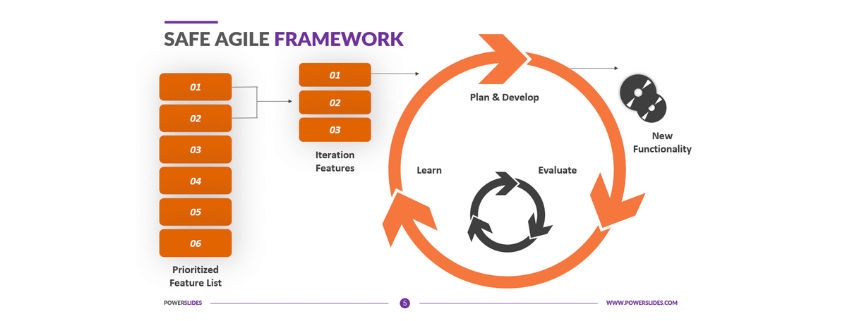
These levels help in connecting strategy and execution. Teams follow syncrhonized cycles called Agile Release Trains (ARTs). This is done to ensure that shared business goals are aligned. There are different roles that have defined responsibilities when it comes to maintain governance.
Here are some crucial roles in SAFe:
- Product Manager
- Release Train Engineer
- Solution Architect
- Portfolio Manager
SAFe helps complex environments to follow a structured Agile implementation. It is commonly used in organizations that require compliance and transparency. Visibility and structure are the biggest strengths of SAFe. A thorough implementation calls for discipline and investment in change management training.
Source: wimi.com
What is LeSS in Agile?
The LeSS (Large-Scale Scrum) framework helps organizations to extend Scrum principles to multiple teams. This is done without hierarchy being added, which is helpful for different teams working on the same product.
It was created by Bas Vodde and Craig Larman, and focuses on increasing transparency to simplify structures.
LeSS promotes the presence of a single Product Owner managing a single product backlog, this helps in unifying sprint reviews across multiple teams. The driving principle of LeSS is “More with LeSS”. This encourages organizations to remove unnecessary layers of management that act as hindrances for collaboration.
LeSS focuses on depening Scrum instead of the addition of new frameworks. Value is given for face-to-face communication, continuous learning, and collective ownership.
LeSS is best-suited for organizations that have mature Agile teams. Scaling is supported by preserving adaptability and customer focus while teams are introduced. Organizations follow a lightweight, principle-driven model without added focus on bureaucracy.
SAFe vs LeSS: Table of Differences
| Parameter | SAFe Framework | LeSS Framework |
| 1. Approach | Structured model with defined roles | Lightweight scaling based on principles |
| 2. Governance & Roles | Defined roles across multiple levels | Minimal roles & shared accountability |
| 3. Structure | Multi-tiered hierarchy | Flat structure with a single Product Owner and backlog |
| 4. Complexity in Implementation | High - requires organizational transformation | Moderate - suited for experienced Scrum teams |
| 5. Primary Focus | Alignment, visibility, and predictability | Simplicity, learning, and descaling |
SAFe vs LeSS: Detailed Comparison
Understanding the differences between these two frameworks can help you choose the one that works best for your organization.
1. SAFe vs LeSS: Philosophy and Core Approach
SAFe is built around alignment and governance. It standardizes processes to synchronize delivery across teams. This makes it ideal for large enterprises.
In contrast, LeSS prioritizes simplicity and empowerment. This is under the assumption that fewer rules lead to faster learning and innovation.
2. SAFe vs LeSS: Roles and Hierarchy
SAFe introduces roles like Product Management, Solution Architect, and Release Train Engineer. These roles help maintain coordination. Accountability is ensured with a lot of layers.
LeSS prioritizes minimal team roles. There is only a single Product Owner and Scrum Master per team. This encourages teams for cross-collaboration by reducing handoffs.
3. LeSS vs SAFe: Governance and Decision-Making
Program Increments and Lean Portfolio Management helps SAFe to follow top-down management. Business strategy is directly tied to team output.
LeSS emphasizes transparency and collective ownership. This is done by spreading decision-making across teams.
4. LeSS vs SAFe: Implementation and Learning Curve
Implementing SAFe in any organization requires extensive planning, certification, and executive support. While such rollouts offer productivity, adoption is slowed.
On the other hand, LeSS is easier for teams with high Scrum maturity. Success is dependent on disciplined communication and the willingness of leadership to relinquish control.
5. LeSS vs SAFe: Scalability and Fit
SAFe can be scaled to hundreds of teams across global enterprises. It is commonly seen in industries like finance, telecom, and defense.
In contrast, LeSS can accommodate up to 8–10 teams per product. LeSS Huge can support more teams while staying lightweight. It suits organizations that want to grow agility without institutionalizing it.
6. SAFe vs LeSS: Certification and Ecosystem
SAFe offers globally recognized certifications that cater to growing demand for those roles. LeSS certifications are smaller in scale, but emphasize principle-driven transformation.
What Should You Choose Between SAFe and LeSS?
The choice between SAFe and LeSS depends on the following factors:
- Organizational culture
- Average team size
- Business goals
- Current Agile maturity
SAFe is suitable for organizations that prefer structure, visibilty, and governance across teams and departments. It shows great results in regulated and mult-vendor environments. The comprehensive roadmap offered by SAFe makes implementation easy if hierarchies are already established.
LeSS is a great choice for organizations that have an effective Scrum practice and prefer simplicity and autonomy. Agility is retained by removing redundant layers of management. Mid-sized or tech-driven companies thriving on adaptability and learning can benefit by implementing LeSS.
There is no right answer to the question “Which is a better framework?” Both of these frameworks solve different problems. Complexity is managed through structure with SAFe, while LeSS focuses on eliminating it.
There are some organizations which also blend both of these frameworks. The portfolio-level governance of SAFe is mixed with the lightweight team practices seen in LeSS.
Choose and approach that aligns with your business objectives and don’t follow latest trends if it doesn’t work.
Summing Up
SAFe and LeSS aim to scale Agile without losing the focus on customer value. These frameworks adopt contrasting approaches to the same. SAFe builds scalability through structure, while LeSS achieves it through simplification.
The right choice for your depends on what your organization prioritizes between control and adaptability.
Whichever path you take, remember that agility isn’t defined by frameworks. It’s built by teams that learn, adapt, and deliver value continuously.
Frequently Asked Questions (FAQs)
1. What is the meaning of LeSS in Agile?
LeSS stands for Large-Scale Scrum, a framework that extends Scrum principles across multiple teams working on one product.
2. Is SAFe more popular than LeSS?
Yes. SAFe is more widely adopted in large enterprises due to its structure and established certification paths, while LeSS appeals to smaller, more flexible organizations.
3. How to get SAFe certification?
Enroll in accredited SAFe courses such as Leading SAFe® or SAFe Scrum Master offered by platforms like upGrad KnowledgeHut, then pass the certification exam.
4. How many Agile frameworks are there?
Popular Agile frameworks include Scrum, Kanban, SAFe, LeSS, Disciplined Agile, and the Spotify Model. Each of them addresses different scaling and workflow needs.
5. What is the LeSS model?
The LeSS model extends Scrum to multiple teams, keeping one Product Owner, one backlog, and synchronized sprint reviews for transparency and collaboration.
1639 articles published
KnowledgeHut is an outcome-focused global ed-tech company. We help organizations and professionals unlock excellence through skills development. We offer training solutions under the people and proces...
Get Free Consultation
By submitting, I accept the T&C and
Privacy Policy
Ready to learn about Agile Certifications Roadmap?