
- Blog Categories
- Project Management
- Agile Management
- IT Service Management
- Cloud Computing
- Business Management
- BI And Visualisation
- Quality Management
- Cyber Security
- DevOps
- Most Popular Blogs
- PMP Exam Schedule for 2025: Check PMP Exam Date
- Top 60+ PMP Exam Questions and Answers for 2025
- PMP Cheat Sheet and PMP Formulas To Use in 2025
- What is PMP Process? A Complete List of 49 Processes of PMP
- Top 15+ Project Management Case Studies with Examples 2025
- Top Picks by Authors
- Top 170 Project Management Research Topics
- What is Effective Communication: Definition
- How to Create a Project Plan in Excel in 2025?
- PMP Certification Exam Eligibility in 2025 [A Complete Checklist]
- PMP Certification Fees - All Aspects of PMP Certification Fee
- Most Popular Blogs
- CSM vs PSM: Which Certification to Choose in 2025?
- How Much Does Scrum Master Certification Cost in 2025?
- CSPO vs PSPO Certification: What to Choose in 2025?
- 8 Best Scrum Master Certifications to Pursue in 2025
- Safe Agilist Exam: A Complete Study Guide 2025
- Top Picks by Authors
- SAFe vs Agile: Difference Between Scaled Agile and Agile
- Top 21 Scrum Best Practices for Efficient Agile Workflow
- 30 User Story Examples and Templates to Use in 2025
- State of Agile: Things You Need to Know
- Top 24 Career Benefits of a Certifed Scrum Master
- Most Popular Blogs
- ITIL Certification Cost in 2025 [Exam Fee & Other Expenses]
- Top 17 Required Skills for System Administrator in 2025
- How Effective Is Itil Certification for a Job Switch?
- IT Service Management (ITSM) Role and Responsibilities
- Top 25 Service Based Companies in India in 2025
- Top Picks by Authors
- What is Escalation Matrix & How Does It Work? [Types, Process]
- ITIL Service Operation: Phases, Functions, Best Practices
- 10 Best Facility Management Software in 2025
- What is Service Request Management in ITIL? Example, Steps, Tips
- An Introduction To ITIL® Exam
- Most Popular Blogs
- A Complete AWS Cheat Sheet: Important Topics Covered
- Top AWS Solution Architect Projects in 2025
- 15 Best Azure Certifications 2025: Which one to Choose?
- Top 22 Cloud Computing Project Ideas in 2025 [Source Code]
- How to Become an Azure Data Engineer? 2025 Roadmap
- Top Picks by Authors
- Top 40 IoT Project Ideas and Topics in 2025 [Source Code]
- The Future of AWS: Top Trends & Predictions in 2025
- AWS Solutions Architect vs AWS Developer [Key Differences]
- Top 20 Azure Data Engineering Projects in 2025 [Source Code]
- 25 Best Cloud Computing Tools in 2025
- Most Popular Blogs
- Company Analysis Report: Examples, Templates, Components
- 400 Trending Business Management Research Topics
- Business Analysis Body of Knowledge (BABOK): Guide
- ECBA Certification: Is it Worth it?
- Top Picks by Authors
- Top 20 Business Analytics Project in 2025 [With Source Code]
- ECBA Certification Cost Across Countries
- Top 9 Free Business Requirements Document (BRD) Templates
- Business Analyst Job Description in 2025 [Key Responsibility]
- Business Analysis Framework: Elements, Process, Techniques
- Most Popular Blogs
- Best Career options after BA [2025]
- Top Career Options after BCom to Know in 2025
- Top 10 Power Bi Books of 2025 [Beginners to Experienced]
- Power BI Skills in Demand: How to Stand Out in the Job Market
- Top 15 Power BI Project Ideas
- Top Picks by Authors
- 10 Limitations of Power BI: You Must Know in 2025
- Top 45 Career Options After BBA in 2025 [With Salary]
- Top Power BI Dashboard Templates of 2025
- What is Power BI Used For - Practical Applications Of Power BI
- SSRS Vs Power BI - What are the Key Differences?
- Most Popular Blogs
- Data Collection Plan For Six Sigma: How to Create One?
- Quality Engineer Resume for 2025 [Examples + Tips]
- 20 Best Quality Management Certifications That Pay Well in 2025
- Six Sigma in Operations Management [A Brief Introduction]
- Top Picks by Authors
- Six Sigma Green Belt vs PMP: What's the Difference
- Quality Management: Definition, Importance, Components
- Adding Green Belt Certifications to Your Resume
- Six Sigma Green Belt in Healthcare: Concepts, Benefits and Examples
- Most Popular Blogs
- Latest CISSP Exam Dumps of 2025 [Free CISSP Dumps]
- CISSP vs Security+ Certifications: Which is Best in 2025?
- Best CISSP Study Guides for 2025 + CISSP Study Plan
- How to Become an Ethical Hacker in 2025?
- Top Picks by Authors
- CISSP vs Master's Degree: Which One to Choose in 2025?
- CISSP Endorsement Process: Requirements & Example
- OSCP vs CISSP | Top Cybersecurity Certifications
- How to Pass the CISSP Exam on Your 1st Attempt in 2025?
- Most Popular Blogs
- Top 7 Kubernetes Certifications in 2025
- Kubernetes Pods: Types, Examples, Best Practices
- DevOps Methodologies: Practices & Principles
- Docker Image Commands
- Top Picks by Authors
- Best DevOps Certifications in 2025
- 20 Best Automation Tools for DevOps
- Top 20 DevOps Projects of 2025
- OS for Docker: Features, Factors and Tips
- More
- Agile & PMP Practice Tests
- Agile Testing
- Agile Scrum Practice Exam
- CAPM Practice Test
- PRINCE2 Foundation Exam
- PMP Practice Exam
- Cloud Related Practice Test
- Azure Infrastructure Solutions
- AWS Solutions Architect
- IT Related Pratice Test
- ITIL Practice Test
- Devops Practice Test
- TOGAF® Practice Test
- Other Practice Test
- Oracle Primavera P6 V8
- MS Project Practice Test
- Project Management & Agile
- Project Management Interview Questions
- Release Train Engineer Interview Questions
- Agile Coach Interview Questions
- Scrum Interview Questions
- IT Project Manager Interview Questions
- Cloud & Data
- Azure Databricks Interview Questions
- AWS architect Interview Questions
- Cloud Computing Interview Questions
- AWS Interview Questions
- Kubernetes Interview Questions
- Web Development
- CSS3 Free Course with Certificates
- Basics of Spring Core and MVC
- Javascript Free Course with Certificate
- React Free Course with Certificate
- Node JS Free Certification Course
- Data Science
- Python Machine Learning Course
- Python for Data Science Free Course
- NLP Free Course with Certificate
- Data Analysis Using SQL
- Home
- Blog
- Artificial Intelligence
- How Long Does It Take to Learn AI for Supply Chain Management?
How Long Does It Take to Learn AI for Supply Chain Management?
Updated on Oct 17, 2026 | 358 views
Share:
Table of Contents
View all
- How long does it take to learn AI for supply chain management?
- What is the learning roadmap for AI in supply chain management?
- What factors affect how quickly you can learn AI for supply chain management?
- What skills do you need to learn AI for supply chain management?
- What projects can help you practise AI for supply chain management?
Quick Overview
- AI for supply chain management can take 2-6 weeks to learn at a foundational level, 2-3 months to apply AI tools, and 6-12 months or longer to develop technical machine learning skills.
- Start with AI fundamentals and supply chain use cases, then learn data analysis using Excel or BI tools before progressing to SQL, Python, and machine learning.
- Your learning time depends on your supply chain experience, existing data skills, weekly study hours, and whether you want to use AI tools or build predictive models.
- Practise with real-world projects such as demand forecasting, inventory optimization, and delivery performance analysis to understand how AI supports supply chain decisions.
- This guide covers the learning timeline, step-by-step roadmap, essential skills, factors affecting progress, and practical projects to help you learn AI for supply chain management.
Explore how AI agents can streamline supply chain workflows and support smarter decisions with the Applied Agentic AI Certification by upGrad KnowledgeHut.
How long does it take to learn AI for supply chain management?
Learning AI for supply chain management time can vary from a few weeks to several months, depending on your objectives. Understanding basic AI concepts required less time than building and testing machine learning models.
The below table will provide the general idea of how long each learning stage may take.
| Learning goal | Estimated time | What you can achieve |
| Learn AI fundamentals | 2-6 weeks | Understand basic AI concepts and identify supply chain use cases |
| Apply AI tools at work | 2-3 months | Use AI tools for basic analysis, reporting, and planning tasks |
| Complete practical projects | 3-6 months | Work on forecasting, inventory analysis, or delivery performance |
| Develop technical AI skills | 6-12 months or longer | Build and evaluate machine learning models with suitable datasets |
Also Read: Best AI Tools for Supply Chain Professionals in 2026
What is the learning roadmap for AI in supply chain management?
A step-by-step roadmap makes learning easier because you can build one skill before moving to the next. Start with basic concepts, learn how to work with data, and then apply your knowledge to real supply chain problems.
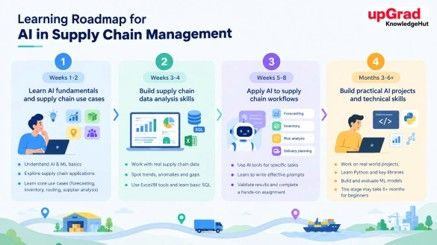
Weeks 1-2: Learn AI fundamentals and supply chain use cases
Start by understanding what AI is, how machine learning works, and how businesses use these technologies. You do not need to begin with coding or complex mathematical concepts.
Focus on common supply chain applications, such as:
- Demand forecasting in order to estimate future demand of a certain product.
- Inventory management in order to spot potential shortages or excesses in inventories.
- Routes planning to increase efficiency of deliveries.
- Analysis of suppliers in order to spot any delays or supply risks.
For example, a retail business could make a forecast of which products are likely to sell well during the festive period. This helps the planning team to prepare their stock in advance.
Weeks 3-4: Build supply chain data analysis skills
Since the AI is based on the data, one of the crucial skills to be learned is working with data, including its reading and interpretation.
Work with data, like sales history, current stock quantity, supplier delivery time, etc. Learn to recognize any anomalies in data, gaps, as well as compare actual and expected data.
Start with Excel or a business intelligence tool to create simple reports and charts. You can also learn basic SQL if you want to retrieve information from a database.
For instance, by looking at previous orders you can identify products which often run out of stock. This in turn gives you a better understanding of where improved forecasting or inventory planning may help.
Also Read: How Artificial Intelligence Is Transforming Supply Chain Risk Management
Weeks 5-8: Apply AI to supply chain workflows
Once you understand the basics and can work with data, start using AI tools for specific tasks. Choose one workflow rather than trying to learn every possible application at once.
You could practise using AI to summarise supplier reports, analyse demand patterns, prepare inventory insights, or support delivery planning. Learn to write clear instructions, provide relevant context, and check the results before using them.
AI can make mistakes. You need to check AI's suggestions against real data, company rules, and actual work situations.
At this stage you should complete an assignment to demonstrate the use of an AI application in solving a particular supply chain issue.
Months 3-6+: Build practical AI projects and technical skills
If you want to develop a deeper level of skill then start working on small projects using real world examples. That's where you can move beyond just using the tools that are available and start to learn how the models are actually built and how they are actually evaluated.
Start learning Python if your aim is to develop machine learning models. Explore libraries like pandas for data analysis and scikit-learn for machine learning. You can then practise forecasting demand, comparing model predictions, and measuring errors.
You should also learn how to assess whether a model is of any use in practice. A forecast that looks accurate on historical data may still perform poorly when the demand actually changes.
This stage could take longer than 6 months if you're new to programming or statistics.
For those who prefer a bit more guidance explore AI-Powered Supply Chain Management Certification from upGrad KnowledgeHut.
Also Read: AI Use Cases in Retail Supply Chain Management
What factors affect how quickly you can learn AI for supply chain management?
The amount of time needed by individuals to learn AI is not the same. There are three main factors which affect how fast you can make progress.
Existing supply chain knowledge
If you have already worked in procurement, logistics, warehouse operations, or demand planning, then you have a good starting point as you are aware of the problems that businesses encounter and can relate AI concepts to the kinds of tasks you are used to.
For instance, a demand planner might already be familiar with seasonal demand and stock shortages. It would be simpler for them to learn how AI can be used in forecasting than it would be to learn both supply chain concepts and AI from the beginning.
Beginners can still learn these skills, but they may need extra time to understand basic supply chain processes.
Also Read: How Artificial Intelligence Helps Businesses Predict Supply Chain Disruptions
Data analytics and programming experience
Someone who is already comfortable with Excel, dashboards and the like will get through the early stages very quickly. Being familiar with data makes it a lot easier to understand how the models work and why the results turn out as they do.
Those coming from zero should be absolutely fine. Python and SQL are both well known as being very beginner friendly and a few weeks of regular practice will make a huge difference.
Weekly study time and hands-on practice
Time plays an important role, however, what you do with the time is more important. 5 to 7 hours per week spent on studying with consistent practice is better than spending 15 hours per week passively observing. Consistency is the key. A little done everyday is better than one big effort once a month.
Practice is the component that makes theory into practice. Everything you learn should be complemented with a little practical example based on what you learned.
Discover how to use generative AI for supply chain analysis, reporting, and planning with the Generative AI and Prompt Engineering Course.
What skills do you need to learn AI for supply chain management?
A good learner doesn't need to master everything at once. Three skill areas and that's pretty much all you need.
Supply chain analytics and data literacy
Data literacy is about being able to read the data, question the data and explain the data. In the context of supply chains that means being able to understand the key metrics (inventory turnover, order fill rate, lead time, on time delivery etc) and also being able to spot when the data is wrong or the data is incomplete.
This skill is frequently overlooked. The quality of the model is entirely dependent on the quality of the data it's trained on and someone with good data literacy can spot the issues early on.
AI and machine learning fundamentals
A learner should get the key points without necessarily needing to go into the maths. The key points are: how the model learns from past data, what training and what testing are and how you decide whether a prediction is good enough to be trusted.
It's also useful to know the various types of model that are out there (forecasting models, classification models, clustering etc). More important than knowing how to code them from the ground up is knowing when to use which type.
AI tools, SQL, and Python
Tools turn ideas into results. SQL is used to pull and filter data from databases. Python is used to clean data, build models and automate the stuff you do over and over again. You then have a whole raft of no code and low code AI tools which allow people to go and test their ideas without writing a single line of code. A sensible order would be spreadsheets first, then some basic SQL, then Python.
Also Read: How AI Analytics Helps Businesses Build More Resilient Supply Chains
What projects can help you practise AI for supply chain management?
Projects are where learning becomes visible. They also give you something to show off in an interview. The ideal starter project is one that uses a fairly simple dataset and addresses one very clear problem. Here are three good projects to get you started with AI for supply chain.
Demand forecasting
This is the textbook starter project. The idea is to take historical sales data and use it to forecast future demand for a product. A beginner can start off with a very simple trend based forecast in a spreadsheet and then progress to a basic Python model.
The real learning comes from comparing the forecast to what actually happened and asking why there's a gap. Seasonality, promotions and sudden spikes will account for most of it.
Inventory optimization
Too much stock ties up cash. Too little stock and you miss sales. This project is about finding the right balance. A learner can use demand data and lead times to work out the level of safety stock and the reorder point for a handful of products.
A good extension would be to group the products by how fast they sell and how much they cost and then set different stock rules for each group. That would be a clear example of data driving decisions rather than decisions being made on the basis of guesswork.
Delivery performance analysis
This is all about shipping and logistics data. The objective is to work out which routes, which carriers, which regions have the worst delays. You can work out on time delivery rates, spot the patterns and then make recommendations as to how to fix them.
It's a great project for the novice as the data is easy to understand and the results are easy to explain. With a bit more work it can be developed into a model that will predict which orders are likely to be late.
Learn to identify valuable AI use cases and align AI-driven solutions with business goals through the AI-Powered Product Management Certification by upGrad KnowledgeHut.
Conclusion
Learning AI for supply chain management can take 2-3 months to apply existing AI tools to tasks such as demand analysis and inventory planning, while building machine learning models may take 6-12 months or longer. The exact timeline depends on your existing knowledge, study hours, and learning goals.
Start with AI fundamentals and supply chain data analysis, then practise with projects in demand forecasting, inventory optimization, and delivery analysis. Focus on applying what you learn rather than simply completing courses. With consistent practice, you can build the skills needed to use AI more effectively in supply chain operations.
Have A Query? Get in Touch With Our Customer Support | upGrad KnowledgeHut
Frequently Asked Questions (FAQs)
1. What are the 7 C's of SCM?
The 7 C’s of supply chain management are commonly described as coordination, collaboration, communication, connectivity, consistency, customer focus, and cost efficiency. These principles help businesses align suppliers, manufacturers, distributors, and retailers. However, the exact seven terms can vary across supply chain frameworks, as there is no single universally accepted list.
2. What are the four main types of supply chain management?
The four commonly discussed supply chain management models are continuous flow, fast chain, efficient chain, and agile chain. Continuous flow suits stable demand, fast chains support short product life cycles, efficient chains focus on cost and resource utilization, and agile chains respond to changing demand. Some frameworks classify supply chains differently based on business needs.
3. Which course teaches AI for supply chain management?
The AI-Powered Supply Chain Management Certification by upGrad KnowledgeHut is a relevant option for professionals looking to explore AI applications in supply chain operations. You can check the program details on upGrad KnowledgeHut for the latest curriculum, availability, and enrollment information.
4. Which AI tools are used in supply chain management?
Popular AI-powered supply chain tools include SAP Integrated Business Planning (SAP IBP) for demand forecasting and inventory planning, Blue Yonder for supply chain planning and optimization, and Oracle Fusion Cloud SCM for logistics and supply chain operations. Businesses also use Microsoft Dynamics 365 Supply Chain Management for demand planning and inventory management. The right tool depends on the company’s size, existing systems, and operational needs.
5. How do I measure the success of an AI supply chain project?
Measure success by comparing performance before and after implementing AI. Track metrics relevant to the project, such as forecast accuracy, inventory carrying costs, stockout rates, on-time delivery, and order fulfilment time. For example, a demand forecasting project is successful if it improves forecast accuracy and helps reduce excess inventory without increasing stockouts.
6. Is Python necessary for supply chain AI?
No, Python is not necessary if you want to use existing AI tools for reporting, demand planning, or inventory analysis. However, Python is valuable for building machine learning models, processing large datasets, and developing custom forecasting solutions. Beginners can start with Excel and AI-enabled tools before learning Python for more technical applications.
7. What is the best first project for learning supply chain AI?
A demand forecasting project is a practical starting point because it uses historical sales data to predict future demand. Begin by organizing sales records, identifying seasonal patterns, and generating a basic forecast. Compare your predictions with actual sales to measure accuracy and understand how forecasting can support inventory decisions.
8. What jobs can I pursue after learning AI for supply chain management?
Learning AI for supply chain management can help you prepare for roles such as supply chain analyst, demand planning analyst, inventory analyst, logistics analyst, and supply chain data analyst. With stronger programming and machine learning skills, you can also target machine learning engineer or supply chain data scientist roles that focus on predictive models and optimization.
9. Do I need advanced mathematics to build supply chain AI models?
No, you do not need advanced mathematics to begin learning AI, but building machine learning models requires a stronger foundation in statistics, probability, and basic algebra. More advanced forecasting and optimization methods may require calculus, linear algebra, or operations research. The mathematical depth depends on the models you want to develop.
10. How do companies implement AI across their supply chains?
Companies typically begin by identifying a specific problem, such as inaccurate demand forecasts, excess inventory, or delivery delays. They collect and prepare relevant data, select an appropriate AI solution, test its performance against business metrics, and integrate it into existing workflows. They then monitor accuracy, costs, and operational results before expanding implementation to other supply chain processes.
1639 articles published
KnowledgeHut is an outcome-focused global ed-tech company. We help organizations and professionals unlock excellence through skills development. We offer training solutions under the people and proces...
Get Free Consultation
By submitting, I accept the T&C and
Privacy Policy