
- Blog Categories
- Project Management
- Agile Management
- IT Service Management
- Cloud Computing
- Business Management
- BI And Visualisation
- Quality Management
- Cyber Security
- DevOps
- Most Popular Blogs
- PMP Exam Schedule for 2025: Check PMP Exam Date
- Top 60+ PMP Exam Questions and Answers for 2025
- PMP Cheat Sheet and PMP Formulas To Use in 2025
- What is PMP Process? A Complete List of 49 Processes of PMP
- Top 15+ Project Management Case Studies with Examples 2025
- Top Picks by Authors
- Top 170 Project Management Research Topics
- What is Effective Communication: Definition
- How to Create a Project Plan in Excel in 2025?
- PMP Certification Exam Eligibility in 2025 [A Complete Checklist]
- PMP Certification Fees - All Aspects of PMP Certification Fee
- Most Popular Blogs
- CSM vs PSM: Which Certification to Choose in 2025?
- How Much Does Scrum Master Certification Cost in 2025?
- CSPO vs PSPO Certification: What to Choose in 2025?
- 8 Best Scrum Master Certifications to Pursue in 2025
- Safe Agilist Exam: A Complete Study Guide 2025
- Top Picks by Authors
- SAFe vs Agile: Difference Between Scaled Agile and Agile
- Top 21 Scrum Best Practices for Efficient Agile Workflow
- 30 User Story Examples and Templates to Use in 2025
- State of Agile: Things You Need to Know
- Top 24 Career Benefits of a Certifed Scrum Master
- Most Popular Blogs
- ITIL Certification Cost in 2025 [Exam Fee & Other Expenses]
- Top 17 Required Skills for System Administrator in 2025
- How Effective Is Itil Certification for a Job Switch?
- IT Service Management (ITSM) Role and Responsibilities
- Top 25 Service Based Companies in India in 2025
- Top Picks by Authors
- What is Escalation Matrix & How Does It Work? [Types, Process]
- ITIL Service Operation: Phases, Functions, Best Practices
- 10 Best Facility Management Software in 2025
- What is Service Request Management in ITIL? Example, Steps, Tips
- An Introduction To ITIL® Exam
- Most Popular Blogs
- A Complete AWS Cheat Sheet: Important Topics Covered
- Top AWS Solution Architect Projects in 2025
- 15 Best Azure Certifications 2025: Which one to Choose?
- Top 22 Cloud Computing Project Ideas in 2025 [Source Code]
- How to Become an Azure Data Engineer? 2025 Roadmap
- Top Picks by Authors
- Top 40 IoT Project Ideas and Topics in 2025 [Source Code]
- The Future of AWS: Top Trends & Predictions in 2025
- AWS Solutions Architect vs AWS Developer [Key Differences]
- Top 20 Azure Data Engineering Projects in 2025 [Source Code]
- 25 Best Cloud Computing Tools in 2025
- Most Popular Blogs
- Company Analysis Report: Examples, Templates, Components
- 400 Trending Business Management Research Topics
- Business Analysis Body of Knowledge (BABOK): Guide
- ECBA Certification: Is it Worth it?
- Top Picks by Authors
- Top 20 Business Analytics Project in 2025 [With Source Code]
- ECBA Certification Cost Across Countries
- Top 9 Free Business Requirements Document (BRD) Templates
- Business Analyst Job Description in 2025 [Key Responsibility]
- Business Analysis Framework: Elements, Process, Techniques
- Most Popular Blogs
- Best Career options after BA [2025]
- Top Career Options after BCom to Know in 2025
- Top 10 Power Bi Books of 2025 [Beginners to Experienced]
- Power BI Skills in Demand: How to Stand Out in the Job Market
- Top 15 Power BI Project Ideas
- Top Picks by Authors
- 10 Limitations of Power BI: You Must Know in 2025
- Top 45 Career Options After BBA in 2025 [With Salary]
- Top Power BI Dashboard Templates of 2025
- What is Power BI Used For - Practical Applications Of Power BI
- SSRS Vs Power BI - What are the Key Differences?
- Most Popular Blogs
- Data Collection Plan For Six Sigma: How to Create One?
- Quality Engineer Resume for 2025 [Examples + Tips]
- 20 Best Quality Management Certifications That Pay Well in 2025
- Six Sigma in Operations Management [A Brief Introduction]
- Top Picks by Authors
- Six Sigma Green Belt vs PMP: What's the Difference
- Quality Management: Definition, Importance, Components
- Adding Green Belt Certifications to Your Resume
- Six Sigma Green Belt in Healthcare: Concepts, Benefits and Examples
- Most Popular Blogs
- Latest CISSP Exam Dumps of 2025 [Free CISSP Dumps]
- CISSP vs Security+ Certifications: Which is Best in 2025?
- Best CISSP Study Guides for 2025 + CISSP Study Plan
- How to Become an Ethical Hacker in 2025?
- Top Picks by Authors
- CISSP vs Master's Degree: Which One to Choose in 2025?
- CISSP Endorsement Process: Requirements & Example
- OSCP vs CISSP | Top Cybersecurity Certifications
- How to Pass the CISSP Exam on Your 1st Attempt in 2025?
- Most Popular Blogs
- Top 7 Kubernetes Certifications in 2025
- Kubernetes Pods: Types, Examples, Best Practices
- DevOps Methodologies: Practices & Principles
- Docker Image Commands
- Top Picks by Authors
- Best DevOps Certifications in 2025
- 20 Best Automation Tools for DevOps
- Top 20 DevOps Projects of 2025
- OS for Docker: Features, Factors and Tips
- More
- Agile & PMP Practice Tests
- Agile Testing
- Agile Scrum Practice Exam
- CAPM Practice Test
- PRINCE2 Foundation Exam
- PMP Practice Exam
- Cloud Related Practice Test
- Azure Infrastructure Solutions
- AWS Solutions Architect
- IT Related Pratice Test
- ITIL Practice Test
- Devops Practice Test
- TOGAF® Practice Test
- Other Practice Test
- Oracle Primavera P6 V8
- MS Project Practice Test
- Project Management & Agile
- Project Management Interview Questions
- Release Train Engineer Interview Questions
- Agile Coach Interview Questions
- Scrum Interview Questions
- IT Project Manager Interview Questions
- Cloud & Data
- Azure Databricks Interview Questions
- AWS architect Interview Questions
- Cloud Computing Interview Questions
- AWS Interview Questions
- Kubernetes Interview Questions
- Web Development
- CSS3 Free Course with Certificates
- Basics of Spring Core and MVC
- Javascript Free Course with Certificate
- React Free Course with Certificate
- Node JS Free Certification Course
- Data Science
- Python Machine Learning Course
- Python for Data Science Free Course
- NLP Free Course with Certificate
- Data Analysis Using SQL
- Home
- Blog
- Cloud Computing
- How long does it take to become job-ready in cloud computing
How long does it take to become job-ready in cloud computing
Updated on Sep 22, 2026 | 1.41K+ views
Share:
Table of Contents
View all
Quick Overview
- Becoming job ready in cloud computing typically takes 3 to 12 months, depending on prior IT experience, study time, and the target role.
- IT professionals with networking or Linux experience may need around 3 to 6 months, while complete beginners may need 6 to 12 months to build fundamentals, cloud skills, projects, and certification knowledge.
- Advanced cloud roles such as Cloud Architect or Cloud Security Specialist can take 1 to 2 years, as they require deeper technical knowledge and practical experience.
- This guide tells you about how long it takes to become job ready in cloud computing, the skills to learn, ways to accelerate the learning process, and a practical cloud job readiness checklist.
Build the skills needed to design and manage scalable cloud solutions with AWS Solutions Architect Training, covering AWS architecture, cloud services, security, and deployment.
Master the Right Skills & Boost Your Career
Avail your free 1:1 mentorship session
How Long Does It Take to Become Job Ready in Cloud Computing?
The Time to Become Job Ready in Cloud Computing can vary from a few months to a year depending on the starting point and career goal. Someone aiming for an entry level cloud support role may need less preparation than someone targeting a cloud engineer or DevOps position.
A realistic timeline can look like this:
• 1 to 2 months for cloud and IT fundamentals
• 1 to 2 months for hands on work with a major cloud platform
• 1 to 2 months for projects, security, automation, and interview preparation
The more practical work included in the learning process, the better the understanding of how cloud environments actually operate.
Cloud Computing Learning Timeline for Beginners
For someone starting from scratch, learning cloud computing can be approached in stages rather than trying to cover everything at once.
A practical beginner timeline is:
Learning Stage |
Approximate Time |
| Cloud fundamentals | 2 to 4 weeks |
| Networking and Linux basics | 3 to 5 weeks |
| AWS, Azure, or Google Cloud fundamentals | 4 to 6 weeks |
| Security and identity basics | 2 to 3 weeks |
| DevOps and automation basics | 3 to 4 weeks |
| Hands on projects and interview preparation | 3 to 5 weeks |
Time Required Based on Prior IT Experience
Prior experience can make a noticeable difference to the Time to Become Job Ready in Cloud Computing.
Background |
Approximate Time |
| No IT background | 5 to 8 months |
| Basic IT knowledge | 4 to 6 months |
| IT support or system administration | 3 to 5 months |
| Networking or Linux experience | 2 to 4 months |
| Experienced developer or DevOps professional | 2 to 3 months |
Time Required for Different Cloud Computing Roles
The time required also depends on the role being targeted. This is an important part of understanding how long does it take to become a cloud engineer, because cloud engineer roles usually require a broader technical foundation.
Cloud Role |
Approximate Preparation Time |
| Cloud Support Associate | 3 to 5 months |
| Junior Cloud Administrator | 4 to 6 months |
| Cloud Engineer | 5 to 8 months |
| Cloud DevOps Engineer | 6 to 9 months |
| Cloud Security Associate | 5 to 8 months |
| Cloud Architect | 1 to 2+ years of broader experience |
Learn more about What Certifications Are Required to Become a Cloud Engineer? and explore the certifications and skills that can support a career in cloud engineering.
What Should You Learn to Become Job Ready in Cloud Computing?
Understanding what is cloud computing is only the starting point. Job readiness comes from combining cloud knowledge with networking, Linux, security, automation, and hands on practice.
The following areas form a practical foundation for anyone wondering how to learn cloud computing.
1. Cloud Computing Fundamentals
Start by understanding how cloud environments work and why organisations use them.
Important concepts include:
• Public, private, and hybrid cloud
• Infrastructure as a Service
• Platform as a Service
• Software as a Service
• Virtual machines
• Containers
• Storage
• Databases
• Scalability and availability
• Cloud pricing concepts
2. Networking and Linux Fundamentals
Cloud systems depend heavily on networking and operating system concepts. Weak networking knowledge can make cloud services much harder to understand.
Focus on:
• IP addresses
• DNS
• Subnets
• Routing
• Firewalls
• Ports and protocols
• Linux commands
• File permissions
• Processes and services
3. Core AWS, Azure, or Google Cloud Services
Beginners should avoid trying to learn every cloud platform at the same time. Start with one provider and understand its core services properly.
Depending on the platform, focus on:
• Compute services
• Storage services
• Databases
• Networking
• Identity and access management
• Monitoring
• Basic serverless services
4. Cloud Security and Identity Management
Security is an essential part of cloud work, even at the entry level.
Learn the basics of:
• Identity and access management
• User roles and permissions
• Authentication
• Encryption
• Network security
• Security monitoring
• Shared responsibility concepts
5. DevOps and Cloud Automation Basics
Modern cloud roles often involve automation and continuous delivery. Basic DevOps knowledge can therefore reduce the Time to Become Job Ready in Cloud Computing for professionals targeting technical roles.
Useful areas include:
• Version control
• Continuous integration
• Continuous delivery
• Infrastructure as code
• Containers
• Monitoring
• Automation workflows
6. Hands On Cloud Projects
Hands on practice is one of the biggest factors affecting Time to Become Job Ready in Cloud Computing. A learner who only watches lessons may understand concepts but still struggle with practical tasks.
Projects can involve:
• Deploying a simple application
• Setting up cloud storage
• Creating a secure cloud network
• Configuring identity and access
• Monitoring a cloud service
• Automating a basic deployment
Learn How to Become a Cloud Engineer to understand the required skills, job profile, salary, career progression, and certifications for a cloud engineering career.
How to Become Job Ready in Cloud Computing Faster?
A shorter Time to Become Job Ready in Cloud Computing does not mean rushing through lessons. It means focusing on the skills that are directly connected to the target role.
A focused learning plan can help avoid spending months on topics that are not immediately useful.
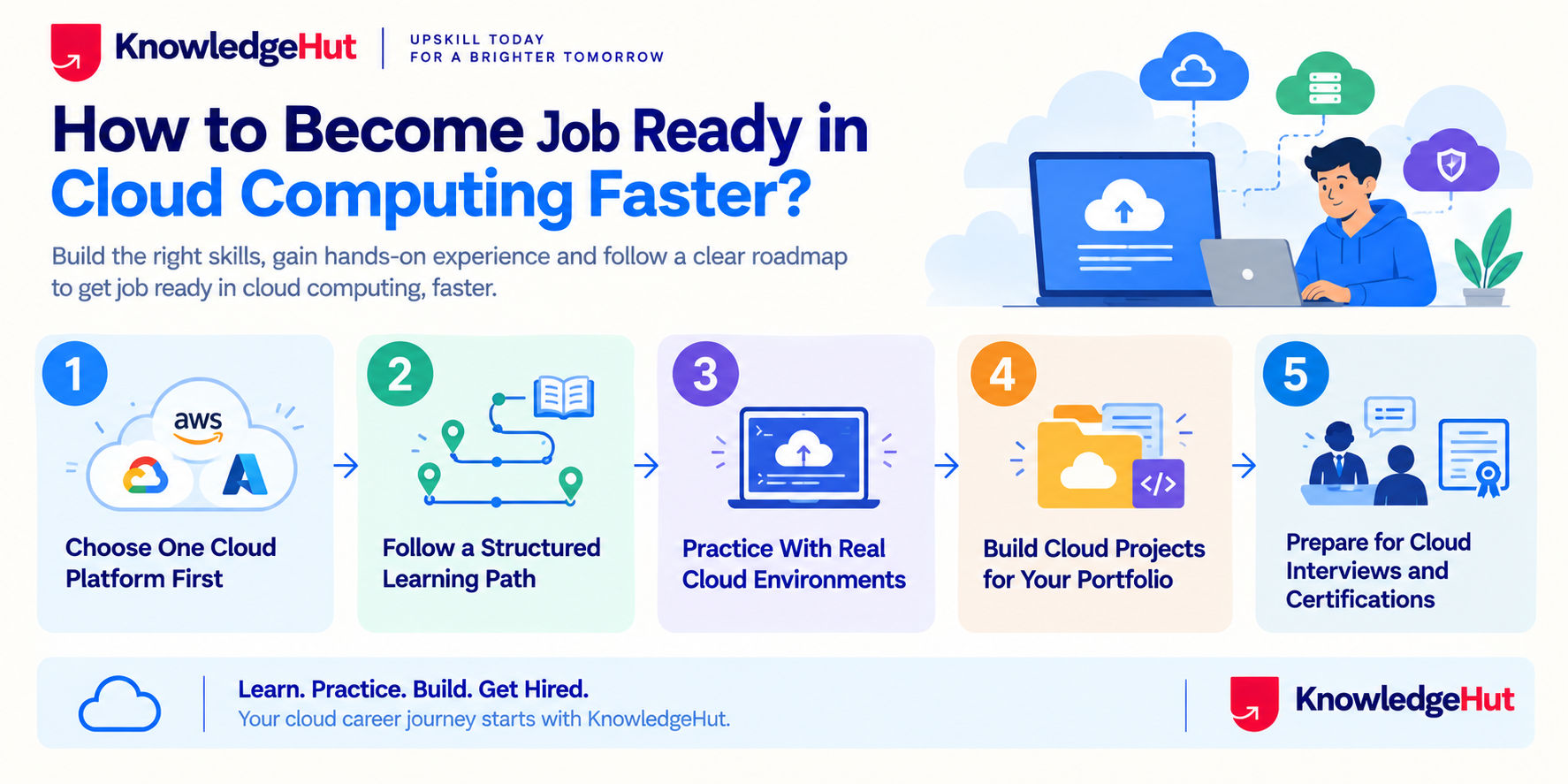
Step-1 Choose One Cloud Platform First
Trying to learn AWS, Azure, and Google Cloud simultaneously can make the learning process unnecessarily broad.
Choose one platform based on:
• Target job openings
• Existing technical experience
• Industry preference
• Career goals
Step-2 Follow a Structured Learning Path
A clear sequence makes how to improve cloud computing skills much easier to manage.
A practical order is:
- Learn cloud fundamentals
- Strengthen networking and Linux
- Learn one cloud platform
- Practise security and identity
- Add DevOps and automation
- Build projects
- Prepare for interviews
Step-3 Practice With Real Cloud Environments
Hands on practice helps connect theory with real cloud behaviour. Free tiers, trial environments, and controlled learning labs can provide opportunities to explore services without building large production systems.
During practice, focus on:
• Creating resources
• Configuring permissions
• Monitoring usage
• Troubleshooting errors
• Removing unused resources
• Understanding service costs
Step-4 Build Cloud Projects for Your Portfolio
A portfolio can show that cloud knowledge has been applied beyond tutorials.
A useful project should explain:
• What problem was solved
• Which cloud services were used
• Why those services were selected
• How security was handled
• What challenges appeared
• How the solution was tested
Step-5 Prepare for Cloud Interviews and Certifications
Interview preparation should begin before the learning journey is over. Practising common questions can reveal weak areas early.
Prepare for:
• Cloud fundamentals
• Networking questions
• Security scenarios
• Troubleshooting questions
• Service comparisons
• Practical project discussions
Explore Cloud Computing Courses with Certification to build skills in cloud platforms, architecture, security, DevOps, and modern cloud technologies.
Cloud Computing Job Readiness Checklist
The Time to Become Job Ready in Cloud Computing is easier to judge when there is a clear checklist. A learner does not need expert level knowledge in every area, but the core skills should be comfortable enough to discuss and apply.
1. Technical Skills
The technical foundation should include:
• Cloud fundamentals
• One major cloud platform
• Networking basics
• Linux basics
• Identity and access management
• Security fundamentals
• Basic automation
2. Practical Cloud Experience
Practical readiness means being able to work inside a cloud environment and troubleshoot common issues.
Check whether the ability exists to:
• Create and configure cloud resources
• Understand permissions
• Monitor services
• Identify basic configuration problems
• Manage cloud resources safely
• Explain how services interact
3. Projects and Portfolio
The portfolio should contain projects that demonstrate actual cloud skills.
A strong project should include:
• Clear documentation
• Architecture or workflow details
• Security considerations
• Screenshots or supporting evidence
• Testing results
• Lessons learned
4. Certifications and Resume
Relevant certifications can help validate knowledge, particularly when experience is limited.
A resume should clearly show:
• Cloud platform skills
• Technical certifications
• Projects
• Related IT experience
• Tools and technologies
• Measurable project outcomes
5. Interview Preparation
Being job ready also means being able to explain technical choices with confidence.
Interview preparation should cover:
• Cloud fundamentals
• Troubleshooting
• Networking
• Security
• Projects
• Scenario based questions
• Basic cost and performance considerations
Learn How to Get a Job in Cloud Computing With No Experience to explore practical steps, skills, certifications, and projects that can help beginners start a cloud computing career.
Conclusion
The Time to Become Job Ready in Cloud Computing can range from around 3 to 8 months for many entry level paths, depending on prior IT knowledge, study time, and the role being targeted. Cloud engineer and specialised roles generally require a broader and deeper skill set.
For beginners, the most practical route is to learn one cloud platform, build networking and Linux fundamentals, practise in real cloud environments, and complete a few strong projects. The key decision is not how long to learn cloud computing in isolation, but whether the learning has produced the technical and practical skills needed for the specific job being targeted.
Have A Query? Get in Touch With Our Customer Support | upGrad KnowledgeHut
Frequently Asked Questions (FAQs)
1. Can I become job ready in cloud computing in 3 months?
Yes, it is possible to build a job ready foundation in three months with consistent study and hands-on practice. The Time to Become Job Ready in Cloud Computing depends on prior IT knowledge, weekly study hours, and the role being targeted. Entry level roles may be more achievable within this period than specialised positions.
2. How many hours a week should I study to become job ready in cloud computing?
A consistent schedule of around 10 to 15 hours per week can provide a practical pace for learning cloud fundamentals, practising services, and building projects. The Time to Become Job Ready in Cloud Computing may be shorter or longer depending on prior experience and learning speed.
3. How do I know when I am actually job ready for a cloud computing role?
Job readiness means being able to explain cloud concepts, work with a cloud platform, troubleshoot basic issues, and demonstrate practical projects. The Time to Become Job Ready in Cloud Computing should be judged by skills and practical confidence rather than course completion alone. A simple portfolio can also help identify remaining skill gaps.
4. Can I get a cloud computing job without prior IT work experience?
Yes, beginners can target entry level cloud roles by building strong fundamentals, completing hands on projects, and developing relevant technical skills. However, the Time to Become Job Ready in Cloud Computing may be longer without an IT background because networking, Linux, and troubleshooting may also need to be learned.
5. Can I get a cloud job without a certification?
Yes, certification is not always mandatory for getting a cloud role. Practical cloud knowledge, projects, technical skills, and the ability to demonstrate real problem solving can also matter. The Time to Become Job Ready in Cloud Computing can still be reduced with a focused learning plan, even without pursuing a certification.
6. How many cloud projects should I complete before applying for jobs?
There is no fixed number, but 2 to 3 well documented projects can provide a useful starting portfolio for entry level roles. The Time to Become Job Ready in Cloud Computing should focus more on project quality than quantity, with each project showing practical cloud skills and clear technical decisions.
7. Do I need coding skills to become job ready in cloud computing?
Basic coding is not required for every cloud role, but it becomes increasingly useful for automation, DevOps, infrastructure management, and cloud engineering. The Time to Become Job Ready in Cloud Computing can therefore vary depending on the role, with technical positions usually requiring stronger programming and scripting skills.
8. Can I become job ready in cloud computing while working full time?
Yes, a structured learning schedule can make it possible to study alongside a full time job. Consistent weekday study combined with weekend hands on practice can gradually build the required skills. The Time to Become Job Ready in Cloud Computing may be longer, but steady progress is more important than studying for long hours occasionally.
9. How much hands on cloud practice is needed before applying for jobs?
Hands on practice should be enough to create resources, configure services, manage permissions, troubleshoot common issues, and explain the work confidently. The Time to Become Job Ready in Cloud Computing is strongly influenced by practical exposure, so regular work in a real or controlled cloud environment is important.
10. What should I do after finishing a cloud computing course to get job ready?
After completing a course, focus on hands on projects, resume preparation, interview practice, and targeted job applications. Review weak technical areas and build experience with the cloud platform used in target roles. This final stage can significantly improve the Time to Become Job Ready in Cloud Computing by turning course knowledge into practical job skills.
1639 articles published
KnowledgeHut is an outcome-focused global ed-tech company. We help organizations and professionals unlock excellence through skills development. We offer training solutions under the people and proces...
Get Free Consultation
By submitting, I accept the T&C and
Privacy Policy