
- Blog Categories
- Project Management
- Agile Management
- IT Service Management
- Cloud Computing
- Business Management
- BI And Visualisation
- Quality Management
- Cyber Security
- DevOps
- Most Popular Blogs
- PMP Exam Schedule for 2025: Check PMP Exam Date
- Top 60+ PMP Exam Questions and Answers for 2025
- PMP Cheat Sheet and PMP Formulas To Use in 2025
- What is PMP Process? A Complete List of 49 Processes of PMP
- Top 15+ Project Management Case Studies with Examples 2025
- Top Picks by Authors
- Top 170 Project Management Research Topics
- What is Effective Communication: Definition
- How to Create a Project Plan in Excel in 2025?
- PMP Certification Exam Eligibility in 2025 [A Complete Checklist]
- PMP Certification Fees - All Aspects of PMP Certification Fee
- Most Popular Blogs
- CSM vs PSM: Which Certification to Choose in 2025?
- How Much Does Scrum Master Certification Cost in 2025?
- CSPO vs PSPO Certification: What to Choose in 2025?
- 8 Best Scrum Master Certifications to Pursue in 2025
- Safe Agilist Exam: A Complete Study Guide 2025
- Top Picks by Authors
- SAFe vs Agile: Difference Between Scaled Agile and Agile
- Top 21 Scrum Best Practices for Efficient Agile Workflow
- 30 User Story Examples and Templates to Use in 2025
- State of Agile: Things You Need to Know
- Top 24 Career Benefits of a Certifed Scrum Master
- Most Popular Blogs
- ITIL Certification Cost in 2025 [Exam Fee & Other Expenses]
- Top 17 Required Skills for System Administrator in 2025
- How Effective Is Itil Certification for a Job Switch?
- IT Service Management (ITSM) Role and Responsibilities
- Top 25 Service Based Companies in India in 2025
- Top Picks by Authors
- What is Escalation Matrix & How Does It Work? [Types, Process]
- ITIL Service Operation: Phases, Functions, Best Practices
- 10 Best Facility Management Software in 2025
- What is Service Request Management in ITIL? Example, Steps, Tips
- An Introduction To ITIL® Exam
- Most Popular Blogs
- A Complete AWS Cheat Sheet: Important Topics Covered
- Top AWS Solution Architect Projects in 2025
- 15 Best Azure Certifications 2025: Which one to Choose?
- Top 22 Cloud Computing Project Ideas in 2025 [Source Code]
- How to Become an Azure Data Engineer? 2025 Roadmap
- Top Picks by Authors
- Top 40 IoT Project Ideas and Topics in 2025 [Source Code]
- The Future of AWS: Top Trends & Predictions in 2025
- AWS Solutions Architect vs AWS Developer [Key Differences]
- Top 20 Azure Data Engineering Projects in 2025 [Source Code]
- 25 Best Cloud Computing Tools in 2025
- Most Popular Blogs
- Company Analysis Report: Examples, Templates, Components
- 400 Trending Business Management Research Topics
- Business Analysis Body of Knowledge (BABOK): Guide
- ECBA Certification: Is it Worth it?
- Top Picks by Authors
- Top 20 Business Analytics Project in 2025 [With Source Code]
- ECBA Certification Cost Across Countries
- Top 9 Free Business Requirements Document (BRD) Templates
- Business Analyst Job Description in 2025 [Key Responsibility]
- Business Analysis Framework: Elements, Process, Techniques
- Most Popular Blogs
- Best Career options after BA [2025]
- Top Career Options after BCom to Know in 2025
- Top 10 Power Bi Books of 2025 [Beginners to Experienced]
- Power BI Skills in Demand: How to Stand Out in the Job Market
- Top 15 Power BI Project Ideas
- Top Picks by Authors
- 10 Limitations of Power BI: You Must Know in 2025
- Top 45 Career Options After BBA in 2025 [With Salary]
- Top Power BI Dashboard Templates of 2025
- What is Power BI Used For - Practical Applications Of Power BI
- SSRS Vs Power BI - What are the Key Differences?
- Most Popular Blogs
- Data Collection Plan For Six Sigma: How to Create One?
- Quality Engineer Resume for 2025 [Examples + Tips]
- 20 Best Quality Management Certifications That Pay Well in 2025
- Six Sigma in Operations Management [A Brief Introduction]
- Top Picks by Authors
- Six Sigma Green Belt vs PMP: What's the Difference
- Quality Management: Definition, Importance, Components
- Adding Green Belt Certifications to Your Resume
- Six Sigma Green Belt in Healthcare: Concepts, Benefits and Examples
- Most Popular Blogs
- Latest CISSP Exam Dumps of 2025 [Free CISSP Dumps]
- CISSP vs Security+ Certifications: Which is Best in 2025?
- Best CISSP Study Guides for 2025 + CISSP Study Plan
- How to Become an Ethical Hacker in 2025?
- Top Picks by Authors
- CISSP vs Master's Degree: Which One to Choose in 2025?
- CISSP Endorsement Process: Requirements & Example
- OSCP vs CISSP | Top Cybersecurity Certifications
- How to Pass the CISSP Exam on Your 1st Attempt in 2025?
- Most Popular Blogs
- Top 7 Kubernetes Certifications in 2025
- Kubernetes Pods: Types, Examples, Best Practices
- DevOps Methodologies: Practices & Principles
- Docker Image Commands
- Top Picks by Authors
- Best DevOps Certifications in 2025
- 20 Best Automation Tools for DevOps
- Top 20 DevOps Projects of 2025
- OS for Docker: Features, Factors and Tips
- More
- Agile & PMP Practice Tests
- Agile Testing
- Agile Scrum Practice Exam
- CAPM Practice Test
- PRINCE2 Foundation Exam
- PMP Practice Exam
- Cloud Related Practice Test
- Azure Infrastructure Solutions
- AWS Solutions Architect
- IT Related Pratice Test
- ITIL Practice Test
- Devops Practice Test
- TOGAF® Practice Test
- Other Practice Test
- Oracle Primavera P6 V8
- MS Project Practice Test
- Project Management & Agile
- Project Management Interview Questions
- Release Train Engineer Interview Questions
- Agile Coach Interview Questions
- Scrum Interview Questions
- IT Project Manager Interview Questions
- Cloud & Data
- Azure Databricks Interview Questions
- AWS architect Interview Questions
- Cloud Computing Interview Questions
- AWS Interview Questions
- Kubernetes Interview Questions
- Web Development
- CSS3 Free Course with Certificates
- Basics of Spring Core and MVC
- Javascript Free Course with Certificate
- React Free Course with Certificate
- Node JS Free Certification Course
- Data Science
- Python Machine Learning Course
- Python for Data Science Free Course
- NLP Free Course with Certificate
- Data Analysis Using SQL
- Home
- Blog
- Data Science
- Build vs Buy Enterprise AI Platforms
Build vs Buy Enterprise AI Platforms
Updated on Aug 27, 2026 | 472 views
Share:
Table of Contents
View all
Quick Overview
- Building an enterprise AI platform means developing AI capabilities, models, infrastructure, and integrations in a house for greater control and customization.
- Buying an AI platform involves adopting ready-made vendor solutions that can provide faster deployment, lower maintenance, and access to managed AI infrastructure.
- The main difference is control and speed. Building an enterprise AI platform in-house offers greater customization and control, while buying a ready-made platform enables faster deployment with less development and maintenance effort.
- This guide explains the differences between building and buying an enterprise AI platform, when each approach makes sense, the key factors to evaluate, and the common challenges involved.
Explore: Enterprise AI Platforms with AWS, Azure & Google Cloud- Develop the skills to evaluate, implement, and optimize enterprise AI solutions using the cloud infrastructure, AI services, and governance capabilities of AWS, Azure, and Google Cloud.
Build vs Buy AI Platform: Key Factors
The build vs buy AI platform decision becomes easier when the major business and technical factors are compared side by side. Building can provide greater control, while buying can reduce implementation time and development effort.
| Factor | Build AI Platform | Buy AI Platform |
| Business Requirements | Highly customized | Based on available platform capabilities |
| Development Time | Longer | Faster |
| Time to Value | Slower initially | Faster |
| Total Cost of Ownership | Higher initial investment | More predictable initial cost |
| Customization | Very high | Depends on vendor |
| Scalability | Controlled internally | Depends on platform infrastructure |
| Data Privacy and Security | Greater control | Depends on vendor and configuration |
| Enterprise Integration | Custom integrations | Supported integrations and APIs |
| Technical Expertise | Requires strong internal team | Less internal development effort |
| Maintenance | Managed internally | Partly managed by vendor |
| Vendor Dependency | Lower | Higher |
| Control | Greater control over architecture and models | Shared with platform provider |
Evaluate AI platforms based on capabilities, scalability, integration, security, cost, governance, and long-term business value.
What Does Building an Enterprise AI Platform Mean?
To build an enterprise AI platform you must create the necessary AI infrastructure, applications, integrations, and controls either on your own or with a high level of internal involvement.
The choice between building an AI platform and buying one generally leans in the direction of building when an organisation needs capabilities which existing platforms cannot easily provide.
Developing an AI Platform In House
An internal platform may include:
- AI models
- Data pipelines
- APIs
- Application services
- Monitoring
- Security controls
Customizing AI Models and Infrastructure
Building allows teams to customize:
- Model selection
- Model behavior
- Data pipelines
- Retrieval systems
- Infrastructure
- Application workflows
Managing Development and Maintenance Internally
Internal teams remain responsible for:
- Deployment
- Monitoring
- Security
- Scaling
- Updates
- Troubleshooting
Use Cases for Building an AI Platform
Building can make sense when the organization:
- Has highly specialized AI requirements
- Needs extensive customization
- Handles sensitive proprietary data
- Requires deep control over architecture
- Expects AI to be a strategic core capability
Understand Enterprise AI Platform Architecture and how its core components support scalable, secure, and governed AI deployments.
What Does Buying an Enterprise AI Platform Mean?
When you buy an enterprise AI platform, you are taking in a ready-made solution from a technology provider and then setting it up to meet your organizational requirements.
When making the decision between building an AI platform and buying one, it is attractive to buy if speed, ease of deployment, and access to managed infrastructure are the main considerations.
Adopting a Ready-Made AI Platform
A purchased platform may provide:
- AI models
- APIs
- Application tools
- Security features
- Monitoring
- Integrations
Using Vendor Managed AI Models and Infrastructure
The vendor may handle parts of:
- Model hosting
- Infrastructure scaling
- Platform updates
- Security improvements
- Reliability management
Integrating a Purchased AI Platform
Integration still requires planning around:
- Data access
- Identity
- APIs
- Existing software
- Governance
- Business workflows
Use Cases for Buying an AI Platform
Buying may be a better fit when the organization:
- Needs faster deployment
- Has limited AI engineering resources
- Requires common AI capabilities
- Wants predictable platform management
- Needs to test an AI use case before making a larger investment
Learn to collect, analyze, and interpret data using modern tools and techniques through this comprehensive upGrad KnowledgeHut's Data Science Certification Course.
Common Challenges of Building and Buying Enterprise AI Platform
Both methods involve making compromises. It is essential to understand these difficulties if one is to make a well-judged decision about whether to build or buy an AI platform.
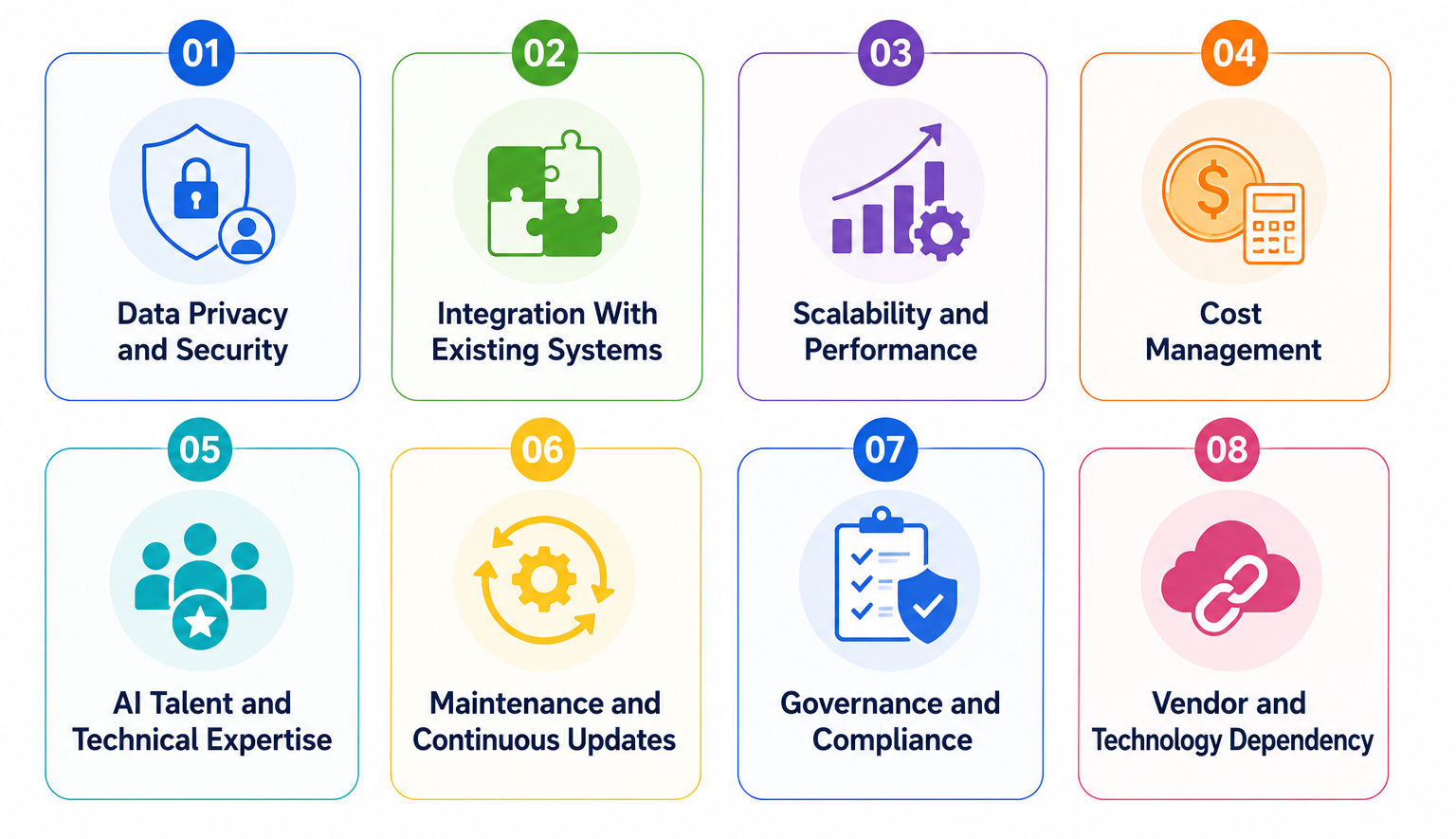
1. Data Privacy and Security
Both models have a need for strong data protection.
Businesses need to consider:
- Sensitive information
- Access controls
- Encryption
- Data storage
- Data processing
- Compliance requirements
2. Integration With Existing Systems
AI platforms are seldom operated by themselves.
Integration challenges can involve:
- Legacy systems
- Data silos
- APIs
- Authentication
- Inconsistent data formats
- Workflow dependencies
3. Scalability and Performance
As more people adopt AI, the amount of work it has to handle can increase rapidly.
Teams need to consider:
- User volume
- Model usage
- Response time
- Infrastructure capacity
- Data growth
4. Cost Management
The cost of AI can go up due to the way the model is used, the infrastructure required, the need for integration, monitoring, and support.
Companies should keep an eye on both the first costs and the costs that continue to arise during operations.
5. AI Talent and Technical Expertise
To carry out the building process, it is necessary to have access to experienced teams in the fields of AI and engineering.
Although buying does reduce the need for some development requirements, it still necessitates specialists who are able to handle integration, governance, security, and AI operations.
6. Maintenance and Continuous Updates
AI technology changes quickly.
Organizations need processes for:
- Model updates
- Testing
- Monitoring
- Security
- Performance optimization
- Platform improvements
7. Governance and Compliance
There must be proper governance in relation to how the models and the data are used by Enterprise AI.
Important areas include:
- Data governance
- Responsible AI
- Access policies
- Auditability
- Regulatory compliance
8. Vendor and Technology Dependency
When platforms are purchased, this leads to a dependence on the vendor's pricing, the availability of the platforms, the vendor's technology roadmap, and their support model.
Before agreeing to adopt a long-term platform, organizations should assess the available exit options and portability.
Use an Enterprise AI Platform Selection Framework to compare platforms based on capabilities, integration, security, scalability, governance, and cost.
Conclusion
The build vs buy AI platform decision should be based on business requirements rather than the assumption that one approach is always better.
Build is generally more suitable when customization, control, proprietary data, and strategic differentiation are critical. Buy can be a better fit when speed, predictable implementation, and managed infrastructure matter more.
Contact our upGrad KnowledgeHut experts for personalized guidance on choosing the right course, career path, and certification to achieve your goals.
Frequently Asked Questions (FAQs)
1. When should an enterprise choose a hybrid build and buy AI strategy?
A hybrid approach works when an enterprise wants to use existing AI platforms while building custom capabilities where differentiation matters. This can balance faster deployment with greater control over critical workflows, data, or applications.
2. How should enterprises calculate the three year total cost of a build versus buy AI decision?
Compare development, infrastructure, licenses, AI usage, staffing, integration, security, maintenance, and training costs over three years. Include expected scaling and switching costs to get a more realistic long-term comparison.
3. How does proprietary data influence the decision to build or buy an AI platform?
Proprietary data can support a build or customization strategy when it provides a meaningful competitive advantage. Enterprises may want greater control over how sensitive or unique data is accessed, processed, and used.
4. What should enterprises include in an AI platform vendor exit strategy?
An exit strategy should address data portability, application dependencies, APIs, integrations, contracts, migration costs, and replacement options. Enterprises should also clarify how they can retrieve their data and move critical workloads if required.
5. How can enterprises assess whether an AI platform creates competitive differentiation?
Assess whether the platform enables capabilities competitors cannot easily reproduce through standard tools. Differentiation may come from proprietary data, unique workflows, specialized models, or deeply integrated customer experiences.
6. What hidden costs should enterprises consider when buying an AI platform?
Hidden costs can include integration, customization, data migration, training, support, usage-based charges, security reviews, and vendor switching costs. These should be included in the total cost of ownership rather than evaluating subscription prices alone.
7. How many AI use cases to justify building an internal AI platform?
There is no fixed number that automatically justifies the building. The decision becomes more attractive when multiple AI use cases can share common infrastructure, data services, governance, and engineering capabilities.
8. How should enterprises evaluate data portability before buying an AI platform?
Check whether data, configurations, workflows, embeddings, and other important assets can be exported in usable formats. Enterprises should also review API access, contract terms, migration support, and any restrictions on moving data between platforms.
9. Who should own and govern an enterprise AI platform after implementation?
Ownership should typically involve a clear combination of business, technology, data, security, and governance of stakeholders. Responsibilities should cover platform strategy, access, risk management, performance, compliance, and ongoing investment.
10. How should enterprises decide whether to build the AI model or only the application layer?
Building the model may be justified when model control or highly specialized behavior is strategically important. For many organizations, using an existing model while building the application, data layer, workflows, and integrations can provide a better balance of speed and customization.
1639 articles published
KnowledgeHut is an outcome-focused global ed-tech company. We help organizations and professionals unlock excellence through skills development. We offer training solutions under the people and proces...
Get Free Consultation
By submitting, I accept the T&C and
Privacy Policy