
- Home
- Blog
- Data Science
- Enterprise RAG Architecture: Components, Workflow, and Best Practices
Enterprise RAG Architecture: Components, Workflow, and Best Practices
Updated on Aug 31, 2026 | 395 views
Share:
Table of Contents
View all
- What is enterprise RAG architecture?
- What are the main components of enterprise RAG architecture?
- How does enterprise RAG architecture work?
- Which technologies power enterprise RAG architecture?
- How do enterprises improve retrieval accuracy in RAG architecture?
- What security and governance considerations are critical in enterprise RAG architecture?
- What challenges do organizations face when implementing enterprise RAG architecture?
- Conclusion
Quick Overview
- Enterprise RAG architecture connects enterprise data sources with retrieval systems and LLMs to generate responses based on relevant organizational information.
- Its core architecture includes data ingestion, document processing and chunking, embedding generation, vector storage, retrieval engines, LLM orchestration, and monitoring.
- The workflow moves from ingesting and indexing enterprise data to query retrieval, context augmentation, response generation, and continuous optimization through feedback.
- Retrieval accuracy can be improved using hybrid search, metadata filtering, reranking techniques, query transformation, and evaluation frameworks.
- This guide covers the components, workflow, technologies, retrieval strategies, security considerations, and implementation challenges of enterprise RAG architecture.
RAG is changing how organizations connect AI with enterprise knowledge. Develop a stronger understanding of the broader generative AI ecosystem with upGrad KnowledgeHut Generative AI Masters Program.
What is enterprise RAG architecture?
Enterprise RAG architecture refers to a system that combines retrieval methods with generative AI models using organization's own data to produce accurate and contextual answers. They generate responses by using information from company's data rather than relying solely on the information learned during training.
It is important for large organization's because their data is constantly changing. A regular AI model is not able to follow updates of new policies, pricing, and customers. Enterprise RAG architecture solves this problem by making AI responses more useful, latest, and grounded with the help of organization's data.
The main goal of RAG architecture for enterprises is to provide AI access to current business information without disturbing security and compliance. This use of RAG architecture is widely used for internal knowledge assistants, customer support, document searches. and employee productivity tools.
What are the main components of enterprise RAG architecture?
A production RAG architecture for enterprises consists of several interconnected layers. Below are some important components that need to be interconnected and work together to provide users with the appropriate and relevant information.
Data ingestion layer
This layer gathers information from a number of different sources such as PDFs, databases, cloud storage services, internal wikis, CRM platforms, and other enterprise apps.
Data ingestion is an essential part of any modern enterprise RAG architecture that allows to build a reliable knowledge base. Updating it regularly makes sure that employees and customers get responses based on the latest information.
Document processing and chunking layer
When the information is gathered, the documents are processed and divided into parts called chunks.
Chunking helps to increase the accuracy of retrieving since the AI system can find the required information more easily. The best enterprise RAG architecture has the appropriate size of chunks.
Embedding generating layer
Embeddings transform the text into numerical representations that contain information about its semantic meaning.
Embeddings enable the system to understand the relationship between different words, phrases, and other objects, which means that semantic search can be implemented.
Vector database and knowledge storage
After creating embeddings, they are stored in the vector database, which ensures that relevant content can be found quickly. The vector database is a knowledge storage of the enterprise RAG architecture. It allows to make quick searches through huge amounts of enterprise content.
Retrieval engine
The retrieval engine conducts search through the indexed information and finds the most relevant information. Good enterprise RAG architecture combines semantic, keyword, and metadata searches in order to provide high-quality retrieval of information and relevant results.
LLM orchestration layer
The orchestration layer organizes all the processes that happen between the retriever, vector database, and language model. In enterprise RAG architecture, this layer controls the prompts, context choice, generation of the answer, and workflow.
LLM orchestration is widely used by enterprises due to the use of orchestration frameworks.
Monitoring and governance layer
The final layer should monitor the work of the whole system, tracking all queries, measuring accuracy, and spotting such issues as outdated information or other problems. It is also responsible for enforcing security policies within the system.
Monitoring tools control the performance, accuracy, and behavior of the enterprise RAG architecture.
How does enterprise RAG architecture work?
Below is the simple breakdown of the six-step process of the RAG architecture workflow.
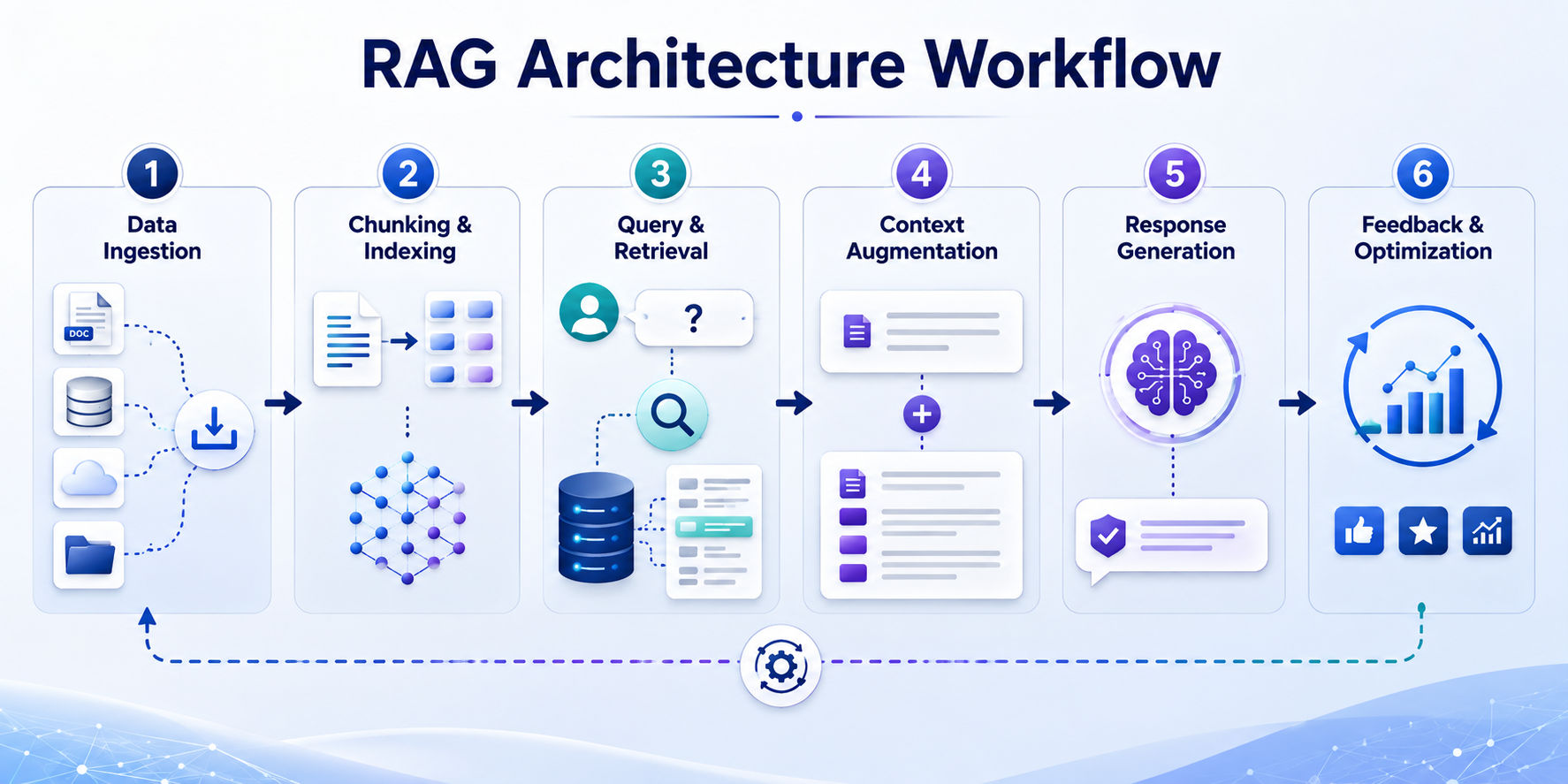
Step 1: Enterprise data ingestion
The process starts with importing content from enterprise knowledge bases such as documents, reports, policies, and records. This gives the RAG architecture the ability to retrieve relevant business knowledge based on user queries.
Step 2: Content chunking and indexing
Each document gets split into pieces and transformed into embeddings which get indexed. This stage is important since the performance of the enterprise RAG architecture greatly depends on its indexing process.
Step 3: Query processing and retrieval
Once a user asks a question, the system generates an embedding for the query and looks for similar content. The retrieval engine in the enterprise RAG architecture finds the most relevant information in the knowledge base.
Step 4: Context augmentation
The content found is incorporated into the prompt as additional context.
The use of this technique makes sure that the RAG architecture for enterprises does not depend only on the language model but also on the verified company knowledge.
Step 5: Response generation
With the help of the context retrieved, the language model generates a response. Since the information retrieved comes from the enterprise knowledge base, the response will be much more reliable.
Step 6: Feedback and optimization
The system gets optimized using feedback, performance, and evaluation results. Optimization allows keeping the retrieval quality at a high level in the RAG architecture for enterprises.
Which technologies power enterprise RAG architecture?
There are many different tools and frameworks available for this type of setup. The choice of the appropriate stack impacts performance, accuracy, and costs.
Embedding models
Embedding models transform text into vectors and represent the base of this type of retrieval system. There are models which have general purpose and those which are designed for particular domains like law, medicine, or finance.
It often helps to choose a domain-specific embedding model to get better retrieval results.
Vector database
This type of database stores and searches for embeddings. It is optimized for similarity search but not for the traditional one using keywords.
For processing huge amounts of data, vector databases are crucial components of RAG architecture.
Hybrid retrieval systems
Hybrid retrieval involves semantic vector search and keyword search. It is helpful when searching through enterprise content which contains things like product codes, policy names, customer ids, technical terms and other information that is exact.
Such method allows the system to understand both the meaning of the query and particular exact words.
Reranking models
Reranking models rearrange retrieval results according to their relevance to the query. It examines the initial set of search results and ranks it by its relevancy.
Usually, the additional step of reranking improves answer quality since it discards irrelevant chunks.
LLM orchestration frameworks
An orchestration framework connects models, retrieval service, data sources, tools, prompts and application logic.
When creating enterprise RAG architecture, an orchestration layer should be sufficiently flexible to cope with changes in the models, retrieval service or business needs.
How do enterprises improve retrieval accuracy in RAG architecture?
The retrieval accuracy is perhaps one of the most important aspects that defines the success or failure of the entire solution. No matter how powerful the language model might be, an incorrect answer is generated when it gets incorrect data.
Hybrid search strategies
As was mentioned previously, the combination of keyword search and vector search tends to work better than the use of only one of them. Such an approach is particularly useful in the context of RAG architecture in enterprises working with specific content.
Metadata filtering
Using such metadata as the type of the document, the department, or the date makes it possible to filter results before sorting and ranking them. Thus, less noise is produced.
Reranking techniques
Reranking algorithms introduce an additional step in the process and evaluate each item in the search results to ensure that the degree of its match is high enough.
Query transformation methods
Sometimes a query formulated by a user is not formulated in accordance with how the data is saved in the knowledge base. In order to address this issue, it is possible to transform the query and make it broader.
Evaluation frameworks
Testing the solution is essential to evaluate its performance. Therefore, the use of various evaluation frameworks and tools is required.
From preparing enterprise data to working with AI models, RAG involves several data science concepts. Build your foundation with Data Science Courses from upGrad KnowledgeHut.
What security and governance considerations are critical in enterprise RAG architecture?
Enterprises need to safeguard the confidential information while being mindful about the responsible use of AI.
Access control and permissions
It should be possible to regulate access to the system so that each document can be accessed only by those people who have a permission to do that depending on their role or department in the company.
Data privacy and compliance
Different companies have different restrictions concerning the storage and processing of data. The system should comply with all the regulation of the certain industry it operates in.
Auditability and traceability
The company should be able to track all the documents that were used to generate a particular response because it is crucial for the whole infrastructure of the company.
Responsible AI governance
Apart from security issues, it is necessary to define the responsibility for monitoring, updating, and correcting the system in case of any mistakes.
Following responsible AI practices mitigates the risk of bias, misuse, and wrong output generation. Governance allows ensuring that enterprise RAG architecture meets the organization’s standards.
What challenges do organizations face when implementing enterprise RAG architecture?
Despite its many advantages, implementing enterprise RAG architecture is a complex process.
Poor data quality
Outdated, incomplete, or inconsistent data might impair system performance. No matter how advanced the enterprise RAG architecture, it will not be able to generate quality results based on low-quality data.
Ineffective chunking strategies
Low-quality chunking can render information hard to retrieve. Organizations creating their own RAG architecture for enterprises need to thoroughly test different chunk sizes and formats in order to get the best performance out of the system.
Retrieval accuracy limitation
Sometimes the retrieval system will produce incorrect or incomplete results. The issue of improving the accuracy of retrieval is among the most pressing tasks for any enterprise RAG architecture initiative.
Scalability and performance bottelnecks
Performance of the system could be negatively impacted by increasing data volumes. Enterprise RAG architecture should be designed in such a way that it scales well.
Cost management challenges
Operating language models, vector database, and retrieval services could become costly. Organizations need to track usage and optimize resource usage in order to operate the system effectively and affordably.
Conclusion
Enterprise RAG architecture helps organizations connect generative AI with their latest and most relevant business data. A well-designed RAG architecture for enterprises combines reliable data ingestion, accurate retrieval, strong security, monitoring, and scalable infrastructure.
By addressing data quality, retrieval accuracy, governance, and cost, organizations can build RAG systems that deliver reliable and useful AI responses.
Have A Query? Get in Touch With Our Customer Support | upGrad KnowledgeHut
Frequently Asked Questions (FAQs)
How is enterprise RAG different from basic RAG?
Enterprise RAG is designed for large scale business environments with complex data, strict access controls, and multiple users. Unlike basic RAG, it includes governance, security, monitoring, scalability, and integration with enterprise systems. It is built to deliver reliable, permission aware, and traceable responses in production environments.
What retrieval strategy is best for enterprise RAG?
Hybrid retrieval is often the best choice because it combines semantic vector search with keyword based search. It can find both conceptually similar content and exact terms such as product IDs, policy names, or technical codes. Metadata filtering and reranking can further improve the relevance of retrieved information.
What metrics measure RAG performance?
RAG performance can be measured using retrieval relevance, precision, recall, context quality, and answer faithfulness. Operational metrics such as response latency, error rate, cost per query, and index freshness are also important. Together, these metrics show whether the system is accurate, reliable, fast, and cost effective.
How do you build an enterprise RAG system?
Start by identifying trusted enterprise data sources and building an ingestion and document processing pipeline. Then create embeddings, index the content, implement retrieval and reranking, and connect the retrieved context to an LLM. Finally, add access controls, monitoring, evaluation, governance, and continuous improvement processes.
What technologies are used in enterprise RAG?
Enterprise RAG commonly uses data connectors, document processing tools, embedding models, vector databases, search engines, and reranking models. LLMs and orchestration frameworks connect these components and manage the retrieval and generation workflow. The technology stack depends on data volume, security requirements, existing infrastructure, and business needs.
How does RAG handle confidential enterprise data?
RAG can protect confidential data by applying authentication, authorization, encryption, tenant isolation, and permission based retrieval. Access controls should be checked before restricted information is passed to the LLM. Organizations should also use audit logs, data governance policies, and appropriate data retention controls.
What components are typically involved in RAG system?
A typical RAG system includes data sources, ingestion, document processing, chunking, embeddings, a search or vector database, and a retrieval engine. It also includes an orchestration layer, LLM, security controls, and monitoring capabilities. Together, these components retrieve relevant information and provide it to the LLM for grounded responses.
Why is RAG particularly valuable in regular specialised environment?
RAG is especially valuable in specialised environments where information is domain specific, frequently updated, or difficult for a general LLM to know reliably. It allows AI systems to use trusted internal knowledge without requiring the model to be retrained every time information changes. This makes RAG useful for areas such as healthcare, finance, legal services, manufacturing, and technical support.
How do embeddings affect enterprise RAG accuracy?
Embeddings determine how effectively the system represents and compares the meaning of documents and user queries. High quality embeddings can improve semantic retrieval, while poor embeddings may cause relevant information to be missed. The choice should consider language, domain terminology, query patterns, accuracy, latency, and cost.
Should enterprise RAG use a vector database or an existing search engine?
The choice depends on the organization's data, search requirements, infrastructure, and scale. Vector databases are strong for semantic similarity, while existing search engines can provide keyword search, filtering, and enterprise search capabilities. Many enterprise systems combine both through hybrid search to improve retrieval quality and flexibility.
1639 articles published
KnowledgeHut is an outcome-focused global ed-tech company. We help organizations and professionals unlock excellence through skills development. We offer training solutions under the people and proces...
Get Free Consultation
By submitting, I accept the T&C and
Privacy Policy