
- Home
- Blog
- It Service Management
- What Is an SLA? How to Write Service Level Agreements
What Is an SLA? How to Write Service Level Agreements
Updated on Aug 25, 2026 | 323 views
Share:
Table of Contents
View all
Quick Overview
- SLA stands for Service Level Agreement. It is a formal agreement between a service provider and a customer that defines the services, performance standards, and responsibilities of both parties.
- Key components of an SLA include service scope, exclusions, responsibilities, service levels, SLA metrics, monitoring, reporting, penalties, and termination.
- The three main types of SLA are customer-based, service-based, and multi-level SLA.
- Common SLA metrics include uptime, response time, resolution time, availability, and recovery time.
- This guide covers what is an SLA, its components, types, industry examples, and how to write an SLA step-by-step.
Build practical IT service management skills with ITIL 5 Foundation Certification Training Online and learn how effective service management practices support clear SLAs, service levels, and performance management.
Master the Right Skills & Boost Your Career
Avail your free 1:1 mentorship session
What is an SLA?
SLA stands for service level agreement, a formal agreement between a service provider and a customer. It clearly describes the level of service a provider guarantees to the customer. It includes performance requirements, responsibilities, response times, and actions taken in case the agreement is not followed.
The main purpose of the SLA is to remove confusion between the parties. It clearly defines what a provider is delivering to the customer, which helps in maintaining clarity between the parties.
Key components of an SLA
Every SLA includes a few core components, irrespective of the industry for which it is made. The following are common components of an SLA:
Agreement overview
It identifies the parties involved in the SLA agreement. It also explains the purpose of the agreement and the nature of the service being provided.
It generally includes the service provider, customer, effective date, agreement term, and its overall purpose.
Service scope
It defines what is exactly included in the SLA agreement. It includes services covered, operating hours, maintenance, technical assistance, and other agreed services.
An agreement with a clearly defined scope avoids misunderstandings. SLA helps the parties in understanding in advance about the services covered in the agreement.
Exclusion
SLA includes the list of services, events, or situations that are excluded from the agreement and cannot be managed by the service provider in some cases.
It is an important element in an SLA as it helps avoid confusion about what the provider is not responsible for.
Roles and responsibilities
It clearly explains the duties of each party. For example, a provider may be responsible for maintaining the system and on the other hand, the customer may be responsible for providing information and access.
Clearly defined roles make the service legal agreement easy to follow for everyone involved.
Service level objectives and performance metrics
Service level objectives are the specific measurable targets that the provider agrees to meet in the SLA. They defined the expected performance standards and these standards are measured through SLA metrics.
Some of the common metrics includes response time, resolution time, error rate, recovery time, and service request completion time.
Monitoring and reporting
The agreement must state how performance will be measured and reported. It should include information related to data source, measurement period, reporting frequency, and the responsible person or team for measuring the performance.
Penalties and termination
It states what happens if the service level agreement is not met. It includes penalties like service credits, refunds, or discounts if SLA metrics fall behind target. It also explains the conditions under which the parties may end the SLA agreement.
What are the types of SLA?
There are three common types of SLAs. Understanding these types helps in understanding what is an SLA in different situation.
Customer-based SLA
It is designed for a single customer only and provides all the information about all the services that will be delivered by the service provider to this particular customer.
This type is common when the needs of a certain company are unique and cannot be included into some group of customers.
Service-based SLA
It is related to a particular service and it applies to every customer using this service. It is mainly used in standard offerings such as cloud storage or help desk service which can be used by everyone equally.
Multi-level SLA
It includes several level of agreements, which may be arranged on the corporate level, customer level, and service level. It is useful for large organizations where services differ across departments, teams, or customer groups.
Strengthen your understanding of SLAs and service delivery with the upGrad KnowledgeHut ITSM Certification Course | IT Service Management Training, and build practical IT service management skills.
SLA examples across industries
Different industries use different metrics based on the service type and its importance to the business.
IT services
For the IT services, an SLA agreement may include system uptime, incident response time, and resolution time for the technical problems.
SLA metrics could be, for example, a target of 99.9% of system uptime and a promise to resolve critical issues in several hours.
Cloud computing
For cloud providers, service level agreements play a key role in offering service availability. An SLA agreement may promise a particular percentage of uptime monthly, with penalties if this goal is not achieved.
Since enterprises need cloud services all the time, SLA metrics in this field are rather strict.
Customer support
Customer support uses SLA to agree upon the response time to queries. It may involve first response time, average resolution time, and customer satisfaction target SLA metrics monthly.
Telecommunications
Telecom companies employ service level agreements to offer network uptime, call quality, and outage repair time. Potential customers normally consider SLA metrics when choosing a company for business grade internet or telephone services.
Logistics
For logistics companies, an SLA agreement may be concerned with delivery timelines, order accuracy, and damage rates during transportation.
On-time delivery rate SLA metric, among other metrics, shows how well logistics companies satisfy customers' needs.
Healthcare
Service level agreements are used by healthcare providers and their technology vendors in order to guarantee system availability for patient record management, appointment scheduling, and billing system.
Due to the special character of healthcare information, SLA agreements contain rather strict SLA metrics concerning system uptime and data security response time.
Banking and financial services
For banks, SLA may concern transaction processing times, system uptime for the purposes of online banking, and support response time. Delays may lead to a loss of clients' confidence, and that is why SLA metrics in this area are closely monitored.
How to write an SLA step-by-step
Here is a brief step-by-step guide on how to create an effective service level agreement.
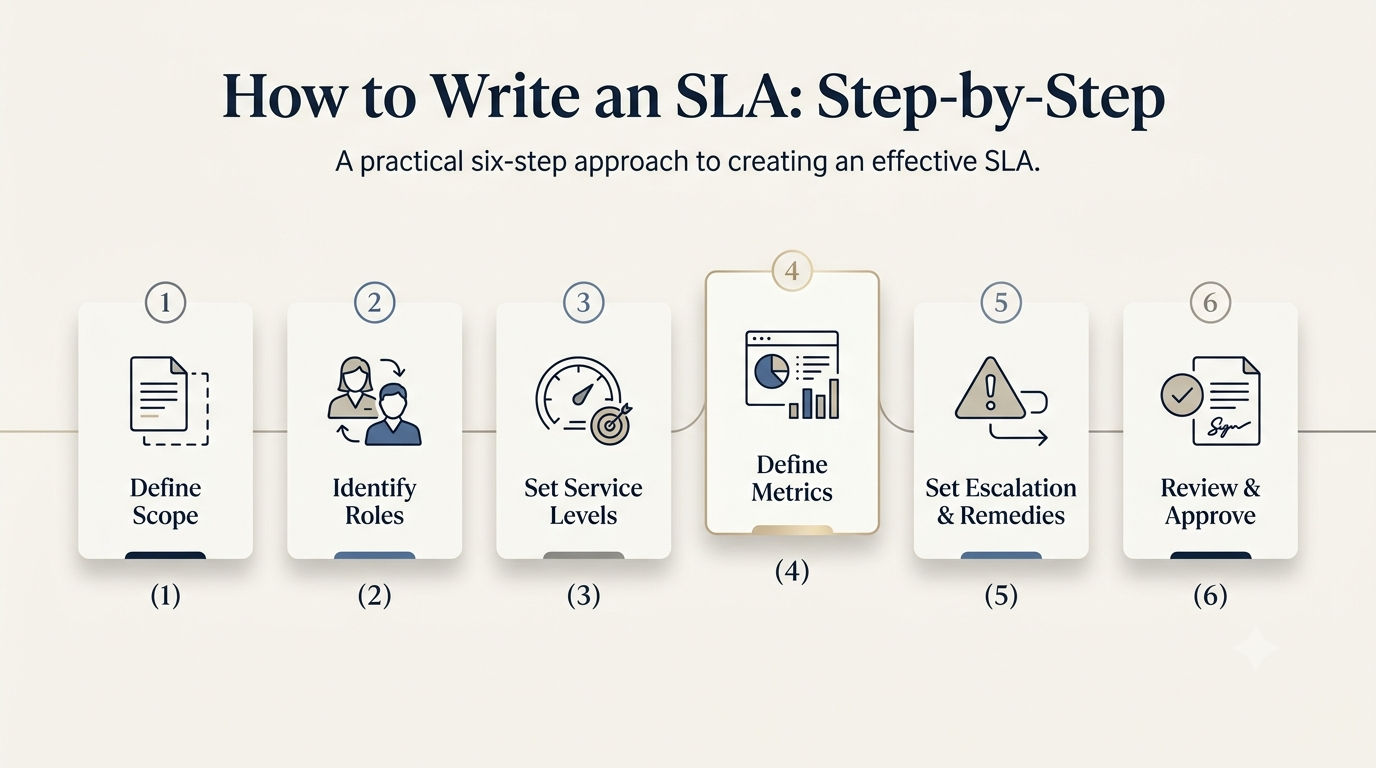
Define the services and scope
First, you need to define which services are to be included in the SLA agreement. It means defining what kind of services will be provided and determining boundaries for the services that do not fall within the SLA agreement.
Identify roles and responsibilities
Second, you have to determine roles of both the provider and the consumer. In other words, you should define the provider's obligations like maintenance of the services and the consumer's responsibilities like reporting any failures on time.
Set service levels
This step implies defining the actual service levels that have to be met. Such elements of service levels include uptime, response times, etc. These levels will be the core of the SLA agreement and have to be realistic for both sides.
Define performance metrics
Once you defined service levels, you should choose SLA metrics to determine whether the actual service level is met or not. In order to be good metrics, SLAs should be specific, measurable and relevant to the agreed-upon service levels.
Choosing SLA metrics is regarded as the most important stage in writing a service level agreement.
Set escalation procedure, SLA breaches, and remedies
At this point, you need to describe what is to be done if SLA metrics are not met. Escalation procedure, definition of SLA breaches and possible remedies will help make your service level agreement fair and enforceable.
Review and approve the SLA
Finally, you have to review your service level agreement with all stakeholders prior to signing. Both parties should make sure that scope, roles, service levels, SLA metrics and penalties are appropriate. Once this is done, you can sign and use your service level agreement.
Conclusion
An SLA provides a clear framework for defining service expectations, responsibilities, and performance standards between a provider and customer. A well written SLA agreement uses measurable SLA metrics to track service quality and manage accountability.
Choosing the right SLA type and clearly defining scope, targets, and remedies can help prevent misunderstandings. When reviewed regularly, an SLA can support consistent service delivery and stronger business relationships.
Have A Query? Get in Touch With Our Customer Support | upGrad KnowledgeHut
Frequently Asked Questions (FAQs)
What is the purpose of an SLA?
The purpose of an SLA is to clearly define the services a provider must deliver and the performance standards they must meet. It also sets responsibilities for both parties and provides a clear process for handling service issues. This helps create accountability and reduces misunderstandings.
Why is an SLA important?
An SLA is important because it turns general service expectations into clear and measurable commitments. It helps customers evaluate provider performance and gives providers clear service targets to follow. It also defines what happens when agreed service levels are not met.
How is SLA performance measured?
SLA performance is measured using specific metrics such as uptime, availability, response time, and resolution time. Performance data is collected over an agreed measurement period and compared with the targets in the SLA. Regular reports can then show whether the provider has met the agreed standards.
What happens when an SLA is breached?
When an SLA is breached, the provider may need to follow the agreed escalation and corrective action process. Depending on the terms, the customer may receive service credits, fee reductions, or other remedies. Repeated or serious breaches may also lead to contract termination.
What are SLA penalties?
SLA penalties are consequences agreed upon when a provider fails to meet specified service levels. They can include service credits, financial adjustments, corrective actions, or other contractual remedies. The exact penalty should be clearly defined in the SLA before the agreement takes effect.
What is the difference between SLA and KPI?
An SLA is a formal agreement that defines service commitments between two parties, while a KPI is a metric used to measure performance against a business objective. For example, an SLA may require 99.9% uptime, while uptime can be tracked as a KPI. An SLA can therefore include KPIs as part of its performance measurement.
What is the difference between SLA and SLO?
An SLA is a formal commitment between a service provider and customer, while an SLO, or Service Level Objective, is a specific performance target. For example, 99.9% availability may be an SLO included within an SLA. An SLA can contain one or more SLOs to define expected service performance.
How detailed should an SLA be?
An SLA should be detailed enough to clearly define services, responsibilities, performance targets, measurement methods, and remedies. However, unnecessary technical or operational details can make it difficult to understand and manage. The level of detail should match the complexity, risk, and importance of the service.
How often should an SLA be reviewed?
An SLA should be reviewed regularly to ensure its targets and terms still match business and service requirements. Many organizations review SLAs annually, while critical or frequently changing services may require more frequent reviews. The agreement should also be reviewed after major changes to services, technology, or business requirements.
Does every service provider need an SLA?
Not every service provider necessarily needs a formal SLA, particularly when the service is simple, low risk, or informal. However, an SLA is valuable when service reliability, response times, availability, or accountability are important. Businesses often use SLAs for critical services and long term provider relationships.
What mistakes should be avoided when writing an SLA?
Avoid vague service targets, unrealistic performance commitments, unclear responsibilities, and metrics that cannot be measured reliably. The SLA should also clearly define exclusions, reporting methods, escalation procedures, and remedies for missed targets. Regularly reviewing the agreement helps prevent outdated terms from becoming a problem.
1638 articles published
KnowledgeHut is an outcome-focused global ed-tech company. We help organizations and professionals unlock excellence through skills development. We offer training solutions under the people and proces...
Get Free Consultation
By submitting, I accept the T&C and
Privacy Policy
Ready to fast-track your ITSM career?