
- Home
- Blog
- It Service Management
- XLA vs SLA: Key Differences, Similarities & Best Use Cases
XLA vs SLA: Key Differences, Similarities & Best Use Cases
Updated on Nov 18, 2025 | 1.83K+ views
Share:
Table of Contents
View all
Service Level Agreements (SLAs) are a crucial indicator of performance for IT service management. As the importance of customer-centric service increases, traditional SLAs are failing at capturing an essential element. User experience is often left missing in SLAs.
This is where Experience Level Agreements (XLAs) enter the picture. They encapsulate how users feel about the service they recieve.
This blog explores what XLAs and SLAs, how they differ, where they overlap, and why the future of IT service management depends on balancing both metrics — performance and experience.
Master the Right Skills & Boost Your Career
Avail your free 1:1 mentorship session
What is XLA?
An Experience Level Agreement (XLA) is a framework that measures the quality of user experience. It tries to go beyond service performance. Instead of tracking uptime or speed alone, XLAs assess how end users perceive a service. This is done through satisfaction surveys, sentiment analysis, or behavioral data.
While SLAs focus on technical success, XLAs focus on human success. For example, if a support ticket is resolved in five minutes but leaves the user frustrated, an SLA might consider this great, but an XLA would flag it a poor experience.
In essence, XLAs bridge the gap between IT metrics and human outcomes. They encourage organizations to design services that are not just efficient, but empathetic, ensuring every digital touchpoint contributes to a positive experience.
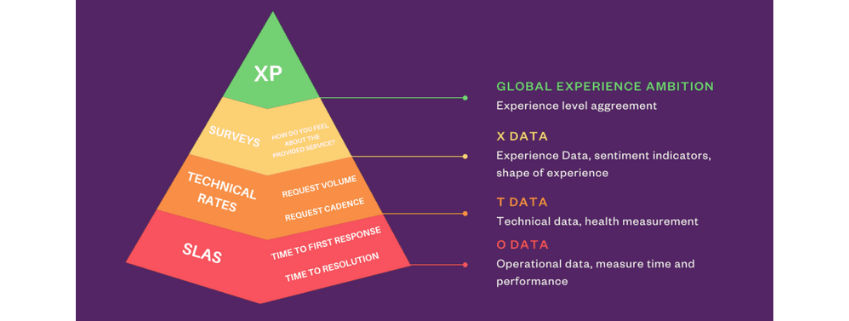
Source: elements.com
What is SLA?
A Service Level Agreement (SLA) is a formal, measurable contract between a service provider and a customer that defines expected service standards. Typical SLA metrics include uptime percentage, response time, mean time to repair (MTTR), and incident resolution rates.
SLAs ensure accountability and transparency by setting clear expectations for service quality. They help organizations measure operational performance and evaluate vendor reliability.
However, while SLAs are effective at managing delivery consistency, they don’t always reflect how well the service supports business outcomes or user satisfaction. This limitation paved the way for XLAs. XLAs complement SLAs by focusing on the end-user’s perspective and emotional engagement with the service.
XLA vs SLA: Table of Differences
Parameter |
SLA |
XLA |
| Focus | Service performance and availability | User experience and satisfaction |
| Measurement Type | Quantitative (uptime, response time) | Qualitative (feedback, sentiment) |
| Primary Goal | Ensure compliance and reliability | Improve engagement and experience |
| Data Source | System metrics and reports | Surveys, NPS, and behavioral insights |
| Outcome | Operational efficiency | Human-centric service value |
XLA vs SLA: Detailed Differences
Before diving deeper, it’s important to understand that both SLAs and XLAs aim to enhance service quality. They implement it through different lenses.
1. XLA vs SLA: Focus and Philosophy
SLAs measure service performance, ensuring systems and teams meet agreed targets. XLAs measure experience quality, emphasizing how users perceive those services. For example, while an SLA ensures the network is “up,” an XLA checks whether employees can collaborate smoothly without disruption.
2. XLA vs SLA: Measurement Approach
SLAs rely on technical data like system logs, uptime reports, and ticket resolution times. XLAs use experience data such as feedback surveys, sentiment scores, and usage patterns. The goal is to connect measurable outcomes with emotional responses.
3. SLA vs XLA: Business Alignment
SLAs ensure IT delivers all promises, but they don’t necessarily link to business value. XLAs bridge IT performance with organizational goals, such as employee productivity or customer satisfaction. This alignment helps leadership understand how IT supports business outcomes.
4. SLA vs XLA: Accountability and Ownership
SLA metrics are typically owned by service providers or IT operations teams. XLA metrics require cross-functional ownership between IT, HR, CX, and operations. This is because the experience is influenced by multiple touchpoints.
5. SLA vs XLA: Continuous Improvement
SLAs track compliance; XLAs drive transformation. SLAs confirm whether expectations were met; XLAs explore how those expectations felt and how to improve them.
In summary, SLAs define the minimum acceptable standard, while XLAs inspire teams to exceed it by creating an environment where service quality is not just efficient, but emotionally resonant.
What are the Similarities Between XLA and SLA?
Although XLAs and SLAs measure different dimensions of service, they share common ground. Both frameworks aim to establish clear expectations between providers and customers, ensuring accountability and measurable outcomes.
Both depend on data-driven insights to assess service performance. Where SLAs rely on technical metrics, XLAs use experience metrics. Yet both of these support continuous improvement cycles. Regular reviews, feedback loops, and governance mechanisms are integral to both models.
Another similarity is their role in building trust. SLAs assure clients that the provider will maintain operational reliability. XLAs reinforce that commitment by ensuring the experience matches expectations.
Finally, neither model works in isolation. In a mature IT environment, SLAs and XLAs complement each other. SLAs provide the foundation of consistency, while XLAs add context and empathy. Together, they define a service culture that values both reliability and human experience. This is the kind of balance that defines modern IT success.
Final Thoughts
The evolution from SLA to XLA reflects a larger shift in IT service management — from efficiency to empathy. Organizations now realize that uptime alone doesn’t equal satisfaction; experience does.
While SLAs will remain vital for operational governance, XLAs ensure services deliver true value to people. The future of IT service management lies in combining both, by using SLAs to guarantee performance and XLAs to measure emotional impact.
By adopting both frameworks, organizations can deliver not just reliable systems, but meaningful experiences that drive loyalty, productivity, and trust.
Frequently Asked Questions (FAQs)
1. Is SLA a contract and XLA a commitment?
Yes. SLAs are formal contracts defining measurable service levels, while XLAs represent a commitment to delivering great user experiences.
2. What are the three types of SLAs?’
Customer-based, service-based, and multi-level SLAs. Each of these are tailored to specific client or service contexts.
3. Are SLAs legally binding?
Yes, SLAs are often legally enforceable in agreements between service providers and customers.
4. What is an SLA in HR?
In HR, an SLA defines timelines or standards for internal services such as onboarding, payroll, or employee query resolution.
1634 articles published
KnowledgeHut is an outcome-focused global ed-tech company. We help organizations and professionals unlock excellence through skills development. We offer training solutions under the people and proces...
Get Free Consultation
By submitting, I accept the T&C and
Privacy Policy
Ready to fast-track your ITSM career?