
- Home
- Blog
- Project Management
- Solution Train Engineer in SAFe: Roles, Responsibilities, Career Path
Solution Train Engineer in SAFe: Roles, Responsibilities, Career Path
Updated on Sep 23, 2025 | 1.32K+ views
Share:
Table of Contents
View all
Managing an Agile Release Train (ART) is monumental within the Scaled Agile Framework. The Release Train Engineer (RTE) coordinated and ensures that various teams function properly. They need to ensure value delivery is never impacted.
Global enterprises rarely have a single ART functioning at the same time. There are multiple ARTs to be managed simultaneously. This is where the Solution Train Engineers (STEs) become indispensable in SAFe. They oversee multiple ARTs. This is done by coordinating with the respective RTEs. STEs ensure value is delivered consistently across to customers under a single brand.
In this blog, we will look at what is a Solution Train Engineer, their responsibilities, what they oversee, and the path to becoming one.
Ultimate PMP Formula Cheat Sheet
Get a quick, exam-ready PMP cheat sheet with all essential formulas and key concepts in one place.
What is a Solution Train Engineer (STE)?
Let us define a solution train before explaining what a solution train engineer does.
In the Scaled Agile Framework (SAFe), a Solution Train coordinates multiple ARTs to build a large and complex solution. Nationwide telecom systems, modernizing banking systems, and autonomous vehicle platforms are examples where a solution train is needed.
A Solution Train Engineer (STE) is in the middle of these complex coordination efforts. They facilitate work at a solution level like an RTE facilitates a single ART. They create a conducive environment for value delivery across multiple ARTs. STEs do not make technical decisions. They also work alongside different stakeholders to align without compromising on velocity.
An STE can be seen as someone who orchestrates and conducts the Solution Train by ensuring all ARTs and stakeholders are in harmony. An effective STE elevates solution delivery in a scalable manner.
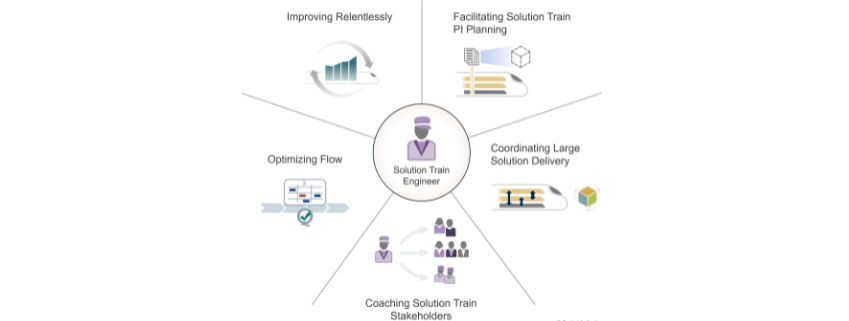
Source: scaledagile.com
Responsibilities of a Solution Train Engineer
A Solution Train Engineer has skills like facilitation, servant leadership and system thinking. Let us look at the various responsibilities of an STE:
- Facilitating Solution-Level Events
STEs ensure that all SAFe artifacts and solutions happen smoothly. They facilitate situations for collaboration, alignment and decision-making. - Driving Alignment Across ARTs
There are various risks and dependencies that occur when multiple ARTs move parallelly. The STE needs to resolve these dependencies early on and manage conflict. This is done to maintain focus on the shared objectives. - Maintaining Transparency
The STE is responsible for providing transparency to all related stakeholders. This is done by managing dashboards and all required metrics. Increased transparency builds trust and enables proactive corrective actions. - Coaching and Leadership Enablement
STEs are responsible for coaching RTEs, Product Managers, and Business Owners on Lean-Agile practices. They also create an environment for the ARTs to implement them in a seamless manner. - Risk and Dependency Management
STEs need to be prepared to mitigate and handle any risks. Identification, mitigation, and escalation need to happen in a timely manner. - Promotion Continuous Improvement
An STE needs to conduct feedback loops on a frequent manner. This creates a culture of continuous improvement, which is crucial in adapting to varying market conditions.
If you look at the responsibilities of solution train engineers, can you notice something? The STE job focuses on orchestrating and collaborating across teams rather than authoritative execution. Clarity in complex situations ensure that value delivery is never hampered across all ARTs.
upGrad KnowledgHut top Agile certifications can pave the way for enterprise-level roles like that of a Solutions Train Engineer or SAFe Program Constultant.
Events & Artifacts in the Solution Train
A Subject Train Engineer guards the rhythm and flow of value delivery by considering the entire solution. This is done by facilitating various events to align strategy.
Let us look at different events and artifacts done at the solution level in SAFe.
Solution-level Planning Events
Planning can be done in 3 phases by an STE. It is categorized into planning before, during and after each Program Increment.
- Pre-PI Planning: All ARTs and suppliers are prepared by aligning priorities, dependencies, and solution intent. This needs to be done before the main PI Planning starts.
- PI Planning: The STE plans the next increment for all ARTs managed by them. Objectives and commitments are synchronized in alignment with business objectives. The STE ensures all ARTs are balanced.
- Post-PI Planning: All ART plans are made into a unified solution plan. Outstanding dependencies are resolved, ensuring business objectives are on track.
Solution Demo, Inspect & Adapt
A solution demo is critical for stakeholders to have a holistic understanding of the integrated progress across all ARTs. It helps in validating if the solution is moving as intended.
The Inspect & Adapt (I&A) workshop helps in identifying problems in the system along with areas for improvement. This is a constructive forum focusing on continuous improvement.
Artifacts: Vision, Backlog, Roadmap, Architectural Runway
The STE is also responsible for maintaining certain artifacts relevant to the solution.
- Solution Vision: This is the north star that guides everyone’s effort.
- Solution Backlog: This is a prioritized set of capabilities feeding ART backlogs.
- Solution Roadmap: This forward-looking view defines when capabilities may be delivered.
- Architectural Runway: This forms a technical foundation needed for upcoming features, ensuring teams can build without delay.
By stewarding these events and artifacts, the STE ensures the entire Solution Train stays aligned, transparent, and focused on value delivery.
How to Become a Solution Train Engineer?
Aspiring to be an STE isn’t just about collecting certifications; it requires depth of experience, mindset, and credibility. Here’s how to get there:
- Build Strong Agile Foundations: Most STEs start as Scrum Masters, RTEs, or Agile Coaches. These roles develop facilitation, servant leadership, and systems thinking. These are the most crucial skills needed for this role.
- Gain Multi-ART Experience: Exposure to large programs or solution-level initiatives is essential. If you’ve only worked within one team or ART, volunteer for cross-ART initiatives, dependency workshops, or large-scale planning events.
- Develop Technical & Business Acumen: While STEs aren’t architects, they must grasp architectural concepts, integration challenges, and the business value behind solutions. This balance builds credibility with both technical and business stakeholders.
- Invest in Formal Training: SAFe offers the SAFe Program Consultant (SPC) and other advanced certifications that cover solution-level facilitation. While there isn’t a standalone “STE certification,” organizations often look for SPCs or senior RTEs who can grow into the role.
- Strengthen Soft Skills: Communication, negotiation, and conflict resolution are critical. The best STEs are calm under pressure and skilled at turning friction into collaboration.
- Embrace Continuous Learning: STEs must stay current with Lean-Agile practices, flow metrics, and organizational change techniques. Reading, networking, and coaching others are part of the growth journey.
Becoming an STE is less about a title and more about evolving into the kind of leader who can guide large solutions across turbulent waters.
Explore the top Agile certifications to pursue roles like Solution Train Engineer.
Best Practices for STEs
Even seasoned STEs face challenges in keeping multiple ARTs aligned. Here are practices that distinguish the best from the rest:
- Lead with Transparency: Make dependencies, risks, and progress visible. Avoid surprises by ensuring information radiators are up to date and accessible.
- Balance Facilitation with Authority: STEs don’t own delivery, but they must step in to steer difficult conversations. Know when to listen and when to intervene.
- Foster Collaboration Across Silos: Actively encourage ARTs and suppliers to share learnings, align objectives, and co-create solutions rather than optimizing locally.
- Focus on Outcomes, Not Outputs: Metrics should reflect value delivered, not just story points burned. Keep the conversation anchored on business value and customer impact.
- Relentlessly Coach Leaders: Many ARTs succeed or fail based on leadership behaviors. An STE’s influence often lies in shifting those behaviors toward Lean-Agile leadership.
- Stay Neutral but Not Passive: The STE must remain impartial in conflicts, but never disengaged. Their neutrality builds trust, while their active engagement ensures alignment.
By practicing these habits, STEs create the trust, clarity, and cadence needed for the Solution Train to deliver reliably.
Summing Up
The Solution Train Engineer is one of the most pivotal roles in scaling Agile at the enterprise level. While they may not write code or prioritize backlogs, their impact is profound: ensuring that multiple ARTs and suppliers stay aligned, predictable, and continuously improving. For professionals who enjoy orchestration, facilitation, and enabling teams to succeed, this role offers both challenge and reward.
If you’re on the path to becoming an STE, start by deepening your Agile expertise, broadening your cross-ART exposure, and honing the leadership skills that make large-scale solutions possible. In the ever-evolving world of enterprise agility, the STE is the quiet conductor behind the symphony of delivery.
Frequently Asked Questions (FAQs)
1. What is the salary of a Solution Train Engineer in India?
On average, Solution Train Engineers in India can earn between ₹28–40 LPA, depending on industry, experience, and the scale of solutions managed.
2. What is the difference between RTE and Solution Train Engineer?
An RTE facilitates one ART, focusing on program-level delivery, while an STE facilitates across multiple ARTs and suppliers at the solution level. The STE’s scope is broader and more strategic.
3. Who facilitates Solution Train events?
The Solution Train Engineer is the primary facilitator, often collaborating with Solution Management, Architects, and Business Owners to ensure alignment.
4. What is PI Planning in SAFe?
PI Planning is a cadence-based, face-to-face event where ARTs align on objectives, identify dependencies, and commit to a plan for the next Program Increment (8–12 weeks).
5. What is the highest paid Solutions Engineer?
In the global market, senior solutions engineers in tech giants (like Google, AWS, or Salesforce) can command salaries upwards of $200K+ annually, depending on specialization and region.
1634 articles published
KnowledgeHut is an outcome-focused global ed-tech company. We help organizations and professionals unlock excellence through skills development. We offer training solutions under the people and proces...
Get Free Consultation
By submitting, I accept the T&C and
Privacy Policy