
- Home
- Blog
- Cloud Computing
- What is Cloud Orchestration? Benefits, Models, and Tools
What is Cloud Orchestration? Benefits, Models, and Tools
Updated on Aug 18, 2025 | 1.56K+ views
Share:
Table of Contents
View all
Imagine your cloud setup as a large, bustling city. Tall towers of public clouds, quiet private neighborhoods, hybrid bridges connecting them, and multi-cloud highways moving data back and forth. Each part follows its own rules. Without proper direction, the result is confusion and slowdowns. Cloud orchestration plays both roles - the city planner and traffic manager. It navigates resources on where they should go, automates everyday processes, and keeps everything moving without bottlenecks.
Orchestration turns disorder into smooth, reliable operation - whether you’re moving workloads to a new platform, launching complex applications, or quickly scaling to meet demand. In this blog, we’ll explain what cloud orchestration is, why it’s important, the tools you can use, and how it differs from automation - so you can plan your cloud strategy with confidence or choosing the right Cloud computing certification to sharpen your skills.
Master the Right Skills & Boost Your Career
Avail your free 1:1 mentorship session
What is Cloud Orchestration?
In cloud environments, it often takes many processes - in a precise order - to happpen before a service or application is ready for use. Orchestration handles this by setting out the sequence in advance and running each task as part of a coordinated workflow.
The work it manages can be broad. It might involve provisioning servers, adjusting traffic distribution, deploying container workloads, or linking services through integration points like APIs. All of these actions are run from one set of instructions so that each step begins only when the last one is complete.
Orchestration isn’t tied to a single deployment model. It’s applied in public, private, and hybrid clouds - removing the need for manual triggers, reduces delays, and keeps configuration standards in place. This helps teams roll out services more quickly and update them without unexpected interruptions.
A practical example is preparing an environment for a new application. The database setup usually comes first, followed by network and security adjustments. Next, the core application components are deployed, and finally, a distribution layer such as a CDN is enabled. Once built, this process can be repeated or expanded to fit larger workloads.
By converting a complex series of actions into a repeatable plan, orchestration empowers more predictable outcomes, improves operational efficiency, and gives teams greater oversight of cloud operations.
Why is Cloud Orchestration Important?
Managing today’s cloud setups is rarely simple. They most of the times involve multiple vendors, layered services, and diverse technologies. Without orchestration in place, teams end up juggling tasks by hand - a process that’s slow, error-prone, and inconsistent.
Keeping everything uniform is one of orchestration’s biggest strengths. Deployments follow the same reliable process each time, which cuts down on surprises. By running multi-step tasks automatically rather than waiting for manual triggers, it also boosts delivery speed. Scaling happens on its own when usage changes, so resources aren’t sitting idle or falling short during spikes.
Security and compliance checks can be built directly into deployment workflows. That means policies are enforced before anything reaches production, reducing last-minute issues.
The impact is felt beyond the technical side. Engineers have more time for higher-value projects instead of repeating setup steps. Costs reduce when idle resources are powered off automatically or workloads are routed to cheaper capacity. Reliability improves through features like failover and disaster recovery, keeping services running during outages.
In competitive markets, these gains matter. Orchestration helps businesses respond faster, maintain stability, and keep spending under control - all without getting bogged down in infrastructure management.
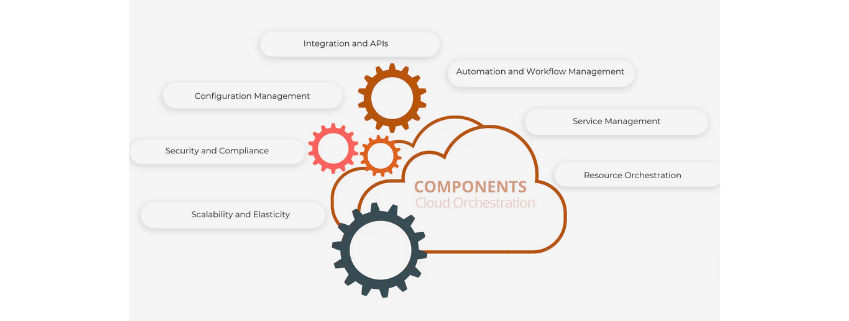
Source: mega.com
Key Components of Cloud Orchestration
A solid orchestration setup isn’t one magic button you press - it’s more like an ensemble. Each piece plays its role, and together, they turn a jumble of cloud services into something orderly, reliable, and surprisingly elegant.
1. Service Catalogs
Picture this as your ready-made menu of cloud options. Instead of building from scratch, teams pick from pre-set templates that are already tuned for performance and security. The result? Services spin up faster, with fewer “did we set this up right?” moments.
2. Workflow Engine
If orchestration had a brain - this would be it. The workflow engine chooses what needs to happen, in what order, and only under the right conditions. It quietly handles dependencies in the background so tasks don’t step on each other’s toes.
3. Resource Management
Think of it as your cloud’s air traffic controller. It directs compute, storage, and network resources where they’re needed most, while keeping an eye on the skies for idle capacity or overloaded systems. The goal is balance - no wasted runway space, no bottlenecks.
4. Policy & Compliance Framework
Rules aren’t glamorous, but they keep you out of trouble. This framework weaves governance, security, and compliance checks right into the deployment process. It’s the difference between “We hope it’s compliant” and “We know it is.”
5. Integration Layer
Rarely does everything live neatly in one place. The integration layer acts like a translator and connector. It allows APIs, platforms, and tools from different vendors talk to each other without fuss.
6. Monitoring & Analytics
You can’t improve what you can’t see. Monitoring delivers a live dashboard of performance, resource usage, and SLA health. Analytics then steps in to tell the story behind the numbers, pointing out where tweaks could make things run smoother.
7. From Moving Pieces to One Clear Picture
When these elements click together, you get a single control point over even the messiest, most scattered environments. Suddenly, cloud chaos feels less like chaos - and more like choreography.
Benefits of Cloud Orchestration
Used well, cloud orchestration doesn’t just keep the lights on - it changes how an organization works. Done right, it shows up on the balance sheet, boosts morale, and quietly removes headaches that used to eat up entire afternoons.
Making Work Flow, Not Just Work Happen
Think of all the repetitive little tasks your team handles: setting up instances, moving files, checking configurations. So that engineers spend their time solving tricky problems instead of clicking through endless screens, orchestration automates the lot. The beauty here? Fewer errors creep in because every process runs the same way, every single time.
Trimming the Fat From Cloud Spend
Idle resources can be like lights left on in an empty room - harmless in the moment, costly over time. Orchestration notices and switches them off for you. It’s also clever about matching workloads with the most affordable, sensible compute or storage option available. No guesswork, no waste.
Speed Without the Chaos
Launching something new shouldn’t feel like running an obstacle course. With orchestration, you can spin up a prototype, test it, and deploy to production before competitors have even finished their coffee. Better yet, it reacts instantly when demand spikes or drops - scaling resources so smoothly you barely notice.
Built-In Resilience
Outages happen - servers crash, networks misbehave. Instead of scrambling, orchestration kicks in with automatic failover and disaster-recovery playbooks. The result? Services stay online, customers stay happy.
Security That’s Part of the Plan
Compliance checks aren’t bolted on at the end; they’re woven into the process. Every environment is scanned, verified, and cleared before going live. It’s like a safety net you don’t have to remember to deploy.
More Than a Bonus Feature
In the end, orchestration is less 'nice extra' and more 'unfair advantage'. It makes your team faster, your systems tougher, and your cloud budget leaner - and in a competitive market, that’s a mix worth having.
What Are Cloud Orchestration Model?
Cloud orchestration can take a few different shapes, and the 'best' one is rarely universal. What works for a small, agile team might frustrate a regulated enterprise - and the other way around. A quick breakdown:
1. Hybrid Cloud Orchestration
This is basically a mix, but not a random one. The private cloud (or your own on-site systems) handles sensitive stuff, while the public cloud catches the overflow - those times when you suddenly need more capacity than usual. A lot of companies like it because they get both control and flexibility, though managing the connection points can be tricky.
2. Multi-Cloud Orchestration
Rather than commit to one vendor, some teams work across several public cloud providers at once. Why? It keeps them from being locked in, and it means they can pick the 'best deal' for each workload - maybe speed from one provider, storage rates from another. The downside is complexity; you’ll be juggling multiple dashboards and billing models.
3. Private Cloud Orchestration
Everything’s under your roof (figuratively speaking - or literally, if it’s in your own data center). This gives maximum control, tighter compliance, and predictable performance. Of course, scaling it up means buying more gear or expanding your capacity, which isn’t as instant as clicking 'upgrade' on a public cloud console.
4. Public Cloud Orchestration
Here, the provider’s infrastructure is the stage, and you’re just arranging the resources. It’s quick to set up, can expand on demand, and you only pay for what you actually use. But because someone else owns the environment, you might hit limits on customization or governance.
In the end, your choice depends on how you weigh cost, speed, control, and compliance - and honestly, those priorities tend to shift as your business grows or regulations change.
Popular Cloud Orchestration Tools
The cloud world is full of orchestration tools, and no single one of rules them all. The one to use will depend on your current setup, your team’s comfort zone, and sometimes just the path of least resistance. Here’s a closer look - in no particular order.
1. Kubernetes
Probably the name you’ve heard the most. It’s a heavyweight in container orchestration, handling everything from rolling out updates to scaling services automatically. Once you get past the initial learning curve, it’s almost addictive - but 'simple' is not a word most people would use for it.
2. Terraform
Instead of clicking buttons in a dashboard, you write code that declares exactly what your infrastructure should look like. The tool then makes it happen - across multiple providers if you want. This approach makes changes predictable, but you’ll need to keep those scripts neat and version-controlled.
3. AWS CloudFormation
If you’re deep in the AWS ecosystem, this is the native option. You write templates describing your ideal setup, and AWS takes care of provisioning and configuring everything. It’s powerful but very AWS-specific - portability is basically zero. For AWS professionals, especially those preparing for the AWS Certified Solutions Architect Associate exam, mastering CloudFormation is almost essential.
4. Azure Resource Manager (ARM)
Microsoft’s counterpart to CloudFormation. You define resources and configurations in JSON templates, and ARM spins them up in Azure. Great if you live in the Azure world, less so if you’re juggling multiple providers.
5. Google Cloud Deployment Manager
Same pattern as the other big cloud vendors: describe your infrastructure in configuration files, deploy in one go. Plays nicely with other Google services, though it’s not as widely discussed outside Google-heavy shops.
6. Apache Mesos
Think of it as a cluster manager that can run anything - containers, Hadoop jobs, or even traditional applications. Scales to massive environments, though setup can feel a bit old-school compared to flashier newer tools.
7. Red Hat Ansible Automation Platform
A favorite for automating repetitive tasks, whether it’s deploying apps, updating configurations, or orchestrating entire environments. It uses YAML playbooks — easy enough to read once you see a few examples.
8. HashiCorp Nomad
More lightweight than Kubernetes and can handle both containerized and non-containerized workloads. Flexible, but you won’t get the same massive plugin ecosystem that Kubernetes enjoys.
In the end, the 'best' tool is the one that matches your current stack, your team’s habits, and the complexity you can actually manage without pulling your hair out.
Cloud Orchestration vs Cloud Automation
Here's a glance at the differences between cloud orchestration and cloud automation.
Aspect |
Cloud Orchestration |
Cloud Automation |
| Primary Role | Coordinates and links several automated activities into a unified, logical sequence | Runs a specific task or action without arranging it in a series |
| Level of Effort | Designed for multi-step workflows with dependencies between components | Designed for quick, isolated actions |
| Main Objective | Streamlined delivery of a complete service or process | Completion of a single, well-defined job |
| Illustration | Rolling out an application with database, backend, and frontend layers in one workflow | Launching a virtual machine instance |
| Typical Tools | Kubernetes, Terraform, AWS CloudFormation | Shell scripts, AWS CLI commands |
Final Thoughts
Cloud orchestration is now the backbone of modern, efficient, and scalable IT operations rather than longer an optional capability. Organizations can gain agility, reduce costs, and improve reliability across their cloud footprint - by understanding what is cloud orchestration, choosing the right model, and leveraging the right tools.
The next step? Master these skills. If you're ready to dive deeper into cloud technologies, explore upGrad KnowledgeHut’s computing certifications and position yourself as the go-to cloud strategist in your organization.
Frequently Asked Questions (FAQs)
1. What is the orchestration process in Oracle Cloud?
In the Oracle cloud, orchestration refers to the automated coordination of tasks involved in provisioning and managing resources. It makes sure services, configurations, and dependencies are executed in the correct order to deliver complete solutions.
2. What is orchestration in cloud computing - with an example?
Orchestration is the automated arrangement and execution of multiple processes to deliver a service or workflow. For example, deploying a web application might involve provisioning servers, configuring databases, setting up networking, and applying security policies - all handled in sequence without manual intervention.
3. When to use orchestration?
Use orchestration when a task requires multiple interconnected steps, dependencies, or systems to work together. It’s especially beneficial for large-scale cloud deployments, DevOps pipelines, and environments that demand consistent, repeatable configurations.
4. What is the role of an orchestrator?
An orchestrator is the system or tool that coordinates automated processes, ensuring they run in the right order with the right resources. It handles dependencies, error handling, scaling, and compliance checks to keep workflows efficient and reliable.
5. What is orchestration in Azure?
In Microsoft Azure, orchestration involves using tools like Azure Resource Manager (ARM) or Azure Automation to deploy, configure, and manage cloud resources as part of defined workflows. It streamlines complex setups, integrates with Azure services, and enforces policies at scale.
1639 articles published
KnowledgeHut is an outcome-focused global ed-tech company. We help organizations and professionals unlock excellence through skills development. We offer training solutions under the people and proces...
Get Free Consultation
By submitting, I accept the T&C and
Privacy Policy