
- Home
- Blog
- Cloud Computing
- What is Private Cloud? Types, Process, Benefits, Examples
What is Private Cloud? Types, Process, Benefits, Examples
By Megha Bansal
Updated on Apr 25, 2023 | 9 min read | 17.19K+ views
Share:
Table of Contents
View all
- What is a Private Cloud?
- How Does a Private Cloud Work?
- Private Cloud Architecture
- Private Cloud Services and Types
- Private Cloud vs Public Cloud
- Private Cloud vs Hybrid Cloud
- Benefits of Private Cloud
- Disadvantages of Private Cloud
- Reasons for Popularity of Private Cloud Environments
- Major Private Cloud Vendors
- The Right Cloud for You
Instead of owning and maintaining physical servers, cloud technology has given us the opportunity of leveraging computing resources over the internet with flexibility in payment modes, scalability, adaptability, and easier deployment on a secure worldwide server. Public, Private, and Hybrid Clouds are the different cloud deployment models in cloud computing. Consider industry-recognized cloud certifications to boost career prospects. Research AWS Solutions Architect certification costs based on desired level. Private Cloud is better to use when:
- Sensitive data control and security are required.
- Customization is required in terms of compute, storage, or networking for the deployment of any business logic.
Master the Right Skills & Boost Your Career
Avail your free 1:1 mentorship session
What is a Private Cloud?
Private Cloud definition: A private cloud deployment model can be defined as a model wherein the IT resources are dedicated to a single organization. It is a single-tenant infrastructure. It is like an internal server of a company, only users within that company can access the resources. They require allocations of space, hardware, and environmental controls. It is like a personal cloud for the organization.
1. Internal Private Cloud
An internal private cloud is present at the organization’s local data center. All the resources are owned by the organization itself. This allows more control over the resources of the organization. The capital expenditure in this model is high. It is difficult to scale and offers higher latencies as servers are deployed on-premises.
2. External Private Cloud
An external private cloud is hosted by a third-party cloud provider for the organization. They dedicate resources on behalf of the organization. This gives lesser control to the organization. The capital expenditure in this model is low and expenses are variable. It is easy to scale and offers lower latencies as servers can be deployed in different locations.
How Does a Private Cloud Work?
Private cloud computing follows a single tenancy, only one organization or customer has access to it. This also increases resource availability. Internal Private Cloud will not be connected to the internet as it is on-premises, and it can be connected through internal networks like data centers. Whereas External Private Cloud can establish connectivity over the public internet but over a VPN (Virtual Private Network), Fiber, or Ethernet. When considering a career in Cloud computing, it is important to keep in mind that obtaining a strong foundation in the fundamentals of Cloud Computing is crucial.
Private Cloud Architecture
A private cloud server is also based on technologies followed by other clouds such as public clouds which allow virtualizing IT resources to quickly scale and improve availability. Private cloud providers allow users to architect data centers using Virtual Machines, Containers, and Software Defined Networks instead of physical servers. They provide on-demand management of all the IT resources such as compute, storage, and network. To achieve this, a private cloud gets support from these technologies:
- Virtualization: Virtualization is a means to create a virtual version of a device or resource, such as — Server, Storage, Network, or OS where the framework divides the resources into one or more execution environments. Devices, Applications, and Human Beings can interact with the virtual resource as if it were a single logical resource.
- Management software: Management software provided by cloud server companies help the cloud administrator to monitor and manage the underlying infrastructure as well as the workloads above it having the business logic. It helps in scheduling tasks related to security, provisioning, scaling, etc.
- Automation: If 10 identical complex servers need to be provisioned and there is no automated method available for it, it can become tedious. Automation reduces the need for it. The same process can be automated, and human resources can be useful for other tasks.
A private cloud can also leverage DevOps and cloud-native practices to maximize agility.
Private Cloud Services and Types
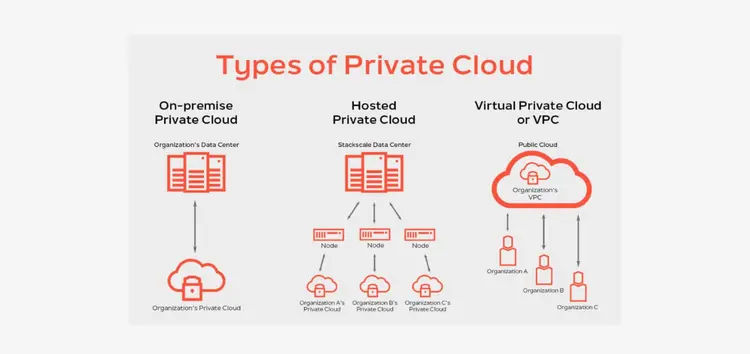
Stakescale
1. Virtual Private Cloud
It is simply a virtual network dedicated to one organization or user in a public cloud. It can be termed a Network-As-A-Service by the public cloud providers. Organizations can create logically isolated data centers and labs within them. Any computer resource deployed will be part of this customized private IP subnet or lab. The underlying infrastructure is maintained by the cloud provider itself. Organizations can access the resources within this subnet over a secured VPN connection. Examples of Virtual Private Cloud are – Amazon VPC, Google Cloud Platform (GCP) VPC, and IBM Cloud VPC.
2. Managed Private Cloud
In a managed private cloud, the hardware and software are owned by the organization. It can be on-premises or off-premises. However, the entire management, operation, and maintenance tasks of the cloud are outsourced to external private cloud providers.
3. Hosted Private Cloud
In a hosted private cloud, cloud providers provide isolated servers in their data centers. The cloud provider is responsible for the hardware, software, network, and security of the infrastructure. Labor and maintenance costs to the organization get reduced in this model.
4. On-Premises Private Cloud
On-premises private cloud allows users to host servers locally in data centers. It provides high security because the boundary of physical and logical accessibility is only within the organization.
Private Cloud vs Public Cloud
The table below states the differences between Public Cloud and Private Cloud based on parameters like cost effectiveness, ease of use, audience along with some examples. Please go through Public cloud vs Private cloud to learn more about it.
| Parameter | Public | Private |
| Cost | Cost-effective | High-priced |
| Security | Dependent on the cloud provider | Most Secure |
| Scalability | High | Restricted |
| Accessibility | Everyone | Restricted |
| Maintenance | Lowest | Highest |
| Shared Resources | Multitenant, Shared Servers | On-premises, Private Servers |
| Owner | Cloud Provider | Organization |
| Examples | AWS, GCP, Azure, IBM, Oracle | VMware, HPE, Dell, OpenStack |
Private Cloud vs Hybrid Cloud
Below is a table of differences between Hybrid Cloud and Private Cloud:
| Parameter | Private | Hybrid |
| Cost | High-priced | High-priced |
| Security | Most Secure | Secure |
| Scalability | Restricted | High |
| Accessibility | Restricted | Medium |
| Maintenance | Highest | Medium |
| Shared Resources | On-premises, Private Servers | Mixed |
| Owner | Organization | Organization |
| Examples | VMware, HPE, Dell, OpenStack | Rackspace, VMware, Cisco, IBM |
Benefits of Private Cloud
- It is easier to provide isolation and control into the infrastructure consisting of compute, storage, and network resources of a particular organization.
- Since the resources are isolated, it provides greater data security and integrity. It offers private cloud storage.
- Budgeting becomes easier for a company while using a private cloud, public clouds cannot be predicted.
- Since there is no resource or bandwidth sharing with any other organization or user, performance becomes better for a particular organization’s workload.
- It provides scope for customizing software and hardware requirements which is not provided at a high scale in a public cloud.
- Though the upfront capital expenditure is huge, there is a long-term pay-off benefit as subscription cost gets cut.
- Any industry and regulatory compliance are not forced upon private cloud users as in the case of a public cloud. Private clouds can decide this.
- Organizations can easily adopt some of the public cloud functionalities in the future and shift to a hybrid cloud model.
Disadvantages of Private Cloud
- High upfront capital expenditure is required to set up physical data centers and servers.
- On-demand scaling is difficult and costly.
- Availability is very difficult to achieve. The area of operation is restricted.
- Since the entire infrastructure and workload management must be done by the organization itself, it can become cumbersome. A highly skilled IT team must be recruited to architect and manage it.
- The organization is accountable for any sort of inconsistency and not the cloud provider.
Reasons for Popularity of Private Cloud Environments
A private cloud is suitable to use when:
- There is a requirement for high security for sensitive data as the resources in a private cloud can be accessed only by trusted people within an organization. It is not accessible over the public internet.
- The organization requires high control and more isolation in the system and resources.
- A high level of resource customization is required for any business logic. Since the infrastructure is dedicated, it becomes easier to customize.
- Predictable costs are required. Public cloud costing can be unpredictable based on usage.
Major Private Cloud Vendors
Some of the major private cloud vendors are:
- Amazon Virtual Private Cloud (VPC): It is a virtual network dedicated to one’s AWS account. Private EC2 instances can be launched on this VPC. While there is no additional charge for creating and using an Amazon Virtual Private Cloud (VPC) itself, one can pay for optional VPC capabilities with usage-based charges.
- Hewlett Packard Enterprise (HPE): HPE provides software-driven private cloud architecture solutions. Organizations can compose any workload, and any service, all while reducing infrastructure cost and complexity.
- VMware: VMware's private cloud solution allows organizations to architect data centers using Virtual Machines and a Software Defined Network. There are three types of private cloud which VMware provides - Managed Private Cloud, Hosted Private Cloud, and Virtual Private Cloud.
- IBM Cloud: IBM’s private cloud solutions include IBM Cloud Pak System, IBM Cloud Private, IBM Storage, and Cloud Orchestrator.
Looking to enhance your IT skills? Discover the best ITIL course, designed to boost your knowledge and expertise. Gain a competitive edge in the industry with this unique training opportunity. Don't miss out!
The Right Cloud for You
To conclude, there are a plethora of options and models available if one decides to choose a private cloud for their workload deployments. Organizations need to decide on the correct architecture for their business logic and choose accordingly. Security and privacy are the main advantages of using a private cloud. Most of the cloud providers come with great documentation, which can help one get an overview of the services they offer. Examples of private clouds are – Amazon VPC, HPE, VMware, and IBM. They leverage technologies like Virtualization, Management Software, and Automation to achieve this. A private cloud can also leverage DevOps and cloud-native practices to maximize agility. KnowledgeHut Computing training provides comprehensive training on the fundamentals of cloud computing.
Frequently Asked Questions (FAQs)
1. What is the advantage of a private cloud?
It is easier to provide isolation and control into the infrastructure consisting of computing, storage, and network resources of a particular organization. Since the resources are isolated, it provides greater data security and integrity. It provides scope for customizing software and hardware requirements which is not provided at a high scale in a public cloud.
2. What are examples of private clouds?
Private Cloud examples - HPE, OpenStack, Dell, VMware, IBM, AWS VPC.
3. Why private cloud is more secure?
A private cloud is more secure because all the resources belong to a single organization, it is not shared among others which allows organizations to have maximum control over access and data. A private cloud also allows the customization of security.
4. Is it better to use a public cloud or a private cloud?
It depends on the decided architecture. Small organizations can use the public cloud and then cautiously move to a private cloud for the security of important data, for example, a database, and deploy the rest of the services in a public cloud.
Public Cloud is better to use when:
The organization is short of funds to invest in a private cloud infrastructure.
High and instant autoscaling is required.
Low latency is required, and public clouds provide location-independent services.
Private Cloud is better to use when:
Sensitive data control and security are required.
Customization is required in terms of compute, storage, or networking for the deployment of any business logic.
4 articles published
I’ve acquired experience as a DevOps Engineer. Amidst my busy work schedule, I love spending time writing blogs and sharing my knowledge about the latest trends through them
Get Free Consultation
By submitting, I accept the T&C and
Privacy Policy