
- Home
- Blog
- Project Management
- ETC vs EAC: Top Key Differences and Similarities
ETC vs EAC: Top Key Differences and Similarities
Updated on May 12, 2026 | 7 min read | 9.36K+ views
Share:
Table of Contents
View all
In project management, tracking project costs accurately is essential to avoid budget overruns and keep work on schedule. Two important Earned Value Management concepts that help with this are ETC, which stands for Estimate to Complete, and EAC, which means Estimate at Completion.
While ETC focuses on the expected cost required to finish the remaining project work, EAC gives an estimate of the total project cost once everything is completed. Understanding the difference between these two metrics helps project managers make better financial decisions and improve project forecasting.
If you want to strengthen your knowledge of such project management concepts and prepare for industry recognized certifications, you can explore upGrad KnowledgeHut PMP Certification Training for structured learning and practical insights.
Ultimate PMP Formula Cheat Sheet
Get a quick, exam-ready PMP cheat sheet with all essential formulas and key concepts in one place.
What is Estimate to Complete (ETC)?
ETC, or Estimate to Complete, is a projection of the cost required to complete the remaining work in a project. In my experience, it’s a valuable tool for keeping a project within its budget.
What is Estimate at Completion (EAC)?
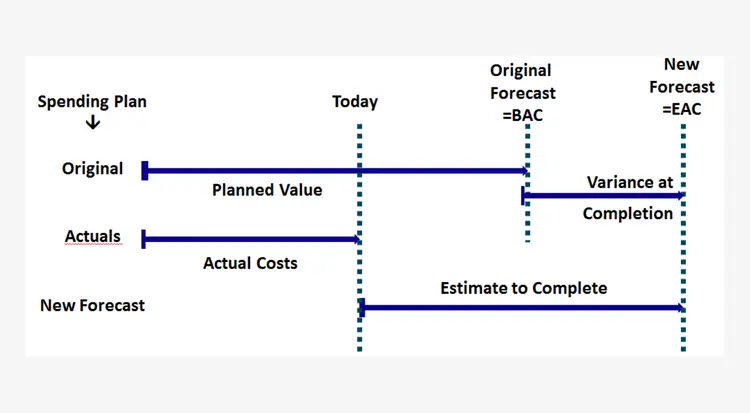
However, EAC, or the Estimate at Completion in project management, is the total cost anticipated at the project's completion. It’s a combination of the actual cost incurred till date and the ETC.
ETC vs EAC: Comparison Table
Let us now take a brief look at what is the difference between ETC and EAC:
| Parameter | Estimate to Complete (ETC) | Estimate at Completion (EAC) |
| Definition | Cost to complete remaining work | Total cost at project completion |
| Focus | Remaining Work | Total Project Cost |
| Calculation | (BAC - EV) / CPI | AC + ETC |
| Decision Making | Resource Allocation | Overall Project Budget Control |
| Impact | Affects future cash flow needs | Indicates potential budget overruns/underruns |
| Usage | Mid-project to control budget | Start of project to set budget |
| Change | Changes as project progresses | Generally constant, changes if scope changes |
Difference Between Estimate to Complete and Estimate at Completion in Project Management
1. ETC vs EAC: Focus
Understanding ETC or EAC in terms of the metric's focus, ETC focuses on anticipating the future costs required to complete the remaining work in a project. It is a forward-looking metric, aiming to project the financial landscape ahead. In contrast, EAC shifts its focus to the total project cost, incorporating both actual expenses incurred so far and the estimated costs to finish the project. EAC provides a real-time assessment of the overall financial health of the project, blending past expenditures with future projections.
firebrand
2. Estimate to Complete and Estimate at Completion: Calculation
Suppose you have a project with a Budget at Completion (BAC) of $1000. Halfway through, you’ve spent $600 (Actual Cost or AC), but you’ve only completed work worth $400 (Earned Value or EV). Your Cost Performance Index (CPI) is 0.67, which is calculated as EV divided by AC.
To calculate ETC:
ETC= (BAC - EV) / CPI =0.671000−400 ≈895.52
This means you estimate it will cost approximately $895.52 more to complete the project in accordance with the ETC formula in PMP. Boost your skills with a Project Management Professional training course to improve your expertise.
Now, to find EAC:
EAC=AC+ETC=600+895.52=1495.52
So, as per the formula for EAC in project management, the estimated total cost at completion is approximately $1495.52, indicating you will go over budget if things continue as they are.
3. ETC vs EAC: Decision Making
When it comes to decision-making or choosing between ETC vs. EAC in project management guides you in different directions. ETC focuses on resource allocation. By understanding the additional funding required for remaining tasks (ETC), you can effectively allocate resources like materials or manpower. On the other hand, EAC helps with overall project budget control. It provides a complete picture of potential overruns or underruns, allowing you to make informed adjustments if needed.
4. ETC vs EAC: Impact
ETC directly affects your future cash flow needs. It tells you how much extra money you'll need to complete the project, helping you plan for upcoming expenses. In contrast, EAC focuses on the bigger picture, indicating potential budget overruns or underruns. By showing the total expected cost (EAC), you can identify if the project might go over budget and take corrective actions.
5. ETC vs EAC: Usage
ETC (Estimate to Complete) is typically used mid-project when you need to control and forecast future spending to complete the project. It’s a tool for project managers to adjust their strategies and resources to stay within budget. EAC (Estimate at Completion), on the other hand, is used from the start of the project to set the initial budget and throughout the project to update the total expected cost. It helps stakeholders understand the overall financial picture and make informed decisions about project funding.
6. ETC vs EAC: Change
ETC may change as the project progresses, adapting to the actual performance and any modifications in work scope. In contrast, EAC is generally constant but will change if there are significant scope changes. These metrics are dynamic, reflecting the evolving nature of project management. They ensure that estimates remain relevant and aligned with the project’s status.
Gain hands on project management knowledge with Project Management Certification Courses and boost your professional growth.
7. Estimate to Complete and Estimate at Completion: Example
Imagine you’re saving up to buy a bike that costs $200. You’ve already saved $50. Now, you think it’ll cost you $180 more to reach your goal because prices went up (ETC).
EAC is your new total expected cost. So, you add what you’ve already saved ($50) to the new amount you think you need ($180). Your EAC is now $230.
In short:
- ETC is like the extra money you think you need to save because the bike’s price increased.
- EAC is your total savings goal after considering the price increase.
So, ETC helps you figure out how much more you need, while EAC tells you the total amount you’ll spend or save up by the end.
How They are Similar?
- Both are estimates: They are forecasts of future project costs, not guaranteed figures.
- Both rely on past data: They incorporate the actual costs incurred so far (AC) to provide insights into future spending.
- Both are crucial for project success: Understanding both ETC and EAC in project management helps you manage resources effectively, anticipate potential budget issues, and ultimately deliver projects on budget.
What Should You Choose Between ETC and EAC?
You don't actually choose between ETC and EAC! They serve different purposes at different stages of your project. Here's how to think about it:
- Start of Project: Use EAC to set a high-level budget based on the total project cost (BAC).
- Mid-Project: Use ETC to control your budget by estimating the additional funds needed to finish remaining tasks.
Conclusion
ETC and EAC are both essential tools in Earned Value Management that help project managers stay on top of project costs and performance. While ETC focuses on estimating the remaining cost to complete the work, EAC gives a complete picture of the total expected project cost.
Understanding both helps in better forecasting, smarter budgeting, and more informed decision making. When used together, they provide a clearer view of project financial health and help ensure successful project delivery.
Contact our upGrad KnowledgeHut experts and get personalized guidance on choosing the right course, career path, and certification for your goals.
Frequently Asked Questions (FAQs)
Can ETC ever become zero during a project?
Yes, ETC becomes zero when all the remaining work is completed. At this stage, there are no future costs left to estimate. This usually happens when the project reaches its final completion phase.
How often should ETC and EAC be updated?
ETC and EAC should be reviewed and updated regularly throughout the project. Many teams do this weekly or monthly depending on the project size and complexity. Frequent updates help keep cost forecasts accurate and relevant.
What happens if ETC increases during a project?
An increase in ETC means that the remaining work is expected to cost more than planned. This could be due to delays, inefficiencies, or changes in scope. It is a warning sign that the project may need corrective actions.
Can ETC and EAC ever be equal?
In most cases, they are not equal because ETC only represents the remaining cost, while EAC includes total project cost. However, at the very beginning of a project, before any cost is spent, they may appear similar. As the project progresses, they differ.
How do project managers use ETC in real scenarios?
Project managers use ETC to estimate how much budget is still needed to finish the project. This helps them plan resources, adjust spending, and avoid cost overruns. It also supports better decision-making during execution.
Is EAC only used for tracking costs?
EAC is mainly used for cost forecasting, but it also provides insights into overall project performance. It helps identify whether the project is likely to go over or stay within budget. This makes it valuable for both planning and reporting.
What factors can cause sudden changes in EAC?
EAC can change due to unexpected risks, resource issues, or changes in project scope. Poor performance or delays can also increase the estimated total cost. That is why it is important to monitor project performance continuously.
Are ETC and EAC useful for small projects too?
Yes, even small projects can benefit from using ETC and EAC. They help maintain control over budget and spending. For smaller projects, simpler calculations can be used to track costs effectively.
How do ETC and EAC help in stakeholder communication?
They provide clear and quantifiable data about project costs. Stakeholders can easily understand if the project is on budget or not. This improves transparency and builds trust between teams and stakeholders.
Can software tools calculate ETC and EAC automatically?
Yes, many project management tools can calculate ETC and EAC automatically. Tools like MS Project or Primavera use real-time data to update these values. This saves time and reduces the chance of manual errors.
3 articles published
Mary Tresa Gabriel is a PMP Certified Project Manager and Career Coach.She has worked in various big MNCs like UST, Muraai, Dell, etc. Being a PMP-certified project manager she is now a career coach w...
Get Free Consultation
By submitting, I accept the T&C and
Privacy Policy