
- Home
- Blog
- Project Management
- What are the Types of Productivity and How to Use Them?
What are the Types of Productivity and How to Use Them?
Updated on May 12, 2026 | 8 min read | 2.73K+ views
Share:
Table of Contents
View all
Productivity in project management is all about how effectively work is completed compared to the effort, time, and resources used. It helps project managers understand whether teams are delivering good results with the available inputs.
There are different types of productivity such as labor productivity, capital productivity, material productivity, and total factor productivity, each focusing on a specific area of performance.
Understanding these types helps in tracking progress, improving efficiency, reducing unnecessary costs, and ensuring project deadlines are met.
For professionals who want to strengthen their project management skills and apply these concepts effectively, exploring upGrad KnowledgeHut PMP Certification Training can be a great step toward career growth.
Ultimate PMP Formula Cheat Sheet
Get a quick, exam-ready PMP cheat sheet with all essential formulas and key concepts in one place.
What is Productivity?
By definition, productivity means how much output is generated per unit of input. It is a gauge of how efficiently efforts and resources are utilized or applied to achieve the desired outcomes. Productivity can be applied situationally to individuals or resources. In the case of individuals, productivity means doing more i.e. completing more tasks/activities in less time while for businesses it may mean the production of more goods or delivery of better services with fewer resources - clearly indicating how effectively labor, time, and material are applied to the project and what value they deliver once onboarded.
Whether it is traditional execution/development or modern ways of working, this key metric is of paramount importance in any organization setup.

Source: betterup
Types of Productivity
There are various types of productivity tools on which the business is bound to keep a keen eye to maintain balance and profitability. These include:
1. Labor Productivity - This is a measure of the output per unit of labor burnt i.e. the amount of work completed by an individual within the given time. It is an important measure that guides the efficiency of efforts spent and is a key performance improvement indicator for the teams.
Formula = Total Output/Total Labor hours (efforts)
2. Material Productivity - This is a measure of how efficiently raw materials are converted into finished goods in the manufacturing processes. It is a critical measure of cost optimization and waste reduction aimed at bringing efficiencies and economies.
Formula = Output/material input*
3. Capital Productivity - This is a measure of how effectively capital i.e. physical assets, infrastructure, machinery, etc are applied to produce goods or services that bring revenue to the organization.
Formula = Output/capital input*
4. Total Factory productivity - This is an all-around metric that considers the multiple inputs of labor, material, capital to assess and improvise efficiencies.
Formula = Output (labor + material + capital) /multiple inputs (labor + material + capital)*
*Here, both output and input are evaluated in monetary terms for measuring productivity.
For any business, considering all the above types of productivity measures is important to take the first step in improvising processes to improve outcomes. Categorizing productivity into various types just gives businesses the added advantage of managing it in smaller portions and constantly looking for avenues to overcome challenges. Not all of these productivity types may be relevant to all teams/businesses, leadership must constantly evaluate the situation and measures required. It is also important to remember that productivity never remains static and is subject to organization, industry, and technology dynamics.
Factors Affecting Productivity
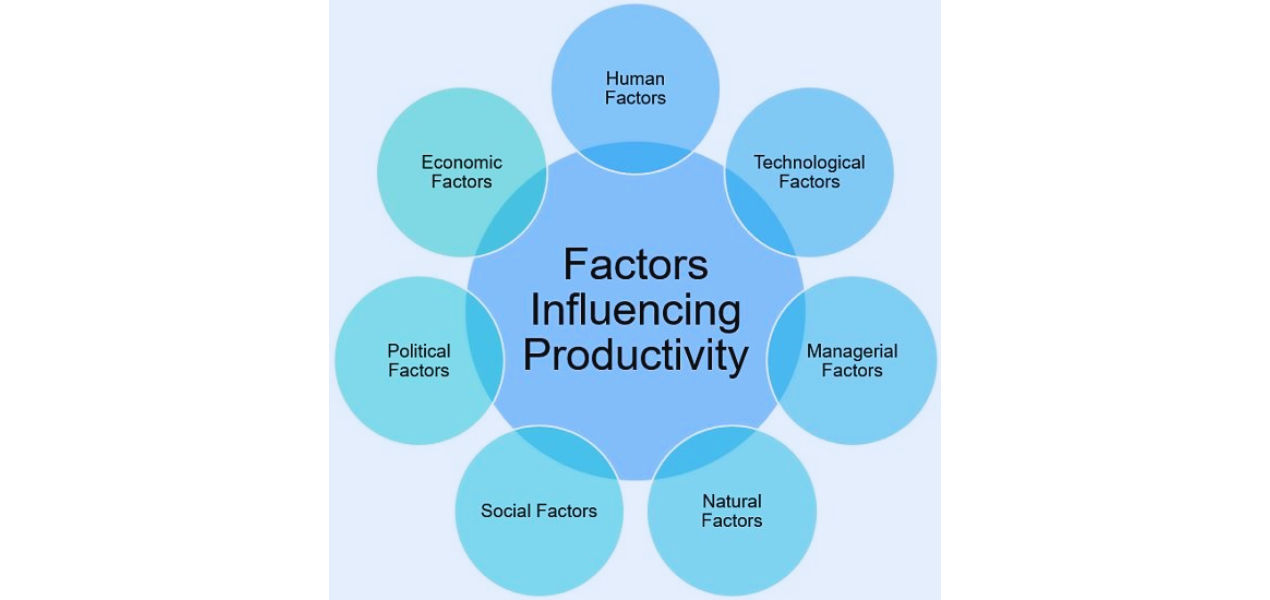
Productivity is not constant and keeps changing as many different factors influence how people and teams work. Businesses always try to improve productivity, but it depends on a mix of personal, organizational, and external elements. Understanding these factors can help improve performance and achieve better results.
Individual Factors
An individual’s productivity is influenced by their skills, training, motivation, and level of engagement at work. Factors like work life balance, time management, and overall health also play a major role in how effectively a person performs.
Organizational Factors
The work environment, leadership style, company policies, available technology, recognition systems, and internal processes all impact how productive employees can be. A supportive and well-structured organization usually leads to better performance.
External Factors
Productivity is also affected by outside influences such as government regulations, market competition, economic conditions, and global or social events. These factors can change how businesses operate and how teams perform their work.
Based on the factors and types of productivity discussed earlier, teams usually move through a natural cycle of productivity that includes four main stages:
Forming
This is the starting phase where the team is built and basic goals, roles, and expectations are defined.
Storming
In this stage, teams often face challenges, differences in opinion, or conflicts while figuring out how to work together effectively.
Norming
Here, the team starts settling in, building trust, and following agreed processes and tools to maintain a steady workflow.
Performing
This is the most productive stage where the team works smoothly, collaboration is strong, and efficiency and output are at their highest.
Source: businessjargons
How to Use Productivity Measures in the Workplace?
Set Clear Goals and Objectives: Start by defining what productivity means for your team so everyone knows what they are working toward.
Use Key Performance Indicators: Apply KPIs to measure output in a clear and structured way so performance can be tracked easily.
Monitor Progress Regularly: Keep an eye on KPIs and other metrics to spot gaps early and make improvements when needed.
Simplify Workflows: Create clear and easy processes that reduce confusion and help teams work more efficiently.
Encourage and Motivate Teams: Use rewards and recognition to boost morale and keep employees motivated to perform better.
Leverage Tools and Technology: Adopt modern tools to track work, improve visibility, and reduce delays or bottlenecks.
Conclusion
Understanding the types of productivity and how to use them in project management helps teams work more efficiently and deliver better results. When productivity measures are applied correctly, they make it easier to track performance, improve processes, and manage resources effectively.
Factors affecting productivity also remind us that both people and work environments play an important role in overall success. By following a structured productivity cycle, teams can move from planning to high performance in a more organized way
In the end, focusing on productivity is not just about doing more work, but about doing the right work in a smarter way.
Contact our upGrad KnowledgeHut experts and get personalized guidance on choosing the right course, career path, and certification for your goals.
Frequently Asked Questions (FAQs)
How is productivity different from efficiency in project management?
Productivity measures how much output is produced using inputs like time and resources. Efficiency focuses on how well those resources are used with minimal waste. A team can be productive but still not fully efficient.
Can productivity be measured in creative or non-technical work?
Yes, but it is measured using quality, deadlines, and outcomes instead of just numbers. For example, client satisfaction and project impact can be used as indicators. This helps evaluate work that is not easily quantifiable.
Why does productivity differ between teams in the same organization?
Productivity varies due to differences in skills, leadership, communication, and tools used by each team. Work environment and experience levels also play a role. Even similar teams may perform differently based on these factors.
How does employee motivation impact productivity?
Motivated employees are more focused, consistent, and engaged in their tasks. This leads to better performance and fewer mistakes. Lack of motivation often results in delays and lower quality work.
What role does communication play in productivity?
Clear communication helps teams understand tasks, expectations, and deadlines properly. Poor communication leads to confusion, rework, and missed deadlines. Good communication improves coordination and workflow efficiency.
Can productivity improve without increasing workload?
Yes, productivity can improve by removing unnecessary tasks and improving processes. Using better tools and automation also helps save time. The goal is to improve output quality, not just increase effort.
What tools help track productivity in project management?
Teams use project dashboards, time tracking tools, and reporting software to monitor progress. These tools help identify delays and performance gaps early. They also improve transparency across teams.
How does leadership influence productivity?
Good leadership creates clarity, motivation, and direction for teams. Poor leadership can cause confusion and reduce morale. A strong leader helps teams stay aligned and focused on goals.
Is higher productivity always beneficial in projects?
Not always, because extremely high productivity without quality control can lead to errors. It may also cause employee burnout if not managed well. Balance between speed and quality is important.
How does technology improve productivity?
Technology automates repetitive tasks and improves communication across teams. It also helps track progress in real time. This reduces manual effort and increases efficiency.
29 articles published
Rohit Arjun Sambhwani is an IT professional having over a decade and half of experience in various roles, domains & organizations, currently playing a leading role with a premier IT services organizat...
Get Free Consultation
By submitting, I accept the T&C and
Privacy Policy