
Product-Led Growth (PLG) Explained for Product Managers
Updated on Aug 26, 2026 | 351 views
Share:
Table of Contents
View all
Quick Overview
- Product-led growth (PLG) uses the product to drive customer acquisition, retention, and expansion through experiences such as free trials, freemium plans, and self-serve onboarding.
- Core PLG principles include helping users experience value quickly, reducing friction, and encouraging organic growth through sharing, collaboration, and referrals.
- Key PLG metrics include activation, conversion, retention, churn, customer acquisition cost, product engagement, adoption, and referral metrics.
- This guide explains what PLG is, how to build a PLG strategy, which metrics product managers should track, and the key benefits of adopting a product-led approach.
Build strategic product skills with SAFe® 6.0 Agile Product Managementand learn how to align product strategy with customer needs and business goals.
What is product-led growth?
Product-led growth is a business strategy in which the amount of product usage leads to customer acquisition, conversion, expansion, and retention; the product thus acts as one of the primary means through which customers discover its value and decide if they want to keep using it.
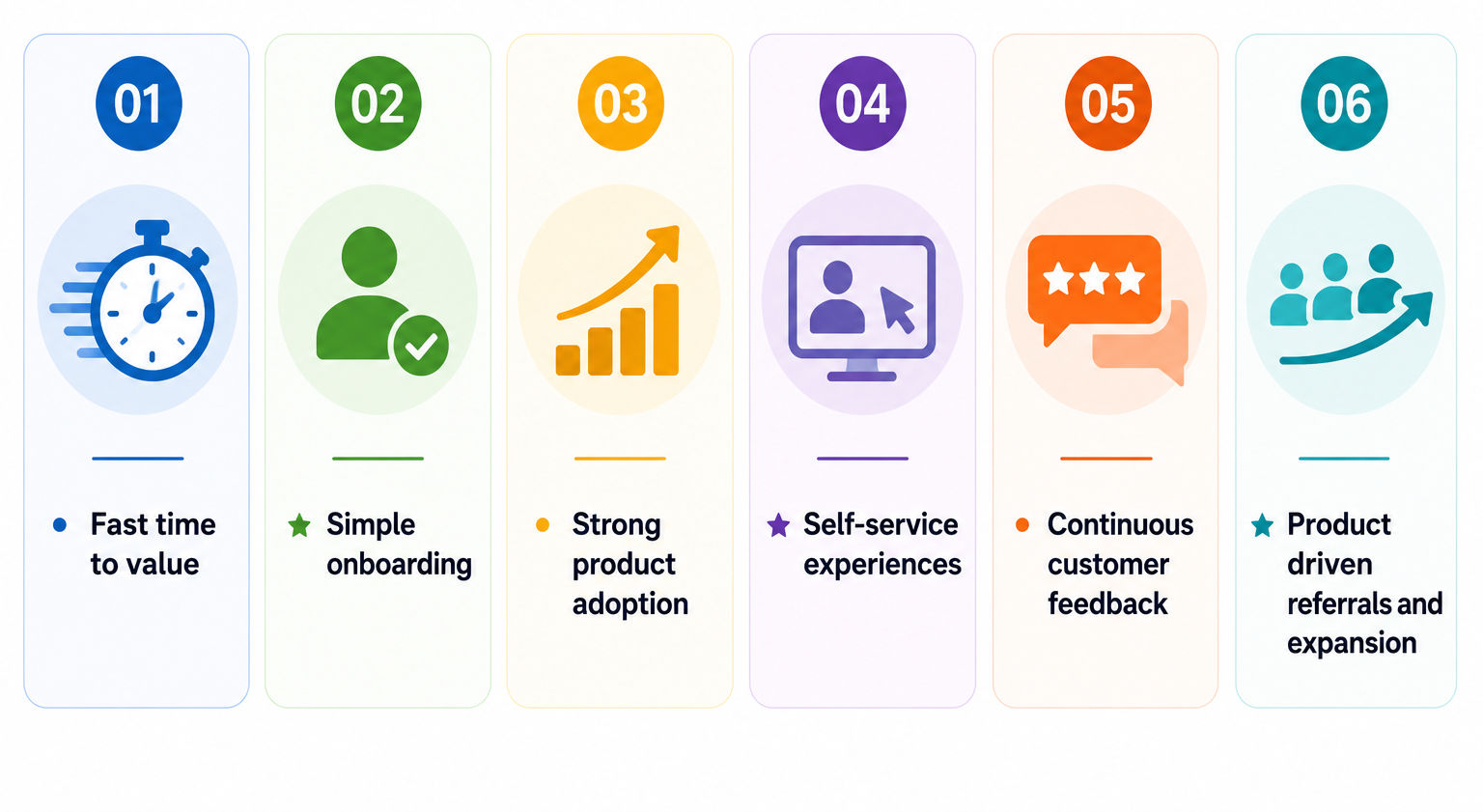
A strong PLG approach usually focuses on:
Product Led Growth vs Sales Led Growth
The extent to which sales-driven growth depends on sales teams is that they must educate potential customers, build relationships with them, negotiate agreements, and secure customers.
The emphasis on product led growth is on product experience.
| Product Led Growth | Sales Led Growth |
| Product demonstrates value | Sales team demonstrates value |
| Self-service journey | Sales guided journey |
| Faster user experimentation | More human interaction |
| Usage drives conversion | Sales process drives conversion |
| Product adoption is central | Sales pipeline is central |
Product Led Growth vs Marketing Led Growth
Marketing led growth relies heavily on campaigns, content, advertising, SEO, social media, and brand building to generate demand.
| Factor | Product Led Growth | Marketing Led Growth |
| Primary Focus | Product experience drives growth | Marketing activities drive demand |
| Customer Acquisition | Product usage, trials, referrals, and self service | Campaigns, advertising, SEO, content, and social media |
| Value Demonstration | Customers experience value through the product | Marketing communicates the product's value |
| Customer Journey | Product guides users toward activation and conversion | Marketing moves prospects toward consideration and purchase |
| Growth Driver | Product adoption and user engagement | Marketing reach, awareness, and lead generation |
Explore the Product Manager Future and discover the top trends, skills, and predictions shaping product management careers in 2026 and beyond.
How can one build a successful product-led growth strategy?
A growth strategy that is based on a good product begins with its product value proposition and extends throughout the entire customer journey. To carry out their role effectively, Product Managers must know the places where users feel the value, the points at which they drop off, and the factors that cause them to keep going.
1. Identify the Ideal Customer and Core Product Value
Start by clearly defining:
- Who the product is for
- What problem it solves
- Why the problem matters
- What makes the solution valuable
2. Define the Activation Poin
Activation is the point at which a user experiences a significant aspect of the product's value.
The activation point should be:
- Clearly measurable
- Closely connected to customer value
- Relevant to long term retention
3. Reduce Friction in the User Journey
Any step that is not necessary can cause friction.
Teams can reduce friction by:
- Simplifying sign up
- Removing unnecessary form fields
- Improving navigation
- Making important features easier to find
- Reducing setup requirements
4. Optimize Product Onboarding
It's good if the onboarding process helps users to know what they should do next and why it is important.
Effective onboarding can include:
- Clear guidance
- Product tours where useful
- Contextual tips
- Relevant defaults
- Progress indicators
- Early success opportunities
5. Create Product Driven Growth Loops
Growth loops are systems in which one customer action leads to another growth opportunity.
A product may encourage:
- Sharing
- Invitations
- Referrals
- Collaboration
- Content creation
- Team expansion
6. Align Product, Marketing, Sales, and Customer Success
The idea that product-led growth makes it unnecessary for other teams to exist is incorrect.
Instead, teams should share:
- Customer insights
- Product usage data
- Conversion signals
- Retention trends
- Expansion opportunities
Build practical Agile skills with the Best Agile Management Certification Training Courses and advance your Agile career.
What Product Led Growth Metrics Should Product Managers Track?
Metrics enable Product Managers to determine if product-led growth is in fact having a positive effect, with the most useful ones linking user behaviour to business outcomes rather than concentrating solely on the number of signups.
1. Activation Rate
The activation rate is the figure which shows the percentage of users who carry out a specific value-oriented action.
The activation metric should reflect real product usage and not just the creation of an account.
2. Conversion Rate
The conversion rate indicates the extent to which users move from one stage to another.
Depending on the product, this may include:
- Free to paid conversion
- Trial to paid conversion
- Sign up to activation
- Product use to expansion
3. Retention and Churn Rate
Retention refers to the number of customers who continue to use the product over time, whereas churn is the figure showing how many customers stop using it.
The fact that retention is high suggests that customers are still receiving valuable benefits.
4. Customer Acquisition Cost
Customer acquisition cost shows how much it costs to get a customer.
Product-led growth can be used to lower acquisition costs since users find value and promote adoption through the product itself.
5. Product Engagement and Adoption
Engagement of metrics enable Product Managers to determine if users are actually making use of the key product features.
Track:
- Feature adoption
- Usage frequency
- Active users
- Session activity
- Depth of product usage
6. Virality and Referral Metrics
The referral and virality figures indicate whether or not users help to attract further customers or users to the product.
Useful measures include:
- Referral rate
- Invitation rate
- Shared usage
- User generated referrals
- New users from existing users
Build a strong foundation with the key skills required to become a Product Manager, from product strategy and market research to communication and data driven decision making.
What are the benefits of product-led growth?
The advantages of product-led growth result from making the product itself a major factor in both acquiring customers and keeping them. But this approach is most effective when the product provides clear and measurable value.
1. Lower Customer Acquisition Costs
For certain customer groups, a good product experience can lessen the need for costly sales and marketing activities.
Users may discover value through:
- Free trials
- Freemium plans
- Self-service experiences
- Referrals
- Product sharing
2. Faster Time to Value
People are more likely to carry on when they get clear value right away.
Shortening the time between signing up and gaining value can be achieved by reducing the friction involved in onboarding and by making the initial experience simpler.
3. Improved Product Adoption
PLG advises teams to concentrate on whether customers actually make use of the key product features.
This can lead to stronger:
- Feature adoption
- Engagement
- User understanding
- Product utilization
4. Scalable Customer Acquisition
The rate at which customer growth occurs will be the same as the rate at which a product that supports self-service adoption can scale, without any increase in sales effort.
This is especially beneficial when it comes to products that have repeatable use cases and a clear value proposition.
5. Higher Customer Retention
People are more likely to stay when the product is incorporated into their regular workflow.
Strong retention usually comes from:
- Consistent value
- Good usability
- Product habit formation
- Continuous improvement
Conclusion
Product led growth makes the product a central part of how a business attracts, converts, and retains customers. For Product Managers, the focus is on delivering value quickly, reducing friction, improving adoption, and creating experiences that naturally support growth.
The key decision factor is whether the product experience can demonstrate and deliver enough value to become a genuine growth engine. Product Managers should start by identifying the core value moment, defining activation and retention metrics, reducing friction, and continuously improving the customer journey.
Contact our upGrad KnowledgeHut experts for personalized guidance on choosing the right course, career path, and certification to achieve your goals.
Frequently Asked Questions (FAQs)
1. Is product led growth suitable for every type of SaaS product?
No. Product led growth works best when customers can understand and experience product value with limited assistance. Products with complex implementation, long sales cycles, heavy customization, or extensive enterprise requirements may need a stronger sale led approach.
2. Should a product led growth strategy use freemium or a free trial?
Both can work, but the right choice depends on how quickly customers can experience value. Freemium provides ongoing access to a limited product experience, while a free trial offers broader access for a fixed period. The choice should support activation and conversion goals.
3. What is a product qualified lead in product led growth?
A Product Qualified Lead, or PQL, is a user or account showing product behaviors associated with purchase readiness. Examples can include high usage, repeated feature adoption, or reaching specific product milestones. PQLs can help sales teams focus on users by showing stronger buying signals.
4. Can product led growth work for enterprise customers?
Yes. Enterprise PLG can combine self service product experiences with sales support when customers need larger contracts, integrations, security reviews, or procurement assistance. The product can generate initial interest while sales helps move complex accounts toward expansion.
5. Does product led growth eliminate the need for a sales team?
No. Sales can remain important for enterprise deals, complex purchases, and account expansion. In a PLG model, product usage can create demand and buying signals, while sales teams focus on opportunities that benefit from human support.
6. How can Product Managers identify the product led growth “aha” moment?
The aha moment is usually linked to a behavior that shows users have experienced meaningful product value. Product Managers can analyze retained users and identify actions that strongly correlate with continued engagement, then test whether encouraging that behavior improves activation or retention.
7. How can teams improve free to paid conversion in a PLG model?
Teams can improve conversion by helping users reach value faster and making the upgrade path clear. Improving onboarding, reducing friction, demonstrating premium value, and targeting users who show strong product engagement can support better free to paid conversion.
8. What causes a product led growth strategy to fail?
PLG can struggle when the product takes too long to demonstrate value, onboarding creates friction, or the product is not suitable for self service adoption. Weak activation, poor retention, unclear pricing, and insufficient customer demand can also limit results.
9. Can a sales led company transition to product led growth?
Yes, but the transition usually requires changes to the product experience, onboarding, pricing, metrics, and internal processes. Companies can begin with a specific customer segment or self service journey rather than changing the entire business model immediately.
10. How does product led growth support expansion and upselling?
Product usage can reveal when customers need more features, capacity, or users. Teams can use these signals to offer relevant upgrades, additional products, or expanded plans at the right point in the customer journey.
1639 articles published
KnowledgeHut is an outcome-focused global ed-tech company. We help organizations and professionals unlock excellence through skills development. We offer training solutions under the people and proces...
Get Free Consultation
By submitting, I accept the T&C and
Privacy Policy