
- Home
- Blog
- Artificial Intelligence
- Agentic AI in Finance: How Banks and Fintechs Are Using Autonomous AI
Agentic AI in Finance: How Banks and Fintechs Are Using Autonomous AI
Updated on Jul 31, 2026 | 226 views
Share:
Table of Contents
View all
- How Banks and Fintechs Are Implementing Agentic AI
- Why Financial Services Are Adopting Agentic AI
- Benefits of Agentic AI in Financial Services
- Top Use Cases of Agentic AI in Finance
- Challenges and Risks of Agentic AI in Finance
- Real-World Examples of Agentic AI in Finance
- Future of Agentic AI in Banking and Fintech
- Skills Needed to Work with Agentic AI in Finance
- Conclusion
Quick Overview
- Agentic AI in Finance represents autonomous AI technologies capable of planning, reasoning, using tools, decision-making and performing financial operations with human supervision.
- Agentic AI changes banks and fintechs from passive content generation into autonomous action via goal-oriented AI agents, real-time tool coordination and autonomous workflow management.
- The top-tier financial organizations are employing Agentic AI to solve problems related to fraud detection, credit underwriting, regulation compliance, customer support, treasury management and other important financial operations.
- Get to know how banks and fintechs deploy Agentic AI, why they choose it and what business advantages it brings to them.
- Review the major use cases of Agentic AI in finance such as fraud detection, loan processing, financial advisory, compliance, customer support, treasury management, investment research and back-office automation.
- Find out about the major problems and threats of Agentic AI in finance as well as ways to mitigate them and effective governance practices.
- Become familiar with successful case studies of banks and fintechs, upcoming trends in autonomous finance and necessary competencies for building a career in Agentic AI in finance.
Ready to build the Agentic AI systems powering the future of banking and fintech? Gain hands-on expertise with the IIT KGP–Executive PG Certificate in Gen AI and Agentic AI and learn to design, deploy, and scale production-ready AI solutions.
How Banks and Fintechs Are Implementing Agentic AI
Agentic AI in financial services has advanced beyond the experimental stage. It is not about the latest chatbot craze; it is a move toward building agents capable of planning, making decisions, and performing actions in multi-step workflows with clear human decision-making checkpoints.
Successful implementations by institutions typically go through the following life cycle steps:
1. Business problem definition - Successful projects start small, solving a particular problem such as alert handling or document evaluation, rather than pursuing “AI transformation.”
2. Integration with data - Agents require seamless access to core banking systems, CRM, transaction logs, and other relevant databases. It is the longest and most underestimated step.
3. LLM selection - In financial services, model accuracy, latency, cost, and, importantly, its explainability are considered.
4. Tool Orchestration - Agents are connected to internal APIs, databases, and third-party providers so that they can perform actions rather than just outputting text.
5. AI agents - The orchestrated system is applied to solve an end-to-end task: analyzing a suspicious transaction, pre-evaluating a loan application, preparing a report on compliance.
6. Human Approval Workflows - All meaningful decisions, giving credit, detecting fraud, executing trades, go through the human approval step before being finalized.
7. Monitoring - Agent decisions and performance metrics are monitored in real-time via dashboards.
8. Continuous Optimization - Models and workflows are continuously improved using their performance and regulatory feedback and specific examples of errors made by the agent.
A typical rollout follows this path:
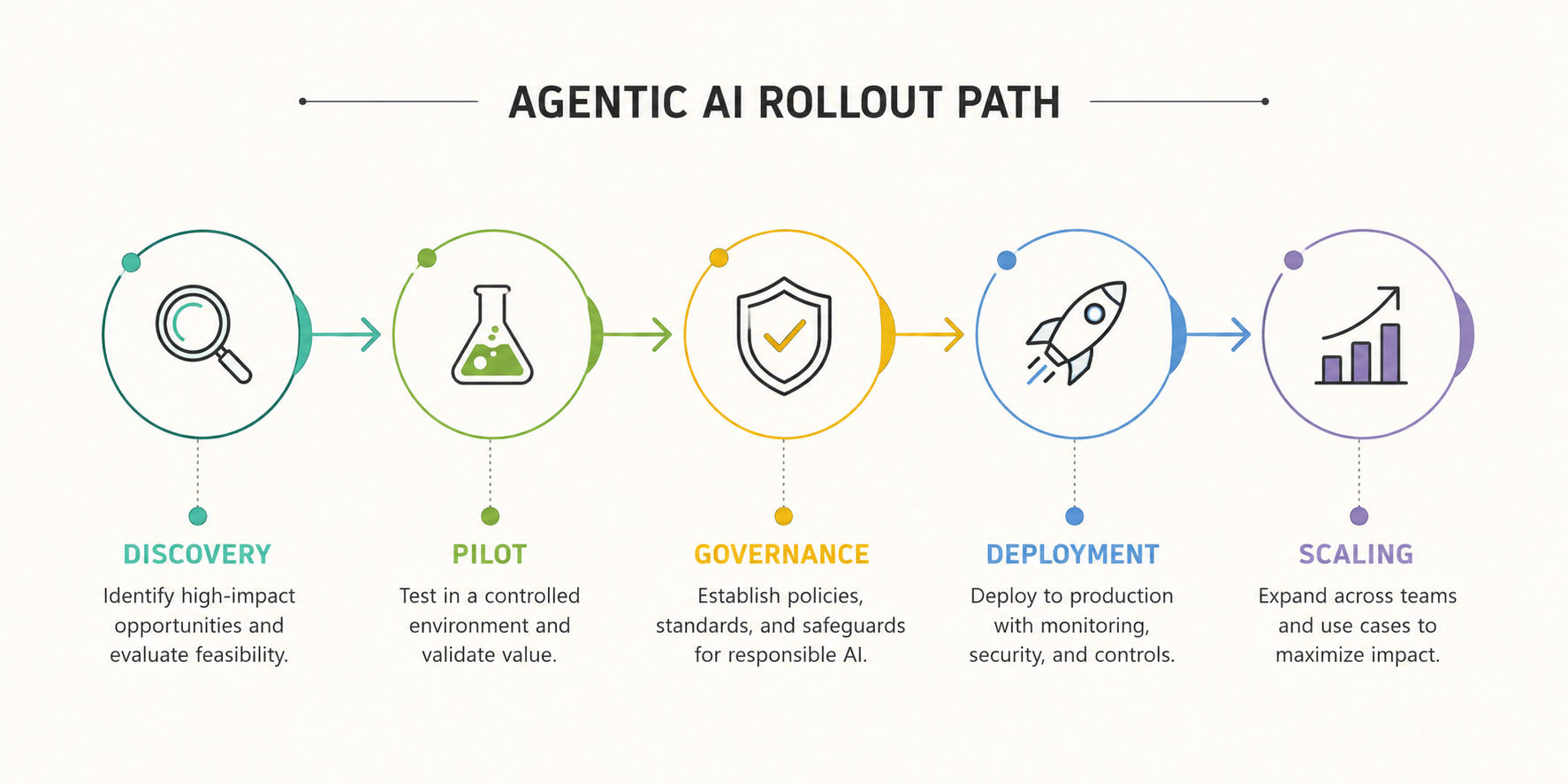
Institutions that reach controlled production successfully tend to spend the early months almost entirely on data readiness, governance frameworks, and fallback processes before writing a single line of agent logic. Scaling across multiple workflows takes considerably longer than the initial pilot, since each new use case needs its own testing, audit trail, and regulatory review.
Want to build a career in Agentic AI and enterprise AI? Explore KnowledgeHut's Artificial Intelligence Courses to master Generative AI, AI agents, LLMs, RAG, and other in-demand skills powering the future of finance and beyond.
Why Banking Is an Ideal Environment?
Unlike many industries, financial services operate on structured data, well-defined processes, and strict regulatory controls. These characteristics make banking particularly suitable for AI agents that can automate repetitive work while remaining within clearly defined approval, audit, and compliance boundaries.
Why Financial Services Are Adopting Agentic AI
A handful of pressures are converging to push banks and fintechs toward agentic systems:
- Rising fraud: Attack patterns evolve faster than manual review teams can track
- Regulatory complexity: AML, KYC, and cross-border compliance requirements keep expanding
- Customer expectations: Instant, personalized service is now the baseline
- Digital banking growth: More transactions happening with no human banker in the loop
- Operational efficiency and cost reduction: Margin pressure across the industry
- Faster decision-making: Competitive pressure to underwrite, approve, and respond in minutes, not days
- 24/7 financial operations: Markets and fraud don't keep banking hours
These business pressures are reflected in broader enterprise AI adoption as well. Nearly 80% of organizations now use Generative AI in at least one business function, creating a strong foundation for financial institutions to move beyond AI assistants toward autonomous, goal-driven AI agents capable of executing end-to-end workflows.
Why finance is uniquely suited for AI agents?
Financial services runs on structured data, repeatable processes, and clear rules, exactly the conditions where an AI agent can operate reliably within defined limits.
The need for smarter automation is particularly evident in financial crime prevention. Despite billions of dollars invested in compliance every year, financial institutions currently detect only around 2% of global illicit financial flows, highlighting why banks are exploring Agentic AI for more adaptive fraud detection and AML investigations.
Benefits of Agentic AI in Financial Services
- Faster operations and same-day resolution on tasks that used to take days
- Lower operational costs through reduced manual review
- Improved customer experience via instant, always-on service
- Better fraud prevention through continuous, real-time monitoring
- Reduced repetitive manual work for compliance and back-office staff
- Higher employee productivity, freeing people for judgment-heavy work
- Better decision quality through consistent, data-driven analysis
- Continuous operations that don't stop at 5 p.m.
Early enterprise deployments are already demonstrating measurable business value. Industry research suggests Agentic AI can reduce manual workloads by 30%–50% across complex banking workflows, while mature implementations could lower operating costs by more than 20% and improve operating profits by 9%–15% through greater automation and productivity.
The gap between ambition and execution is still real, though. Plenty of institutions have run pilots without ever reaching production, and the difference usually comes down to governance readiness rather than the technology itself.
Wondering how Generative AI enables Agentic AI? Explore how Generative AI and Agentic AI work together to power autonomous reasoning, tool use, and intelligent decision-making across enterprise workflows.
Top Use Cases of Agentic AI in Finance
Financial organizations are evolving from simple AI assistants into agents who are able to not only collect and analyze data but also make certain decisions within certain boundaries, organize workflow processes, and improve financial services. Below you may see where such evolution brings financial companies the most benefit right now.
Intelligent Fraud Detection
Current agentic systems can do:
- Transaction monitoring of many events in real time
- Pattern detection of things that would escape notice by a human analyst
- Automatic analysis collecting data on account history, devices used, and behaviour prior to any human review
- Escalation of suspicious transactions for fraud teams with all the supporting evidence assembled already
- Risk scoring that adjusts dynamically as new information comes in
In practice: Modern fraud platforms often deploy multiple AI agents simultaneously—one detecting suspicious activity, another gathering supporting evidence, and a third prioritizing cases for fraud investigators.
Autonomous Loan Processing
Agents are increasingly handling the full pre-approval pipeline:
- Document verification
- Credit analysis
- Risk assessment
- Approval recommendations
- Compliance validation
The human approval layer remains standard practice for final credit decisions, particularly given fair-lending obligations.
In practice: Most banks still reserve final lending decisions for human credit officers, while AI agents accelerate document analysis, eligibility checks, and risk assessment.
AI-Powered Financial Advisory
Robo-advisory is evolving from static portfolio allocation into something more dynamic:
- Personalized portfolio construction based on individual goals and risk tolerance
- Retirement planning that adjusts as circumstances change
- Wealth management support for advisors, not just direct-to-consumer tools
- A shift from "set it and forget it" robo-advisors toward continuously monitored, agent-assisted portfolios
Compliance & Regulatory Monitoring
This is one of the areas where agentic AI shows the clearest value, because compliance work is repetitive, document-heavy, and high-stakes.
The opportunity is substantial. Between 2015 and 2022, banks in several mature markets increased spending on KYC and AML compliance by up to 10% annually, yet detection rates have remained largely unchanged. Agentic AI aims to improve both efficiency and effectiveness by continuously analyzing transactions, documents, and regulatory updates.
- AML transaction pattern analysis
- KYC document and identity verification
- Risk alerts generated and triaged automatically
- Policy monitoring as regulations shift across jurisdictions
- Audit documentation generated automatically alongside each decision, creating a defensible trail
In practice: Compliance agents continuously monitor regulatory updates, map policy changes to internal controls, and generate audit-ready documentation for governance teams.
Customer Service AI Agents
- Banking copilots have moved well past scripted chatbots
- Virtual assistants now handle a large volume of customer interactions using privacy-first pipelines that scrub personally identifiable information before it ever reaches the underlying language model
- Leading banking assistants resolve the large majority of customer interactions without a human handoff
- These systems now handle account servicing and transaction assistance that used to require a phone call
In practice: Rather than replacing human advisors, AI agents increasingly resolve routine requests independently while seamlessly escalating complex or sensitive cases.
Treasury & Cash Flow Management
Agentic tools are being applied to:
- Liquidity forecasting across accounts and currencies
- Cash optimization, automatically shifting balances to minimize idle capital
- Multi-scenario forecasting that updates as market conditions shift
In practice: Treasury teams use AI agents to continuously monitor liquidity positions and recommend actions as market conditions evolve throughout the day.
Investment Research & Trading Support
- Market analysis synthesized across news, filings, and price data
- Research automation that compresses hours of analyst work into minutes
- Signal generation to flag opportunities for human traders
Fully autonomous trading without human oversight is not the direction most institutions are taking, and for good reason, given regulatory and fiduciary risk. The pattern that's emerging is human-supervised trading, where agents surface analysis and signals but a person makes the final call.
In practice: Most institutions use AI-generated research as decision support rather than allowing autonomous investment execution.
Back Office Process Automation
- Reconciliation across accounts and ledgers
- Reporting generated automatically from live data
- Claims processing in insurance-adjacent financial services
- Payment investigations that used to require manual case-by-case digging
In practice: Organizations often begin with reconciliation and reporting because these high-volume, standardized workflows provide quick operational wins.
Curious how Agentic AI is transforming industries beyond finance? Explore real-world applications of Agentic AI across healthcare, manufacturing, retail, logistics, customer service, and more.
Challenges and Risks of Agentic AI in Finance
None of this comes without real risk, and the institutions moving fastest are also the ones most exposed if governance lags behind deployment.
| Challenge | Potential Impact | Mitigation Strategy |
|---|---|---|
| Data privacy | Exposure of sensitive customer financial data | PII scrubbing before data reaches the LLM; strict access controls |
| Model hallucinations | Incorrect financial advice, compliance errors | Human-in-the-loop review for high-stakes outputs; grounding in verified data sources |
| Cybersecurity | Agents as a new attack surface | Dedicated AI security platforms and monitoring, treated as core infrastructure rather than an afterthought |
| Bias in lending | Discriminatory credit or underwriting outcomes | Regular bias audits, diverse training data, explainability requirements |
| Model governance | Untracked model drift, unclear accountability | Formal model risk management frameworks, versioning, audit trails |
| Human oversight | Autonomous errors compounding before detection | Defined approval thresholds; agents act within hard limits, not unconstrained authority |
| Legacy banking integration | Agents unable to access or act on core systems | Phased integration via APIs; middleware layers where direct integration isn't feasible |
| Operational risk | Cascading failures across interconnected agent workflows | Circuit breakers, monitoring dashboards, fallback to manual processes |
Recent incidents have demonstrated how sophisticated AI-enabled attacks have become. In one widely reported case, fraudsters used deepfake technology during a video conference to trick employees into authorizing a fraudulent transfer of approximately US$25 million, underscoring why AI governance and identity verification remain essential alongside Agentic AI adoption.
The pattern across the industry is fairly consistent: institutions find it much easier to launch a pilot than to move it into full production, and the sticking points are almost always data quality, governance maturity, and security, not the underlying AI capability itself.
Real-World Examples of Agentic AI in Finance
| Organization | Use Case | Business Outcome |
|---|---|---|
| JPMorgan Chase | Fraud/AML alerting; dynamic portfolio & pricing tools | Overnight AI screening frees bankers for client work; stronger sales performance |
| Wells Fargo | Virtual assistant for customer servicing; FX post-trade agents | High-volume interactions handled autonomously |
| Bank of America | Virtual assistant for account servicing | Most interactions resolved without human handoff |
| Goldman Sachs & Citigroup | AI software-engineering agents | Deployed alongside human developers |
| PayPal | AI-driven fraud detection infrastructure | Lower infrastructure costs |
| Mastercard | Pre-authorization transaction scoring | Real-time fraud scoring, industry standard |
| Commerzbank | AI avatar for customer queries | Personalized account info via app-based assistant |
Across the industry, several of the largest banks have already put AI tools directly in the hands of the majority of their workforce, signaling that agentic AI is becoming embedded in daily operations rather than staying confined to a lab environment.
Future of Agentic AI in Banking and Fintech
A few trends are shaping where this goes next:
- Multi-agent banking ecosystems - specialized agents handling different functions (fraud, compliance, servicing) that coordinate with each other rather than operating in isolation
- Autonomous financial operations - treasury, reconciliation, and reporting running with minimal manual intervention
- AI-native fintech platforms - new entrants built around agentic workflows from day one, rather than retrofitting AI onto legacy systems
- Hyper-personalized banking - advice, offers, and servicing tailored to the individual in real time
- AI-driven risk management - continuous, live risk scoring rather than periodic manual review
- Autonomous CFO assistants - agents handling forecasting, scenario planning, and reporting for finance leaders
- Continuous compliance agents - monitoring for regulatory changes and flagging exposure as rules shift, rather than relying on periodic audits
Broader frontiers like autonomous capital markets and decentralized AI infrastructure are moving quickly too, but they deserve their own deep dive rather than a passing mention here, worth returning to in a dedicated article as those areas mature.
Skills Needed to Work with Agentic AI in Finance
Skill |
Why It Matters |
Learning Priority |
|---|---|---|
Python |
Core language for building and customizing agent workflows |
High |
APIs |
Agents are only as useful as the systems they can connect to |
High |
LLMs |
Understanding model capabilities and limitations shapes what agents can safely do |
High |
RAG (Retrieval-Augmented Generation) |
Grounds agent outputs in verified, current data, critical for accuracy in finance |
High |
AI agents / orchestration frameworks |
Building the multi-step workflows agents actually execute |
Medium |
Cloud infrastructure |
Most agentic systems run on cloud platforms at scale |
Medium |
Banking operations |
Understanding the workflows agents are meant to improve |
High |
Risk management |
Framing where agents should and shouldn't have autonomy |
High |
Compliance |
Regulatory literacy shapes what's deployable, not just what's technically possible |
High |
Financial analysis |
Judging whether an agent's output actually makes financial sense |
Medium |
Prompt engineering |
Getting reliable, consistent output from LLM-based agents |
Medium |
AI governance |
Building the guardrails that make autonomous systems safe to deploy |
High |
Decision evaluation |
Knowing when to trust an agent's recommendation and when to override it |
High |
Want to build a career as an Agentic AI Engineer? Discover the technical and practical skills required to become a Microsoft Agentic AI Engineer and prepare for the next generation of enterprise AI roles.
Conclusion
Agentic AI is changing the way banks and fintechs work by automating complex financial tasks while keeping humans involved in important decisions. From fraud detection and loan processing to compliance and customer service, these systems improve speed, accuracy, and efficiency. However, successful adoption depends on strong data quality, security, governance, and regulatory compliance. As the technology continues to evolve, organizations that combine autonomous AI with responsible oversight will be better prepared to deliver smarter financial services and stay competitive in the future.
Have A Query? Get in Touch With Our Customer Support | KnowledgeHut
Frequently Asked Questions (FAQs)
1. Can Agentic AI make autonomous financial decisions without human approval?
Agentic AI can autonomously perform tasks such as data analysis, fraud investigation, document verification, and workflow orchestration. However, in regulated financial environments, high-impact decisions like loan approvals, investment execution, and compliance actions typically require human review to ensure regulatory compliance, transparency, and accountability.
2. How is Agentic AI different from AI agents used in banking today?
Many banks already use AI agents for isolated tasks like answering customer queries or detecting fraud. Agentic AI goes a step further by enabling multiple AI agents to collaborate, plan multi-step workflows, use enterprise tools, retain context, and complete complex financial processes with minimal human intervention.
3. Which banking functions benefit the most from Agentic AI?
Agentic AI delivers the greatest value in functions involving repetitive, data-intensive workflows, including:
- Fraud detection and AML investigations
- Loan underwriting
- KYC verification
- Regulatory compliance
- Treasury and cash management
- Customer support
- Financial reporting
- Back-office reconciliation
These areas combine structured data with clearly defined business rules, making them well suited for autonomous AI systems.
4. Is Agentic AI secure enough for financial institutions?
Yes, when implemented responsibly. Financial institutions typically deploy Agentic AI within secure environments that include encryption, identity and access management, audit trails, human approval checkpoints, and continuous monitoring. Strong AI governance is essential to protect sensitive financial data and meet regulatory requirements.
5. Can small banks and fintech startups adopt Agentic AI?
Absolutely. Cloud-based AI platforms and open-source orchestration frameworks have made Agentic AI more accessible than ever. Many fintech startups begin with focused use cases such as customer support, document processing, or fraud detection before expanding to more advanced autonomous workflows.
6. What technologies are required to build Agentic AI systems for finance?
Most Agentic AI solutions combine several technologies, including:
- Large Language Models (LLMs)
- Retrieval-Augmented Generation (RAG)
- AI agent orchestration frameworks
- APIs and enterprise integrations
- Vector databases
- Cloud infrastructure
- Model monitoring and governance tools
Together, these technologies enable AI agents to reason, retrieve information, interact with financial systems, and execute complex workflows.
7. Does Agentic AI comply with financial regulations?
Agentic AI itself is not automatically compliant. Financial institutions must design AI systems that satisfy regulatory requirements related to explainability, auditability, data privacy, model governance, and consumer protection. Human oversight remains a key requirement in most regulated financial processes.
8. Will Agentic AI replace finance professionals?
Rather than replacing finance professionals, Agentic AI is expected to automate repetitive operational tasks while allowing employees to focus on strategic decision-making, customer relationships, risk assessment, and regulatory oversight. Most organizations view it as a productivity tool that augments human expertise.
9. How long does it take to implement Agentic AI in a bank or fintech company?
Implementation timelines vary depending on the use case and system complexity. A focused pilot for fraud detection or customer service may take a few months, while enterprise-wide deployments involving multiple departments, governance frameworks, and legacy system integration can take a year or longer to scale successfully.
10. What is the future of Agentic AI in financial services?
Agentic AI is expected to drive the next phase of digital transformation in finance through multi-agent ecosystems, autonomous financial operations, continuous compliance monitoring, AI-powered treasury management, personalized banking experiences, and intelligent decision support. As governance frameworks mature, autonomous AI is likely to become a core component of modern banking and fintech operations.
1639 articles published
KnowledgeHut is an outcome-focused global ed-tech company. We help organizations and professionals unlock excellence through skills development. We offer training solutions under the people and proces...
Get Free Consultation
By submitting, I accept the T&C and
Privacy Policy