
Customer Centricity in SAFe Explained
Updated on Aug 06, 2026 | 216 views
Share:
Table of Contents
View all
Quick Overview
- Customer centricity in SAFe is a mindset that puts customer needs, experiences, and outcomes at the center of every product decision.
- It helps organizations deliver the right solutions by focusing on customer value, continuous feedback, and collaboration.
- SAFe implements customer centricity through Design Thinking, Lean Portfolio Management, and continuous delivery.
- This guide explains the principles of customer centricity in SAFe, how teams apply it, and best practices for building a customer focused culture.
Build product management expertise with the SAFe® AI-Empowered Product Owner/Product Manager (6.0) course.
Master the Right Skills & Boost Your Career
Avail your free 1:1 mentorship session
What Is Customer Centricity in SAFe?
Customer centricity in SAFe is a mindset that places customer needs at the center of every business and development decision. Every activity, from planning and prioritization to delivery and improvement, is driven by creating value for customers rather than simply completing work.
Instead of asking, "Can we build this?" SAFe encourages teams to ask:
- Does this solve a real customer problem?
- Will customers find value in this feature?
- How can we improve customer experience?
- What feedback supports this decision?
This approach helps organizations create products that customers want instead of products built solely around internal assumptions.
Why does SAFe focus on customers instead of just delivery?
Many organizations traditionally measured success by how quickly projects were completed or how many features were delivered. While speed remains important, delivering the wrong solution quickly does not create business value.
SAFe shifts this perspective by encouraging teams to focus on customer outcomes.
Benefits include:
- Better understanding of customer expectations
- Reduced investment in unnecessary features
- Higher customer satisfaction
- Better return on business investment
- Faster validation of ideas
For example, a banking application may launch ten new features within a quarter of a year. However, if customers continue abandoning the application because payments are difficult to complete, the delivery effort has not achieved its purpose. Under customer centricity safe, improving the payment experience would receive higher priority than adding more features.
How is customer centricity different from a traditional customer focused approach?
Although both approaches aim to satisfy customers, they differ in how customers need to influence decision making.
A traditional customer focused organization often:
- Conducts occasional surveys
- Collects feedback after product launch
- Prioritizes business objectives first
- Makes customer involvement limited to specific stages
In contrast, customer centricity safe encourages continuous collaboration throughout the product lifecycle.
Teams regularly:
- Observe customer behavior
- Gather ongoing feedback
- Test assumptions before large investments
- Improve products based on real usage data
- Align business priorities with customer value
Rather than treating customer feedback as an afterthought, SAFe makes it an essential part of planning, development, delivery, and continuous improvement.
Also Read: Scaled Agile Framework
What Are the Core Principles of Customer Centricity in SAFe?
Customer centricity is not a single practice or activity. It is a collection of principles that guide how organizations understand customers, prioritize work, and continuously improve their products. These principles help every team make decisions that maximize customer value while supporting business goals.
When organizations consistently apply these principles, customer centricity safe becomes part of their culture rather than just another Agile practice.
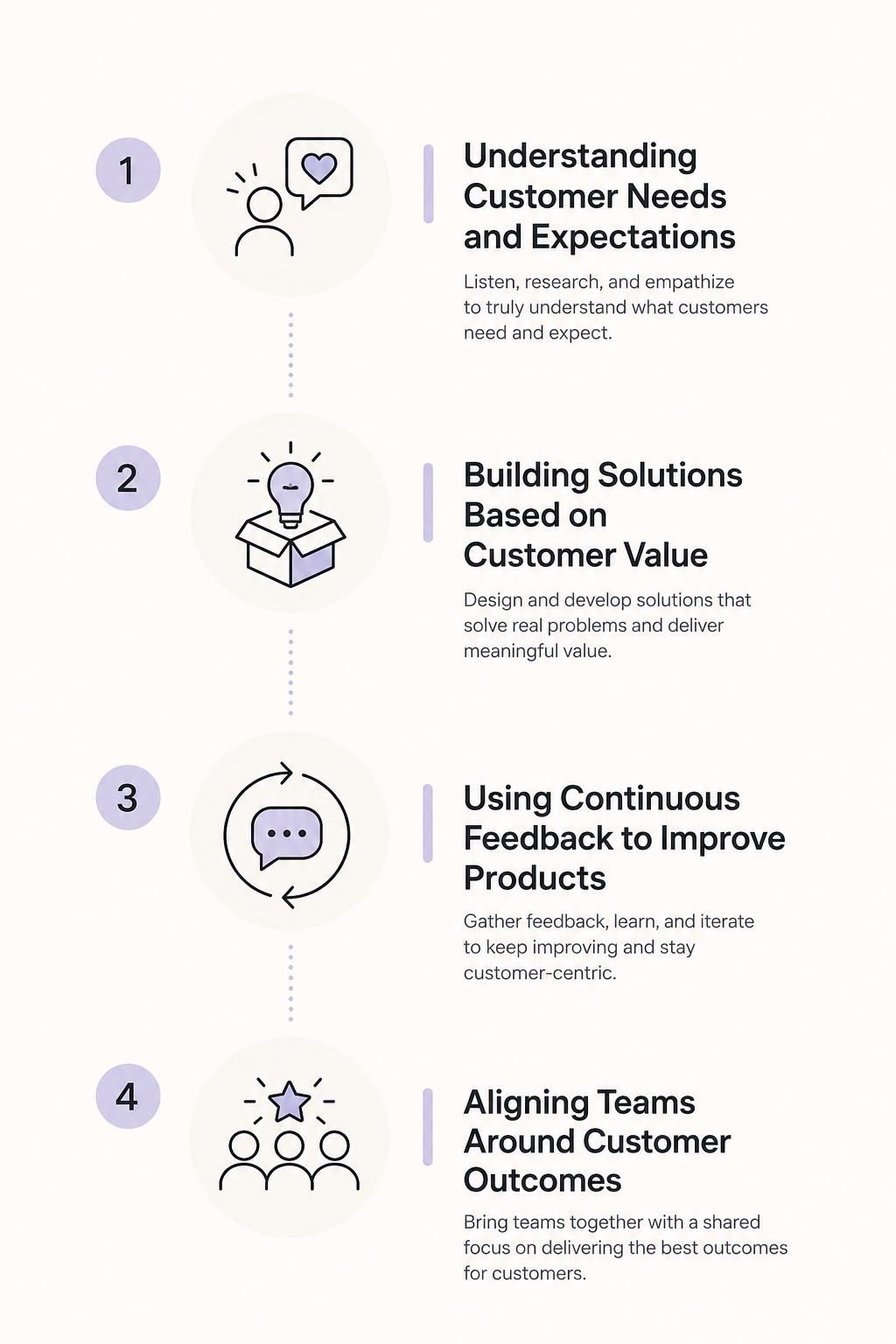
1. Understanding customer needs and expectations
Every successful product begins with a clear understanding of what customers need. Teams should avoid making assumptions and instead gather insights directly from the people who use their products.
Effective ways to understand customer needs include:
- Conducting customer interviews
- Running surveys and feedback sessions
- Observing customer behavior
- Analyzing product usage data
- Reviewing customer support requests
- Studying market trends
- Monitoring customer satisfaction scores
Customer expectations also evolve over time. A feature that delighted customers last year may no longer meet their expectations today. This is why continuous learning is an essential part of customer centricity safe.
Organizations that regularly listen to customers are better equipped to identify emerging needs before competitors do.
2. Building solutions based on customer value
Not every requested feature creates meaningful value. Teams should focus on solving the most important customer problems instead of trying to implement every suggestion.
Before development begins, teams should ask questions such as:
- What customer problem are we solving?
- How many customers will benefit?
- Will this improve overall experience?
- Does this support business objectives?
- Can we measure its impact after release?
Prioritizing work based on customer value helps organizations:
- Reduce unnecessary development
- Improve product quality
- Increase customer satisfaction
- Deliver features that customers actively use
- Maximize return on investment
This approach allows teams to spend more time building valuable capabilities rather than maintaining features that provide little benefit.
3. Using continuous feedback to improve products
Customer feedback should not be collected only after a product launch. Instead, feedback should guide every stage of product development.
Continuous feedback can come from many sources, including:
- Beta testing
- Product reviews
- Customer interviews
- User analytics
- Customer support interactions
- Social media discussions
- Product demonstrations
Teams should regularly evaluate:
- Which features customers use most
- Which features customers ignore
- Common pain points
- Customer satisfaction trends
- Opportunities for improvement
Continuous learning enables organizations to respond quickly when customers need to change. This ongoing improvement cycle is one of the strongest advantages of customer centricity safe.
4. Aligning teams around customer outcomes
Large organizations often have multiple teams working on different parts of the same product. Without a shared understanding of customer value, these teams may prioritize conflicting objectives.
SAFe encourages cross functional alignment by ensuring that everyone understands the desired customer outcomes.
This alignment helps teams:
- Share common priorities
- Reduce duplicated effort
- Deliver consistent customer experiences
- Improve collaboration across departments
- Focus on measurable business value
When every team understands how its work contributes to customer success, decision making becomes faster and more effective.
Explore the key updates and changes in What’s New in Leading SAFe® 5.0.
How Does SAFe Implement Customer Centricity?
Customer centricity becomes effective only when it is integrated into daily work. SAFe provides several practices that help organizations understand customer problems, prioritize valuable work, and continuously improve solutions.
Instead of treating customer feedback as a final validation step, customer centricity safe embeds customer learning throughout the product development lifecycle.
1. Identifying customer needs through Design Thinking
Designing helps teams understand the people they are building before creating solutions.
Rather than jumping directly into development, teams first explore customer challenges and identify the root cause of problems.
Common Design Thinking activities include:
- Customer interviews
- Observation sessions
- Empathy mapping
- Brainstorming workshops
- Rapid prototyping
- Idea validation
This approach reduces the risk of building products that customers do not need.
By focusing on customer problems first, organizations create solutions that are more relevant and valuable.
2. Creating customer focused solutions with Lean Portfolio Management
Lean Portfolio Management ensures that investments are directed toward initiatives that generate the highest customer and business value.
Instead of approving projects based only on financial estimates, leaders also consider:
- Customer demand
- Strategic alignment
- Market opportunities
- Business outcomes
- Customer impact
- Long term value
This helps organizations allocate resources more effectively while supporting the principles of customer centricity safe.
3. Prioritizing features based on customer value
Feature prioritization is one of the most important decisions during product development.
Rather than asking which feature is easiest to build, SAFe encourages teams to identify which feature creates the greatest value for customers.
Teams typically evaluate:
- Customer importance
- Business value
- Risk reduction
- Market demand
- Development effort
- Strategic objectives
This balanced approach ensures that development resources are invested where they can create the greatest impact.
4. Validating solutions through continuous delivery
Continuous delivery allows organizations to release improvements frequently instead of waiting for large product launches.
Frequent releases provide several advantages:
- Faster customer feedback
- Earlier issue detection
- Lower development risk
- Continuous product improvement
- Higher customer confidence
Each release becomes an opportunity to learn from customers and improve future development decisions.
This creates an ongoing cycle of learning, validation, and improvement that strengthens customer centricity safe across the organization.
Understand the key differences between SAFe vs Agile Frameworks.
Role of Design Thinking in Customer Centricity in SAFe
Design Thinking helps organizations understand customers before investing time and resources in development. Instead of assuming what customers need, teams explore real problems, validate ideas, and build solutions based on evidence. Within SAFe, Design Thinking supports better collaboration and ensures every product decision is grounded in customer value.
When combined with customer centricity safe, Design Thinking enables organizations to reduce risk, improve innovation, and deliver experiences that customers truly appreciate.
How does Design Thinking help SAFe teams understand customers?
Design Thinking encourages teams to develop empathy for customers before creating solutions. It focuses on understanding customer behaviors, motivations, challenges, and expectations.
Teams achieve this by:
- Interviewing customers and stakeholders
- Observing how customers use existing products
- Conducting usability studies
- Identifying customer pain points
- Validating assumptions with real users
By investing time in understanding the customer, teams are less likely to build unnecessary features and more likely to solve meaningful problems.
What are the key Design Thinking steps used in SAFe?
Although organizations may adapt the process, the key Design Thinking activities generally include:
- Empathize with customers
- Define the actual problem
- Generate possible solutions
- Build quick prototypes
- Test with real customers
- Improve based on feedback
These steps encourage experimentation and learning before large scale development begins, reducing waste and improving customer satisfaction.
How do personas and customer journey maps support customer centricity?
Personas and customer journey maps help teams visualize customer experiences from beginning to end.
Personas help teams understand:
- Customer goals
- Daily challenges
- Expectations
- Behaviors
- Preferences
Customer journey maps help identify:
- Friction points
- Customer emotions
- Opportunities for improvement
- Moments that influence customer satisfaction
Together, these tools help teams make decisions that align with the principles of customer centricity safe.
Explore the Best Agile Management Certification Training Courses to choose the right learning path.
How Can Organizations Build a Customer Centric Culture Using SAFe?
Building a customer centric culture requires more than adopting Agile practices. It involves creating an environment where every employee understands that customer success drives business success.
Organizations practicing customer centricity safely learn, adapt, and improve based on customer insights.
Encourage continuous customer collaboration
Customer collaboration should become part of everyday work instead of being limited to product launches.
Organizations can encourage collaboration by:
- Conducting regular customer interviews
- Inviting customers to product reviews
- Running feedback sessions
- Sharing customer insights across teams
- Acting on customer recommendations
Frequent interaction helps teams stay connected to evolving customer needs.
Train teams to think from the customer perspective
Customer centric thinking develops through continuous learning.
Organizations should provide training on:
- Customer empathy
- Design Thinking
- Value driven decision making
- Customer research techniques
- Data driven prioritization
When employees understand customer expectations, they make better day to day decisions.
Use metrics that measure customer value
Traditional delivery metrics alone do not provide a complete picture of success.
Organizations should also monitor customer focused metrics such as:
- Customer Satisfaction Score
- Net Promoter Score
- Customer Retention Rate
- Product Adoption Rate
- Feature Usage
- Customer Effort Score
- Time to Value
These metrics help leaders evaluate whether development efforts are creating meaningful customer outcomes.
Create feedback driven improvement cycles
Continuous improvement is one of the defining characteristics of SAFe.
Organizations should establish regular cycles for:
- Collecting customer feedback
- Reviewing product performance
- Identifying improvement opportunities
- Prioritizing enhancements
- Measuring outcomes after implementation
This cycle allows organizations to remain responsive as customer expectations change over time.
Conclusion
Customer centricity in SAFe helps organizations deliver products that solve real customer problems instead of simply releasing more features. It is best suited for businesses looking to improve customer satisfaction, accelerate value delivery, and make better product decisions through continuous feedback.
By embedding customer centricity into every stage of development, organizations can build solutions that create lasting value and stay competitive in a rapidly changing market.
Contact our upGrad KnowledgeHut experts for personalized guidance on choosing the right course, career path, and certification to achieve your goals.
Frequently Asked Questions (FAQs)
What is the difference between customer centricity and customer experience?
Customer centricity is a business approach that places customer needs at the center of every decision, from strategy to product development. Customer experience focuses on how customers feel when interacting with a product or service. In SAFe, customer centricity drives decisions, while customer experience reflects the outcome of those decisions.
Is customer centricity one of the core competencies in SAFe?
Yes. Customer Centricity and Design Thinking is one of the seven core competencies of Business Agility in SAFe. It encourages organizations to understand customer needs, validate assumptions, and continuously deliver solutions that create measurable value.
What are the principles of customer centricity in Lean Agile?
The key principles include understanding customer needs, prioritizing work based on value, gathering continuous feedback, and improving products through iterative development. Lean Agile teams also focus on reducing waste and delivering solutions that solve real customer problems.
How does customer centricity support business agility?
Customer centricity helps organizations respond quickly to changing customer expectations and market demands. By using continuous feedback to guide decisions, businesses can adapt faster, prioritize valuable work, and remain competitive while delivering consistent customer value.
What is the relationship between customer centricity and continuous innovation in SAFe?
Customer centricity provides insights into customer needs, while continuous innovation turns those insights into better products and services. Together, they help organizations experiment with new ideas, validate them early, and continuously improve solutions based on customer feedback.
How does customer centricity improve product management in SAFe?
Customer centricity enables Product Managers to prioritize features that deliver the greatest customer value instead of focusing only on business requests. This leads to better product roadmaps, informed investment decisions, and higher customer satisfaction over time.
What tools are used to support customer centricity in SAFe?
Organizations use tools such as customer surveys, product analytics platforms, journey mapping software, feedback management tools, and collaboration platforms to understand customer behavior. These insights help Agile teams make data driven decisions throughout the product lifecycle.
How does customer centricity affect PI Planning?
Customer centricity ensures that Program Increment Planning focuses on delivering the highest value to customers. Teams prioritize features based on customer needs, business objectives, and market demand, resulting in more effective planning and better alignment across Agile Release Trains.
What is the role of Value Streams in customer centricity?
Value Streams represent the sequence of activities required to deliver value to customers. In SAFe, understanding Value Streams helps organizations identify bottlenecks, eliminate inefficiencies, and improve the speed and quality of delivering customer focused solutions.
How do Lean Startup practices support customer centricity in SAFe?
Lean Startup practices encourage teams to build minimum viable products, test ideas with real customers, and learn from feedback before making larger investments. This approach reduces risk, validates assumptions early, and ensures products evolve according to actual customer needs.
1639 articles published
KnowledgeHut is an outcome-focused global ed-tech company. We help organizations and professionals unlock excellence through skills development. We offer training solutions under the people and proces...
Get Free Consultation
By submitting, I accept the T&C and
Privacy Policy
Ready to learn about Agile Certifications Roadmap?