
- Blog Categories
- Project Management
- Agile Management
- IT Service Management
- Cloud Computing
- Business Management
- BI And Visualisation
- Quality Management
- Cyber Security
- DevOps
- Most Popular Blogs
- PMP Exam Schedule for 2025: Check PMP Exam Date
- Top 60+ PMP Exam Questions and Answers for 2025
- PMP Cheat Sheet and PMP Formulas To Use in 2025
- What is PMP Process? A Complete List of 49 Processes of PMP
- Top 15+ Project Management Case Studies with Examples 2025
- Top Picks by Authors
- Top 170 Project Management Research Topics
- What is Effective Communication: Definition
- How to Create a Project Plan in Excel in 2025?
- PMP Certification Exam Eligibility in 2025 [A Complete Checklist]
- PMP Certification Fees - All Aspects of PMP Certification Fee
- Most Popular Blogs
- CSM vs PSM: Which Certification to Choose in 2025?
- How Much Does Scrum Master Certification Cost in 2025?
- CSPO vs PSPO Certification: What to Choose in 2025?
- 8 Best Scrum Master Certifications to Pursue in 2025
- Safe Agilist Exam: A Complete Study Guide 2025
- Top Picks by Authors
- SAFe vs Agile: Difference Between Scaled Agile and Agile
- Top 21 Scrum Best Practices for Efficient Agile Workflow
- 30 User Story Examples and Templates to Use in 2025
- State of Agile: Things You Need to Know
- Top 24 Career Benefits of a Certifed Scrum Master
- Most Popular Blogs
- ITIL Certification Cost in 2025 [Exam Fee & Other Expenses]
- Top 17 Required Skills for System Administrator in 2025
- How Effective Is Itil Certification for a Job Switch?
- IT Service Management (ITSM) Role and Responsibilities
- Top 25 Service Based Companies in India in 2025
- Top Picks by Authors
- What is Escalation Matrix & How Does It Work? [Types, Process]
- ITIL Service Operation: Phases, Functions, Best Practices
- 10 Best Facility Management Software in 2025
- What is Service Request Management in ITIL? Example, Steps, Tips
- An Introduction To ITIL® Exam
- Most Popular Blogs
- A Complete AWS Cheat Sheet: Important Topics Covered
- Top AWS Solution Architect Projects in 2025
- 15 Best Azure Certifications 2025: Which one to Choose?
- Top 22 Cloud Computing Project Ideas in 2025 [Source Code]
- How to Become an Azure Data Engineer? 2025 Roadmap
- Top Picks by Authors
- Top 40 IoT Project Ideas and Topics in 2025 [Source Code]
- The Future of AWS: Top Trends & Predictions in 2025
- AWS Solutions Architect vs AWS Developer [Key Differences]
- Top 20 Azure Data Engineering Projects in 2025 [Source Code]
- 25 Best Cloud Computing Tools in 2025
- Most Popular Blogs
- Company Analysis Report: Examples, Templates, Components
- 400 Trending Business Management Research Topics
- Business Analysis Body of Knowledge (BABOK): Guide
- ECBA Certification: Is it Worth it?
- Top Picks by Authors
- Top 20 Business Analytics Project in 2025 [With Source Code]
- ECBA Certification Cost Across Countries
- Top 9 Free Business Requirements Document (BRD) Templates
- Business Analyst Job Description in 2025 [Key Responsibility]
- Business Analysis Framework: Elements, Process, Techniques
- Most Popular Blogs
- Best Career options after BA [2025]
- Top Career Options after BCom to Know in 2025
- Top 10 Power Bi Books of 2025 [Beginners to Experienced]
- Power BI Skills in Demand: How to Stand Out in the Job Market
- Top 15 Power BI Project Ideas
- Top Picks by Authors
- 10 Limitations of Power BI: You Must Know in 2025
- Top 45 Career Options After BBA in 2025 [With Salary]
- Top Power BI Dashboard Templates of 2025
- What is Power BI Used For - Practical Applications Of Power BI
- SSRS Vs Power BI - What are the Key Differences?
- Most Popular Blogs
- Data Collection Plan For Six Sigma: How to Create One?
- Quality Engineer Resume for 2025 [Examples + Tips]
- 20 Best Quality Management Certifications That Pay Well in 2025
- Six Sigma in Operations Management [A Brief Introduction]
- Top Picks by Authors
- Six Sigma Green Belt vs PMP: What's the Difference
- Quality Management: Definition, Importance, Components
- Adding Green Belt Certifications to Your Resume
- Six Sigma Green Belt in Healthcare: Concepts, Benefits and Examples
- Most Popular Blogs
- Latest CISSP Exam Dumps of 2025 [Free CISSP Dumps]
- CISSP vs Security+ Certifications: Which is Best in 2025?
- Best CISSP Study Guides for 2025 + CISSP Study Plan
- How to Become an Ethical Hacker in 2025?
- Top Picks by Authors
- CISSP vs Master's Degree: Which One to Choose in 2025?
- CISSP Endorsement Process: Requirements & Example
- OSCP vs CISSP | Top Cybersecurity Certifications
- How to Pass the CISSP Exam on Your 1st Attempt in 2025?
- Most Popular Blogs
- Top 7 Kubernetes Certifications in 2025
- Kubernetes Pods: Types, Examples, Best Practices
- DevOps Methodologies: Practices & Principles
- Docker Image Commands
- Top Picks by Authors
- Best DevOps Certifications in 2025
- 20 Best Automation Tools for DevOps
- Top 20 DevOps Projects of 2025
- OS for Docker: Features, Factors and Tips
- More
- Agile & PMP Practice Tests
- Agile Testing
- Agile Scrum Practice Exam
- CAPM Practice Test
- PRINCE2 Foundation Exam
- PMP Practice Exam
- Cloud Related Practice Test
- Azure Infrastructure Solutions
- AWS Solutions Architect
- IT Related Pratice Test
- ITIL Practice Test
- Devops Practice Test
- TOGAF® Practice Test
- Other Practice Test
- Oracle Primavera P6 V8
- MS Project Practice Test
- Project Management & Agile
- Project Management Interview Questions
- Release Train Engineer Interview Questions
- Agile Coach Interview Questions
- Scrum Interview Questions
- IT Project Manager Interview Questions
- Cloud & Data
- Azure Databricks Interview Questions
- AWS architect Interview Questions
- Cloud Computing Interview Questions
- AWS Interview Questions
- Kubernetes Interview Questions
- Web Development
- CSS3 Free Course with Certificates
- Basics of Spring Core and MVC
- Javascript Free Course with Certificate
- React Free Course with Certificate
- Node JS Free Certification Course
- Data Science
- Python Machine Learning Course
- Python for Data Science Free Course
- NLP Free Course with Certificate
- Data Analysis Using SQL
- Home
- Blog
- Artificial Intelligence
- How AI Reduces Logistics Costs: Use Cases, Benefits, and Real-World Applications
How AI Reduces Logistics Costs: Use Cases, Benefits, and Real-World Applications
Updated on Oct 19, 2026 | 382 views
Share:
Table of Contents
View all
Quick Overview
- AI helps businesses lower logistics expenses by optimizing delivery routes, forecasting demand, automating warehouse operations, predicting equipment failures, and improving shipment tracking.
- Key AI Use Cases in Logistics: Route optimization, demand forecasting, inventory management, warehouse automation, predictive maintenance, and real-time shipment monitoring help reduce waste and improve efficiency.
- Benefits of AI in Logistics: AI can reduce fuel and transportation costs, minimize excess inventory and stockouts, improve delivery times, and optimize the use of vehicles, warehouse space, and workforce capacity.
- This guide explains how AI reduces logistics costs, its key use cases and real-world applications, major benefits and challenges, and the steps businesses can take to implement AI and measure cost savings.
Professionals looking to understand how AI can improve logistics operations can explore the AI Masters Program to build knowledge of artificial intelligence, machine learning, and AI-driven solutions for business efficiency and process optimization.
How does AI reduce logistics costs?
AI in logistics helps businesses reduce costs by improving how goods are stored, transported, tracked, and delivered. It uses data from orders, vehicles, warehouses, and supply chains to identify inefficiencies and support better decisions.
Instead of relying entirely on manual planning, businesses can use AI to predict demand, choose efficient delivery routes, prevent equipment failures, and automate repetitive tasks. These improvements can reduce fuel consumption, unnecessary inventory, delays, and operating expenses.
1. AI driven route optimization and fuel savings
Transportation is a major logistics expense, especially for businesses managing large delivery fleets. AI powered route optimization analyses traffic, delivery locations, road conditions, vehicle capacity, and delivery schedules to recommend efficient routes.
Businesses can use it to:
- Reduce unnecessary kilometres and fuel consumption.
- Plan multiple deliveries more efficiently.
- Avoid traffic congestion and road disruptions.
- Improve vehicle utilization and delivery schedules.
2. Demand forecasting and inventory optimization
Poor demand forecasting can leave businesses with excess stock or insufficient inventory. Both situations increase costs through storage expenses, wasted products, emergency shipments, and missed sales.
AI analyses historical sales, seasonal trends, customer behaviour, and other relevant data to estimate future demand. This helps logistics teams decide how much stock to maintain and where to position it.
Key benefits include:
- Reducing excess inventory and storage costs.
- Preventing stockouts of frequently purchased products.
- Improving replenishment schedules.
- Supporting better warehouse space planning.
3. Warehouse automation and order fulfillment
Warehouses involve several cost intensive activities, including picking, sorting, packing, and dispatching orders. AI can improve these operations by analysing order patterns, recommending efficient picking routes, and coordinating automated equipment.
AI enabled warehouse systems can help businesses:
- Assign picking tasks more efficiently.
- Identify suitable storage locations for products.
- Reduce order processing errors.
- Improve the use of warehouse space and labour.
4. Predictive maintenance for vehicles and equipment
Unexpected vehicle breakdowns and equipment failures can cause repair expenses, missed deliveries, and operational delays. Predictive maintenance uses data from sensors, vehicle diagnostics, and maintenance records to identify signs of possible failure.
AI can help logistics teams:
- Detect unusual vehicle or equipment behaviour.
- Schedule maintenance before a serious breakdown occurs.
- Reduce unexpected repair costs.
- Improve vehicle availability and equipment lifespan.
5. Automated shipment tracking and customer service
Shipment delays often create additional costs through customer complaints, manual status checks, and repeated coordination between teams. AI can analyse shipment updates, location information, and delivery patterns to improve visibility across the logistics process.
Businesses can use AI to automate routine customer queries, provide delivery updates, and flag shipments that may arrive late. This reduces repetitive work for support teams and helps customers receive more timely information.
Also read: AI for Warehouse Management
What are the benefits of AI in logistics?
AI in logistics can help businesses control expenses while improving service quality and operational efficiency. The results depend on the type of AI application, the quality of business data, and how well the technology fits existing workflows.
1. Lower transportation and operating costs
AI helps identify avoidable expenses across transportation, warehouse operations, and delivery planning. Route optimization can reduce unnecessary travel, while automation can lower the time spent on repetitive administrative tasks.
Businesses may benefit from:
- Lower fuel and transportation expenses.
- Better vehicle and workforce utilization.
- Fewer manual processing errors.
- Reduced costs associated with unplanned disruptions.
2. Reduced inventory waste and stockouts
Inventory decisions affect both storage expenses and customer satisfaction. AI powered forecasting helps businesses estimate demand more accurately and adjust inventory levels before shortages or excess stock become costly.
This is particularly valuable for products with seasonal demand, limited shelf life, or unpredictable sales patterns. Better inventory planning can reduce waste, emergency replenishment, and the need for excessive safety stock.
3. Faster deliveries and improved efficiency
AI can help logistics teams plan routes, allocate vehicles, coordinate warehouse activities, and identify potential delays. These capabilities make it easier to use available resources effectively and complete deliveries on schedule.
Faster and more predictable operations can also improve customer satisfaction. However, actual delivery improvements depend on road conditions, workforce availability, warehouse capacity, and other factors beyond AI's control.
4. Better resource utilization and supply chain visibility
AI brings together information from different parts of the supply chain to help managers understand where resources are being used and where problems may occur.
With better visibility, businesses can:
- Identify underused vehicles and warehouse capacity.
- Monitor shipments across different locations.
- Detect operational bottlenecks.
- Allocate staff and equipment according to demand.
- Respond to disruptions with better information.
Professionals looking to apply data-driven insights to logistics operations can explore the Executive Post Graduate Certificate in Data Science and Applied AI to build skills in data analytics, machine learning, and AI for demand forecasting, operational planning, and cost optimization.
What are the real world applications of AI in logistics?
AI is already used across transportation, warehousing, inventory planning, and shipment monitoring. These applications help logistics businesses address specific operational problems rather than treating AI as a single solution for every cost challenge.
1. AI powered fleet and delivery management
Fleet management systems use AI to support vehicle scheduling, route planning, delivery allocation, and driver performance analysis. They can consider factors such as vehicle capacity, delivery deadlines, traffic, and fuel efficiency.
For logistics operators, this can mean fewer unnecessary trips, better delivery planning, and more effective use of available vehicles. Fleet managers can also use operational data to identify recurring delays and improve future schedules.
2. Smart warehousing and inventory management
AI powered warehouse systems help businesses organize inventory, prioritize orders, and coordinate picking and packing activities. Some facilities also use AI with robotics and computer vision to support product identification and material movement.
These applications can reduce manual handling, improve inventory accuracy, and help warehouses process fluctuating order volumes. The level of automation should match the facility's scale, product mix, and expected return on investment.
3. Predictive supply chain planning
Supply chains are affected by changing demand, supplier delays, market conditions, and transportation disruptions. AI can analyse historical patterns and current information to identify possible risks and forecast future requirements.
Businesses can use these insights to adjust purchasing plans, reposition inventory, evaluate supplier performance, and prepare alternative arrangements. Better planning can reduce the financial impact of unexpected disruptions.
4. Real time shipment monitoring and delay prediction
AI systems can analyse shipment locations, estimated arrival times, traffic conditions, weather information, and historical delivery patterns to identify possible delays.
When a shipment is likely to arrive late, the system can alert logistics teams so they can inform customers, revise delivery schedules, or explore alternative routes. Early warnings can reduce the cost of last minute decisions and improve communication across the supply chain.
Also read: How Artificial Intelligence Is Transforming Supply Chain Risk Management
What are the challenges of using AI in logistics?
AI adoption can improve logistics operations, but it also requires investment, reliable data, and changes to existing workflows. Businesses should understand these challenges before selecting a solution or expanding its use across the supply chain.
1. High implementation costs and legacy system integration
AI tools may require spending on software, sensors, cloud infrastructure, automation equipment, and technical support. Connecting new tools with older warehouse management, transportation management, or enterprise resource planning systems can also be difficult.
Businesses can manage these costs by starting with one clearly defined problem, testing a small implementation, and expanding only after measuring the results.
2. Data quality, security, and privacy risks
AI recommendations are only as reliable as the information used to produce them. Incomplete shipment records, inaccurate inventory data, or inconsistent vehicle information can lead to poor decisions.
Logistics businesses also need to protect sensitive customer, supplier, employee, and shipment information. Access controls, data validation, secure integrations, and clear data governance practices help reduce these risks.
3. Skills gaps and workforce training
Employees may need training to use AI tools, interpret recommendations, and manage exceptions. Without adequate support, teams may ignore the system or rely on its outputs without checking whether they make sense.
Businesses should provide role specific training and explain how AI supports existing responsibilities. Human oversight remains important when decisions involve safety, customer commitments, or unusual operational conditions.
4. Measuring return on investment from AI adoption
AI projects do not automatically produce savings. A tool may reduce one expense while introducing software fees, integration costs, or additional maintenance requirements.
Businesses should establish a baseline before implementation and monitor indicators such as fuel cost per delivery, order fulfilment time, inventory holding costs, vehicle downtime, and on time delivery rates.
Comparing these results with the total cost of adoption helps leaders decide whether the solution is delivering enough value to justify further investment.
Also read: How AI Improves Supply Chain Visibility Across Enterprises
How can businesses implement AI to reduce logistics costs?
Businesses should adopt AI in logistics through a focused, measurable approach. Starting with a specific operational problem makes it easier to evaluate performance, control investment, and determine whether the technology is suitable for wider use.
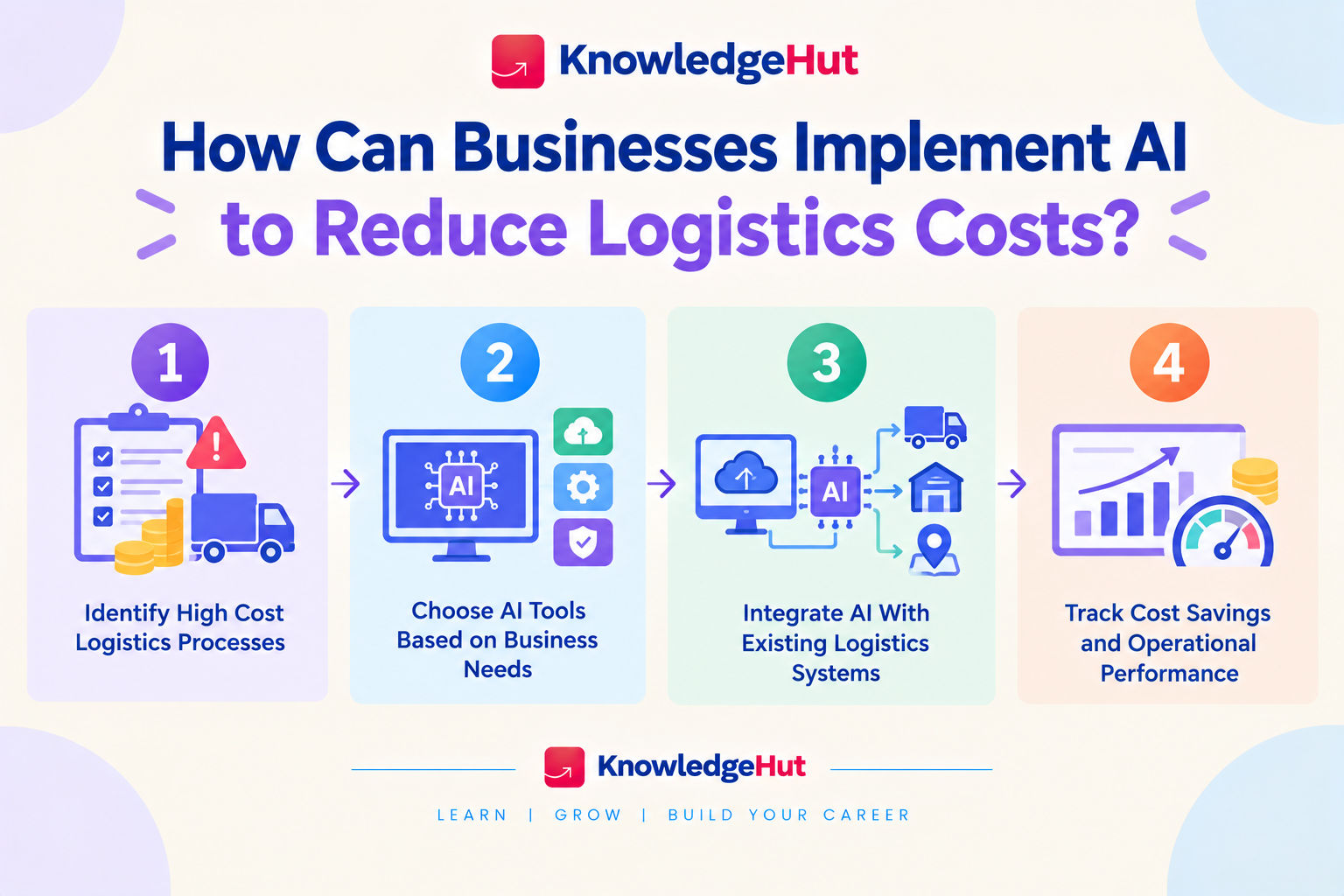
Step-1 Identify high cost logistics processes
Begin by reviewing where the business spends the most money or experiences recurring inefficiencies. These areas may include fuel, delayed deliveries, excess inventory, warehouse labour, equipment breakdowns, or manual shipment processing.
Review operational data and speak with the teams responsible for these activities. Prioritize problems that occur frequently, have a measurable financial impact, and can realistically be improved with available data.
Step-2 Choose AI tools based on business needs
Select tools that address the identified problem rather than adopting AI simply because it is available. A business struggling with delivery delays may benefit from route optimization, while one facing stock imbalances may need demand forecasting.
When comparing tools, consider:
- Compatibility with existing logistics systems.
- Data requirements and integration effort.
- Total implementation and operating costs.
- Ease of use and employee training needs.
- Security, scalability, and vendor support.
Step-3 Integrate AI with existing logistics systems
AI tools need access to relevant information to produce useful recommendations. Businesses may need to connect them with inventory databases, fleet tracking platforms, warehouse systems, order management software, and other operational tools.
Start with the most important data sources and test whether information flows accurately between systems. Keep employees involved in the rollout and establish clear procedures for reviewing AI recommendations and handling exceptions.
Step-4 Track cost savings and operational performance
Before introducing AI, record baseline costs and performance levels. After implementation, compare results over a suitable period to understand whether the solution has made a measurable difference.
Useful indicators include:
- Fuel cost per kilometre or delivery.
- Average order fulfilment time.
- Inventory holding costs and stockout rates.
- Vehicle downtime and maintenance expenses.
- On time delivery rates.
- Total AI implementation and operating costs.
Professionals looking to strengthen their understanding of AI-driven logistics can explore Generative AI and Prompt Engineering to learn how to use AI tools for analyzing logistics data, improving operational planning, and generating actionable business insights.
Conclusion
AI in logistics can help businesses reduce fuel expenses, improve inventory planning, automate warehouse tasks, and prevent costly disruptions. However, the best results come from solving specific operational problems rather than investing in technology without a clear purpose.
Businesses should begin by identifying their biggest cost drivers, selecting a suitable AI solution, and measuring its impact against existing performance. The key decision is whether the expected savings and efficiency gains justify the total cost of implementation, integration, and training.
Have A Query? Get in Touch With Our Customer Support | upGrad KnowledgeHut
Frequently Asked Questions (FAQs)
1. How can AI improve supply chain management?
AI in logistics helps businesses forecast demand, optimize delivery routes, manage inventory, and predict potential disruptions. It analyzes real time data to support faster decisions and improve supply chain visibility. These capabilities can reduce operating costs, minimize delays, and improve customer satisfaction.
2. What are the problems with AI in logistics?
The main challenges of AI in logistics include high implementation costs, poor data quality, cybersecurity risks, and integration with existing systems. Businesses may also face skill gaps and employee resistance to change. Regular monitoring and proper workforce training can help address these challenges.
3. What is the best AI tool for supply chain management?
The best AI tool depends on business needs, budget, and existing systems. Platforms such as SAP Integrated Business Planning, Oracle Fusion Cloud SCM, and Blue Yonder support areas such as demand forecasting, inventory planning, and supply chain optimization. Businesses should compare integration capabilities, scalability, and cost before choosing a solution.
4. What is a major barrier to AI adoption in logistics?
One major barrier is integrating AI with legacy logistics systems and inconsistent data sources. AI in logistics relies on accurate, accessible data to generate reliable predictions and recommendations. High initial costs and a shortage of skilled professionals can also slow adoption.
5. How does Amazon use AI in logistics?
Amazon uses AI and machine learning to support demand forecasting, inventory placement, warehouse operations, and delivery route planning. Its fulfillment centers also use robotics and automated systems to help move and sort products efficiently. These applications help improve delivery speed, operational efficiency, and inventory management.
6. How is DHL using AI?
DHL uses AI and machine learning across logistics operations, including shipment forecasting, route optimization, warehouse automation, and supply chain analytics. These technologies help improve planning, identify potential disruptions, and support more efficient deliveries. Its specific AI applications vary by service, location, and business unit.
7. Is AI a threat to supply chain management?
AI is generally a tool for improving supply chain management rather than a threat to the entire function. Although automation may change some job responsibilities, it also creates opportunities in data analysis, AI oversight, and supply chain planning. Combining human judgment with AI in logistics can help businesses make better decisions.
8. What are the 7 steps of logistics?
The seven common steps of logistics are order processing, inventory management, warehousing, packaging, transportation, delivery, and returns management. The exact sequence can vary depending on the business and supply chain model. AI in logistics can improve several of these steps through automation, forecasting, and real time tracking.
9. What are the 5 C's of supply chain management?
The five C's of supply chain management are commonly described as Customer, Cost, Convenience, Communication, and Collaboration, though different frameworks may use different terms. They emphasize understanding customer needs, controlling costs, coordinating partners, and sharing information. Businesses can use AI in logistics to improve collaboration, visibility, and customer service.
10. What is the Six Sigma approach in logistics?
Six Sigma is a data driven approach that aims to reduce errors, defects, and process variation. In logistics, it can improve order accuracy, delivery performance, warehouse productivity, and inventory control. The DMAIC method-Define, Measure, Analyze, Improve, and Control-helps teams identify problems and make measurable improvements. AI in logistics can complement Six Sigma by identifying patterns and detecting inefficiencies.
1648 articles published
KnowledgeHut is an outcome-focused global ed-tech company. We help organizations and professionals unlock excellence through skills development. We offer training solutions under the people and proces...
Get Free Consultation
By submitting, I accept the T&C and
Privacy Policy