
- Blog Categories
- Project Management
- Agile Management
- IT Service Management
- Cloud Computing
- Business Management
- BI And Visualisation
- Quality Management
- Cyber Security
- DevOps
- Most Popular Blogs
- PMP Exam Schedule for 2025: Check PMP Exam Date
- Top 60+ PMP Exam Questions and Answers for 2025
- PMP Cheat Sheet and PMP Formulas To Use in 2025
- What is PMP Process? A Complete List of 49 Processes of PMP
- Top 15+ Project Management Case Studies with Examples 2025
- Top Picks by Authors
- Top 170 Project Management Research Topics
- What is Effective Communication: Definition
- How to Create a Project Plan in Excel in 2025?
- PMP Certification Exam Eligibility in 2025 [A Complete Checklist]
- PMP Certification Fees - All Aspects of PMP Certification Fee
- Most Popular Blogs
- CSM vs PSM: Which Certification to Choose in 2025?
- How Much Does Scrum Master Certification Cost in 2025?
- CSPO vs PSPO Certification: What to Choose in 2025?
- 8 Best Scrum Master Certifications to Pursue in 2025
- Safe Agilist Exam: A Complete Study Guide 2025
- Top Picks by Authors
- SAFe vs Agile: Difference Between Scaled Agile and Agile
- Top 21 Scrum Best Practices for Efficient Agile Workflow
- 30 User Story Examples and Templates to Use in 2025
- State of Agile: Things You Need to Know
- Top 24 Career Benefits of a Certifed Scrum Master
- Most Popular Blogs
- ITIL Certification Cost in 2025 [Exam Fee & Other Expenses]
- Top 17 Required Skills for System Administrator in 2025
- How Effective Is Itil Certification for a Job Switch?
- IT Service Management (ITSM) Role and Responsibilities
- Top 25 Service Based Companies in India in 2025
- Top Picks by Authors
- What is Escalation Matrix & How Does It Work? [Types, Process]
- ITIL Service Operation: Phases, Functions, Best Practices
- 10 Best Facility Management Software in 2025
- What is Service Request Management in ITIL? Example, Steps, Tips
- An Introduction To ITIL® Exam
- Most Popular Blogs
- A Complete AWS Cheat Sheet: Important Topics Covered
- Top AWS Solution Architect Projects in 2025
- 15 Best Azure Certifications 2025: Which one to Choose?
- Top 22 Cloud Computing Project Ideas in 2025 [Source Code]
- How to Become an Azure Data Engineer? 2025 Roadmap
- Top Picks by Authors
- Top 40 IoT Project Ideas and Topics in 2025 [Source Code]
- The Future of AWS: Top Trends & Predictions in 2025
- AWS Solutions Architect vs AWS Developer [Key Differences]
- Top 20 Azure Data Engineering Projects in 2025 [Source Code]
- 25 Best Cloud Computing Tools in 2025
- Most Popular Blogs
- Company Analysis Report: Examples, Templates, Components
- 400 Trending Business Management Research Topics
- Business Analysis Body of Knowledge (BABOK): Guide
- ECBA Certification: Is it Worth it?
- Top Picks by Authors
- Top 20 Business Analytics Project in 2025 [With Source Code]
- ECBA Certification Cost Across Countries
- Top 9 Free Business Requirements Document (BRD) Templates
- Business Analyst Job Description in 2025 [Key Responsibility]
- Business Analysis Framework: Elements, Process, Techniques
- Most Popular Blogs
- Best Career options after BA [2025]
- Top Career Options after BCom to Know in 2025
- Top 10 Power Bi Books of 2025 [Beginners to Experienced]
- Power BI Skills in Demand: How to Stand Out in the Job Market
- Top 15 Power BI Project Ideas
- Top Picks by Authors
- 10 Limitations of Power BI: You Must Know in 2025
- Top 45 Career Options After BBA in 2025 [With Salary]
- Top Power BI Dashboard Templates of 2025
- What is Power BI Used For - Practical Applications Of Power BI
- SSRS Vs Power BI - What are the Key Differences?
- Most Popular Blogs
- Data Collection Plan For Six Sigma: How to Create One?
- Quality Engineer Resume for 2025 [Examples + Tips]
- 20 Best Quality Management Certifications That Pay Well in 2025
- Six Sigma in Operations Management [A Brief Introduction]
- Top Picks by Authors
- Six Sigma Green Belt vs PMP: What's the Difference
- Quality Management: Definition, Importance, Components
- Adding Green Belt Certifications to Your Resume
- Six Sigma Green Belt in Healthcare: Concepts, Benefits and Examples
- Most Popular Blogs
- Latest CISSP Exam Dumps of 2025 [Free CISSP Dumps]
- CISSP vs Security+ Certifications: Which is Best in 2025?
- Best CISSP Study Guides for 2025 + CISSP Study Plan
- How to Become an Ethical Hacker in 2025?
- Top Picks by Authors
- CISSP vs Master's Degree: Which One to Choose in 2025?
- CISSP Endorsement Process: Requirements & Example
- OSCP vs CISSP | Top Cybersecurity Certifications
- How to Pass the CISSP Exam on Your 1st Attempt in 2025?
- Most Popular Blogs
- Top 7 Kubernetes Certifications in 2025
- Kubernetes Pods: Types, Examples, Best Practices
- DevOps Methodologies: Practices & Principles
- Docker Image Commands
- Top Picks by Authors
- Best DevOps Certifications in 2025
- 20 Best Automation Tools for DevOps
- Top 20 DevOps Projects of 2025
- OS for Docker: Features, Factors and Tips
- More
- Agile & PMP Practice Tests
- Agile Testing
- Agile Scrum Practice Exam
- CAPM Practice Test
- PRINCE2 Foundation Exam
- PMP Practice Exam
- Cloud Related Practice Test
- Azure Infrastructure Solutions
- AWS Solutions Architect
- IT Related Pratice Test
- ITIL Practice Test
- Devops Practice Test
- TOGAF® Practice Test
- Other Practice Test
- Oracle Primavera P6 V8
- MS Project Practice Test
- Project Management & Agile
- Project Management Interview Questions
- Release Train Engineer Interview Questions
- Agile Coach Interview Questions
- Scrum Interview Questions
- IT Project Manager Interview Questions
- Cloud & Data
- Azure Databricks Interview Questions
- AWS architect Interview Questions
- Cloud Computing Interview Questions
- AWS Interview Questions
- Kubernetes Interview Questions
- Web Development
- CSS3 Free Course with Certificates
- Basics of Spring Core and MVC
- Javascript Free Course with Certificate
- React Free Course with Certificate
- Node JS Free Certification Course
- Data Science
- Python Machine Learning Course
- Python for Data Science Free Course
- NLP Free Course with Certificate
- Data Analysis Using SQL
- Home
- Blog
- Artificial Intelligence
- Autonomous Supply Chains: What They Are and How They Work
Autonomous Supply Chains: What They Are and How They Work
Updated on Aug 27, 2026 | 1k+ views
Share:
Table of Contents
View all
Quick Overview
- Autonomous supply chains use AI, real time data, and automation to sense changes, make decisions, and take action with limited human intervention.
- They work through a continuous cycle of sensing data, detecting disruptions, analyzing impact, choosing responses, executing decisions, and learning from outcomes.
- Key technologies include AI and machine learning, IoT, cloud platforms, APIs, generative AI, AI agents, digital twins, robotics, and cybersecurity.
- The main benefits include faster decisions, better resilience, lower inventory and operating costs, higher service levels, and more productive supply chain teams.
- This guide covers how autonomous supply chains work, the technologies behind them, their benefits and use cases, and the key challenges businesses need to address.
Ready to take your supply chain skills a step further? Enroll in upGrad KnowledgeHut AI-Powered Supply Chain Management Certification to learn how AI can help build smarter, more responsive, and autonomous supply chains.
What are autonomous supply chains?
An autonomous supply chain is a digitally enabled supply chain that makes decisions and executes tasks with minimal or no human intervention by using AI, machine learning, automation, and real-time data.
Instead of making all the decisions manually, autonomous supply chains continuously gather information, analyze it, and respond to changing conditions in real-time.
How an Autonomous Supply Chain Works: Step-by-Step Process
The cycle involves sensing, analysis, decision-making, and learning in that order. The following shows how this process normally happens.
Sense real-time supply chain data
The first step involves gathering data from various sources such as inventory systems, ERP platforms, IoT devices, transportation networks, etc. Access to current information helps the system to understand what is happening.
Detect changes and potential disruptions
After data is collected, AI systems continuously monitor and check for unusual patterns or activities such as delays in shipments, sudden rise in orders, low inventory, or transportation disruptions. Early detection helps in responding before disruptions affect customers.
Analyze the impact
Once the potential problem was identified, its impact on the inventory, production planning, shipping schedule, and costs is analyzed. This step is required to establish the scale of the issue and how to tackle it.
Generate and compare possible responses
Using machine learning algorithms, AI generates several solutions depending on available data. For instance, the system may advise using another supplier, changing shipment paths, or increasing the stock level in the warehouse. Every solution is assessed based on its cost and efficiency.
Make or recommend a decision
Depending on corporate guidelines, the system may either take an immediate decision or recommend the best solution to the managers. This step allows reducing time for decision making significantly.
Execute the decision
Once the solution is selected and accepted, the next step is the execution. It involves sending purchase orders, amending inventory management, adjusting transportation schedule, or changing the production plan.
Monitor the outcome
Once the solution is implemented, it is important to monitor the results. This is done to identify whether the issue was addressed properly and whether further adjustment is required.
Learn and adapt
One of the main advantages of Autonomous Supply Chains is that they can learn and evolve over time. Machine learning models used by Autonomous Supply Chains constantly develop based on their previous experience.
Key technologies behind autonomous supply chains
Autonomous Supply Chains do not depend on just one technology, but rather a set of technologies that work in synergy.
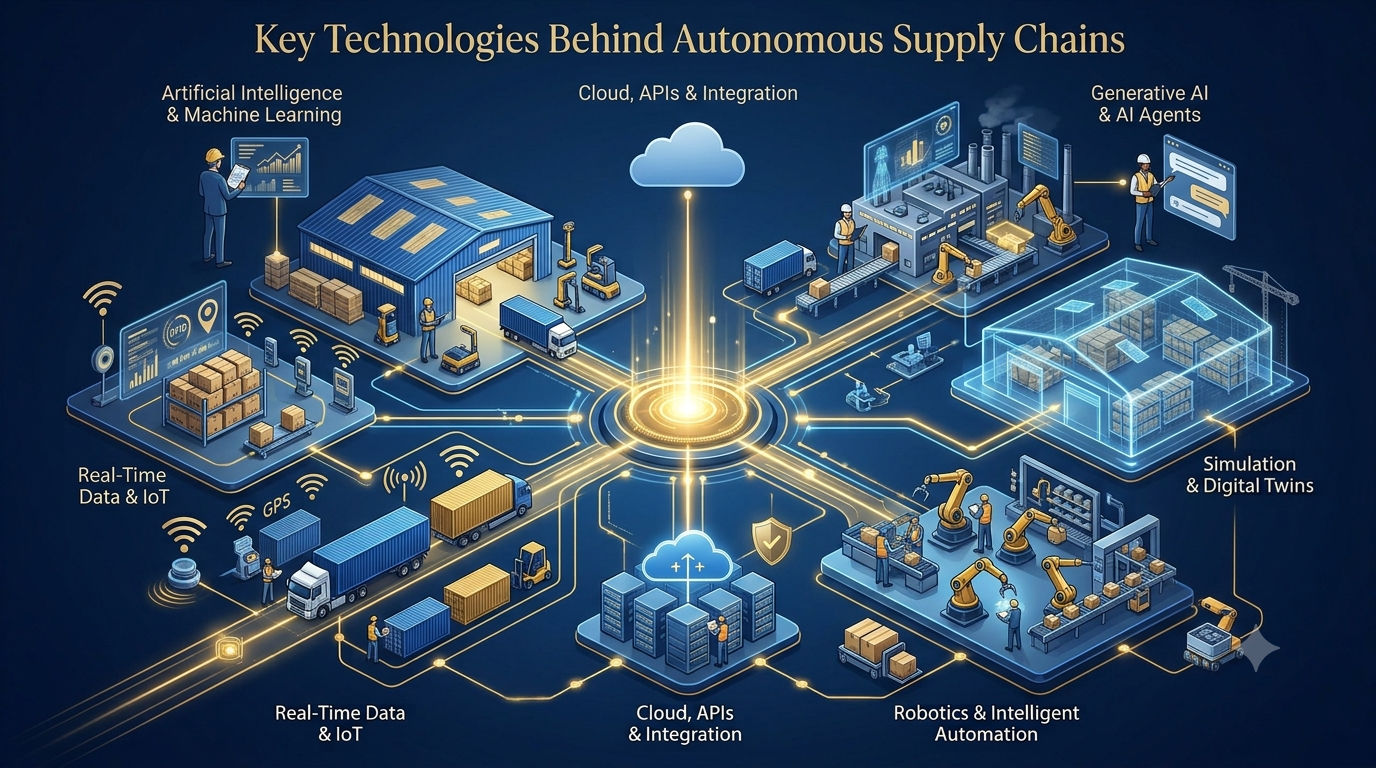
Artificial intelligence and machine learning
AI and machine learning technologies constitute the backbone of autonomous supply chains. The system uses models to forecast demand, spot anomalies, and suggest optimal actions on all stages of planning, procurement, and logistics operations.
Real-time data and Internet of Things (IoT)
Devices such as sensors, RFID tags, and GPS trackers enable tracking of inventory, equipment, and shipments in real-time. Thus, companies receive information on changes that have occurred. It is the availability of real-time data that enables Autonomous Supply Chain to react instantly within minutes instead of days.
Cloud, API and integration of supply chain systems
Through cloud technology, organizations can store and exchange data in several locations. API ensures the integration of applications in order to exchange information. Without this integration, the autonomous supply chain will have only partial visibility, not complete one.
Generative AI and AI agents
With the help of generative AI software, companies can summarize the findings related to their supply chains and even create reports. AI agents can also perform various multi-step procedures independently, like inventory check, selection of the most suitable supplier and place an order, which is a key feature of today's Autonomous Supply Chain.
Simulation and digital twins
The digital twin is a virtual representation of the physical supply chain. In order to test how the real-life supply chain responds to certain disruptions, companies perform simulation of the supply chain using digital twin.
Robotics and intelligent automation
Through robotics and automation, organizations can increase efficiency in warehouses, manufacturing plants, and distribution centers by decreasing the time and manual labor needed for tasks.
Cybersecurity and AI governance
As the systems process sensitive information and make decisions independently, it is important to have high level of cybersecurity and clearly defined AI governance policies.
What are the benefits of autonomous supply chains?
Organizations use Autonomous Supply Chains because the benefits far outweigh any simple savings.
Faster decision-making
The systems will be able to identify an issue and react to it in a matter of minutes instead of hours or days if done manually. This is probably the biggest benefit that Autonomous Supply Chains offer, especially during unexpected situations.
Better resilience
Since Autonomous Supply Chains will always know about risks and have contingencies, they can withstand shocks like failure of a supplier or delayed transport without a big disruption for the end customer.
Lower inventory and operating cost
Demand forecasts and automation of replenishment will result in less extra stock and no shortages. The latter directly impacts holding costs and efficiency throughout the supply chain.
Higher service levels
As a result of better demand forecasts, reduced shortages, and quick reaction to disruptions, the organization will have higher chances of fulfilling its service commitments, even in periods of volatility.
More productive supply chain teams
The autonomous system can handle repetitive monitoring and decision-making. It enables the supply chain professionals to spend their time on strategic planning and decision-making.
Ready to explore the technology behind autonomous decision-making? Start with upGrad KnowledgeHut Artificial Intelligence Course and build a stronger foundation in AI.
Use cases of autonomous supply chains
The Autonomous Supply Chains have already been deployed into multiple operations.
Autonomous demand and inventory planning
AI models constantly monitor the sales data and seasonal patterns to automatically increase or decrease inventory and order additional products without any manual calculations.
Autonomous procurement
Comparisons of different suppliers, their price points, lead time, and reliability scores, followed by ordering or recommending the best supplier without manual search from the buyer's side.
Autonomous production planning
The manufacturing schedules get automatically changed due to orders, machinery availability, and material supply.
Autonomous logistics
Route planning and carrier selection along with monitoring the shipment process is done by AI models and they constantly update the route depending on traffic, weather conditions, and delays. It is probably one of the most obvious uses of the Autonomous Supply Chains.
Warehouse and fulfillment
Automated robotics and AI-driven task assignment allow warehouses to pick up the orders, pack them and ship faster, while inventory management and labor allocation systems operate automatically depending on order volume.
What are the challenges of autonomous supply chains?
Along with many benefits, Autonomous Supply Chains pose a number of difficulties which should be taken into consideration by companies.
Data quality and integration
The efficiency of Autonomous Supply Chains relies completely on the availability and completeness of consistent and timely data. If there is any inconsistency between data from different systems, AI models provide wrong conclusions and, therefore, data cleaning and integration become a bottleneck of implementation of Autonomous Supply Chains.
Legacy systems and interoperability
Companies may use ERP and warehousing systems which are old and were not developed with the feature of data exchange between systems. This may take a lot of time and money to connect such legacy systems into the modern Autonomous Supply Chains.
Cybersecurity and AI governance
The higher the proportion of decision-making which is conducted by AI systems, the greater is the danger of the possibility of cyberattack or bad recommendations made by the AI model. Special governance framework and cybersecurity measures are necessary.
Human oversight and trust
Employees do not like the idea of making autonomous decisions, especially concerning actions with high risk and high cost. They want to check everything before executing the AI recommendations; therefore, establishing trust takes time and good accuracy of algorithms.
Workforce and process readiness
Employees should have the ability to control, monitor and optimize autonomous supply chains instead of performing tasks manually. Otherwise, Autonomous Supply Chains might perform poorly due to the lack of knowledge about how to work with them.
Conclusion
Autonomous supply chains are changing how businesses plan, respond, and manage daily operations. By combining AI, real time data, connected systems, and automation, they can make faster and more informed decisions with less manual effort.
However, successful adoption depends on reliable data, system integration, strong governance, and human oversight. Businesses that adopt autonomy gradually can build more resilient, responsive, and efficient supply chains.
Have A Query? Get in Touch With Our Customer Support | upGrad KnowledgeHut
Frequently Asked Questions (FAQs)
How does AI enable autonomous supply chains?
AI enables autonomous supply chains by analyzing real time data, identifying patterns, predicting changes, and supporting supply chain decisions. It can help with demand forecasting, inventory planning, disruption detection, route optimization, and supplier analysis. With the right rules and controls, AI can also trigger actions automatically instead of only providing recommendations.
What is autonomous supply chain planning?
Autonomous supply chain planning uses AI to continuously monitor demand, inventory, capacity, and supply conditions. Instead of relying mainly on fixed planning cycles, the system can update forecasts and plans as conditions change. It can recommend or automatically make planning decisions based on business rules and defined objectives.
How does autonomous AI respond to supply chain disruptions?
Autonomous AI monitors supply chain data to identify issues such as supplier delays, demand spikes, shortages, or transportation problems. It assesses the likely impact and compares possible responses based on cost, availability, timing, and business priorities. The system can then recommend or execute an appropriate response, depending on its level of autonomy.
What role does agentic AI play in autonomous supply chains?
Agentic AI can perform multi step supply chain tasks by monitoring information, reasoning about a problem, and taking actions within defined limits. For example, an AI agent could identify a potential shortage, check supplier availability, and recommend a suitable replenishment option. This helps move supply chains from simple task automation toward more adaptive decision making and execution.
What is the role of IoT in autonomous supply chains?
IoT devices provide real time information from warehouses, vehicles, machines, shipments, and other physical assets. This data helps autonomous systems understand current inventory, location, equipment conditions, temperature, and movement. By connecting physical operations with digital systems, IoT enables faster and more informed supply chain decisions.
What supply chain processes should be automated first?
Businesses should start with repetitive, rule-based processes that have clear data, measurable outcomes, and relatively low decision risk. Common starting points include inventory alerts, demand forecasting, replenishment, shipment tracking, and routine procurement tasks. Once these processes work reliably, organizations can gradually move toward more complex autonomous decisions.
What is the difference between automation and autonomy in supply chains?
Automation usually follows predefined rules to perform specific tasks, while autonomy can evaluate changing conditions and determine an appropriate response. For example, automation may create an order when inventory reaches a set level, while an autonomous system can consider demand, lead time, cost, and supplier risk. In simple terms, automation follows instructions, while autonomy can make and act on decisions within defined boundaries.
How do autonomous supply chains integrate with ERP and WMS?
Autonomous supply chains connect with ERP and WMS platforms through APIs, integration platforms, and shared data. ERP systems provide information such as orders, purchasing, and inventory, while WMS provides warehouse and fulfillment data. This connected information gives AI systems the visibility needed to make decisions and trigger actions across supply chain workflows.
How long does it take to implement an autonomous supply chain?
There is no fixed timeline because implementation depends on the company’s data quality, existing systems, use cases, and level of autonomy required. A focused pilot can be introduced faster than a full transformation across planning, procurement, logistics, and warehouse operations. Businesses should start with a limited use case, measure results, and gradually expand autonomy.
Can small and mid sized businesses implement autonomous supply chains?
Yes, small and mid-sized businesses can adopt autonomous supply chain capabilities without transforming every process at once. Cloud based platforms, AI tools, and automation services allow businesses to start with areas such as inventory, demand forecasting, or logistics. A phased approach helps control costs while allowing the business to expand its capabilities as its data and processes mature.
1648 articles published
KnowledgeHut is an outcome-focused global ed-tech company. We help organizations and professionals unlock excellence through skills development. We offer training solutions under the people and proces...
Get Free Consultation
By submitting, I accept the T&C and
Privacy Policy