
- Blog Categories
- Project Management
- Agile Management
- IT Service Management
- Cloud Computing
- Business Management
- BI And Visualisation
- Quality Management
- Cyber Security
- DevOps
- Most Popular Blogs
- PMP Exam Schedule for 2025: Check PMP Exam Date
- Top 60+ PMP Exam Questions and Answers for 2025
- PMP Cheat Sheet and PMP Formulas To Use in 2025
- What is PMP Process? A Complete List of 49 Processes of PMP
- Top 15+ Project Management Case Studies with Examples 2025
- Top Picks by Authors
- Top 170 Project Management Research Topics
- What is Effective Communication: Definition
- How to Create a Project Plan in Excel in 2025?
- PMP Certification Exam Eligibility in 2025 [A Complete Checklist]
- PMP Certification Fees - All Aspects of PMP Certification Fee
- Most Popular Blogs
- CSM vs PSM: Which Certification to Choose in 2025?
- How Much Does Scrum Master Certification Cost in 2025?
- CSPO vs PSPO Certification: What to Choose in 2025?
- 8 Best Scrum Master Certifications to Pursue in 2025
- Safe Agilist Exam: A Complete Study Guide 2025
- Top Picks by Authors
- SAFe vs Agile: Difference Between Scaled Agile and Agile
- Top 21 Scrum Best Practices for Efficient Agile Workflow
- 30 User Story Examples and Templates to Use in 2025
- State of Agile: Things You Need to Know
- Top 24 Career Benefits of a Certifed Scrum Master
- Most Popular Blogs
- ITIL Certification Cost in 2025 [Exam Fee & Other Expenses]
- Top 17 Required Skills for System Administrator in 2025
- How Effective Is Itil Certification for a Job Switch?
- IT Service Management (ITSM) Role and Responsibilities
- Top 25 Service Based Companies in India in 2025
- Top Picks by Authors
- What is Escalation Matrix & How Does It Work? [Types, Process]
- ITIL Service Operation: Phases, Functions, Best Practices
- 10 Best Facility Management Software in 2025
- What is Service Request Management in ITIL? Example, Steps, Tips
- An Introduction To ITIL® Exam
- Most Popular Blogs
- A Complete AWS Cheat Sheet: Important Topics Covered
- Top AWS Solution Architect Projects in 2025
- 15 Best Azure Certifications 2025: Which one to Choose?
- Top 22 Cloud Computing Project Ideas in 2025 [Source Code]
- How to Become an Azure Data Engineer? 2025 Roadmap
- Top Picks by Authors
- Top 40 IoT Project Ideas and Topics in 2025 [Source Code]
- The Future of AWS: Top Trends & Predictions in 2025
- AWS Solutions Architect vs AWS Developer [Key Differences]
- Top 20 Azure Data Engineering Projects in 2025 [Source Code]
- 25 Best Cloud Computing Tools in 2025
- Most Popular Blogs
- Company Analysis Report: Examples, Templates, Components
- 400 Trending Business Management Research Topics
- Business Analysis Body of Knowledge (BABOK): Guide
- ECBA Certification: Is it Worth it?
- Top Picks by Authors
- Top 20 Business Analytics Project in 2025 [With Source Code]
- ECBA Certification Cost Across Countries
- Top 9 Free Business Requirements Document (BRD) Templates
- Business Analyst Job Description in 2025 [Key Responsibility]
- Business Analysis Framework: Elements, Process, Techniques
- Most Popular Blogs
- Best Career options after BA [2025]
- Top Career Options after BCom to Know in 2025
- Top 10 Power Bi Books of 2025 [Beginners to Experienced]
- Power BI Skills in Demand: How to Stand Out in the Job Market
- Top 15 Power BI Project Ideas
- Top Picks by Authors
- 10 Limitations of Power BI: You Must Know in 2025
- Top 45 Career Options After BBA in 2025 [With Salary]
- Top Power BI Dashboard Templates of 2025
- What is Power BI Used For - Practical Applications Of Power BI
- SSRS Vs Power BI - What are the Key Differences?
- Most Popular Blogs
- Data Collection Plan For Six Sigma: How to Create One?
- Quality Engineer Resume for 2025 [Examples + Tips]
- 20 Best Quality Management Certifications That Pay Well in 2025
- Six Sigma in Operations Management [A Brief Introduction]
- Top Picks by Authors
- Six Sigma Green Belt vs PMP: What's the Difference
- Quality Management: Definition, Importance, Components
- Adding Green Belt Certifications to Your Resume
- Six Sigma Green Belt in Healthcare: Concepts, Benefits and Examples
- Most Popular Blogs
- Latest CISSP Exam Dumps of 2025 [Free CISSP Dumps]
- CISSP vs Security+ Certifications: Which is Best in 2025?
- Best CISSP Study Guides for 2025 + CISSP Study Plan
- How to Become an Ethical Hacker in 2025?
- Top Picks by Authors
- CISSP vs Master's Degree: Which One to Choose in 2025?
- CISSP Endorsement Process: Requirements & Example
- OSCP vs CISSP | Top Cybersecurity Certifications
- How to Pass the CISSP Exam on Your 1st Attempt in 2025?
- Most Popular Blogs
- Top 7 Kubernetes Certifications in 2025
- Kubernetes Pods: Types, Examples, Best Practices
- DevOps Methodologies: Practices & Principles
- Docker Image Commands
- Top Picks by Authors
- Best DevOps Certifications in 2025
- 20 Best Automation Tools for DevOps
- Top 20 DevOps Projects of 2025
- OS for Docker: Features, Factors and Tips
- More
- Agile & PMP Practice Tests
- Agile Testing
- Agile Scrum Practice Exam
- CAPM Practice Test
- PRINCE2 Foundation Exam
- PMP Practice Exam
- Cloud Related Practice Test
- Azure Infrastructure Solutions
- AWS Solutions Architect
- IT Related Pratice Test
- ITIL Practice Test
- Devops Practice Test
- TOGAF® Practice Test
- Other Practice Test
- Oracle Primavera P6 V8
- MS Project Practice Test
- Project Management & Agile
- Project Management Interview Questions
- Release Train Engineer Interview Questions
- Agile Coach Interview Questions
- Scrum Interview Questions
- IT Project Manager Interview Questions
- Cloud & Data
- Azure Databricks Interview Questions
- AWS architect Interview Questions
- Cloud Computing Interview Questions
- AWS Interview Questions
- Kubernetes Interview Questions
- Web Development
- CSS3 Free Course with Certificates
- Basics of Spring Core and MVC
- Javascript Free Course with Certificate
- React Free Course with Certificate
- Node JS Free Certification Course
- Data Science
- Python Machine Learning Course
- Python for Data Science Free Course
- NLP Free Course with Certificate
- Data Analysis Using SQL
- Home
- Blog
- Data Science
- Vector Databases for Generative AI Applications
Vector Databases for Generative AI Applications
Updated on Aug 25, 2026 | 417 views
Share:
Table of Contents
View all
Quick Overview
- Vector databases for generative AI store and retrieve embeddings, helping LLMs access relevant external knowledge.
- They support semantic search and RAG by finding information based on meaning rather than exact keyword matches.
- Their main GenAI uses include RAG, AI chatbots, semantic search, recommendations, multimodal AI, and agent memory.
- Choosing a vector database for GenAI depends on retrieval needs, scalability, performance, infrastructure, security, and cost.
- This guide covers how vector databases work with GenAI, their key use cases, and how to choose the right database for your application.
Build deeper expertise in LLMs, RAG, embeddings, and other GenAI technologies with upGrad KnowledgeHut Generative AI Masters Program. Gain practical skills to design and apply real-world generative AI solutions.
What are vector databases and why does generative AI need them?
A vector database is a type of database designed to store data such as text, images or audio in the form of numerical representations called vectors or embeddings.
Regular database search by exact matches, but vector databases for generative AI work differently, as they store data as vectors that capture the meaning behind the data, which makes searches based on meaning instead of exact wording.
Also Read: Enterprise Vector Database
Why generative AI needs vector databases
Vector databases help AI models connect to external data sources and ensure that the correct context is fed into LLMs.
Connect LLMs to external knowledge
LLMs knowledge is limited to the information available at the time of its training. Vector databases for generative AI helps LLMs to connect to external data sources like company documents, product manuals, or live business data.
It helps organizations in providing current and domain-specific knowledge to AI models without rebuilding or retraining them.
Enable semantic search
Vector databases not only match keywords but also understand the meaning behind them, which helps them find relevant content for users even when there is a difference between the user's wording and the source document.
For example, a user searching for "affordable laptop" can receive results for "budget laptop". This semantic capability makes generative AI vector databases useful for modern search experiences.
Improve RAG responses
Retrieval-Augmented Generation (RAG) combines retrieval systems with language models to generate more accurate answers. In a RAG system, vector databases retrieve relevant information before the LLM generates a response.
With this additional context, applications provide more relevant and grounded responses while avoiding hallucinations.
Reduce dependance on model retraining
Business information such as company policies, reports, customer information, etc, changes regularly and needs to be added to the knowledge base regularly through model retraining, which is a costly and resource-intensive process.
By using vector databases for generative AI, it is possible to update the knowledge base continuously and have access to the latest information without retraining the model.
Scale knowledge retrieval
Manual document search becomes harder as the organization's base is growing rapidly. A vector database helps the application to retrieve relevant information from thousands or millions of documents.
This makes vector databases for generative AI a practical choice for large scale applications where new information is added constantly.
Also Read: Hybrid Search vs Vector Search
How do vector databases work with generative AI?
The basic workflow includes the embedding of data, storage of the embedding, similarity search, and then providing the outcome to the LLM.
Convert GenAI data into embeddings
The first step is to convert text, image, audio, or any other kind of data into embeddings, i.e., into numerical values that represent their meaning.
The vector database for GenAI saves the generated embeddings to use them in further searches.
Store embeddings with metadata
Embeddings are then stored in the vector database along with metadata such as document name, author, date, department, etc.
Metadata is important for providing more accurate and filtered results to the users.
Convert the user's query into a vector
When a user asks a question, the query is turned into an embedding using the same model that was used during the generation of embeddings.
The generative AI vector database then compares the query vector with the stored vectors based on their meaning.
Perform similarity search
The next step is to find vectors similar to the one created from the user's query. Generative AI vector databases uses similarity search algorithms to find the most similar vector among the massive database within a second.
Similarity search is the key feature of any vector database for Gen AI as it allows fast and relevant retrievals.
Send retrieved context to the LLM
Finally, retrieved information is added as context and sent to the LLM. With the help of this context, applications produce reliable and accurate responses.
What are the main generative AI use cases for vector databases?
There are a lot of real-world uses for vector databases for generative AI, some of the practical applications are as follows:
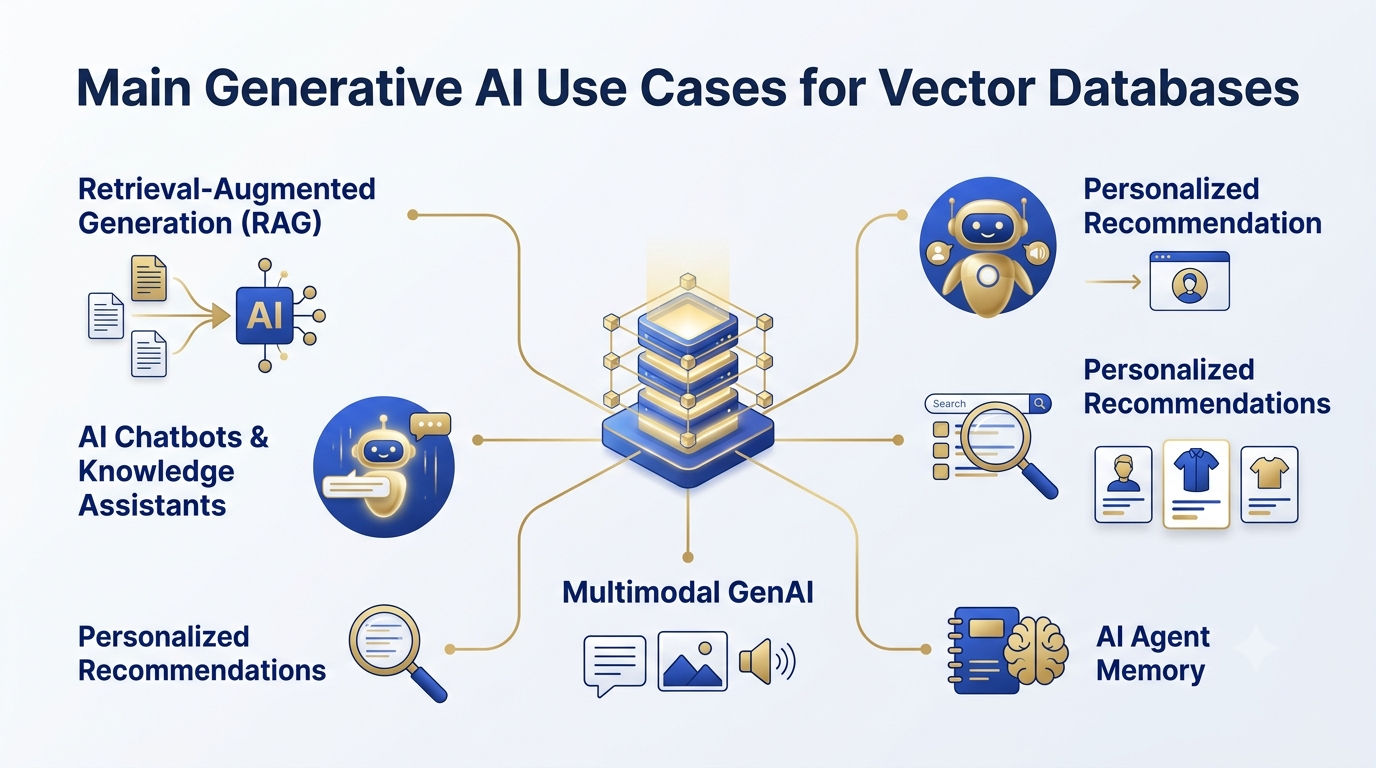
Retrieval-augmented generation (RAG)
It is one of the most common use cases. Vector databases for RAG retrieve relevant documents and knowledge that will help in formulating better answers.
AI chatbots and knowledge assistants
With the help of vector databases for GenAI, chatbots can get access to the organization's rules and regulations, product details, and customer service material which is required for providing relevant answers.
Semantic search
With the help of vector databases for generative AI, search systems can understand the intent of the query, which helps in identifying documents with related meanings instead of looking only for exact keywords.
Personalized recommendations
With the help of semantic or behavioral similarity, a vector database can retrieve relevant information, and the recommendation system then uses these embeddings to identify products, content, or services similar to a user's interests.
Multimodal GenAI
For applications using a mixture of text, image, and audio, vector databases is used to save embeddings for all formats of data in a single database.
This is why vector databases are useful in advanced AI systems.
AI agent memory
AI agents that are performing multistep tasks use vector databases to remember previous actions and interactions.
Vector databases for generative AI help AI agents retrieve useful previous information when completing a new task.
Strengthen your understanding of AI, machine learning, and NLP to work with technologies that power modern GenAI solutions with upGrad KnowledgeHut Data Science Courses.
How to choose a vector database for a generative AI application?
There are several key considerations to keep in mind while selecting a vector database. Some of them are mentioned below:
Consider the retrieval requirements
Different applications have different retrieval requirements. If conversational AI and vector databases for RAG are important, then priority should be given to those that provide both high retrieval accuracy and low latency.
Consider scale and performance
Performance becomes critical when the amount of data is large. Companies need to consider those vector databases for generative AI that allow processing millions of vectors while ensuring rapid search, it is essential for organizations to grow sustainably.
Consider infrastructure and operations
Depending on specific needs, companies should consider those vector databases that will match their organizational security and compliance needs.
Consider total cost
Cost is not limited to licensing fees. Storage, queries, and embedding dimensions affect the costs of vector databases for generative AI. The right vector database is the one that satisfies the retrieval, performance, security, and integration needs.
Conclusion
Vector databases for generative AI help LLMs access and retrieve relevant external information using semantic search. They are especially valuable for RAG, AI assistants, recommendations, and other knowledge-driven applications.
The right vector database for GenAI depends on your data, retrieval needs, scale, performance, infrastructure, and budget. When chosen carefully, it can provide a reliable foundation for building practical and scalable GenAI applications.
Have A Query? Get in Touch With Our Customer Support | upGrad KnowledgeHut
Frequently Asked Questions (FAQs)
Why are vector databases used in generative AI?
Vector databases help generative AI applications find relevant information based on meaning rather than exact keywords. They store embeddings and quickly retrieve related content from large datasets. This makes them useful for RAG, AI assistants, semantic search, and other GenAI applications.
How are embeddings generated for vector databases?
Embeddings are generated by an embedding model that converts text, images, audio, or other data into numerical vectors. Similar content gets vectors that are closer together in the embedding space. These vectors are then stored in a vector database for similarity search.
How do vector databases work with LLMs?
A vector database works as a retrieval layer alongside an LLM rather than replacing the model. It finds relevant information from stored embeddings and sends that information to the LLM as additional context. The LLM then uses this context to generate a response.
Why is metadata filtering important in RAG?
Metadata filtering in RAG helps narrow search results using details such as document type, date, department, user, or access level. It ensures the system retrieves information from the right source instead of searching the entire knowledge base. This can improve retrieval relevance, response accuracy, and data security.
How does a vector database work in RAG?
In RAG, documents are converted into embeddings and stored in a vector database. When a user asks a question, the query is converted into an embedding and matched with relevant stored vectors. The retrieved content is then provided to the LLM to generate a more relevant and grounded answer.
What is the difference between a vector database and a traditional database?
Traditional databases are mainly designed to store and retrieve structured data using queries, filters, and exact matches. Vector databases are designed to store embeddings and retrieve information based on semantic similarity. Many modern AI applications use both, rather than treating one as a complete replacement for the other.
What is the difference between a vector database and a vector store?
A vector database is a database system designed to store, index, search, and manage vector data, often with features such as filtering, scalability, and security. A vector store is a broader term that can describe a component or abstraction used to store and retrieve embeddings. The terms are sometimes used interchangeably, depending on the tool or framework.
How do vector databases reduce hallucinations?
Vector databases can help reduce hallucinations by retrieving relevant external information and providing it to the LLM as context. This gives the model factual material to reference instead of relying only on its learned knowledge. However, a vector database cannot eliminate hallucinations because retrieval quality and LLM behavior also affect the final response.
When should you use a vector database?
Use a vector database when an AI application needs to search large amounts of unstructured information based on meaning or similarity. It is particularly useful for RAG, semantic search, AI assistants, recommendations, and agent memory. For very small datasets or simple applications, a traditional database or another retrieval method may be sufficient.
Which vector database is best for generative AI?
There is no single best vector database for every generative AI application. The right choice depends on factors such as data volume, search requirements, latency, scalability, security, integrations, and cost. Evaluate these requirements first, then compare suitable options based on your specific GenAI workload.
1639 articles published
KnowledgeHut is an outcome-focused global ed-tech company. We help organizations and professionals unlock excellence through skills development. We offer training solutions under the people and proces...
Get Free Consultation
By submitting, I accept the T&C and
Privacy Policy