
- Blog Categories
- Project Management
- Agile Management
- IT Service Management
- Cloud Computing
- Business Management
- BI And Visualisation
- Quality Management
- Cyber Security
- DevOps
- Most Popular Blogs
- PMP Exam Schedule for 2025: Check PMP Exam Date
- Top 60+ PMP Exam Questions and Answers for 2025
- PMP Cheat Sheet and PMP Formulas To Use in 2025
- What is PMP Process? A Complete List of 49 Processes of PMP
- Top 15+ Project Management Case Studies with Examples 2025
- Top Picks by Authors
- Top 170 Project Management Research Topics
- What is Effective Communication: Definition
- How to Create a Project Plan in Excel in 2025?
- PMP Certification Exam Eligibility in 2025 [A Complete Checklist]
- PMP Certification Fees - All Aspects of PMP Certification Fee
- Most Popular Blogs
- CSM vs PSM: Which Certification to Choose in 2025?
- How Much Does Scrum Master Certification Cost in 2025?
- CSPO vs PSPO Certification: What to Choose in 2025?
- 8 Best Scrum Master Certifications to Pursue in 2025
- Safe Agilist Exam: A Complete Study Guide 2025
- Top Picks by Authors
- SAFe vs Agile: Difference Between Scaled Agile and Agile
- Top 21 Scrum Best Practices for Efficient Agile Workflow
- 30 User Story Examples and Templates to Use in 2025
- State of Agile: Things You Need to Know
- Top 24 Career Benefits of a Certifed Scrum Master
- Most Popular Blogs
- ITIL Certification Cost in 2025 [Exam Fee & Other Expenses]
- Top 17 Required Skills for System Administrator in 2025
- How Effective Is Itil Certification for a Job Switch?
- IT Service Management (ITSM) Role and Responsibilities
- Top 25 Service Based Companies in India in 2025
- Top Picks by Authors
- What is Escalation Matrix & How Does It Work? [Types, Process]
- ITIL Service Operation: Phases, Functions, Best Practices
- 10 Best Facility Management Software in 2025
- What is Service Request Management in ITIL? Example, Steps, Tips
- An Introduction To ITIL® Exam
- Most Popular Blogs
- A Complete AWS Cheat Sheet: Important Topics Covered
- Top AWS Solution Architect Projects in 2025
- 15 Best Azure Certifications 2025: Which one to Choose?
- Top 22 Cloud Computing Project Ideas in 2025 [Source Code]
- How to Become an Azure Data Engineer? 2025 Roadmap
- Top Picks by Authors
- Top 40 IoT Project Ideas and Topics in 2025 [Source Code]
- The Future of AWS: Top Trends & Predictions in 2025
- AWS Solutions Architect vs AWS Developer [Key Differences]
- Top 20 Azure Data Engineering Projects in 2025 [Source Code]
- 25 Best Cloud Computing Tools in 2025
- Most Popular Blogs
- Company Analysis Report: Examples, Templates, Components
- 400 Trending Business Management Research Topics
- Business Analysis Body of Knowledge (BABOK): Guide
- ECBA Certification: Is it Worth it?
- Top Picks by Authors
- Top 20 Business Analytics Project in 2025 [With Source Code]
- ECBA Certification Cost Across Countries
- Top 9 Free Business Requirements Document (BRD) Templates
- Business Analyst Job Description in 2025 [Key Responsibility]
- Business Analysis Framework: Elements, Process, Techniques
- Most Popular Blogs
- Best Career options after BA [2025]
- Top Career Options after BCom to Know in 2025
- Top 10 Power Bi Books of 2025 [Beginners to Experienced]
- Power BI Skills in Demand: How to Stand Out in the Job Market
- Top 15 Power BI Project Ideas
- Top Picks by Authors
- 10 Limitations of Power BI: You Must Know in 2025
- Top 45 Career Options After BBA in 2025 [With Salary]
- Top Power BI Dashboard Templates of 2025
- What is Power BI Used For - Practical Applications Of Power BI
- SSRS Vs Power BI - What are the Key Differences?
- Most Popular Blogs
- Data Collection Plan For Six Sigma: How to Create One?
- Quality Engineer Resume for 2025 [Examples + Tips]
- 20 Best Quality Management Certifications That Pay Well in 2025
- Six Sigma in Operations Management [A Brief Introduction]
- Top Picks by Authors
- Six Sigma Green Belt vs PMP: What's the Difference
- Quality Management: Definition, Importance, Components
- Adding Green Belt Certifications to Your Resume
- Six Sigma Green Belt in Healthcare: Concepts, Benefits and Examples
- Most Popular Blogs
- Latest CISSP Exam Dumps of 2025 [Free CISSP Dumps]
- CISSP vs Security+ Certifications: Which is Best in 2025?
- Best CISSP Study Guides for 2025 + CISSP Study Plan
- How to Become an Ethical Hacker in 2025?
- Top Picks by Authors
- CISSP vs Master's Degree: Which One to Choose in 2025?
- CISSP Endorsement Process: Requirements & Example
- OSCP vs CISSP | Top Cybersecurity Certifications
- How to Pass the CISSP Exam on Your 1st Attempt in 2025?
- Most Popular Blogs
- Top 7 Kubernetes Certifications in 2025
- Kubernetes Pods: Types, Examples, Best Practices
- DevOps Methodologies: Practices & Principles
- Docker Image Commands
- Top Picks by Authors
- Best DevOps Certifications in 2025
- 20 Best Automation Tools for DevOps
- Top 20 DevOps Projects of 2025
- OS for Docker: Features, Factors and Tips
- More
- Agile & PMP Practice Tests
- Agile Testing
- Agile Scrum Practice Exam
- CAPM Practice Test
- PRINCE2 Foundation Exam
- PMP Practice Exam
- Cloud Related Practice Test
- Azure Infrastructure Solutions
- AWS Solutions Architect
- IT Related Pratice Test
- ITIL Practice Test
- Devops Practice Test
- TOGAF® Practice Test
- Other Practice Test
- Oracle Primavera P6 V8
- MS Project Practice Test
- Project Management & Agile
- Project Management Interview Questions
- Release Train Engineer Interview Questions
- Agile Coach Interview Questions
- Scrum Interview Questions
- IT Project Manager Interview Questions
- Cloud & Data
- Azure Databricks Interview Questions
- AWS architect Interview Questions
- Cloud Computing Interview Questions
- AWS Interview Questions
- Kubernetes Interview Questions
- Web Development
- CSS3 Free Course with Certificates
- Basics of Spring Core and MVC
- Javascript Free Course with Certificate
- React Free Course with Certificate
- Node JS Free Certification Course
- Data Science
- Python Machine Learning Course
- Python for Data Science Free Course
- NLP Free Course with Certificate
- Data Analysis Using SQL
- Home
- Blog
- Data Science
- Best AI Tools for Content Creation in 2026
Best AI Tools for Content Creation in 2026
Updated on Aug 07, 2026 | 0.9k+ views
Share:
Table of Contents
View all
Quick Overview
- The best AI tools for content creation include ChatGPT, Claude, Gemini, Jasper, Writesonic, Canva AI, Midjourney, Adobe Firefly, and Descript, each designed for specific content creation tasks.
- Whether you're creating blogs, SEO content, marketing copy, social media posts, images, videos, or research reports, choosing the right AI tool depends on your content goals and workflow.
- Factors such as content quality, integrations, collaboration features, pricing, and data security should be considered before selecting an AI content creation tool.
- This guide covers the best AI tools, their use cases, how to choose the right one, and best practices for AI content creation.
Create more accurate, engaging, and impactful AI-generated content by mastering practical prompt engineering with upGrad KnowledgeHut Generative AI and Prompt Engineering course.
Top AI Tools for Content Creation
If you want to use AI for creating content in 2026, the best tool depends on what you need. Some tools are better for writing, while others are made for images, videos, or marketing.
The table below shows what each AI tool does best.
Tool |
Best for |
Content types |
AI model |
Best for users |
| ChatGPT | Everyday writing and brainstorming ideas | Blog posts, emails, scripts, outlines | GPT | Individuals, freelancers, businesses |
| Claude | Long articles and detailed writing | Articles, reports, white papers | Claude | Writers, researchers |
| Gemini | Creating content in Google Workspace | Google Docs, emails, summaries | Gemini | Google Workspace users |
| Jasper | Marketing content | Landing pages, ads, marketing campaigns | Multiple models | Marketing teams |
| Copy.ai | Sales and marketing copy | Emails, ad copy, sales outreach | Multiple models | Sales teams |
| Writesonic | SEO content | Blog posts, website pages | Multiple models | Bloggers, publishers |
| Canva AI | Visual content | Graphics, presentations, social media posts | Multiple models | Designers, marketers |
| Midjourney | AI-generated artwork | Images, illustrations, concept art | Proprietary | Creators, agencies |
| Adobe Firefly | Business-ready graphics | Marketing visuals, branded designs | Firefly | Brands, businesses |
| Descript | Audio and video editing | Podcasts, videos, transcripts | Proprietary | Video creators, podcasters |
Also Read: What is Prompt in AI?
Best AI tools for content creation by use case
AI content creation tools help writers, marketers, and businesses create different types of content faster. The right tool depends on your content goals, such as writing articles, creating marketing copy, improving SEO, or generating creative ideas.
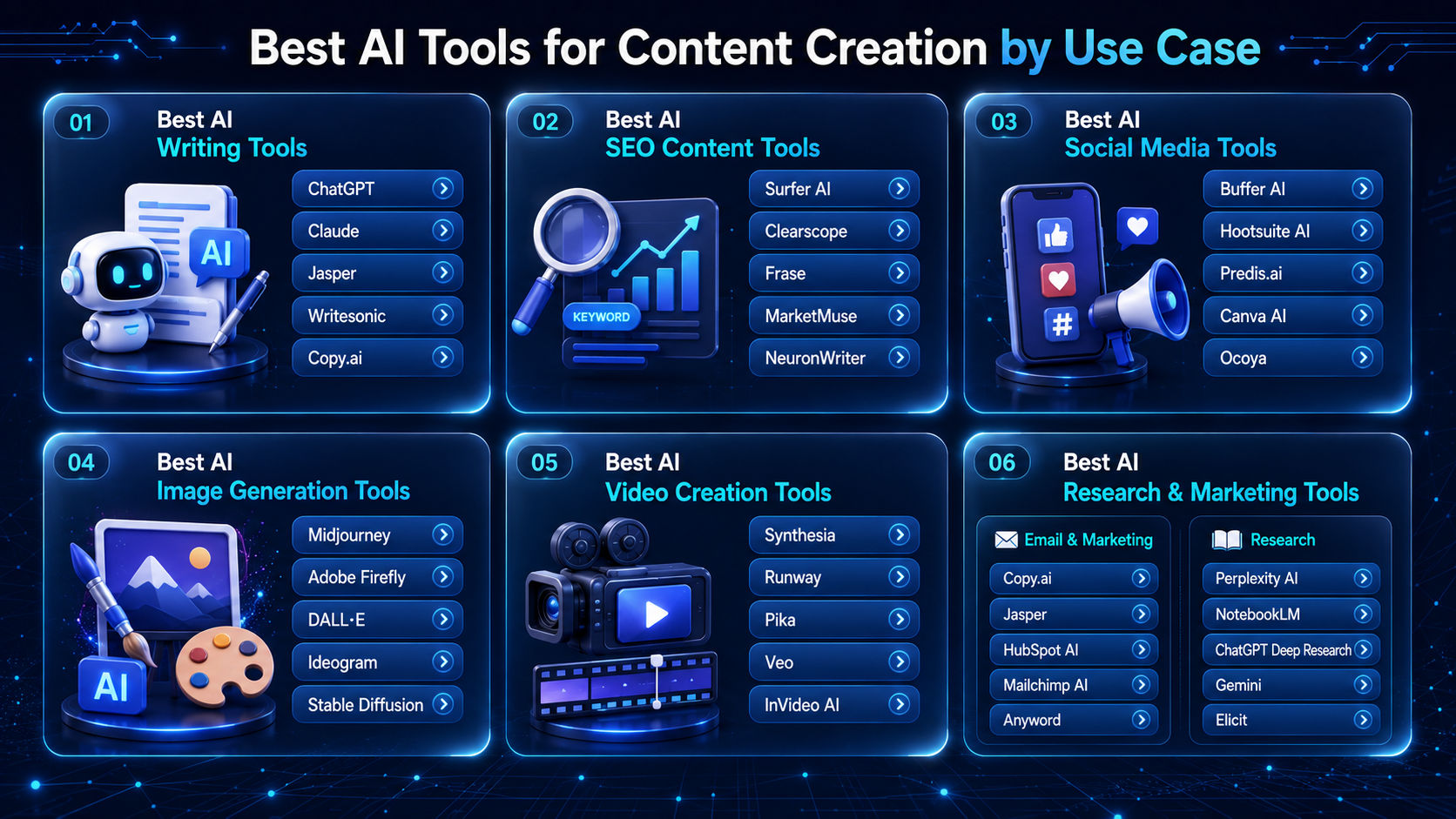
Best AI writing tools
AI writing tools help create, edit, summarize, and improve written content. When choosing a writing tool, consider factors like content quality, ease of use, editing features, templates, and support for different writing formats.
1. ChatGPT
ChatGPT is a versatile AI writing tool that works well for blogs, newsletters, emails, scripts, content briefs, and first drafts. It is a good choice for users who need an all-purpose writing assistant for different types of content creation.
Also Read: How to use ChatGPT in Prompt Engineering?
2. Claude
Claude is best suited for long-form content such as articles, reports, research documents, and detailed guides. It can handle large amounts of information while maintaining context, clarity, and consistency throughout the content.
3. Jasper
Jasper is designed for marketing teams that need structured content creation workflows. It provides templates, brand voice controls, and tools for creating ads, landing pages, emails, and marketing campaigns.
4. Writesonic
Writesonic is a strong choice for SEO-focused content creation. It helps marketers create blog posts, website content, and landing pages while providing features designed to improve search visibility.
5. Copy.ai
Copy.ai focuses on sales and marketing content. It helps businesses create outreach emails, ad copy, product descriptions, and customer-focused content to improve engagement and conversions.
Also Read: Claude vs ChatGPT vs Gemini
Best AI SEO content tools
AI SEO content tools help improve content performance by analyzing search results, identifying important keywords, understanding search intent, and suggesting ways to create more competitive content.
1. Surfer AI
Surfer AI is a popular SEO content optimization tool that helps create search-friendly content. It analyzes top-ranking pages, suggests relevant keywords, provides content scores, and helps improve topic coverage.
2. Clearscope
Clearscope is designed for content teams that focus on quality and search performance. It provides content grading, keyword recommendations, and optimization insights to help writers create more relevant content.
3. Frase
Frase helps users quickly create SEO content briefs by analyzing search results and identifying important topics, questions, and keywords. It is useful for marketers who want to speed up content planning.
4. MarketMuse
MarketMuse focuses on content strategy and topical authority. It helps businesses find content gaps, plan content clusters, and improve their overall SEO strategy.
5. NeuronWriter
NeuronWriter is an affordable SEO optimization tool that provides keyword analysis, content suggestions, and optimization features. It is suitable for creators and small businesses looking for essential SEO support.
Best AI tools for social media content
AI social media tools help create posts, captions, visuals, and publishing workflows to make social media management faster and easier.
1. Buffer AI
Buffer AI helps creators and small businesses generate social media posts and manage publishing schedules. It is useful for maintaining a consistent posting workflow across multiple platforms.
2. Hootsuite AI
Hootsuite AI combines content creation with social media management features. It supports scheduling, analytics, social listening, and AI-powered content suggestions for larger teams.
3. Predis.ai
Predis.ai creates complete social media content from simple prompts, including captions, images, reels, and carousel posts. It is useful for brands that want to automate creative content production.
4. Canva AI
Canva AI helps users create branded social media graphics, images, and marketing visuals quickly. It is popular among marketers and businesses that need easy design solutions.
5. Ocoya
Ocoya combines AI copywriting, graphic creation, and social media scheduling in one platform. It is especially useful for ecommerce businesses and small marketing teams.
Also Read: How Generative AI is Changing Creative Industries in 2026
Best AI image generation tools
AI image generation tools help create visuals from text prompts and support creative tasks such as branding, marketing, and design.
1. Midjourney
Midjourney is known for creating highly detailed and artistic images. It is widely used by designers, artists, and creators who need unique and visually appealing content.
2. Adobe Firefly
Adobe Firefly is designed for professional creative workflows. It integrates with Adobe Creative Cloud and helps businesses create commercial visuals, edit images, and generate design assets.
3. DALL·E
DALL·E creates images from text descriptions and works well for users who want to generate visuals through simple conversations. It is useful for marketing graphics, concepts, and creative ideas.
4. Ideogram
Ideogram specializes in generating images with accurate text rendering. It is useful for creating posters, advertisements, logos, and social media designs that include written content.
5. Stable Diffusion
Stable Diffusion provides greater customization and control compared with many other image generators. It is suitable for users who want to fine-tune models or run AI image generation locally.
Also Read: Gen AI for Marketers: How to Use Generative AI Tools in Your Daily Workflow
Best AI video creation tools
AI video tools help create, edit, and enhance videos using text prompts, templates, and automated workflows.
1. Synthesia
Synthesia is designed for business videos, training materials, and educational content. It uses AI avatars and voice generation to create professional videos without traditional filming.
2. Runway
Runway is a powerful AI video creation platform for generating videos, applying creative effects, and editing content. It is popular among creators, filmmakers, and marketing teams.
3. Pika
Pika focuses on quick AI video generation and is useful for creating short videos, social media content, and creative visual effects.
4. Veo
Veo is an advanced AI video generation tool that creates high-quality videos from text prompts. It is suitable for users looking for realistic AI-generated video content.
5. InVideo AI
InVideo AI helps marketers create videos using AI scripts, templates, stock media, and voice generation. It is useful for quickly producing promotional and social media videos.
Also Read: What are the Best AI Prompts for Content Marketing?
Best AI tools for email and marketing copy
AI marketing tools help businesses create emails, advertisements, product descriptions, and campaign content designed to improve engagement.
1. Copy.ai
Copy.ai focuses on sales and marketing content. It helps create outreach emails, ad copy, product descriptions, and other conversion-focused content.
2. Jasper
Jasper is built for marketing teams that need structured content workflows. It provides templates, brand voice controls, and tools for creating multi-channel marketing campaigns.
3. HubSpot AI
HubSpot AI combines content generation with CRM and marketing automation features. It helps businesses create personalized marketing content based on customer data.
4. Mailchimp AI
Mailchimp AI supports email marketing workflows by helping users create campaigns, improve messaging, and automate customer communication.
5. Anyword
Anyword focuses on performance-based copywriting. It helps marketers create content optimized for engagement, conversions, and campaign performance.
Also Read: What is Prompt Engineering in Generative AI?
Best AI research tools
AI research tools help users find information, analyze documents, summarize content, and generate insights faster.
1. Perplexity AI
Perplexity AI is an AI-powered search tool that provides answers with sources. It is useful for quick research, fact-checking, and gathering information from the web.
2. NotebookLM
NotebookLM helps users analyze their own documents, reports, and research materials. It is useful for summarizing information and generating insights from uploaded sources.
3. ChatGPT Deep Research
ChatGPT Deep Research helps users create detailed reports by analyzing multiple sources and summarizing complex topics. It is useful for professionals, researchers, and analysts.
4. Gemini
Gemini works well for research tasks connected with Google services. It helps users analyze information, summarize content, and work within Google Workspace environments.
5. Elicit
Elicit is designed for academic and scientific research. It helps researchers find relevant papers, summarize studies, and extract useful insights from research literature.
Also Read: How AI is Changing Digital Marketing Careers in 2026
How to Choose the Right AI Content Creation Tool
The best AI content creation tool is the one that fits your work, content needs, and business goals. It is not always the tool with the most features.
1. Know your content goals
First, think about the type of content you create most often. If you write blogs or articles, choose a tool with good writing and SEO features. If you work in marketing, look for tools that help with ads, emails, and social media posts. If you create images or videos, pick a tool with strong design and video features.
2. Choose a tool that fits your workflow
Select a tool that works well with the apps and platforms you already use. Support for Google Workspace, Microsoft 365, WordPress, design software, and project management tools can help you work faster and save time.
3. Check content quality
A good AI tool should create clear, accurate, and useful content. It should understand your instructions, stay on topic, and reduce the amount of editing you need to do.
4. Look for team features
If you work with others, choose a tool that supports teamwork. Features like shared workspaces, content reviews, version history, and easy collaboration can make the process smoother.
5. Compare pricing
Look at both free and paid plans before making a decision. Check the usage limits, team features, subscription cost, and API access if needed. Choose a plan that fits your budget and can grow with your business.
6. Review privacy and security
If you use AI for business content, make sure the tool protects your data. Read its privacy policy and security information to understand how your data is stored and used. Also, check if it meets your company's compliance and data protection needs.
Expand your AI expertise beyond content creation with upGrad KnowledgeHut Data Science Courses, designed to help you build practical, industry-relevant skills.
Best practices for using AI content creation tools
AI content tools work best when people review and improve the content. A simple process helps you create content that is accurate, useful, and easy to read.
Write clear prompts
Tell the AI exactly what you need. Include details like your target audience, purpose, tone, format, and any important points to cover. Clear prompts usually produce better results.
Verify AI-generated information
AI can make mistakes or use outdated information. Always check facts, statistics, product details, and technical information before publishing your content.
Add human expertise
Don't rely only on AI. Add your own ideas, experiences, examples, or expert tips. This makes your content more helpful, original, and trustworthy.
Optimize for SEO and GEO
Write content that answers people's questions and matches what they are searching for. Use clear headings, simple language, and relevant keywords so both search engines and AI search tools can understand your content.
Maintain brand voice
Edit the content so it sounds like your brand. Use a consistent tone and writing style in every article, blog post, or webpage.
Review before publishing
Read the content carefully before you publish it. Check for grammar mistakes, spelling errors, broken links, formatting issues, and incorrect information.
Track content performance
Keep an eye on your content's performance. Check traffic, rankings, engagement, and conversions to see what works. Use this information to improve your future content.
Conclusion
AI tools for content creation can significantly speed up writing, design, research, and content production, but the best results come from using the right tool for the right task.
Whether you're a blogger, marketer, designer, or business owner, choosing a platform that fits your workflow will improve both productivity and content quality.
Pair AI with human expertise, fact-checking, and strategic editing to create accurate, engaging, and search-friendly content that delivers real value to your audience.
Have A Query? Get in Touch With Our Customer Support | upGrad KnowledgeHut
Frequently Asked Questions (FAQs)
What are the best AI tools for email and marketing copy?
Copy.ai, Jasper, HubSpot AI, Mailchimp AI, and Anyword are popular tools for creating email campaigns and marketing copy. They offer templates, brand voice customization, and AI-assisted content generation for ads, landing pages, newsletters, and outreach emails. Businesses often use them to streamline campaign creation and improve productivity.
Which AI tool is best for bloggers?
For bloggers, ChatGPT and Claude are excellent for drafting long-form content and generating ideas, while Writesonic is a strong choice for SEO-focused blog writing. Pairing a writing assistant with an SEO optimization tool like Surfer AI can help improve search visibility. The best setup depends on whether your priority is writing quality or SEO performance.
Which AI tool is best for marketers?
Marketing teams typically benefit from Jasper, Copy.ai, HubSpot AI, and Canva AI because these tools support campaign creation, ad copy, emails, landing pages, and visual content. They also include templates and collaboration features that simplify marketing workflows. Using multiple tools together often delivers better results than relying on a single platform.
Which AI tool is best for creating SEO-friendly content?
For SEO-focused content, Writesonic, Surfer AI, Clearscope, Frase, MarketMuse, and NeuronWriter are among the best choices. These tools help optimize content by analyzing search intent, recommending keywords, and improving topical coverage. Combining them with an AI writing assistant produces better SEO results.
Which AI tool is best for long-form writing?
Claude is widely recognized for handling long-form content such as articles, reports, and research documents while maintaining context throughout lengthy drafts. ChatGPT is also a strong option for comprehensive writing, editing, and content planning. Both tools are well suited for creating detailed, high-quality content.
What features should I compare before choosing an AI tool?
Compare factors such as content quality, ease of use, supported content types, integrations, collaboration features, pricing, and data privacy. Also consider whether the tool supports your workflow, offers brand voice customization, and integrates with platforms like Google Workspace or WordPress. Choosing a tool based on your specific needs ensures better long-term value.
How can I improve AI-generated content quality?
Start with clear, detailed prompts that specify your audience, purpose, and desired format. Always fact-check AI-generated information, add original insights or examples, and edit the content to match your brand voice. A final human review helps improve accuracy, readability, and overall quality.
How do I use AI tools for SEO and GEO?
Use AI to research topics, create structured outlines, optimize content for search intent, and answer common user questions clearly. Combine AI writing tools with SEO optimization platforms to improve keyword coverage and topical relevance. For GEO (Generative Engine Optimization), create well-structured, trustworthy content that AI search engines can easily understand and reference.
Why is human editing important for AI-generated content?
AI can generate inaccurate, outdated, or generic information, making human review essential. Editing helps verify facts, improve clarity, maintain brand voice, and add original expertise that AI cannot provide. This results in more trustworthy, engaging, and valuable content.
How can I get better results from AI content creation tools?
Use AI as a collaborative assistant rather than relying on it to produce publish-ready content. Write specific prompts, review every output, optimize for SEO and GEO, and refine the content with your own expertise and examples. Combining AI efficiency with human judgment consistently delivers the best results.
1641 articles published
KnowledgeHut is an outcome-focused global ed-tech company. We help organizations and professionals unlock excellence through skills development. We offer training solutions under the people and proces...
Get Free Consultation
By submitting, I accept the T&C and
Privacy Policy