
Product Discovery vs Product Delivery: What Modern PMs Need to Master
Updated on Aug 24, 2026 | 426 views
Share:
Table of Contents
View all
Quick Overview
- Product discovery focuses on deciding what to build and why by researching customer needs, identifying problems, and testing potential solutions.
- Product delivery focuses on building, testing, and releasing validated solutions to users.
- Product discovery and delivery work together, with discovery informing delivery decisions and real-world delivery feedback creating new inputs for discovery.
- This guide explains the key differences between product discovery and product delivery, the role of Product Managers in both, and the common challenges teams face when balancing discovery and delivery.
Build product management skills with SAFe® 6.0 Product Owner/Product Manager (POPM) and prepare to lead value delivery in Agile environments.
Product discovery vs Product delivery: key differences
The main difference between product discovery and product delivery lies in the stage at which decisions are made of discovery is concerned with determining what should be built and why, whereas delivery is about how to build and effectively release it.
| Parameter | Product Discovery | Product Delivery |
| Goal | Identify the right problem and solution | Build and release the right solution |
| Focus | Customer needs, problems, opportunities, and validation | Execution, development, quality, and release |
| Primary Risks | Solving the wrong problem or building low value features | Delays, defects, scope issues, and poor execution |
| Core Activities | Research, interviews, ideation, prototyping, and testing | Planning, development, testing, deployment, and monitoring |
| Level of Uncertainty | Higher | Lower after decisions are validated |
| Customer Involvement | Frequent and exploratory | More focused on feedback and validation |
| Key Stakeholders | Customers, Product Managers, designers, business teams | Product, engineering, design, QA, operations, and stakeholders |
| Typical Outputs | Validated problems, insights, concepts, and prototypes | Working features, releases, and product improvements |
Learn how Agentic AI for Product Managers can streamline product workflows, automate tasks, and support faster, data driven decisions.
What is Product discovery?
Product discovery involves understanding the problems that customers have, the business opportunities that exist, and the possible solutions before allocating considerable resources to development.
This helps teams to decrease uncertainty and reach better decisions regarding their products.
Key Activities in Product Discovery
Product discovery can involve:
- Customer interviews
- User research
- Problem validation
- Market research
- Data analysis
- Ideation
- Prototyping
- Usability testing
- Experimentation
The aim goes beyond just coming up with ideas; it is to find evidence that the problem is one that is worth solving and that the suggested solution has the potential to create value.
Role of Product Managers in Discovery
Product Managers play a role in linking customer needs with business goals when carrying out the discovery process.
Their responsibilities may include:
- Defining the problem
- Understanding customer pain points
- Prioritizing opportunities
- Aligning stakeholders
- Evaluating evidence
- Deciding what should move forward
In the case of product discovery as opposed to product delivery, the Product Manager has a significant role to play when it comes to making decisions since uncertainty remains relatively high.
Learning through the upGrad KnowledgeHut Agile Management Course can help you understand how to apply Agile methodologies effectively in real-world project management scenarios.
What is Product delivery?
Product delivery involves taking up a product idea that has been validated and turning it into a working solution before making it available to customers.
It is concerned with carrying out tasks, coordinating activities, ensuring quality, and achieving the expected result.
Key Activities in Product Delivery
Delivery typically includes:
- Sprint or release planning
- Development
- Design implementation
- Testing
- Quality assurance
- Deployment
- Monitoring
- Feedback collection
The focus is on carrying out actions in accordance with the priorities that have been agreed upon while at the same time ensuring quality and handling the constraints.
Role of Product Managers in Delivery
Product Managers help to make sure that the delivery remains connected with both customer and business goals.
Key responsibilities include:
- Clarifying requirements
- Prioritizing work
- Supporting engineering and design teams
- Managing trade offs
- Tracking progress
- Communicating with stakeholders
- Evaluating outcomes
A product manager doesn't just make discovery decisions and then leaves the situation. Rather, good product management links the discovery decisions with delivery execution.
Explore the Career Path After AI Powered Product Management Certification and discover roles, skills, and growth opportunities in AI driven product management.
Common challenges in Product discovery and delivery
The fact that both product discovery and product delivery can fail in different ways also has to be understood. Failure in the discovery phase occurs when teams validate too little, and failure in the delivery phase takes place when execution becomes disconnected from the original problem.
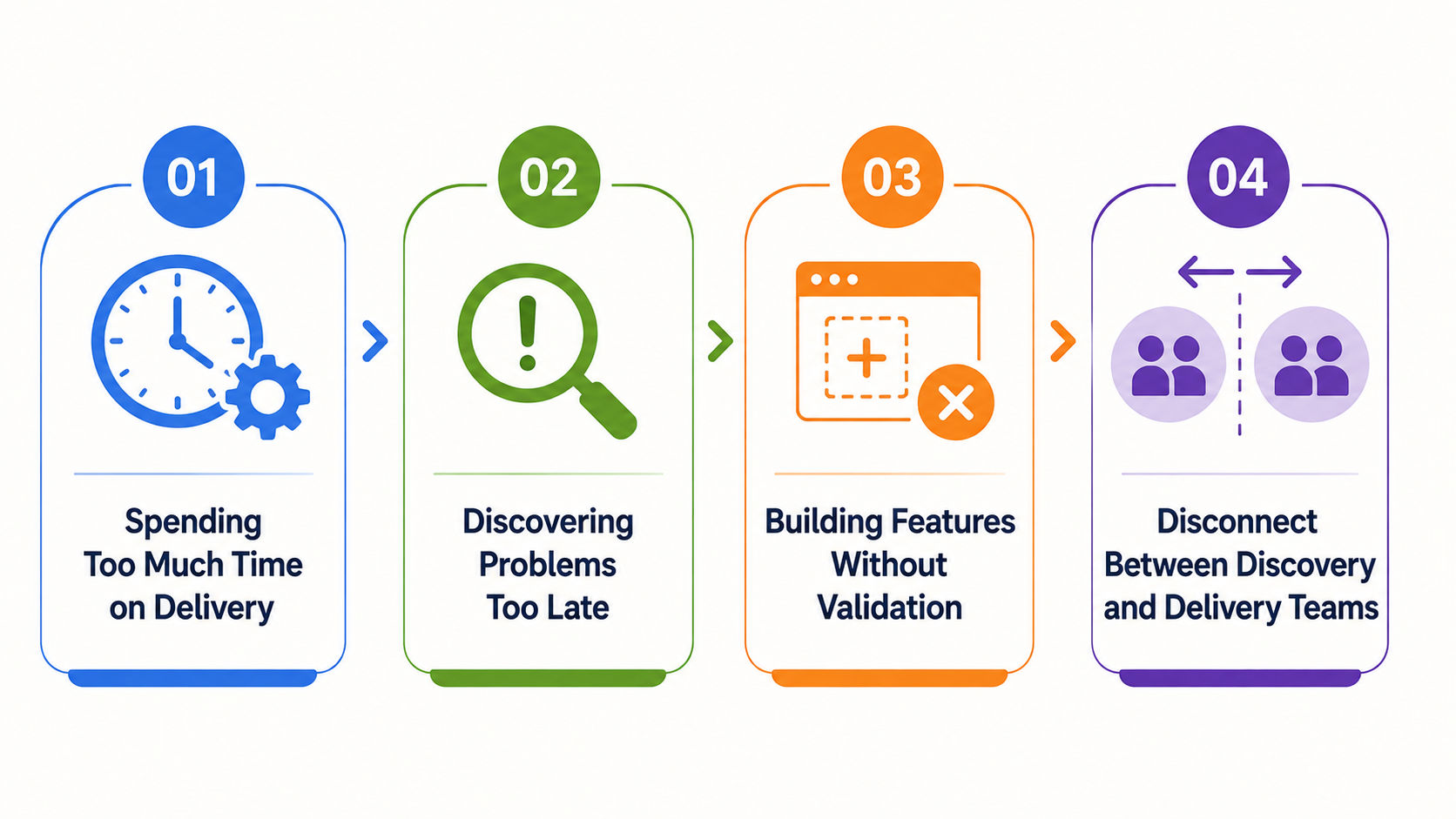
Spending Too Much Time on Delivery
It is possible for teams to concentrate so much on releasing features that they do not spend enough time checking whether these features still address important customer problems.
This can lead to:
- Feature focused roadmaps
- Limited customer research
- Less experimentation
- Building based on assumptions
A good balance between discovery and delivery enables teams to prevent them from focusing solely on output.
Discovering Problems Too Late
If the discovery is made too late, teams will find customers or business problems after a considerable amount of development work has already been carried out.
Early discovery can help identify:
- Weak demand
- Poor usability
- Wrong assumptions
- Missing requirements
- Better solution options
Building Features Without Validation
A feature can be technically successful yet still fails to provide customer value.
Validation helps teams assess:
- Whether the problem is real
- Whether customers care about it
- Whether the proposed solution is useful
- Whether the solution is understandable
One of the key differences between product discovery and product delivery is that in discovery the idea is tested before, in delivery however, heavy investment is made into execution.
Disconnect Between Discovery and Delivery Teams
If discovery and delivery are carried out separately, then valuable customer insights will be lost.
A stronger connection ensures that:
- Research informs priorities
- Product decisions reach delivery teams
- Engineering constraints influence discovery
- Customer feedback returns to the product team
It is best to carry out discovery and delivery as closely linked activities rather than treat them as entirely separate stages.
Also Read: How to Build an AI Product Roadmap
Conclusion
The key takeaway from product discovery vs product delivery is that both solve different product management problems. Discovery reduces uncertainty by helping teams understand what to build and why, while delivery focuses on building, releasing, and improving the solution.
The most effective approach is to balance discovery with delivery, validate important assumptions early, and keep customer outcomes connected to execution.
Contact our upGrad KnowledgeHut experts for personalized guidance on choosing the right course, career path, and certification to achieve your goals.
Frequently Asked Questions (FAQs)
1. Should product discovery and product delivery happen at the same time?
Yes. Modern product teams often treat discovery and delivery as connected activities rather than completely separate phases. Discovery can continue while delivery is underway, helping teams respond to new customer feedback and changing requirements.
2. How much time should Product Managers spend on discovery versus delivery?
There is no fixed ratio because the balance depends on product maturity, uncertainty, and current priorities. More discovery may be needed for new or uncertain products, while established products may require greater delivery of focus.
3. What should happen when discovery findings change an active delivery plan?
The team should review the new evidence and assess its impact on customer value, business goals, cost, and timelines. If the finding is significant, priorities or planned work may need to be adjusted rather than continuing with an outdated assumption.
4. How do teams know when a product discovery problem is validated enough to build?
A problem is generally ready for delivery when there is enough evidence that it is meaningful, relevant, and worth solving. Teams can use customer research, data, experiments, prototypes, and feedback to build confidence before committing development resources.
5. What metrics should be used to measure product discovery success?
Discovery can be measured through indicators such as validated assumptions, customer research findings, experiment results, prototype feedback, and reduced product uncertainty. The goal is to measure learning and decision quality rather than simply counting research activities.
6. How can engineering teams contribute to product discovery?
Engineering teams can contribute by assessing technical feasibility, identifying constraints, estimating complexity, and suggesting alternative solutions. Early engineering involvement can help teams avoid pursuing ideas that are difficult or costly to build.
7. What is dual track agile in product discovery and delivery?
Dual track Agile allows discovery and delivery to progress alongside each other. While one part of the team explores problems and validates solutions, another can work on building previously validated product decisions.
8. How can teams prevent discovery from becoming endless research?
Teams should define clear learning goals, time limits, and decision criteria before starting discovery activities. Once enough evidence supports a decision, the team should move forward rather than continue research without a clear purpose.
9. How can teams avoid becoming too focused on delivery and shipping features?
Teams should regularly connect delivery work with customer problems and measurable outcomes. Continuous customer research, product analytics, and validation can help ensure that shipping activity remains connected to meaningful product value.
10. Who should be involved in both product discovery and product delivery?
Product Managers, designers, and engineers should generally collaborate across both activities. Depending on the product, customers, researchers, analysts, marketers, and other business stakeholders can also contribute valuable insights and expertise.
1639 articles published
KnowledgeHut is an outcome-focused global ed-tech company. We help organizations and professionals unlock excellence through skills development. We offer training solutions under the people and proces...
Get Free Consultation
By submitting, I accept the T&C and
Privacy Policy