
- Home
- Blog
- Artificial Intelligence
- Agentic AI for Product Managers: Using AI Agents in Product Workflows
Agentic AI for Product Managers: Using AI Agents in Product Workflows
Updated on Jul 31, 2026 | 293 views
Share:
Table of Contents
View all
- What Is Agentic AI for Product Managers?
- How Can Product Managers Use AI Agents in Product Workflows?
- How to Build an Agentic AI Workflow for Product Management
- Best AI Agent Tools for Product Managers
- What Are the Benefits of Agentic AI for Product Managers?
- What Are the Challenges and Risks of Using AI Agents in Product Management?
- Conclusion
Quick Overview
- Agentic AI for Product Managers is shifting product management from manually handling every task to orchestrating AI agents that can work toward defined goals and complete multi-step workflows.
- AI agents can plan, reason, use tools, analyze data, and take action, helping with everyday tasks such as customer feedback synthesis, competitive research, PRD drafting, backlog analysis, and product analytics.
- Instead of simply generating answers, agents can work across Product workflows and continuously support activities from product discovery to launch and post-launch optimization.
- The goal is not to replace Product Managers. It is to reduce repetitive work and give PMs more time for strategy, customer understanding, prioritization, product vision, and important decisions.
- In this guide, we’ll explore how Product Managers can use AI agents across Product workflows, the best use cases and tools to consider, how to build an effective AI agent workflow, and the key risks to keep in mind.
Ready to go deeper into AI agent workflows? The upGrad KnowledgeHut Applied Agentic AI Certification Course can help you build practical skills to understand and apply Agentic AI in real-world scenarios.
What Is Agentic AI for Product Managers?
For product managers, Agentic AI refers to AI systems that can work toward specific goals, make decisions within set guidelines, use different tools, and complete tasks that involve multiple steps.
Unlike a traditional AI assistant that simply answers prompts, an AI agent can handle an entire workflow. It can collect information, analyze data, create a plan, take action, review the results, and decide what to do next based on what it learns.
Because of these capabilities, Agentic AI is becoming a valuable tool throughout the product management process. It can support product discovery, roadmap planning, writing and managing requirements, conducting customer research, analyzing product data, and preparing product launches.
Also Read: Agentic AI Career Path
How Can Product Managers Use AI Agents in Product Workflows?
Product Managers can use AI agents across discovery, research, requirements, prioritization, planning, delivery coordination, analytics, product launches, and continuous improvement.
The biggest opportunity is not replacing product judgment. It is reducing the amount of repetitive work surrounding that judgment.
1. AI Agents for Product Discovery and Market Research
Product discovery can involve large amounts of information. Industry reports, competitor websites, customer discussions, reviews, product updates, and market trends all need to be monitored and interpreted.
An AI agent can help gather and organize this information on a regular basis.
For example:
Research goal → Agent gathers sources → Agent categorizes findings → Agent identifies patterns → PM validates insights → Opportunity backlog
A product research agent can help:
- Gather market information
- Analyze industry reports
- Monitor competitor updates
- Identify emerging trends
- Compare product positioning
- Summarize research
- Surface potential opportunities
- Maintain recurring competitive intelligence
Can AI agents conduct market research? Yes, they can support research collection and synthesis. However, important product decisions should not be based on unverified agent output.
The agent can speed up the research process. The Product Manager still needs to decide what the findings actually mean for the product.
Also Read: Product Discovery vs Product Delivery
2. AI Agents for Customer Feedback and User Research
Customer feedback is another area where Agentic AI can save significant time.
A Product Manager may have feedback spread across surveys, customer interviews, support tickets, app reviews, emails, and social channels. Reading every item manually can make it difficult to spot wider patterns.
An AI agent can process these sources and group similar feedback.
A typical workflow could look like:
Feedback sources → Feedback Agent → Theme detection → Segment analysis → Opportunity identification → PM validation
The agent can:
- Analyze surveys
- Cluster support tickets
- Summarize interviews
- Categorize reviews
- Identify recurring pain points
- Detect sentiment patterns
- Extract feature requests
- Connect feedback with customer segments
| Manual PM task | Agent assisted workflow | Human responsibility |
| Read hundreds of reviews | Cluster feedback | Validate themes |
| Summarize interviews | Extract patterns | Interpret user context |
| Identify feature requests | Rank recurring themes | Decide strategic importance |
This distinction matters. An agent may identify that a feature request appears frequently, but frequency alone does not prove that the feature should be built.
3. AI Agents for Product Requirements and PRDs
Writing and maintaining product requirements can become repetitive, especially when the same information needs to appear across PRDs, user stories, tickets, and documentation.
An AI agent can create a first draft based on approved product context.
Possible tasks include:
- Turning validated insights into requirement drafts
- Drafting PRDs
- Identifying missing requirements
- Generating user stories
- Suggesting acceptance criteria
- Identifying edge cases
- Reviewing requirements for ambiguity
- Checking documentation consistency
For example, a Product Manager could provide the validated problem statement, target customer, business goal, product constraints, and relevant research. An agent could then prepare a first PRD draft.
Can AI agents write PRDs? Yes. But the PM should remain responsible for the final requirements, priorities, assumptions, and product decisions.
The best use of Agentic AI here is as a strong first draft and review partner, rather than the final authority on what gets built.
4. AI Agents for Product Prioritization
Prioritization is one of the most important responsibilities in product management. It also involves many competing signals.
An AI agent can bring those signals together before a prioritization discussion.
It can:
- Aggregate customer feedback
- Analyze product metrics
- Compare opportunities
- Apply frameworks such as RICE, ICE, and MoSCoW
- Identify dependencies
- Surface conflicting signals
- Prepare prioritization recommendations
For example, an agent could score a group of feature requests using RICE and prepare the supporting evidence.
But there is an important boundary.
The agent can recommend a priority. The Product Manager owns the trade off.
Business strategy, customer importance, technical constraints, market timing, revenue potential, and company goals cannot always be reduced to a score.
5. AI Agents for Roadmaps and Product Planning
Roadmaps change constantly. Customer needs change. Business priorities shift. Engineering dependencies appear. Launch dates move.
An AI agent can help Product Managers maintain roadmap visibility without manually checking every update.
The workflow can connect:
Business goal → Product outcome → Initiative → Feature → Delivery task → KPI
An agent can:
- Convert strategic goals into candidate initiatives
- Analyze dependencies
- Track roadmap changes
- Monitor progress
- Flag risks
- Generate roadmap updates
- Identify stale assumptions
Can AI agents create product roadmaps? They can help create and update roadmap proposals, but a roadmap should still represent business strategy and product judgment.
Also Read: Microsoft Agentic AI Learning Roadmap for Beginners
6. AI Agents for Product Delivery and Cross Functional Coordination
Product Managers spend considerable time coordinating with design, engineering, marketing, sales, customer success, and leadership.
An AI agent can reduce some of the administrative work around those interactions.
For example, an agent can:
- Convert approved requirements into tickets
- Summarize sprint discussions
- Track action items
- Monitor dependencies
- Identify blockers
- Generate stakeholder updates
- Connect product documentation with delivery systems
- Maintain relevant product context
An agent connected to tools such as Jira, Linear, Notion, or Confluence can help keep information synchronized.
This is where product management should not be confused with project management. The agent can track tasks and dependencies, but the Product Manager remains responsible for product direction, customer value, and prioritization.
7. AI Agents for Product Analytics and Decision Support
Product analytics often contains useful signals that are easy to miss when monitoring is manual.
An AI agent can continuously watch selected product KPIs and flag unusual changes.
A typical workflow could be:
Metric monitoring → Anomaly detection → Context gathering → Possible causes → Recommendation → PM decision
Agents can help:
- Monitor product KPIs
- Detect anomalies
- Compare results with targets
- Investigate changes
- Generate recurring reports
- Identify potential product issues
- Recommend questions for deeper analysis
For example, an agent may notice that activation has fallen over the past week. It can compare the change with recent releases, customer segments, traffic sources, and other approved data sources before preparing possible explanations.
The key distinction is simple:
Detecting a signal is not the same as deciding what it means.
8. AI Agents for Product Launch and Post Launch Optimization
The work does not stop after a feature is released.
AI agents can help Product Managers prepare for launches and monitor what happens afterward.
Possible tasks include:
- Checking launch readiness
- Drafting release notes
- Preparing stakeholder communications
- Checking product documentation
- Monitoring launch metrics
- Analyzing customer response
- Detecting adoption issues
- Suggesting follow up experiments
After launch, an agent can continuously monitor agreed metrics and alert the product team when something changes.
This creates a tighter feedback loop between launch → measurement → learning → improvement.
Also Read: Career Opportunities After Agentic AI
How to Build an Agentic AI Workflow for Product Management
Successful adoption begins with solving a specific problem.
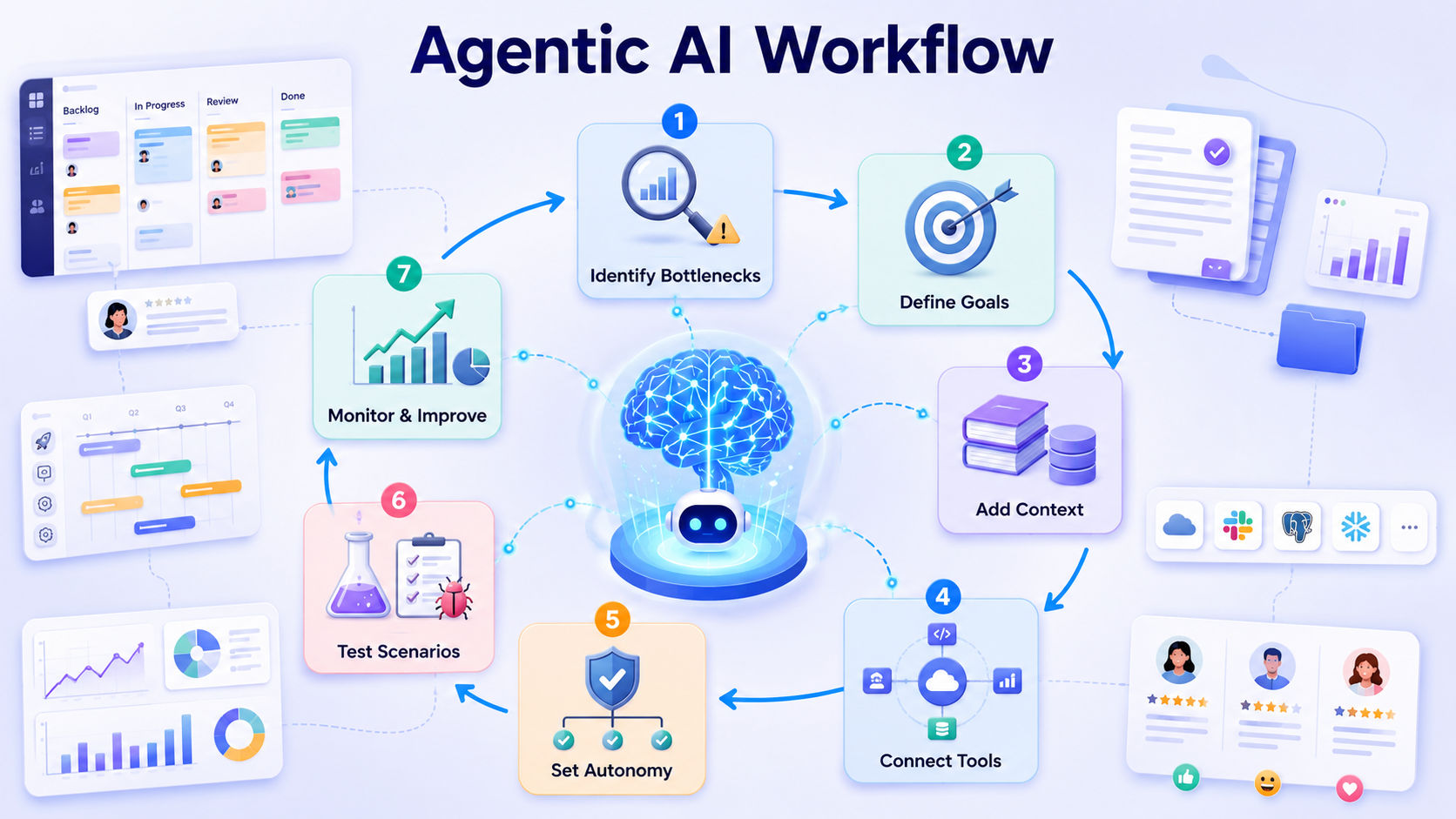
Step 1: Identify the Workflow Bottleneck
Look for areas involving:
- Repetitive manual work
- Constant context switching
- High-volume information processing
- Slow handoffs
- Recurring reporting
- Data synthesis
These are often the best candidates for an AI agent workflow.
Step 2: Define the Goal and Success Criteria
Vague instructions often lead to poor agent performance.
Every workflow should clearly specify:
- Goal
- Inputs
- Expected output
- Constraints
- Success criteria
- Escalation conditions
The more precise the objective, the more reliable the agent behavior becomes.
Step 3: Give the Agent the Right Context
Many organizations focus heavily on prompt engineering. In reality, context engineering often matters more.
Provide access to:
- Product documentation
- Customer research
- Analytics
- Roadmaps
- Requirements
- Business rules
- Team conventions
Better context generally leads to better outcomes.
Step 4: Connect the Agent to Tools
Agents become more valuable when connected to existing systems.
Common integrations include:
- Product management platforms
- Documentation systems
- Analytics tools
- CRM platforms
- Customer feedback tools
- Communication platforms
- Code repositories
Without tool access, most agents remain limited to conversation.
Step 5: Define Autonomy and Approval Levels
A practical maturity model is:
Observe → Recommend → Draft → Execute with Approval → Execute Automatically
Most product teams should begin at the observe or recommend stage before increasing autonomy.
Step 6: Test With Real Product Scenarios
Evaluate agent performance using:
- Normal cases
- Edge cases
- Missing information
- Conflicting data
- Incorrect inputs
- Sensitive requests
- Tool failures
Testing reveals weaknesses before they affect real workflows.
Step 7: Monitor and Improve
Track:
- Accuracy
- Completion rate
- Escalations
- Errors
- Cost
- Time saved
- Human intervention
- Business outcomes
Like any product feature, agent workflows require continuous improvement.
Product Managers looking to strengthen their AI foundation can explore upGrad KnowledgeHut Artificial Intelligence Courses and build skills relevant to today’s AI-powered workflows.
Best AI Agent Tools for Product Managers
The best AI agent tool depends on your product workflow, technology stack, security requirements, and desired level of autonomy.
While some teams start with general-purpose AI tools, others prefer specialized platforms designed specifically for product management.
1. General-Purpose Agent Platforms
General-purpose AI platforms can support research, analysis, writing, summarization, planning, and connected workflows.
Common options include:
- ChatGPT Agents
- Microsoft Copilot
- Gemini
- Claude
These platforms are ideal for teams that want to experiment with Agentic AI for Product Managers before investing in a specialized solution.
2. Product-Focused AI Platforms
Product-focused AI platforms are built around core product management activities, including:
- Product discovery
- Customer feedback analysis
- PRD creation
- User story generation
- Product planning
- Roadmap management
- Product analytics
These tools are often a good fit when the goal is to improve a specific product workflow rather than deploy a general-purpose AI agent.
3. Workflow and Orchestration Platforms
Workflow and orchestration platforms help teams connect AI models, business systems, data sources, and tools into a structured AI agent workflow.
They are useful when organizations need greater control over how agents access information, make recommendations, and execute tasks across multiple systems.
4. Internal Agent Frameworks
Organizations with strong technical capabilities may build internal AI agents using their own data, permissions, business rules, and product systems.
While this approach offers maximum flexibility and control, it also requires ongoing investment in security, governance, maintenance, monitoring, and evaluation.
What Are the Benefits of Agentic AI for Product Managers?
The value of Agentic AI for Product Managers extends beyond simple productivity gains.
1. Less Manual Product Operations
Agents can reduce time spent on:
- Documentation
- Summaries
- Reports
- Ticket creation
- Data compilation
This frees PMs from repetitive administrative work.
2. Faster Product Discovery
Agents can continuously process:
- Customer feedback
- Market research
- Competitor tracking
- Industry developments
Insights arrive faster because analysis occurs continuously rather than periodically.
3. Better Use of Product Data
Many organizations struggle with disconnected information.
Agents can connect signals across:
- Analytics
- Customer feedback
- CRM systems
- Research repositories
- Product documentation
This creates a more complete view of product performance.
4. Faster Decision Preparation
Instead of reviewing raw information, product managers receive synthesized findings. That means less time collecting evidence and more time evaluating strategic options.
5. More Time for Strategic Product Work
The goal is not simply efficiency.
The bigger opportunity is creating more time for:
- Product strategy
- Customer understanding
- Prioritization
- Stakeholder alignment
- Product vision
These activities remain fundamentally human-driven.
6. Continuous Product Intelligence
Unlike traditional reporting cycles, AI agents can monitor signals continuously.
This enables:
- Earlier issue detection
- Faster feedback loops
- Better visibility
- Ongoing learning
What Are the Challenges and Risks of Using AI Agents in Product Management?
Agentic AI can be powerful, but it should not be treated as a risk-free shortcut.
1. Hallucinations and incorrect recommendations
An agent can confidently produce an incorrect answer or recommendation. This becomes more serious when the agent has access to tools and can take action.
Important product decisions should have appropriate human review.
2. Context loss
An agent may miss important product history or business context if its information sources are incomplete.
A technically correct response can still be a poor product recommendation when the context is wrong.
3. Excessive autonomy
More autonomy creates more potential impact when something goes wrong.
An agent that only drafts a Jira ticket presents a different level of risk from one that can change a roadmap, modify production data, or send customer communications without approval.
4. Data privacy and security
Product teams may work with:
- Customer information
- Internal product data
- Proprietary strategy
- Business plans
- Access credentials
Agent permissions should therefore be limited to what is actually required for the workflow.
5. Bias in customer feedback analysis
AI agents may focus heavily on frequently mentioned issues. But the most frequent request is not always the most strategically important one.
A smaller group of high value customers may reveal a more important product problem than hundreds of low impact comments.
6. Tool and workflow failures
An agent may:
- Call the wrong tool
- Use outdated information
- Create duplicate work
- Get stuck in a loop
- Misinterpret a tool response
Testing and monitoring help reduce these problems.
7. Cost and token consumption
Agentic workflows can involve repeated model calls, tool calls, and large amounts of context processing.
As a result, the cost of an agent should be measured as an operational workflow cost, not simply as the subscription price of an AI tool.
8. Over automation
Automating a bad process does not make it a good process.
Before building an agent, Product Managers should first ask whether the underlying workflow is clear, useful, and worth automating.
Conclusion
Agentic AI helps Product Managers handle complex Product workflows with less manual effort and faster access to useful insights. From customer research and PRDs to prioritization, roadmaps, analytics, and product launches, AI agents can support work across the product lifecycle.
The key is to use AI for repetitive and data-heavy tasks while keeping humans in control of strategy and important decisions. With the right workflow, tools, context, and guardrails, Product Managers can use Agentic AI to spend more time on what matters most: building better products for their customers.
Have A Query? Get in Touch With Our Customer Support | KnowledgeHut
Frequently Asked Questions (FAQs)
How can a Product Manager start using Agentic AI without technical skills?
Product Managers do not need to become AI engineers to start using AI agents. Begin with simple workflows such as feedback analysis, meeting summaries, research monitoring, or PRD reviews using no-code or low-code tools. As you become comfortable, you can gradually explore more advanced agent workflows.
What skills do Product Managers need to work with AI agents?
Product Managers should understand how to define clear goals, provide useful context, evaluate AI output, and set appropriate approval rules. Basic knowledge of AI, data, APIs, automation, and prompt or context design can also help. Strong product judgment remains more important than coding ability.
How do you measure the ROI of Agentic AI in product management?
Start by measuring the time and effort spent on a workflow before introducing an agent. Then compare time saved, output quality, error rates, human review time, operating costs, and business impact after implementation. The goal is to determine whether the agent improves the workflow, not simply whether it produces more output.
Which product management tasks should not be given to AI agents?
Tasks involving major strategic decisions, sensitive customer situations, significant business trade-offs, or final product approval should generally retain strong human oversight. An agent can prepare evidence or recommendations, but the Product Manager should make decisions where context, judgment, and accountability matter most.
How can Product Managers prevent AI agents from using outdated product information?
Create a controlled source of truth and define which documents, databases, and systems the agent can use. Product information should also have clear ownership and review dates. Regularly checking the agent's sources can prevent old requirements, roadmaps, or business assumptions from influencing new recommendations.
How can Product Managers use AI agents for stakeholder communication?
An agent can turn product updates, meeting notes, metrics, and delivery information into different versions for executives, engineering teams, sales, or customer-facing teams. The PM can then review and adjust the message before sending it. This can make stakeholder communication faster without removing human context.
How can AI agents help Product Managers manage product documentation?
AI agents can help identify outdated documents, compare requirements across different sources, summarize changes, and prepare documentation updates. This is particularly useful when product information is spread across several tools. A review step is still important before changes become the official source of truth.
How can Product Managers create a good AI agent workflow for customer feedback?
Start by deciding exactly what you want the agent to find, such as recurring complaints, feature requests, or differences between customer segments. Then define the feedback sources, categories, output format, and situations that require human review. This makes the workflow much more useful than simply asking an agent to “analyze feedback.”
How can Product Managers make AI agent outputs more reliable?
Give the agent clear instructions, trusted context, defined output formats, and specific rules for when it should ask for human input. Test it against real examples, including incomplete and conflicting information. Regular evaluation is important because an agent that works well in one workflow may perform poorly in another.
How will Agentic AI change the Product Manager role?
Agentic AI is likely to reduce some repetitive research, documentation, analysis, and coordination work while increasing the importance of strategic thinking. Product Managers may spend more time interpreting evidence, understanding customers, making trade-offs, and guiding AI-supported workflows. The role is likely to shift toward managing both products and intelligent systems that support them.
1639 articles published
KnowledgeHut is an outcome-focused global ed-tech company. We help organizations and professionals unlock excellence through skills development. We offer training solutions under the people and proces...
Get Free Consultation
By submitting, I accept the T&C and
Privacy Policy