
- Home
- Blog
- Artificial Intelligence
- How to Build an AI Product Roadmap: A Practical Guide for PMs
How to Build an AI Product Roadmap: A Practical Guide for PMs
Updated on Jul 28, 2026 | 219 views
Share:
Table of Contents
View all
Quick Overview
- Building an AI product roadmap requires a flexible, outcome-driven approach that accounts for data readiness, model performance, experimentation, and continuous learning.
- Traditional product roadmaps usually follow defined features, predictable timelines, and structured delivery plans.
- AI product roadmaps involve more uncertainty, as outcomes depend on data quality, model performance, and real-world user behaviour.
- Rather than following a fixed “build, launch, and move on” cycle, AI products need ongoing testing, evaluation, feedback, and optimisation.
- This guide explains how to build an AI product roadmap step by step, from defining the business problem and assessing data readiness to prioritising initiatives, setting milestones, and measuring success.
Strengthen AI product roadmap planning skills with the upGrad KnowledgeHut AI Product Management Course, covering practical AI product management concepts.
What Is an AI Product Roadmap?
An AI product roadmap is a strategic plan that shows how an AI-powered product will grow over time. It aligns business goals, AI capabilities, customer needs, and product development into a clear plan.
Unlike a traditional product roadmap, an AI product roadmap also includes:
- Data collection and preparation
- AI model development
- Model testing and performance evaluation
- Infrastructure improvements
- User adoption goals
- AI governance and compliance
- A plan for monitoring and retraining after launch
Why AI Product Roadmaps Are Different from Traditional Roadmaps
The biggest difference between a traditional product roadmap and an AI product roadmap is uncertainty.
In a traditional product, the process is usually clear and predictable. Product managers gather requirements, plan features, build them, test them, and then release them. Most of the work follows a fixed plan.
AI products are different. The final results depend on data, model performance, and user behavior, which can change over time. Because of this, teams need to keep testing, learning, and improving even after the product is launched.
Traditional Product Roadmap |
AI Product Roadmap |
| Focuses on building features | Focuses on solving user problems and achieving outcomes |
| Follows fixed development timelines | Uses flexible timelines based on experiments and learning |
| Requirements are mostly clear from the start | Requirements change as the team learns more |
| Success is measured by delivering features | Success is measured by model performance and user impact |
| Testing happens before launch | Testing and improvements continue after launch |
Also Read: How to Present Product Roadmaps to Leadership Teams
Step by Step Process to Build an AI Product Roadmap
Building an AI product roadmap is easier when it is broken into clear stages. Here is a practical, step by step process product managers can follow.
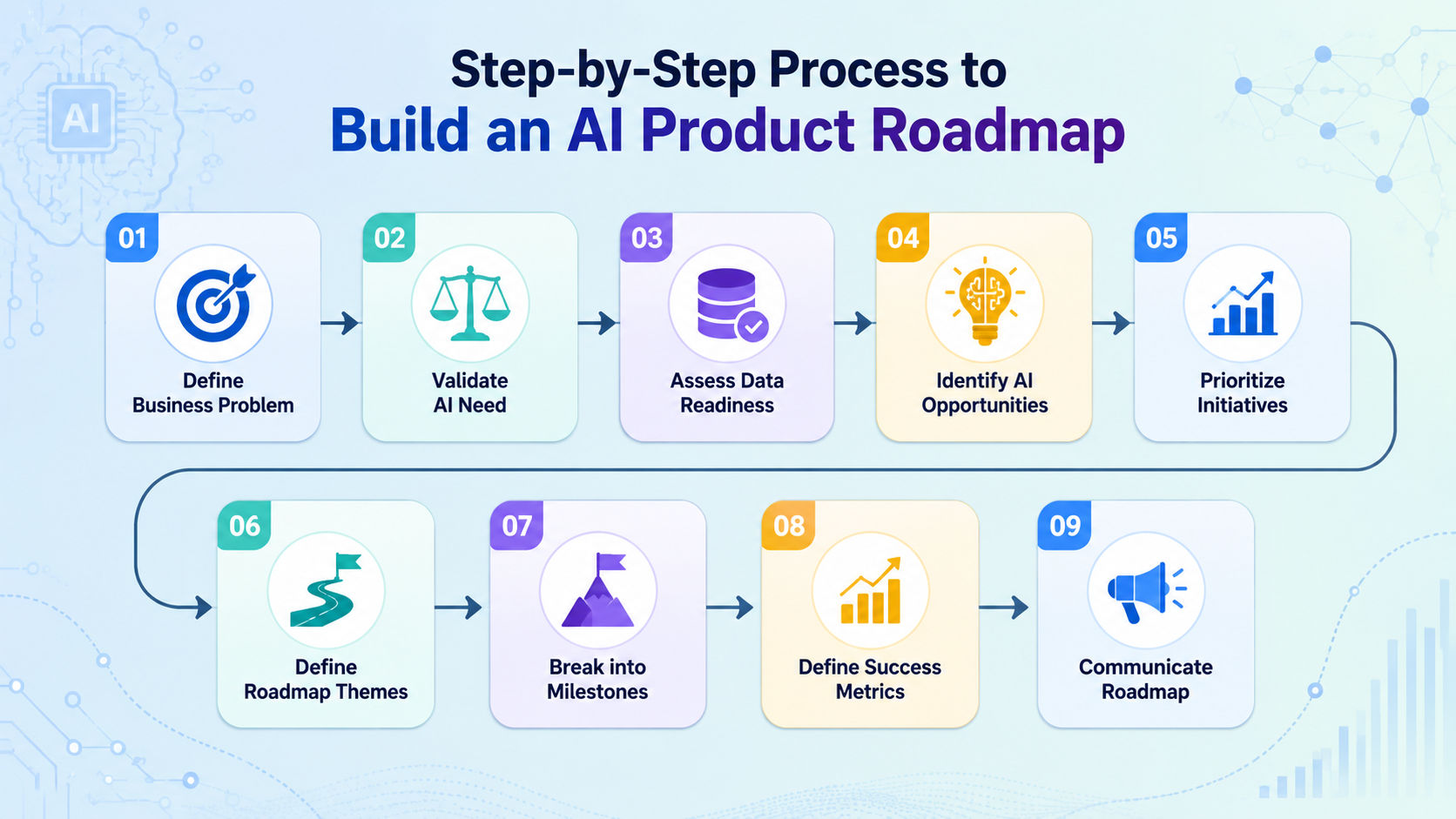
Step 1: Define the Business Problem
Before anything else, get specific about the actual business problem, not the feature. Instead of starting with "build a recommendation engine," start with the gap it needs to close, such as low repeat purchase rates or slow customer support resolution.
This problem statement becomes the anchor for every decision that follows in the roadmap.
Step 2: Validate Whether AI Is the Right Solution
Not every business problem needs an AI solution. Before committing resources, check whether a simpler rule-based system, a workflow change, or an existing tool could solve the same problem faster and cheaper.
AI should be chosen because it is genuinely the best fit, such as when patterns in data are too complex for fixed rules, not because it is trending.
Step 3: Assess Data Readiness
This step often gets skipped, and it is usually the reason AI projects fall behind schedule. Before setting any dates, the team should check: there is enough data, is it labeled correctly, is it recent enough to reflect current behavior, and is it free of major bias or gaps.
If the data is not ready, the roadmap should say so plainly instead of hiding it behind an optimistic timeline.
Step 4: Identify AI Opportunities
Once the problem is validated and the data situation is clear, map out where AI can realistically create value. This might include several possible use cases within the same problem area.
Listing them out helps the team see the full range of options before narrowing down to what actually goes on the roadmap.
Step 5: Prioritize AI Initiatives
With a list of possible opportunities in hand, rank them by business impact, data readiness, and technical feasibility. An initiative with high potential impact but poor data readiness should usually wait behind one with a smaller impact but a clear, ready path to execution. This keeps the roadmap grounded in what can actually be delivered.
Step 6: Define Roadmap Themes
Rather than listing individual AI features in isolation, group-related initiatives under broader themes, such as personalization, automation, or forecasting.
Themes make the roadmap easier to communicate and help stakeholders see the bigger strategic direction instead of a scattered list of projects.
Step 7: Break Initiatives into Milestones
Each prioritized initiative should be broken into smaller milestones, such as data collection, model development, internal testing, pilot rollout, and general availability.
Breaking work into milestones makes progress visible and creates natural checkpoints for reviewing whether the initiative should continue as planned.
Step 8: Define Success Metrics
Every initiative on the roadmap needs clear success metrics agreed upon before development starts. These should include both model level metrics, such as accuracy or error rate, and business level metrics, such as conversion lift or resolution time reduction.
Metrics defined upfront prevent disagreements later about whether an AI feature is actually working.
Step 9: Communicate the Roadmap
Once the roadmap is built, it needs to be shared in a way stakeholders across the business can understand. This means using ranges and confidence levels instead of exact delivery dates, explaining the reasoning behind prioritization, and being transparent about which initiatives depend on data or platform work that is still in progress.
Clear communication protects the credibility of the product manager and sets realistic expectations across the business.
Strengthen your AI knowledge with upGrad KnowledgeHut Artificial Intelligence Courses and learn how AI concepts can support smarter product decisions and roadmap planning.
Tools for Building AI Product Roadmaps
Choosing the right roadmap tool helps Product Managers turn AI ideas into clear and actionable plans.
The best tool depends on team size, working style, collaboration needs, and the level of connection required with development and AI experimentation platforms.
Productboard
It is a great choice for product teams that build roadmaps based on customer feedback. It helps prioritize features, collect user insights, plan product development, and create roadmaps that focus on business outcomes.
Aha!
It is best for teams that need strong strategic planning. It helps define goals, manage initiatives, create product roadmaps, and plan across multiple products or projects.
Jira Product Discovery
It works well for agile teams that collaborate closely with engineering. It helps prioritize ideas, manage product discovery, align stakeholders, and integrates smoothly with Jira for development tracking.
Notion
It is a popular option for startups and small AI teams. It provides a flexible workspace for documentation, project planning, databases, meeting notes, and team collaboration.
Miro
It is ideal for teams that prefer visual planning. It supports brainstorming sessions, roadmap workshops, user journey mapping, and collaboration across different departments.
Confluence
It is widely used by large organizations for documentation and knowledge sharing. It helps teams create product requirements, maintain project documentation, and collaborate effectively in one central place.
Also Read: AI Tools for Product Launch Planning
Common Challenges and How to Overcome Them
Even a well-planned AI product roadmap can face challenges. The good news is that most of these problems can be managed with the right planning and approach.
Challenge 1: Poor Data Quality
Problem:
The data may be incomplete, inconsistent, outdated, or biased. Poor-quality data leads to poor AI results.
Solution:
Focus on data quality from the beginning. Set up proper data governance, clean the data regularly, and create reliable data labeling processes before building AI models.
Challenge 2: Unrealistic Stakeholder Expectations
Problem:
Stakeholders may expect AI to deliver perfect results or show immediate business impact.
Solution:
Set realistic expectations from the start. Explain that AI involves experimentation and continuous improvement. Be open to possible risks, expected outcomes, and confidence levels.
Challenge 3: Model Drift
Problem:
AI models can become less accurate over time as customer behavior, market conditions, or data patterns change.
Solution:
Monitor model performance regularly and retrain the model with updated data whenever needed to keep it accurate and reliable.
Also Read: What is Model Drift and Why Does It Matters?
Challenge 4: Low User Adoption
Problem:
People may not trust AI recommendations or may hesitate to use AI-powered features.
Solution:
Make AI decisions easier to understand. Improve transparency, explain how recommendations are made, and include human review where needed to build user confidence.
Challenge 5: Compliance and Privacy Risks
Problem:
AI systems can create legal, regulatory, or privacy issues if they are not managed properly.
Solution:
Include compliance and privacy checks throughout the roadmap. Don't leave them until the end of the project. Regular reviews help reduce risks and keep the product aligned with legal requirements.
Also Read: How To Use ChatGPT for Product Roadmapping
AI Product Roadmap Best Practices
Following a process is only half the work. These best practices help product managers keep an AI product roadmap realistic and useful long after the first draft is done.
1. Start with the problem, not the technology
An AI product roadmap holds up better when every initiative traces back to a clear business problem, rather than starting from a model or technology the team wants to try.
2. Treat AI as one possible solution, not the default one
Before an initiative earns a place on the roadmap, it should be checked against simpler alternatives. This keeps the roadmap focused on genuine AI opportunities instead of AI for its own sake.
3. Audit data before setting any dates
Data readiness should be assessed honestly at the start of every initiative, not assumed. This single habit prevents most of the delays that show up later in AI projects.
4. Prioritize with more than one lens
Business impact alone is not enough. Data readiness and technical feasibility need equal weight when deciding what goes on the roadmap first.
5. Group work into themes, not scattered features
Organizing initiatives under broader themes makes the roadmap easier to explain to leadership and easier to adjust as priorities shift.
6. Keep milestones visible and reviewable
Breaking each initiative into milestones creates natural checkpoints where the team can confirm the initiative is still worth pursuing or pause it if the data or results say otherwise.
7. Define success metrics before development starts
Agreeing on model level and business level metrics upfront avoids disputes later about whether an AI feature is actually delivering value.
8. Communicate in ranges, not fixed promises
Sharing timelines as ranges backed by checkpoints protects the credibility of the product manager and sets realistic expectations across the business.
9. Revisit the roadmap regularly
An AI product roadmap is not a one-time document. As data, model performance, and business priorities shift, the roadmap should be reviewed and adjusted rather than treated as fixed.
Also Read: 10 Tips for Creating an Agile Product Roadmap
Conclusion
Building an AI product roadmap works best when it treats uncertainty as part of the plan, not something to hide from stakeholders. A clear business problem, honest data readiness checks, staged rollout, and defined success metrics keep the roadmap grounded in reality rather than guesswork.
Product managers who follow this structured process tend to ship AI initiatives that hold up well after launch, instead of ones that stall once real data hits.
Have A Query? Get in Touch With Our Customer Support | upGrad KnowledgeHut
Frequently Asked Questions (FAQs)
How often should an AI product roadmap be updated?
There isn't a fixed schedule but reviewing the roadmap every quarter is a good practice. It should also be updated whenever there are major changes in customer feedback, business priorities, data quality, or AI model performance. The goal is to keep it relevant rather than rigid.
Who should be involved in creating an AI product roadmap?
An AI product roadmap works best when it's built collaboratively. Product Managers should work closely with data scientists, ML engineers, designers, business stakeholders, and customer-facing teams. Bringing different perspectives together helps create a roadmap that is both technically feasible and customer-focused.
What tools can Product Managers use to create an AI product roadmap?
Many teams use tools like Jira, Productboard, Aha!, Miro, Notion, or Trello to plan and manage AI roadmaps. The right tool depends on your team's workflow, but the focus should always remain on tracking outcomes, experiments, and dependencies rather than just features.
How is an AI product roadmap different from an AI project plan?
An AI product roadmap outlines the long-term vision, priorities, and business goals for the product. An AI project plan, on the other hand, focuses on the detailed execution of a specific initiative, including tasks, timelines, resources, and deliverables. Both are important, but they serve different purposes.
What mistakes should Product Managers avoid when building an AI product roadmap?
One of the biggest mistakes is starting with an AI solution instead of a customer problem. Other common pitfalls include ignoring data quality, setting unrealistic expectations, overlooking ethical considerations, and treating the roadmap as a fixed document instead of updating it as new insights emerge.
How can startups build an AI product roadmap with limited resources?
Startups should begin with one high-impact AI use case instead of trying to solve multiple problems at once. Using pre-trained AI models or existing AI platforms can reduce development costs and speed up validation before investing in custom solutions.
How do you estimate timelines for AI roadmap initiatives?
Unlike traditional software projects, AI development often involves experimentation, making timelines less predictable. Instead of committing to exact release dates, it's better to estimate milestones such as prototype completion, pilot testing, and production readiness.
What role does customer feedback play in an AI product roadmap?
Customer feedback helps validate whether AI features are actually solving user problems. It also highlights areas where the model may need improvement, making feedback an essential part of roadmap updates and future prioritization.
Should every AI feature have measurable success criteria?
Yes. Every AI initiative should have clear success metrics before development begins. These metrics could include business outcomes, user adoption, model performance, or operational improvements, depending on the objective of the feature.
What skills does a Product Manager need to build an AI product roadmap?
A Product Manager doesn't need to become a machine learning engineer, but understanding AI fundamentals, data concepts, product strategy, customer research, prioritization frameworks, and experimentation techniques can make roadmap planning much more effective.
1639 articles published
KnowledgeHut is an outcome-focused global ed-tech company. We help organizations and professionals unlock excellence through skills development. We offer training solutions under the people and proces...
Get Free Consultation
By submitting, I accept the T&C and
Privacy Policy