
How to Prepare for Product Manager Interview in 2026 + Tips
Updated on Sep 14, 2026 | 11 min read | 6.03K+ views
Share:
Table of Contents
View all
- Product Manager interview preparation roadmap for 2026
- What's different about Product Manager interviews in 2026?
- How to prepare for the most common Product Manager interview question types
- Product Manager interview frameworks that are still relevant in 2026
- 30 Day Product Manager interview preparation plan
- Product Manager interview tips to stand out in 2026
- Conclusion
Quick Overview
- Product Manager Interview Preparation in 2026 should cover company research, interview frameworks, product sense, strategy, metrics, behavioral stories, and mock interviews.
- Research the company’s product, customers, business model, competitors, and recent updates, then understand the interview rounds you are likely to face.
- Practise product sense, strategy, execution, analytical, and behavioral questions using frameworks such as CIRCLES, AARM, RICE, SWOT, and STAR without memorizing them as fixed answers.
- Prepare for 2026 interview trends by strengthening AI product knowledge, data driven decision making, structured thinking, end to end ownership, and leadership skills, followed by realistic mock interviews.
- In this guide, you will learn the 7-step Product Manager Interview Preparation roadmap, 2026 interview changes, common question types, key frameworks, a 30-day preparation plan, and practical tips to stand out.
Ready to sharpen your product management skills and stand out in PM interviews? Explore upGrad KnowledgeHut SAFe Product Manager/Product Owner training to build practical, industry-relevant skills.
Master the Right Skills & Boost Your Career
Avail your free 1:1 mentorship session
Product Manager interview preparation roadmap for 2026
Following a step-by-step roadmap will allow you to be better prepared and confident while going through the process of interview.
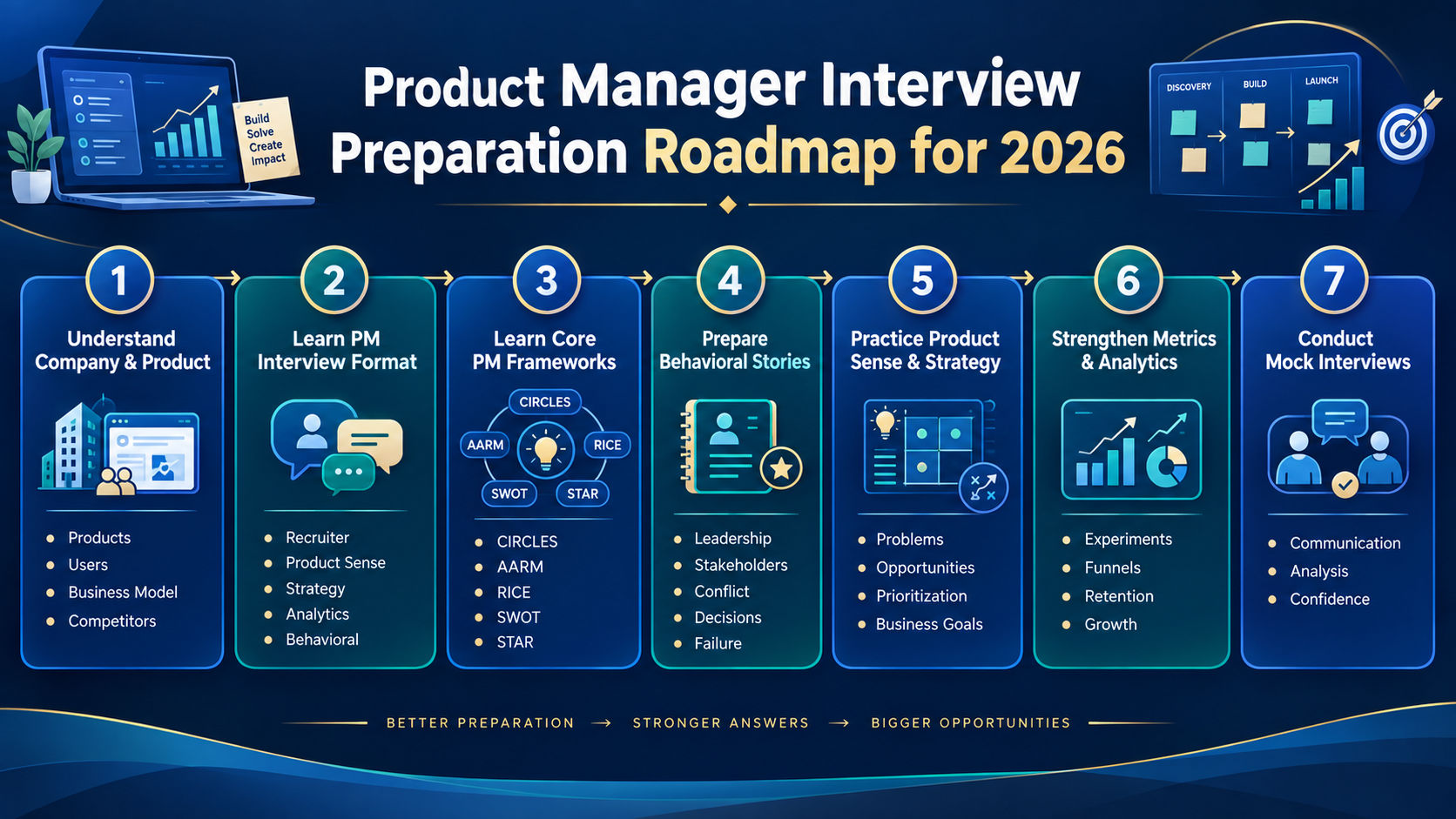
Step 1: Understand the company and its product
The first step involves researching the company's products, users, business model, competitors, and any changes that have recently occurred at the company. It is expected from a candidate to have some background knowledge about the company he or she is applying to.
You need to look at the product from the perspective of the user and analyze any potential areas for improvement.
Step 2: Learn the PM interview format
There are typically several rounds of Product Manager interviews which aim at testing different qualities of candidates. Be familiar with the typical stages, like recruiter screening, product sense interviews, strategic discussions, analytics round, and behavioral interview rounds.
Step 3: Learn core PM interview frameworks
Using frameworks allows you to structure your thoughts and provide a well-thought-out answer to the question. As part of your Product Manager Interview Preparation, learn the most frequently used frameworks for designing, prioritizing, strategizing, measuring and answering behavioral questions.
Step 4: Prepare Behavioral Stories
Interviewers use behavioral interviews quite often to evaluate PMs. Prepare some stories that show your skills in leadership, stakeholder management, conflict resolution, decision-making, and dealing with failures.
It will be useful for you to have several behavioral stories to answer questions about your experience.
Step 5: Practice product sense and strategy
Product sense & strategy are among the most frequent interview topics. Prepare yourself to talk about problem identification, opportunity assessment, solution prioritization, and connecting your recommendations to the company's business objectives.
Step 6: Strengthen metrics and analytical thinking
Metrics and analysis are the part of the PM role where a lot of decisions are made based on data. Study important product metrics, analysis of experiments, funnel metrics, retention metrics, and growth metrics.
It is important for you to feel confident about talking about how to measure success and analyze product performance.
Step 7: Conduct mock interviews
Mock interviews are an essential part of any Preparation for Product Manager Interview. Mock interviews will help you to improve your communication, analytical skills, and confidence.
Also Read: How to Become a Product Manager
What's different about Product Manager interviews in 2026?
Product Manager Interview Preparation today looks different from a few years ago. Several shifts stand out, and understanding them is one of the more important product manager interview tips for anyone applying this year.
AI Product knowledge is becoming more important
As AI becomes an important component of many products, interviewers are assessing the ability of candidates to demonstrate their understanding of how AI helps to add value for users and companies. The following topics are expected to be covered during interviews:
- The usage of AI features and products
- The evaluation of trade-offs, risks, and impact of AI on users
- Collaboration with AI-assisted product development
Greater focus on data driven decision making
Product Manager candidates should be able to base their decisions on data instead of going only by gut feel. This means that during the interview process, interviewers may test you on the metrics for success, a steep fall in performance, and what action you would take when the data available is insufficient.
Companies are testing structured thinking over memorized frameworks
While CIRCLES, RICE, and STAR frameworks are relevant, interviewers don’t want to see candidates who are simply rote memorizers of frameworks. They want to see how you can structure your thinking on problems that aren’t familiar.
More emphasis on end to end product ownership
Questions about end to end product ownership are becoming more common during interviews. Prepare to talk about your process of managing products from idea through launch and analysis.
Behavioral interviews carry more weight
Behavioral interviews are now becoming more about leadership in the absence of power, conflicts with stakeholders, difficult decisions, failure, and influence of cross-functional teams. Great answers will describe what you did, the reasons why, and what the measurable results were.
Also Read: Product Manager Salary in India
How to prepare for the most common Product Manager interview question types
Through practice of each type of question, you will gain more confidence and know how to answer them better. The below types of questions cover all the important areas that you need to consider for your Product Manager Interview Preparation.
Product sense questions
Product sense questions measure your knowledge of customer needs, problem identification, and the creation of solutions to those problems.
Examples:
- Develop a product for remote workers.
- What changes would you make to Spotify?
- Develop a product for first-time smartphone users.
Start with the identification of the target user and their primary pain point. Then describe the problem, list down a couple of solutions, prioritize one solution and outline the way of measuring it.
Preparation approach: Try to focus on a particular customer instead of solving a problem for everybody. Explain the importance of the problem before talking about features.
Product strategy questions
Product strategy interview questions evaluate the connection of product strategies with business objectives, the environment and competition.
Examples:
- How would you make Uber grow?
- Is Netflix ready to enter a new market?
- How would you increase the market share of a product?
Start by identifying what the business objective is. Identify the target market, customers, competition, current positioning of the product, and growth opportunities. Conclude by identifying the suggested strategy and outlining the risks and trade-offs of that strategy.
Preparation approach: Research the business model of the company and product decisions taken by the company recently. This will allow you to provide more specific and practical answers.
Product execution questions
Execution questions evaluate your response to the situation that occurred after the launch of the product or feature.
Example:
- There was a sharp decrease in adoption of the feature. What would you do?
Don't rush to change the feature right away. First evaluate the time when the issue appeared, the group of users affected, if there was any consistency across platforms/regions, and if there were changes to the product recently. Identify possible reasons, data needed and the next step.
Preparation approach: Practice root cause analysis through realistic product scenarios. Start with asking questions and then find solutions.
Metrics and Analytical Questions
These questions evaluate your ability to understand product performance by analyzing data and making decisions based on it.
Example:
- What metrics will you use to measure performance of Instagram Stories?
The first step is to define the product goal and user behavior that is required to measure. Based on that, choose metrics that could be adoption, engagement, retention, completion rate, and conversion rate.
Preparation approach: Choose five widely used products and define their main goal, one primary metric, additional metrics, and causes of the changes in their performance.
Behavioral Questions
These questions help an interviewer understand your approach towards people and conflicts and making decisions.
Examples:
- Describe a conflict with stakeholders.
- Tell me about a wrong product decision that you have made.
- Describe a situation when you influenced the team not being its leader.
Apply the STAR framework (Situation, Task, Action, and Result). Make sure you focus on yourself and your actions, thinking process behind the decision, and results.
Preparation approach: Prepare six to eight stories describing your experience in leadership, conflicts, failures, prioritizations, working with stakeholders, and positive outcomes.
Also Read: Product Manager vs Scrum Master
Product Manager interview frameworks that are still relevant in 2026
The frameworks are still very helpful during Product Manager interview preparation; however, they should assist you in forming your thoughts, not vice versa.
CIRCLES framework for product design
CIRCLES assists in structuring the answer related to the product design in the following order: Understanding the situation, identifying the users, reporting their needs, cutting through options, listing the solutions, evaluating them and summing up.
AARM framework for metrics
AARM is a framework that can assist in structuring answers to metric questions. However, the problem is much more important here than applying this sequence to all questions automatically.
RICE framework for prioritization
RICE takes into account four components: Reach, Impact, Confidence, and Effort. RICE will be helpful when you need to make a comparison between multiple product ideas having limited resources.
SWOT framework for strategy questions
SWOT analyses Strengths, Weaknesses, Opportunities and Threats. The SWOT framework will help you in structuring thoughts related to market or competition.
STAR method for behavioral questions
STAR method is Situation, Task, Action and Result. In any case, try to keep the Action part related to your personal activity and make sure the Result is measurable.
Also Read: SAFe Product Manager vs Product Owner: Top Key Differences
30 Day Product Manager interview preparation plan
A 30-day schedule helps Product Manager Interview Preparation become easier and allows you to avoid cramming before an interview.
Days 1 to 7: Understand the company and role
Study the company, product, customers, competition, business model, and job responsibilities. Make a list of questions that you might be asked according to your job.
Days 8 to 14: Build framework fluency
Find out about the frameworks you will use and practice using each framework to solve a problem instead of memorizing definitions.
Days 15 to 21: Practice question categories
Split your practice into product sense, strategy, execution, metrics, and behavioral categories. Try answering questions out loud and identifying where you have difficulties understanding a question.
Days 22 to 27: Complete mock interviews
Conduct several mock interviews. Do it in conditions close to real life and get detailed feedback on structure, communication, prioritization, and decision-making skills.
Days 28 to 30: Final revision and confidence building
Recap your company research, behavioral stories, key metrics, frameworks, and your weaknesses. Don't try to study everything during the final three days.
Want to build stronger Agile skills and become more confident in Product and Project Management roles? Explore upGrad KnowledgeHut Agile Management Courses and find the right path for your career.
Product Manager interview tips to stand out in 2026
These tips for your product manager interview will help you make a bigger impact after all the preparations are completed.
Show customer-centric thinking
Always begin by showing knowledge of the customer when you suggest the feature or the solution. Provide details about the user persona, the issue, and reasons for solving this particular problem. It will prove that your suggestions are grounded in customer needs and not in assumptions.
Provide quantitative measures for impacts
Use quantitative measures as much as possible. For example, instead of saying that the suggested change “increased engagement” of users, demonstrate how it influenced retention rates, conversion, sales, or other metrics. Even when you cannot provide exact figures, provide details on how to measure success.
Provide structured problem-solving approach
Try to break down complicated questions into smaller pieces. List out your assumptions, identify the main issue, come up with several possible solutions, and give reasons for choosing one particular approach. The process of reasoning may sometimes be even more important than the result.
Describe the trade-offs clearly
Decisions relating to product design are generally subject to conflicting requirements. To make your recommendation, describe the trade-off by stating which requirement you would prioritize, which one you would defer, and which one you might sacrifice. This would show that you have comprehended the nature of the trade-offs involved in the process.
Relate your answer to a business outcome
Avoid concentrating only on the features and users. Relate your recommendation to a business objective such as retaining customers, growing revenue, cutting costs, or entering a new market. This will help in showing your understanding of the wider role of a Product Manager.
Prepare for product conversations involving AI
For 2026, be ready for conversations involving the use of AI to enhance the products and user experience. The conversation might also include discussions about accuracy, privacy, cost, bias, reliability, and user trust. You don't need to be an AI engineer; however, you should comprehend the impact of using AI on the product.
Also Read: A Successful Product Manager Career Path: Complete Guide
Conclusion
A strong Product Manager Interview Preparation plan should cover more than frameworks and commonly asked questions. Start by researching the company and product, then build skills in product sense, strategy, metrics, behavioral storytelling, and structured problem solving.
In 2026, add AI product knowledge and practise explaining trade offs using data and measurable outcomes. Finish with timed mock interviews so you can identify weak areas and improve before the actual interview.
Have A Query? Get in Touch With Our Customer Support | upGrad KnowledgeHut
Frequently Asked Questions (FAQs)
1. What is different about PM interviews in 2026?
PM interviews in 2026 place more emphasis on AI awareness, data driven decisions, structured thinking, and end to end product ownership. Interviewers want candidates to explain their reasoning, handle trade offs, and connect product decisions to customer and business outcomes. Behavioral and cross functional skills are also becoming more important.
2. Are AI related questions asked in Product Manager interviews?
Yes, AI related questions are increasingly included in Product Manager interviews, especially for roles involving AI powered products. You may be asked to evaluate an AI feature, identify use cases, or discuss risks such as accuracy, privacy, cost, and user trust. Basic understanding of how AI affects product decisions can help you stand out.
3. What skills are companies prioritizing when hiring PMs?
Companies are prioritizing product thinking, customer empathy, data analysis, strategic decision making, prioritization, and stakeholder management. Strong communication and leadership without authority are also important because PMs work across multiple teams. For many roles, companies also value technical understanding and the ability to work effectively with AI powered products.
4. How many rounds are there in a Product Manager interview?
A Product Manager interview usually has 4 to 7 rounds, depending on the company, role, and seniority. Common rounds include recruiter screening, hiring manager, product sense, strategy, execution and analytics, behavioral, and a final panel. Senior PM roles may include additional leadership or cross functional rounds.
5. How technical does a Product Manager need to be?
A Product Manager needs enough technical knowledge to discuss APIs, databases, system constraints, technical feasibility, and engineering trade offs. The required depth depends on the role. Technical Product Manager roles usually require deeper knowledge than generalist PM positions.
6. How long does it take to prepare for a Product Manager interview?
Most candidates can build focused preparation in 2 to 4 weeks with regular daily practice. Use the first week for company research and frameworks, the second for question practice, and the remaining time for mock interviews and weak areas. Candidates changing careers may need additional preparation for product fundamentals.
7. How can I prepare for a Product Manager interview with no PM experience?
Use examples from previous roles to demonstrate customer understanding, problem solving, prioritization, stakeholder management, and measurable results. Practise product sense, strategy, metrics, and behavioral questions, and connect your past experience to PM responsibilities. Build a few detailed stories that show how you made decisions and influenced others.
8. Do Product Manager interviews require technical knowledge?
Yes, most PM interviews expect some level of technical understanding, but they generally do not require software engineering expertise. You should understand concepts such as APIs, databases, system limitations, data, and technical trade offs. The depth required depends on the product and the specific PM role.
9. What are the most common Product Manager interview questions?
Common questions cover product design, product strategy, execution, metrics, prioritization, and behavioral situations. Examples include “How would you improve Spotify?”, “How would you grow Uber?”, “Why did a key metric drop?”, and “Tell me about a conflict with a stakeholder.” The exact mix depends on the company and role.
10. What should I research before a Product Manager interview?
Research the company's products, target customers, business model, competitors, recent launches, and major product challenges. Use the product yourself if possible and identify specific strengths and weaknesses. Also study the job description to understand the skills and responsibilities the interview will focus on.
1639 articles published
KnowledgeHut is an outcome-focused global ed-tech company. We help organizations and professionals unlock excellence through skills development. We offer training solutions under the people and proces...
Get Free Consultation
By submitting, I accept the T&C and
Privacy Policy
Ready to learn about Agile Certifications Roadmap?