
- Home
- Blog
- Artificial Intelligence
- What is Agentic AI? Complete Beginner's Guide for 2026
What is Agentic AI? Complete Beginner's Guide for 2026
Updated on Jul 30, 2026 | 207 views
Share:
Table of Contents
View all
- What is Agentic AI and How Does Agentic AI Work?
- Key Components of Agentic AI
- Agentic AI vs Generative AI vs AI Agents
- Real-World Examples of Agentic AI
- Benefits of Agentic AI
- Challenges and Limitations of Agentic AI
- Popular Agentic AI Frameworks and Tools
- How to Start Learning Agentic AI?
- The Future of Agentic AI
- Conclusion
Quick Overview
- Agentic AI is a type of artificial intelligence that can independently plan, reason, make decisions, use tools, and complete multi-step tasks to achieve a goal with minimal human input.
- Agentic AI uses key components such as reasoning, planning, persistent memory, and external tool integration to execute tasks intelligently and adapt to changing situations.
- Unlike traditional AI or standard chatbots that only respond to prompts, Agentic AI can take actions, manage workflows, and complete tasks autonomously while using feedback to improve results.
- This blog explains what Agentic AI is, how it works, its core components, and how it compares with Generative AI and AI Agents.
- You'll also learn about real-world use cases, benefits, challenges, popular Agentic AI frameworks, learning resources, and the future of Agentic AI.
Want to build intelligent AI systems? Enroll in the Applied Agentic AI Certification to develop practical, job-ready skills.
What is Agentic AI and How Does Agentic AI Work?
Artificial intelligence has rapidly moved from an experimental technology to a core business capability. Today, 88% of organizations use AI in at least one business function, demonstrating how quickly AI has become part of mainstream operations. As AI adoption matures, businesses are no longer looking for systems that simply generate content, they increasingly want AI that can make decisions, take actions, and complete tasks autonomously.
That's really what "agentic" comes down to: having agency. It's about being able to act independently and make your own calls. Older AI systems just took an input and spit out an output, nothing more. Agentic AI actually decides what to do next, which tools to reach for, and when a task is genuinely finished.
This shift is already underway. Nearly 62% of organizations are experimenting with AI agents, signaling a clear move beyond traditional generative AI tools toward systems that can act more independently. As organizations seek greater automation and productivity, Agentic AI is emerging as the next phase of AI evolution.
How Does Agentic AI Work?
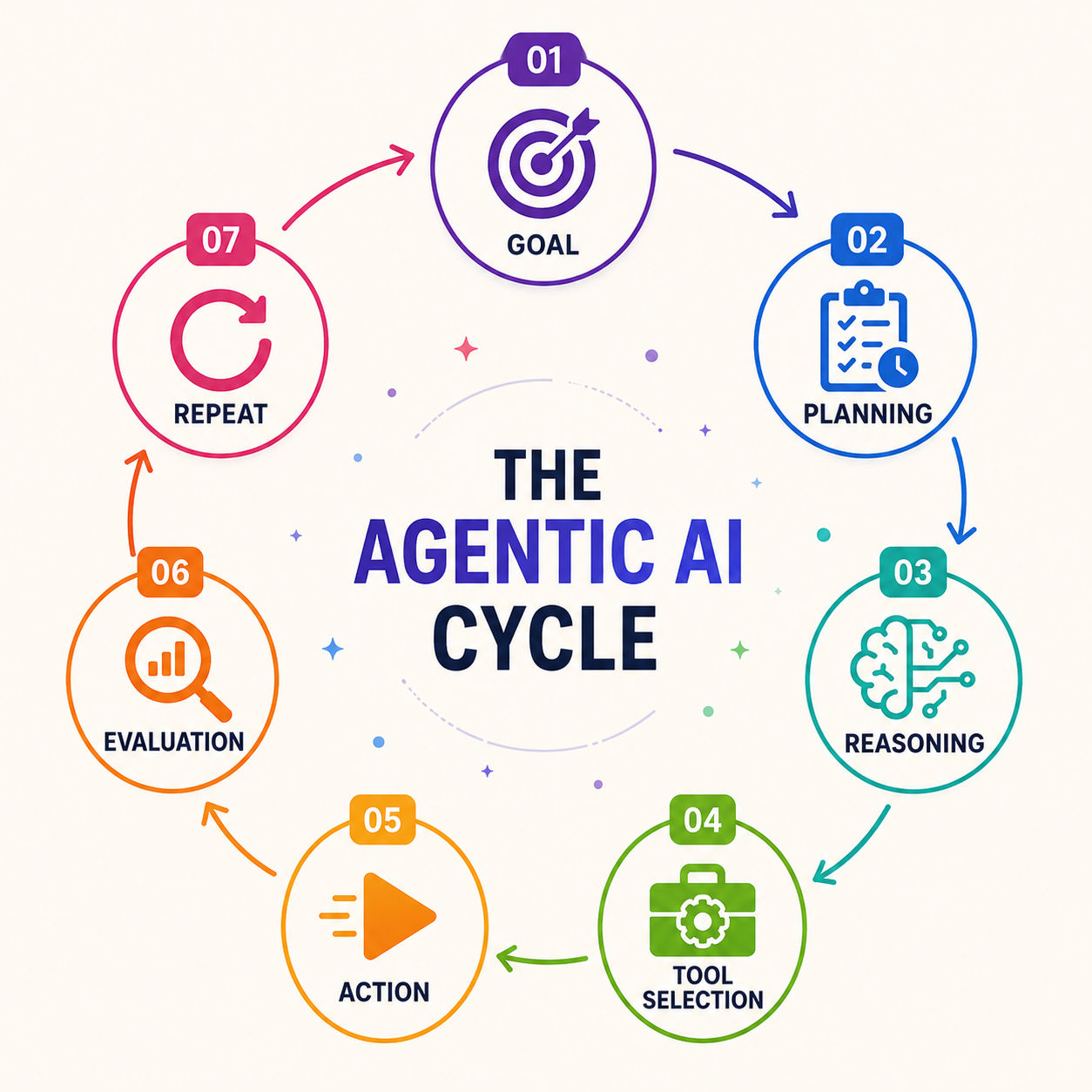
Agentic AI systems generally follow a repeatable workflow. Here's what happens under the hood.
Step 1 - Understand the Goal
It starts with you. You provide an objective, not a single instruction, but a broader outcome you want achieved.
Step 2 - Planning
The AI breaks that objective down into smaller, manageable subtasks. This is where a "plan" starts to take shape, a sequence of steps needed to reach the goal.
Step 3 - Reasoning
For each step, the AI evaluates its options. It weighs different possible actions and chooses the one most likely to move it closer to the goal.
Step 4 - Tool Usage
This is where Agentic AI stands apart from a plain chatbot. It can reach outside itself and use real tools, including:
- APIs
- Search engines
- Databases
- Code execution environments
- CRM systems
- Calendars
Step 5 - Memory
The system stores what's happened so far, earlier steps, results, and context, so it doesn't lose track partway through a multi-step task. This can include short-term memory (for the current task) and long-term memory (for context across sessions).
Step 6 - Execute and Improve
The AI carries out its plan, monitors the outcomes, and adjusts its strategy if something isn't working. If a step fails or a better path appears, it repeats or revises rather than simply stopping.
Key Components of Agentic AI
Several building blocks work together to make an Agentic AI system function:
| Component | Purpose | Example |
| LLM | Language understanding | GPT |
| Memory | Retains context | Vector DB |
| Planning | Task decomposition | LangGraph |
| Tool Use | External actions | APIs |
| Reasoning | Decision making | Chain-of-thought |
| Feedback | Continuous improvement | Reflection loop |
- Large Language Models (LLMs) provide the core language understanding and generation.
- Planning Engine breaks big goals into executable steps.
- Memory (short-term and long-term) keeps track of context across a task or over time.
- Reasoning drives decision-making at each step.
- Tool Integration connects the AI to the outside world, search, code, databases, and more.
- Autonomous Decision-Making lets it choose actions without waiting for approval at every step.
- Feedback Loops allow it to learn from outcomes and improve as it goes.
Looking to expand your AI expertise beyond Agentic AI? Explore our Artificial Intelligence courses to build practical skills in Generative AI, prompt engineering, machine learning, and more.
Agentic AI vs Generative AI vs AI Agents
This comparison trips a lot of people up, so here's a clean breakdown:
| Feature | Traditional AI | Generative AI | AI Agent | Agentic AI |
| Goal | Rule-based tasks | Content creation | Single-action execution | Multi-step goal achievement |
| Autonomy | None | Low | Moderate | High |
| Planning | No | No | Limited | Yes |
| Tool Usage | No | Rare | Yes (one tool) | Yes (multiple, chained) |
| Memory | No | Minimal | Limited | Short- and long-term |
| Multi-step execution | No | No | No | Yes |
| Decision making | Rule-based | Prompt-based | Task-based | Context-based, adaptive |
| Human involvement | High | High | Moderate | Low (with oversight) |
In short:
- Generative AI creates.
- AI Agents perform - They can take a single action based on a prompt.
- Agentic AI plans, reasons, acts, and adapts - Pulling all of these into a continuous, self-directed loop.
So is ChatGPT "Agentic AI"? On its own, not really - it's generative AI. But when it's connected to tools, memory, and a planning loop (as with some of its newer agent-style features), it starts crossing into agentic territory.
Real-World Examples of Agentic AI
Enterprise adoption of agentic technologies is expected to accelerate significantly in the coming years. Industry analysts predict that 40% of enterprise applications will include task-specific AI agents by the end of 2026, compared to less than 5% in 2025. This rapid growth highlights how organizations are embedding autonomous capabilities into everyday business operations.
| Industry | Example Task | Business Outcome |
| Customer Support | Resolving tickets end-to-end, escalating only when needed | Faster resolution, lower support costs |
| Software Development | Writing, testing, and debugging code autonomously | Faster development cycles |
| Healthcare | Coordinating patient scheduling and follow-ups | Reduced administrative burden |
| Finance | Detecting fraud and executing compliance checks | Faster risk response |
| Marketing | Planning and launching multi-channel campaigns | Higher campaign efficiency |
| HR | Screening candidates and scheduling interviews | Reduced hiring time |
| Manufacturing | Monitoring equipment and triggering maintenance | Less downtime |
| Supply Chain | Forecasting demand and reordering inventory | Fewer stockouts |
Ready to enter the field? Browse the most in-demand Agentic AI job roles and required skills.
Benefits of Agentic AI
Agentic AI delivers independent, multi-step execution, smart tool use, context awareness, reduced manual effort, personalization, and continuous optimization, helping businesses boost efficiency, productivity, and scalability.
The business rationale behind these investments is clear. Around 80% of organizations pursuing AI initiatives identify operational efficiency as a primary goal, while leading organizations are also leveraging AI to drive innovation and business growth. Agentic AI supports these objectives by automating complex workflows and reducing manual effort at scale.
Here are the key benefits of Agentic AI:
- Independent, multi-step execution: Once given a goal, it plans and works through a full sequence of steps on its own, without needing approval at every stage. This means faster decision-making, since it doesn't pause for human input along the way.
- Tool use and context awareness: It can connect to external tools like search engines, databases, code environments, and business apps, while also remembering earlier steps and past interactions so it stays consistent and doesn't repeat mistakes.
- Reduced manual effort and higher productivity: By handling repetitive, process-heavy work end to end, it frees up teams to focus on strategy and judgment-based tasks instead of routine execution.
- Personalization and continuous optimization: It adapts its actions based on context and history and improves over time through feedback loops rather than staying static.
- Scalability: It can handle growing volumes of tasks, tickets, or transactions without needing a proportional increase in headcount.
Challenges and Limitations of Agentic AI
Agentic AI carries real risks, including hallucinations, wrong decisions, privacy exposure, security gaps, governance gaps, high costs, and ethical concerns, making human oversight essential for safe use.
Despite the excitement surrounding autonomous AI systems, success is far from guaranteed. Industry forecasts suggest that more than 40% of agentic AI projects could be canceled by the end of 2027 due to high implementation costs, unclear business outcomes, or weak governance structures. This highlights the importance of careful planning and strong oversight when deploying agentic solutions.
- Hallucinations: The AI can still generate incorrect information confidently
- Wrong decisions: Autonomy means mistakes can compound across steps
- Privacy: Agents touching multiple systems means more exposure of sensitive data
- Security: More tool access means a larger attack surface
- Governance: Organizations need clear policies on what agents can and can't do
- Cost: Running multi-step, tool-using agents can be expensive at scale
- Human oversight: Critical for catching errors before they cause damage
- Ethical concerns: Accountability gets murkier when decisions are made autonomously
Trust remains one of the biggest barriers to widespread autonomy. Research shows that 95% of employees have concerns about AI operating without human oversight, reflecting ongoing worries around accountability, decision quality, and organizational control.
This is exactly why "human-in-the-loop" remains important. Even highly autonomous systems benefit from checkpoints where a person reviews, approves, or corrects a decision before it has real-world consequences, especially in high-stakes areas like finance or healthcare.
Trust and Governance Challenges
Another challenge is organizational trust. While 86% of organizations have successfully moved AI into production environments, only 34% fully trust AI agents to take autonomous actions. Concerns around data quality, governance, compliance, and transparency continue to slow adoption, particularly in highly regulated industries.
Popular Agentic AI Frameworks and Tools
| Tool | Best For | Open Source | Beginner Friendly |
| LangChain | General-purpose agent building | Yes | Moderate |
| LangGraph | Complex, stateful workflows | Yes | Moderate |
| CrewAI | Multi-agent collaboration | Yes | Yes |
| AutoGen | Research and multi-agent systems | Yes | Moderate |
| LlamaIndex | Data-connected agents (RAG) | Yes | Moderate |
| Semantic Kernel | Enterprise .NET/Python integration | Yes | Moderate |
| n8n | No-code/low-code automation | Yes | Yes |
| Zapier AI | No-code business automation | No | Yes |
How to Start Learning Agentic AI?
If you're a beginner, here's a simple, step-by-step plan to follow:
- Learn AI basics: Start by understanding what machine learning and neural networks are, in simple terms.
- Understand LLMs: Learn how large language models like GPT read and generate text.
- Learn Python: Almost every agentic AI tool is built using Python, so this is a must-have skill.
- Practice prompt engineering: Learn how to write clear instructions so AI understands exactly what you want.
- Try LangChain: This is one of the most popular tools for building AI applications, and a good starting point.
- Learn RAG: This means connecting AI models to outside information, like documents or databases, so they give more accurate answers.
- Explore multi-agent systems: Understand how several AI agents can work together to complete bigger tasks.
- Build real projects: The best way to learn is by doing. Start small, and build your own simple agent.
Here's roughly how long it takes, depending on where you're starting from:
| Experience Level | Estimated Learning Time |
| Complete Beginner | 4 to 6 months |
| Python Developer | 2 to 4 months |
| AI Engineer | 1 to 2 months |
Curious about the earning potential? Explore the latest Agentic AI engineer salary trends and career growth.
The Future of Agentic AI
Agentic AI is expected to power AI coworkers, multi-agent collaboration, autonomous enterprises, robotics integration, personalized assistants, and enterprise orchestration, with governance shaping how safely this future unfolds.
- AI coworkers: Agents will sit right alongside human teams, handling parts of the daily workload rather than being a separate tool people occasionally open.
- Multi-agent collaboration: Groups of specialized agents will team up to tackle problems too complex for a single agent to handle alone.
- Autonomous enterprises: Entire business processes will run with very little human involvement day to day.
- Robotics integration: The same reasoning and planning that powers digital agents will start guiding physical actions in the real world.
- Personalized AI assistants: Agents will genuinely adapt to you over time, learning your habits and preferences rather than treating every interaction as brand new.
- Enterprise orchestration: Multiple agents will be coordinated across different departments so they work together instead of in silos.
- Governance and regulation: As autonomy grows, clear rules around accountability will become just as important as the technology itself.
Agentic AI really does look like the next big step in how AI evolves. But how quickly, and how safely, that future actually arrives will depend a lot on whether governance can keep pace with how fast the capability is moving.
As Agentic AI adoption grows, explore the career opportunities emerging across industries.
Conclusion
In conclusion, Agentic AI is changing how artificial intelligence works by moving beyond simple responses to independent planning, decision-making, and task execution. It can use tools, remember context, adapt to new situations, and complete complex goals with minimal human input. While it offers greater efficiency, productivity, and automation across many industries, challenges like security, privacy, and accuracy remain important. With proper human oversight and responsible use, Agentic AI has the potential to transform the future of work and everyday life.
Have A Query? Get in Touch With Our Customer Support | KnowledgeHut
Frequently Asked Questions (FAQs)
1. Is Agentic AI the same as Artificial General Intelligence (AGI)?
No. Agentic AI and AGI are different concepts. Agentic AI can autonomously plan, reason, and complete multi-step tasks within a defined scope, while Artificial General Intelligence (AGI) refers to a hypothetical AI capable of performing any intellectual task a human can do. Today's Agentic AI is goal-oriented but still operates within specific boundaries.
2. Does Agentic AI require coding skills?
Not always. Many no-code and low-code platforms allow beginners to build simple AI agents without programming. However, learning Python, APIs, and AI frameworks such as LangChain or CrewAI can help you build more advanced Agentic AI applications.
3. Can Agentic AI work without an internet connection?
It depends on the implementation. If an Agentic AI system relies on cloud-based LLMs, APIs, or web search, it requires internet access. However, organizations can deploy local language models and on-premise tools that enable Agentic AI to operate in secure offline environments.
4. Which industries are adopting Agentic AI the fastest?
Industries with repetitive workflows and data-driven decision-making are leading adoption, including software development, financial services, healthcare, customer support, manufacturing, logistics, retail, and marketing. These sectors use Agentic AI to automate complex workflows while improving efficiency and reducing operational costs.
5. Can small businesses benefit from Agentic AI?
Yes. Small businesses can use Agentic AI to automate customer support, content creation, lead qualification, appointment scheduling, email management, and business reporting. This helps reduce manual work without requiring large AI teams or significant infrastructure investments.
6. Is Agentic AI safe for business-critical tasks?
Agentic AI can improve productivity, but it should be used with appropriate safeguards. Human review, permission controls, monitoring, and governance policies are essential for high-impact decisions involving finance, healthcare, legal compliance, or customer data.
7. What skills should I learn to build Agentic AI applications?
A strong foundation includes Python programming, prompt engineering, Large Language Models (LLMs), Retrieval-Augmented Generation (RAG), API integration, vector databases, orchestration frameworks such as LangChain or LangGraph, and basic software development concepts.
8. What are some examples of companies using Agentic AI?
Many technology companies are introducing Agentic AI capabilities into their products. Organizations such as OpenAI, Microsoft, Google, Salesforce, Amazon, and Anthropic are developing AI systems that can plan tasks, use tools, automate workflows, and assist users with increasingly autonomous capabilities.
9. Will Agentic AI replace human jobs?
Agentic AI is more likely to automate repetitive and process-driven tasks than replace entire professions. As organizations adopt AI, many roles are expected to evolve, requiring professionals to focus on strategic thinking, creativity, collaboration, and AI supervision while working alongside intelligent systems.
10. How can I start a career in Agentic AI?
Begin by learning AI fundamentals, Python, and Large Language Models, then practice building simple AI agents using popular frameworks. Working on real-world projects, earning industry-recognized certifications, and creating a portfolio can significantly improve your chances of securing Agentic AI roles.
1638 articles published
KnowledgeHut is an outcome-focused global ed-tech company. We help organizations and professionals unlock excellence through skills development. We offer training solutions under the people and proces...
Get Free Consultation
By submitting, I accept the T&C and
Privacy Policy