
- Blog Categories
- Project Management
- Agile Management
- IT Service Management
- Cloud Computing
- Business Management
- BI And Visualisation
- Quality Management
- Cyber Security
- DevOps
- Most Popular Blogs
- PMP Exam Schedule for 2025: Check PMP Exam Date
- Top 60+ PMP Exam Questions and Answers for 2025
- PMP Cheat Sheet and PMP Formulas To Use in 2025
- What is PMP Process? A Complete List of 49 Processes of PMP
- Top 15+ Project Management Case Studies with Examples 2025
- Top Picks by Authors
- Top 170 Project Management Research Topics
- What is Effective Communication: Definition
- How to Create a Project Plan in Excel in 2025?
- PMP Certification Exam Eligibility in 2025 [A Complete Checklist]
- PMP Certification Fees - All Aspects of PMP Certification Fee
- Most Popular Blogs
- CSM vs PSM: Which Certification to Choose in 2025?
- How Much Does Scrum Master Certification Cost in 2025?
- CSPO vs PSPO Certification: What to Choose in 2025?
- 8 Best Scrum Master Certifications to Pursue in 2025
- Safe Agilist Exam: A Complete Study Guide 2025
- Top Picks by Authors
- SAFe vs Agile: Difference Between Scaled Agile and Agile
- Top 21 Scrum Best Practices for Efficient Agile Workflow
- 30 User Story Examples and Templates to Use in 2025
- State of Agile: Things You Need to Know
- Top 24 Career Benefits of a Certifed Scrum Master
- Most Popular Blogs
- ITIL Certification Cost in 2025 [Exam Fee & Other Expenses]
- Top 17 Required Skills for System Administrator in 2025
- How Effective Is Itil Certification for a Job Switch?
- IT Service Management (ITSM) Role and Responsibilities
- Top 25 Service Based Companies in India in 2025
- Top Picks by Authors
- What is Escalation Matrix & How Does It Work? [Types, Process]
- ITIL Service Operation: Phases, Functions, Best Practices
- 10 Best Facility Management Software in 2025
- What is Service Request Management in ITIL? Example, Steps, Tips
- An Introduction To ITIL® Exam
- Most Popular Blogs
- A Complete AWS Cheat Sheet: Important Topics Covered
- Top AWS Solution Architect Projects in 2025
- 15 Best Azure Certifications 2025: Which one to Choose?
- Top 22 Cloud Computing Project Ideas in 2025 [Source Code]
- How to Become an Azure Data Engineer? 2025 Roadmap
- Top Picks by Authors
- Top 40 IoT Project Ideas and Topics in 2025 [Source Code]
- The Future of AWS: Top Trends & Predictions in 2025
- AWS Solutions Architect vs AWS Developer [Key Differences]
- Top 20 Azure Data Engineering Projects in 2025 [Source Code]
- 25 Best Cloud Computing Tools in 2025
- Most Popular Blogs
- Company Analysis Report: Examples, Templates, Components
- 400 Trending Business Management Research Topics
- Business Analysis Body of Knowledge (BABOK): Guide
- ECBA Certification: Is it Worth it?
- Top Picks by Authors
- Top 20 Business Analytics Project in 2025 [With Source Code]
- ECBA Certification Cost Across Countries
- Top 9 Free Business Requirements Document (BRD) Templates
- Business Analyst Job Description in 2025 [Key Responsibility]
- Business Analysis Framework: Elements, Process, Techniques
- Most Popular Blogs
- Best Career options after BA [2025]
- Top Career Options after BCom to Know in 2025
- Top 10 Power Bi Books of 2025 [Beginners to Experienced]
- Power BI Skills in Demand: How to Stand Out in the Job Market
- Top 15 Power BI Project Ideas
- Top Picks by Authors
- 10 Limitations of Power BI: You Must Know in 2025
- Top 45 Career Options After BBA in 2025 [With Salary]
- Top Power BI Dashboard Templates of 2025
- What is Power BI Used For - Practical Applications Of Power BI
- SSRS Vs Power BI - What are the Key Differences?
- Most Popular Blogs
- Data Collection Plan For Six Sigma: How to Create One?
- Quality Engineer Resume for 2025 [Examples + Tips]
- 20 Best Quality Management Certifications That Pay Well in 2025
- Six Sigma in Operations Management [A Brief Introduction]
- Top Picks by Authors
- Six Sigma Green Belt vs PMP: What's the Difference
- Quality Management: Definition, Importance, Components
- Adding Green Belt Certifications to Your Resume
- Six Sigma Green Belt in Healthcare: Concepts, Benefits and Examples
- Most Popular Blogs
- Latest CISSP Exam Dumps of 2025 [Free CISSP Dumps]
- CISSP vs Security+ Certifications: Which is Best in 2025?
- Best CISSP Study Guides for 2025 + CISSP Study Plan
- How to Become an Ethical Hacker in 2025?
- Top Picks by Authors
- CISSP vs Master's Degree: Which One to Choose in 2025?
- CISSP Endorsement Process: Requirements & Example
- OSCP vs CISSP | Top Cybersecurity Certifications
- How to Pass the CISSP Exam on Your 1st Attempt in 2025?
- Most Popular Blogs
- Top 7 Kubernetes Certifications in 2025
- Kubernetes Pods: Types, Examples, Best Practices
- DevOps Methodologies: Practices & Principles
- Docker Image Commands
- Top Picks by Authors
- Best DevOps Certifications in 2025
- 20 Best Automation Tools for DevOps
- Top 20 DevOps Projects of 2025
- OS for Docker: Features, Factors and Tips
- More
- Agile & PMP Practice Tests
- Agile Testing
- Agile Scrum Practice Exam
- CAPM Practice Test
- PRINCE2 Foundation Exam
- PMP Practice Exam
- Cloud Related Practice Test
- Azure Infrastructure Solutions
- AWS Solutions Architect
- IT Related Pratice Test
- ITIL Practice Test
- Devops Practice Test
- TOGAF® Practice Test
- Other Practice Test
- Oracle Primavera P6 V8
- MS Project Practice Test
- Project Management & Agile
- Project Management Interview Questions
- Release Train Engineer Interview Questions
- Agile Coach Interview Questions
- Scrum Interview Questions
- IT Project Manager Interview Questions
- Cloud & Data
- Azure Databricks Interview Questions
- AWS architect Interview Questions
- Cloud Computing Interview Questions
- AWS Interview Questions
- Kubernetes Interview Questions
- Web Development
- CSS3 Free Course with Certificates
- Basics of Spring Core and MVC
- Javascript Free Course with Certificate
- React Free Course with Certificate
- Node JS Free Certification Course
- Data Science
- Python Machine Learning Course
- Python for Data Science Free Course
- NLP Free Course with Certificate
- Data Analysis Using SQL
- Home
- Blog
- Artificial Intelligence
- Using Microsoft Agentic AI for Enterprise Knowledge Management
Using Microsoft Agentic AI for Enterprise Knowledge Management
Updated on Aug 14, 2026 | 4 min read | 0.6k+ views
Share:
Table of Contents
View all
- What Is Microsoft Agentic AI for Enterprise Knowledge Management?
- How Microsoft Agentic AI Can Transform Enterprise Knowledge Management
- Microsoft Technologies That Support Agentic Knowledge Management
- How to Build a Microsoft Agentic AI Knowledge Management System
- Best Practices for Enterprise Agentic Knowledge Management
- Conclusion
Quick Overview
- Microsoft Agentic AI for enterprise knowledge management connects AI agents with organizational data, applications, and workflows to help employees discover, understand, and act on enterprise knowledge.
- Technologies such as Microsoft Copilot, Copilot Studio, Azure AI Foundry, Microsoft Graph, Azure AI Search, and Microsoft 365 can support knowledge retrieval, reasoning, and workflow automation.
- AI agents can help connect to distributed knowledge sources, provide context-aware answers, automate knowledge-based tasks, and take actions across enterprise systems.
- This guide explains how Microsoft Agentic AI supports enterprise knowledge management, the technologies involved, implementation steps, and best practices for security, governance, and reliable AI responses.
Build practical agentic AI skills with Applied Agentic AI Certificationand prepare to work with AI agents and real-world applications.
What Is Microsoft Agentic AI for Enterprise Knowledge Management?
Microsoft agentic AI enterprise knowledge management uses AI agents to access organizational knowledge, interpret requests, retrieve relevant information, and support actions within defined controls.
Microsoft Copilot Studio allows agents to use configured knowledge sources and generative answers, while newer experiences can automatically determine which knowledge sources are relevant to a user's question.
Enterprise Knowledge Management With AI Agents
AI agents can act as an intelligent layer between employees and enterprise information.
They can help:
• Find relevant documents
• Summarize policies
• Answer internal questions
• Retrieve business information
• Support knowledge-based processes
Knowledge sources can include internal documents, structured data, connected enterprise systems, and approved external information.
How AI Agents Differ From Traditional Knowledge Management Tools
Traditional knowledge management often depends on:
• Search boxes
• Static repositories
• Manual categorization
• Keyword matching
• User driven navigation
Agentic knowledge management can instead interpret natural language questions, determine which sources are relevant, retrieve information, and formulate contextual responses.
The important shift is from searching for information to interacting with organizational knowledge.
Learn What Microsoft Agentic AI Is and How It Works, including how AI agents use models, tools, data, and workflows to complete tasks.
How Microsoft Agentic AI Can Transform Enterprise Knowledge Management
Microsoft Agentic AI can move knowledge management beyond static repositories and keyword-based searches. Agents can use connected knowledge sources to find relevant information and provide grounded responses based on organizational content.
1. Automating Enterprise Knowledge Discovery
AI agents can help employees find relevant information without manually searching across multiple repositories.
They can support:
• Document discovery
• Policy lookup
• Knowledge retrieval
• Information summarization
• Question answering
This reduces the effort required to locate useful organizational information.
2. Connecting Knowledge Across Enterprise Systems
Enterprise knowledge rarely exists in one system. Microsoft Copilot Studio supports knowledge sources such as SharePoint, Dataverse, Azure AI Search, ServiceNow, Confluence, Jira, Azure DevOps, and Copilot connectors, depending on the environment.
This allows Microsoft agentic AI enterprise knowledge management to bring information from multiple systems into a connected knowledge experience.
3. Delivering Context Aware Answers
Agents can retrieve relevant information based on the user's question and use that context to formulate an answer. Copilot Studio knowledge sources are designed to ground responses in specific organizational content rather than relying only on general model knowledge.
This can help provide:
• More relevant answers
• Context specific information
• Source grounded responses
• More consistent knowledge access
4. Automating Knowledge Based Workflows
Agents can do more than answer questions. They can support knowledge-based processes by combining information retrieval with instructions, tools, and actions.
This can help automate repetitive knowledge tasks while keeping workflows within defined permissions and business rules.
Build in demand skills with Artificial Intelligence Courses with Certification Online and prepare for emerging AI career opportunities.
Microsoft Technologies That Support Agentic Knowledge Management
A Microsoft-based knowledge architecture can combine several services rather than relying on one product. Each technology can contribute to a different part of the overall knowledge management system.
1. Microsoft Copilot
Microsoft Copilot provides AI assistance across Microsoft environments and can help users interact with organizational information and productivity tools.
Its role can include:
• Conversational assistance
• Information discovery
• Summarization
• Productivity support
2. Microsoft Copilot Studio
Copilot Studio is used to build and configure custom agents and connect them to knowledge sources, tools, and workflows.
Its knowledge capabilities can support sources such as SharePoint, Dataverse, Azure AI Search, public websites, files, and connected enterprise systems.
3. Azure AI Foundry
Microsoft Foundry provides a development environment for building and managing AI applications and agents. It can work with Azure AI Search and model deployments as part of more advanced enterprise architectures.
4. Microsoft Graph
Microsoft Graph provides access to Microsoft 365 data and services through APIs. It can help applications work with organizational information and user context across Microsoft services.
5. Azure AI Search
Azure AI Search supports enterprise search and agentic retrieval. Its agentic retrieval capabilities can decompose complex queries into subqueries, retrieve information from knowledge sources, and return results with metadata.
6. Microsoft 365 and Enterprise Data Sources
Enterprise knowledge can come from Microsoft 365 and other connected systems.
Depending on the environment, sources can include:
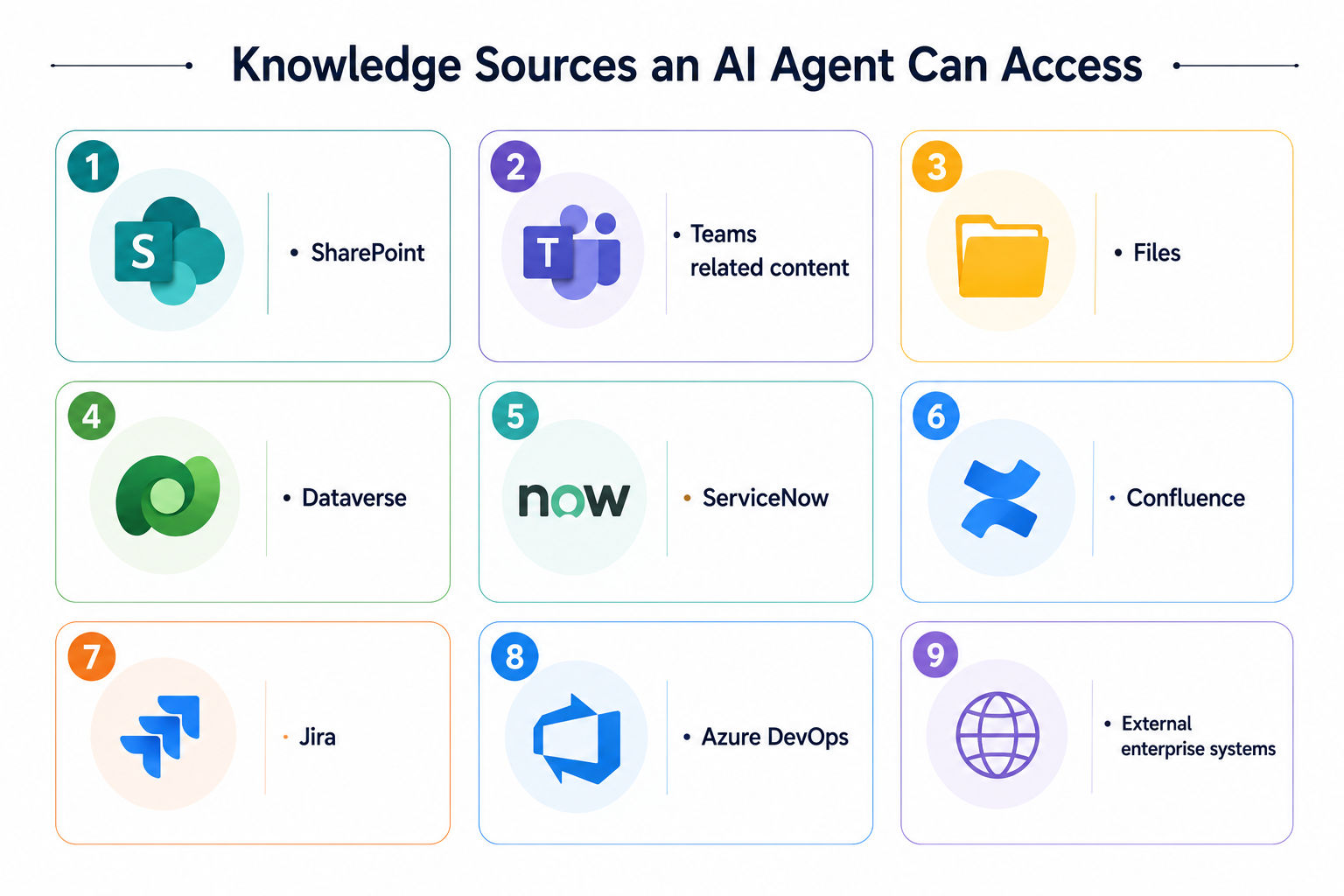
Copilot connectors can also bring non-Microsoft enterprise data into Microsoft Graph while respecting source level permissions.
Explore the Microsoft tools used for Agentic AI development and understand how they support building, deploying, and managing AI agents.
How to Build a Microsoft Agentic AI Knowledge Management System
Building Microsoft agentic AI enterprise knowledge management requires more than connecting an AI model to company documents. The knowledge architecture, data sources, permissions, retrieval process, workflows, and monitoring all need to work together.
1. Identify Enterprise Knowledge Requirements
Start by determining:
• What knowledge employees need
• Which questions occur frequently
• Which processes depend on that knowledge
• Which information requires strict access controls
• Which sources are considered authoritative
This establishes the purpose and scope of the agent.
2. Map Enterprise Data Sources
Identify where important knowledge currently exists.
Map:
• Documents
• Databases
• Collaboration systems
• Business applications
• Knowledge bases
• External connected systems
This prevents important knowledge from being overlooked.
3. Select AI Agents and Microsoft Services
Choose services according to the requirements.
For example:
• Copilot Studio for custom agents
• Azure AI Search for enterprise retrieval
• Microsoft Foundry for advanced AI development
• Microsoft Graph for Microsoft 365 data access
The architecture should use only the components required for the intended use case.
4. Connect and Ground Enterprise Knowledge
Knowledge sources provide the information agents use to answer questions. Copilot Studio supports multiple source types, including files, SharePoint, Dataverse, Azure AI Search, and connected enterprise data.
Grounding helps agents work from current organizational information instead of relying only on general model knowledge.
5. Define Agent Workflows and Actions
Agents should have clear instructions about:
• What they can access
• What actions they can perform
• Which sources they should prioritize
• When they should ask for clarification
• When they should escalate to a person
6. Test and Deploy the Knowledge System
Before deployment, test the agent against realistic knowledge of questions and scenarios.
Review:
• Answer quality
• Source relevance
• Access permissions
• Failure cases
• Response consistency
• User experience
Explore whether Microsoft Agentic AI is worth learning in 2026 and understand the skills and career opportunities emerging around AI agents.
Best Practices for Enterprise Agentic Knowledge Management
Successful Microsoft agentic AI enterprise knowledge management depends heavily on the quality of the underlying knowledge and the controls around agent access and behavior.
1. Establish a Reliable Knowledge Foundation
Knowledge sources should be:
• Accurate
• Relevant
• Well organized
• Consistently maintained
• Easy to retrieve
Poor source quality can lead to poor agent responses.
2. Apply Role Based Access Controls
Agents should not provide information simply because it exists somewhere in the organization.
Access should reflect the permissions of the user and the source system. Microsoft Copilot connectors are designed to respect source level permissions for connected enterprise data.
3. Ground Agents with Trusted Enterprise Sources
Important responses should be grounded in approved organizational information.
Organizations can identify trusted sources and, in applicable Copilot Studio configurations, designate verified sources as official.
4. Keep Enterprise Knowledge Current
Knowledge of repositories requires regular maintenance.
Teams should:
• Remove outdated documents
• Update policies
• Review knowledge sources
• Check broken connections
• Monitor content quality
Keeping sources current helps maintain useful agent responses. Microsoft also recommends regular maintenance of configured knowledge sources.
5. Introduce Human Review for High Impact Decisions
AI agents should not automatically make every important decision.
Human review is particularly valuable when outputs affect:
• Employees
• Customers
• Compliance
• Financial decisions
• Sensitive business processes
6. Continuously Monitor and Improve Agents
Monitoring should cover both the agent and its knowledge sources.
Track:
• Answer quality
• Knowledge source usage
• Failed responses
• User feedback
• Retrieval quality
• Workflow performance
This creates a continuous improvement cycle for Microsoft agentic AI enterprise knowledge management.
Explore Microsoft Agentic AI Careers and discover the skills and opportunities shaping the future of AI driven roles.
Conclusion
Microsoft agentic AI enterprise knowledge management helps organizations connect enterprise knowledge with AI agents for faster, context aware access and workflows.
It works best with reliable data, strong permissions, effective grounding, and continuous monitoring. Organizations should start with a focused use case and scale the solution as requirements grow.
Contact our upGrad KnowledgeHut experts for personalized guidance on choosing the right course, career path, and certification to achieve your goals.
Frequently Asked Questions (FAQs)
1. How does Microsoft Agentic AI handle conflicting information across enterprise sources?
Agents should prioritize trusted and relevant knowledge sources when multiple sources provide different information. Organizations can define authoritative sources and configure knowledge access to reduce conflicting responses. Human review may still be needed for sensitive or unclear information.
2. What happens when enterprise knowledge is outdated or contradictory?
Outdated or conflicting information can lead to less reliable agent responses. Organizations should regularly review knowledge sources, remove obsolete content, and update important information to maintain a reliable knowledge foundation.
3. How can organizations prevent agents from exposing confidential information?
Organizations can use identity controls, permissions, and source level access rules to restrict what agents can retrieve. Agents should only access information that the requesting user is authorized to view.
4. How can businesses measure the accuracy of enterprise knowledge agents?
Accuracy can be measured by testing agent responses against trusted enterprise sources. Useful measures include answer relevance, factual accuracy, citation quality, successful task completion, and user feedback.
5. Can Microsoft Agentic AI distinguish official knowledge from less trusted sources?
Yes, organizations can configure trusted or official knowledge sources for specific agent scenarios. Prioritizing authoritative sources helps agents provide responses based on more reliable enterprise information.
6. How does Microsoft Agentic AI handle knowledge that exists in different formats?
Microsoft agents can work with supported sources such as documents, files, structured data, and connected enterprise systems. The specific capabilities depend on the configured knowledge source and Microsoft service being used.
7. Can enterprise knowledge agents work with frequently changing information?
Yes. Agents can use connected knowledge sources that are updated as enterprise information changes. Regular source maintenance and synchronization are important to ensure responses reflect current information.
8. How can organizations reduce hallucinations in enterprise knowledge agents?
Organizations can reduce hallucinations by grounding agents in trusted enterprise sources and limiting unsupported responses. Clear instructions, retrieval, citations, evaluation, and human review for high impact decisions can further improve reliability.
9. How should businesses decide which enterprise sources an agent can access?
Sources should be selected based on relevance, reliability, sensitivity, and user access requirements. Businesses should prioritize authoritative sources and limit access to information that the agent does not need for its intended purpose.
10. How can Microsoft Agentic AI support knowledge management across multiple departments?
Agents can connect relevant knowledge sources across departments while maintaining appropriate access controls. This can support shared knowledge discovery while allowing teams to maintain department specific information and workflows.
1639 articles published
KnowledgeHut is an outcome-focused global ed-tech company. We help organizations and professionals unlock excellence through skills development. We offer training solutions under the people and proces...
Get Free Consultation
By submitting, I accept the T&C and
Privacy Policy