

Domains
Artificial Intelligence
Harness AI to create smarter workflows and scalable growth.
View All Artificial Intelligence Coursesicon-aiCertifications
Certification
100+ Hours
Trending
Post Graduate Certification Program in Data Analytics and Applied AI
Certification
140+ Hours
Trending
Executive Post Graduate Certificate in Data Science and Applied AI
Certification
140+ Hours
Trending
PG Certificate in Applied Generative Engineering & LLM Applications
Certification
150+ Hours
Trending
PG Certificate in AI Powered Product and Design Thinking
Certification
15 Weeks
Trending
AI Masters Program
Certification
4 Weeks
Trending
Vibe Coding 101: No-code AI Programming.svg)
Certification
48 Hours
Trending
Applied Agentic AI - No Code
Certification
16 Hours
Trending
Generative AI and Prompt Engineering
Certification
8 Weeks
Trending
AI-Powered Product Management
Certification
8 Weeks
Trending
Applied Agentic AI Certification
Certification
16 Hours
Generative AI Course for Scrum Masters
Certification
16 Hours
Generative AI Course for Project Managers
Certification
16 Hours
Generative AI Course for POPM
Certification
16 Hours
Gen AI Course for Business Analysts
Certification
16 Hours
AI Powered Software Development
Certification
16 Hours
AI-Data Analytics with Power BI
Certification
16 Hours
AI-Driven Digital Marketing Training
Certification
16 Hours
Gen AI for Enterprise Agilist
Advanced Certifications
Masters
Executive Diploma
Executive Diploma in Machine Learning and AI
Executive Diploma
Executive Diploma in Data Science & Artificial Intelligence from IIITBCertification
Chief Technology Officer & AI Leadership ProgrammeMaster's Degree
Master of Science in Machine Learning & AI
Dual Certification
Executive Programme in Generative AI for LeadersCertification
Executive Post Graduate Programme in Applied AI and Agentic AIExecutive PG Program
IIT KGP-Executive PG Certificate in Gen AI and Agentic
Self-Learning Courses
Universal AI by MIT Open LearningAgile Management
Master Agile methodologies for efficient and timely project delivery.
View All Agile Management Coursesicon-refresh-cwCertifications
Scrum Alliance
16 Hours
Best Seller
Certified ScrumMaster (CSM) Certification
Scrum Alliance
16 Hours
Best Seller
Certified Scrum Product Owner (CSPO) Certification
Scaled Agile
16 Hours
Trending
Leading SAFe 6.0 Certification.svg)
Scrum.org
16 Hours
Professional Scrum Master (PSM) Certification
Scaled Agile
16 Hours
AI-Empowered SAFe® 6.0 Scrum Master
PMI
21 Hours
Best Seller
PMI Agile Certified Practitioner (PMI-ACP) Certification
Advanced Certifications
Scaled Agile, Inc.
32 Hours
Recommended
Implementing SAFe 6.0 (SPC) Certification.svg)
Scaled Agile, Inc.
24 Hours
AI-Empowered SAFe® 6 Release Train Engineer (RTE) Course
Scaled Agile, Inc.
16 Hours
Trending
SAFe® AI-Empowered Product Owner/Product Manager (6.0)
IC Agile
24 Hours
ICP Agile Certified Coaching (ICP-ACC)
Scrum.org
16 Hours
Professional Scrum Product Owner I (PSPO I) Training
Masters
32 Hours
Trending
Agile Management Master's Program
32 Hours
Agile Excellence Master's ProgramOn-Demand Courses
Agile and ScrumRoles
Scrum MasterAccreditation Bodies
Scrum Alliance Scaled Agile, Inc.
 Scrum.org
 ICAgile
 PMI
PMI
Top Resources
Scrum TutorialProject Management
Gain expert skills to lead projects to success and timely completion.
View All Project Management Coursesicon-standCertifications
PMI
36 Hours
Best Seller
Project Management Professional (PMP) Certification
Axelos
32 Hours
PRINCE2 Foundation & Practitioner Certification
Axelos
16 Hours
PRINCE2 Foundation Certification
Axelos
16 Hours
PRINCE2 Practitioner Certification
PMI
23 Hours
Best Seller
Certified Associate in Project Management (CAPM)®
PMI
24 Hours
Best Seller
Program Management Professional (PgMP®)
PMI
24 Hours
Best Seller
Portfolio Management Professional (PfMP)®
PMI
30 Hours
Best Seller
Project Management Institute-Risk Management Professional (PMI-RMP)®
Skills
Change ManagementMasters
Job Oriented
45 Hours
Trending
Project Management Master's Program
On-Demand Courses
PRINCE2 Practitioner CourseRoles
Project ManagerAccreditation Bodies
PMIAxelos Scrum Alliance
Top Resources
Theories of MotivationCyber Security
Understand how to protect data and systems from threats or disasters.
View All Cyber Security Coursesicon-refresh-cwCertifications
CompTIA
40 Hours
Best Seller
CompTIA Security+
EC-Council
40 Hours
Certified Ethical Hacker (CEH v13) Certification
ISACA
40 Hours
Certified Information Systems Auditor (CISA) Certification
ISACA
40 Hours
Certified Information Security Manager (CISM) Certification
(ISC)²
40 Hours
Certified Information Systems Security Professional (CISSP)
(ISC)²
40 Hours
Certified Cloud Security Professional (CCSP) Certification
16 Hours
Certified Information Privacy Professional - Europe (CIPP-E) Certification
ISACA
16 Hours
COBIT5 Foundation
16 Hours
Payment Card Industry Security Standards (PCI-DSS) Certification
On-Demand Courses
CISSPTop Resources
Laptops for IT SecurityCloud Computing
Learn to harness the cloud to deliver computing resources efficiently.
View All Cloud Computing Coursesicon-cloud-snowingCertifications
AWS
32 Hours
Best Seller
AWS Certified Solutions Architect - Associate
AWS
32 Hours
AWS Cloud Practitioner CertificationAWS
24 Hours
AWS DevOps CertificationMicrosoft
16 Hours
Azure Fundamentals Certification
Microsoft
24 Hours
Best Seller
Azure Administrator CertificationMicrosoft
45 Hours
Recommended
Azure Data Engineer CertificationMicrosoft
32 Hours
Azure Solution Architect CertificationMicrosoft
40 Hours
Azure DevOps CertificationAWS
24 Hours
Systems Operations on AWS Certification TrainingAWS
24 Hours
Developing on AWSMasters
Job Oriented
48 Hours
New
AWS Cloud Architect Masters Program
Roles
Cloud EngineerOn-Demand Courses
AWS Certified Developer Associate - Complete GuideAuthorized Partners of
AWSMicrosoft
Top Resources
Scrum TutorialIT Service Management
Understand how to plan, design, and optimize IT services efficiently.
View All ITSM Coursesicon-git-commitCertifications
Axelos
16 Hours
New
ITIL Foundation (Version 5) Certification
Axelos
16 Hours
Best Seller
ITIL 4 Foundation Certification
Axelos
8 Hours
New
ITIL Foundation Bridge Course (Version 5)Axelos
16 Hours
ITIL Practitioner Certification
PeopleCert
16 Hours
ISO 14001 Foundation Certification
PeopleCert
16 Hours
ISO 20000 CertificationPeopleCert
24 Hours
ISO 27000 Foundation CertificationAxelos
24 Hours
ITIL 4 Specialist: Create, Deliver and Support Training
Axelos
24 Hours
ITIL 4 Specialist: Drive Stakeholder Value TrainingAxelos
16 Hours
ITIL 4 Strategist Direct, Plan and Improve TrainingOn-Demand Courses
ITIL 4 Specialist: Create, Deliver and Support ExamTop Resources
ITIL Practice TestData Science
Unlock valuable insights from data with advanced analytics.
View All Data Science Coursesicon-dataOur Courses
Data Science with PythonRoles
Data ScientistOn-Demand Courses
Data Analysis Using ExcelTop Resources
Machine Learning TutorialDevOps
Automate and streamline the delivery of products and services.
View All DevOps Coursesicon-terminal-squareCertifications
DevOps Institute
16 Hours
Best Seller
DevOps Foundation Certification
CNCF
32 Hours
New
Certified Kubernetes Administrator
Devops Institute
16 Hours
Devops LeaderSkills
KubernetesRoles
DevOps EngineerOn-Demand Courses
CI/CD with Jenkins XGlobal Accreditations
DevOps Institute
Top Resources
Top DevOps ProjectsBI And Visualization
Understand how to transform data into actionable, measurable insights.
View All BI And Visualization Coursesicon-microscopeBI and Visualization Tools
Certification
24 Hours
Recommended
Tableau Certification
Certification
24 Hours
Data Visualization with Tableau Certification
Microsoft
24 Hours
Best Seller
Microsoft Power BI Certification
TIBCO
36 Hours
TIBCO Spotfire Training
Certification
30 Hours
Data Visualization with QlikView CertificationCertification
16 Hours
Sisense BI Certification
On-Demand Courses
Data Visualization Using Tableau TrainingTop Resources
Python Data Viz LibsWeb Development
Learn to create user-friendly, fast, and dynamic web applications.
View All Web Development Coursesicon-codeOur Courses
ReactOn-Demand Courses
Angular TrainingTop Resources
Top HTML ProjectsBlockchain
Understand how transactions and databases work in blockchain technology.
View All Blockchain Coursesicon-stop-squareBlockchain Certifications
40 Hours
Blockchain Professional Certification
32 Hours
Blockchain Solutions Architect Certification
32 Hours
Blockchain Security Engineer Certification
24 Hours
Blockchain Quality Engineer Certification
5+ Hours
Blockchain 101 Certification
On-Demand Courses
NFT Essentials 101: A Beginner's GuideTop Resources
Blockchain Interview QsProgramming
Learn to code efficiently and design software that solves problems.
View All Programming Coursesicon-codeSkills
Python CertificationInterview Prep
Career Accelerator
3 Months
Software Engineer Interview Prep
On-Demand Courses
Data Structures and Algorithms with JavaScriptTop Resources
Python Tutorial- Home
- Data Science
- Python for AI Engineers
Python AI Course for Engineers
Python for AI Engineers
Learn the Python Skills Required for LLMs, AI Agents, APIs, Automation, and Enterprise AI Workflows
 1600+ Enrolled

-88854d4c722847d9812d42d1059f2535.svg)
Prerequisites for Python for AI Engineers
- Basic programming understanding
- Logical problem-solving skills
- Interest in AI, APIs, automation, or AI applications
- No advanced Python expertise required.

- 500K+Professionals trained
- 250+Workshops every month
- 300+Agile transformations

Python for AI Engineers Highlights
6 hours of live instructor-led training
Build AI APIs & Automation Workflows
Learn Async Python for Agentic AI Systems
FastAPI + Pydantic + AI integrations
Industry-Ready Practical Labs
Designed for the Modern AI Engineering Ecosystem
As Generative AI, LLMs, and Agentic AI systems rapidly reshape the technology landscape, Python has emerged as the core language powering modern AI engineering. Today’s AI professionals are expected to go far beyond basic coding they need to build AI APIs, orchestrate automation workflows, manage async systems, validate LLM outputs, and integrate enterprise-grade AI services reliably and securely.
This course is designed specifically for that new era of AI engineering. Unlike traditional Python courses, it focuses entirely on the practical Python skills required for real-world AI applications, automation systems, FastAPI services, AI integrations, and production-ready AI workflows. Through hands-on labs and modern AI engineering projects, learners will gain the ability to build scalable AI systems using tools such as FastAPI, Pydantic, asyncio, APIs, structured data pipelines, and AI automation frameworks.
Whether you are an AI engineer, developer transitioning into Generative AI, automation professional, technical product leader, or someone preparing for advanced AI engineering roles, this program provides the foundational engineering capabilities needed to work confidently with modern AI ecosystems and enterprise AI applications.
High Demand for AI Engineers



-248f19f288074d2489bed7ace303d549.svg)


Why KnowledgeHut For Python for AI Engineers
Comprehensive Curriculum
Immersive Learning
Interactive Experience
Practical Use Cases
Networking Opportunities
Learn from Experienced Trainers
Who can attend the Python for AI Engineers Course
- AI & Software Engineers
- Developers Transitioning into AI
- Automation Engineers
- Data & AI Enthusiasts
- Technical Product Teams
- Professionals Pursuing the Full Masters Program

Python for AI Engineers Projects
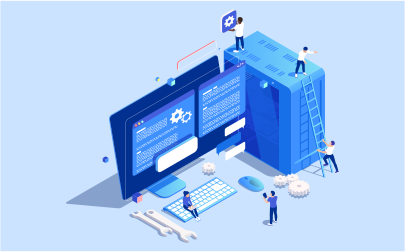

Async AI Tool Runner


Structured LLM Validation Pipeline
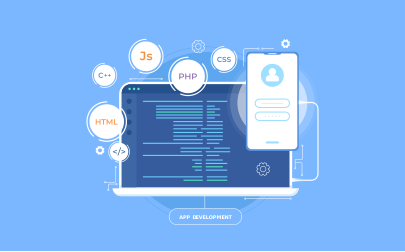

AI API Microservice

Multi-format File Ingestion Utility
Python for AI Engineers Training Curriculum
1. Python Environment and Setup
Learning Objectives:
Set up and manage modern Python development environments optimized for AI engineering workflows.
Topics:
- Python installation and setup
- pyenv
- venv
- Poetry
- uv
- Managing Python environments
- Dependency management basics
2. Core Python for AI Applications
Learning Objectives:
Develop strong foundational Python skills required for AI engineering and automation development.
Topics:
- Python data types
- Functions
- Comprehensions
- Generators
- Decorators
- Python idioms for AI applications
3. Async Python for AI Systems
Learning Objectives:
Build scalable and high-throughput workflows suitable for AI agents and automation pipelines.
Topics:
- asyncio
- await
- concurrent.futures
- Async execution patterns
- Concurrency concepts
4. Structured Data Handling for AI
Learning Objectives:
Design reliable and structured AI workflows with validated data contracts.
Topics:
- Pydantic models
- dataclasses
- TypedDict
- Structured input/output handling
- Schema validation patterns
5. Working with Files & Data Formats
Learning Objectives:
Build file ingestion and processing utilities for AI applications and document workflows.
Topics:
- JSON processing
- YAML handling
- CSV parsing
- PDF ingestion
- DOCX processing
- File-system utilities
6. APIs & External Integrations
Learning Objectives:
Integrate AI workflows with external APIs, services, and orchestration systems.
Topics:
- REST API fundamentals
- requests library
- httpx library
- API integrations
- Calling external services from AI systems
7. FastAPI for AI Applications
Learning Objectives:
Develop lightweight AI microservices and expose AI functionality through APIs.
Topics:
- FastAPI fundamentals
- Creating API endpoints
- Exposing AI tools as APIs
- HTTP services for AI workflows
8. Python Utilities for AI Engineering
Learning Objectives:
Build automation-friendly utilities and workflows commonly used in AI engineering environments.
Topics:
- os
- subprocess
- glob
- pathlib
- File-system operations
- Automation utilities
9. Reliability Engineering for AI Systems
Learning Objectives:
Develop robust and fault-tolerant AI applications suitable for production environments.
Topics:
- Error handling
- Retry mechanisms
- Exponential back-off strategies
- Resilience patterns for AI applications
10. Environment Variables & Secrets Management
Learning Objectives:
Manage secrets and configuration securely in enterprise AI projects.
Topics:
- .env configuration
- python-dotenv
- AWS Secrets Manager
- Secure credential handling
What You Will Learn in Python for AI Engineers Course
Write async Python workflows for AI systems
Build structured AI pipelines using Pydantic
Develop FastAPI-based AI services
Integrate external APIs into AI workflows
Handle retries, errors, and resiliency patterns
Manage secrets and environments securely

Python for AI Engineers Course FAQs
1. Is this a beginner Python course?
No. This course is specifically designed for AI-focused Python engineering rather than generic software programming.
2. Do I need prior coding experience?
Yes, basic programming familiarity is recommended, but advanced Python expertise is not required.
3. Is this course focused on Generative AI?
Yes. The curriculum is designed around the Python skills required for Generative AI, LLM applications, APIs, automation, and Agentic AI systems.
4. Will I build hands-on projects?
Yes. The course includes practical labs involving FastAPI, async Python, AI APIs, file ingestion pipelines, and structured AI workflows.
5. What tools will I learn?
You will work with:
- FastAPI
- Pydantic
- asyncio
- requests
- httpx
- pytest
- Poetry
- python-dotenv and more.
6. Is this course suitable for enterprise teams?
Yes. The curriculum is aligned with modern enterprise AI engineering workflows and automation systems.
7. Are there other courses I can do after this course?
Yes. This course is Module 1 of the “Masters Program in Generative & Agentic AI.” You can continue in that path by doing the three programs that come in that program.
1. What payment options are available?
The payment can be made through different options by using a debit/credit card which includes MasterCard, Visa Card, American Express or through PayPal. Acknowledgment will be issued automatically via email to the candidates once payment is done.
2. I’d like to learn more about this program. Whom should I contact?
To ask further questions, please send in an email to kh.reachus@upgrad.com, and we will answer any queries you may have!
3. If I cancel the enrolment, will I get a refund?
At upGrad KnowledgeHut, we strive diligently to make sure that your learning experience with us is second to none and you are assured of the highest standards of quality. However, if for any reason your expectations are not met, we will process refunds in accordance with our Cancellation, Refund, and Deferment Policy.