
- Home
- Blog
- Data Science
- AI Platform Maturity Model: A Complete Guide for Enterprises
AI Platform Maturity Model: A Complete Guide for Enterprises
Updated on Aug 31, 2026 | 313 views
Share:
Table of Contents
View all
Quick Overview
- An AI platform maturity model is a structured framework that helps enterprises measure their AI capabilities, identify gaps, and scale AI adoption from early experimentation to AI driven business transformation.
- The five stages of AI maturity range from Awareness and Experimentation and Active and Pilot to Operational and Internal Platforms, Systemic and Strategic Integration, Transformational and Native AI.
- Core assessment dimensions include data foundation, strategy and governance, technology and MLOps, people and culture, and value and ROI to evaluate how effectively an organization can adopt and scale AI.
- This guide explains the five stages of AI maturity, the key dimensions used to assess enterprise readiness, and the common challenges organizations face when scaling AI from experimentation to production and strategic transformation.
Build future ready product skills with AI Powered Product Management and learn how AI can support product strategy, research, and decision making.
What Is an AI Platform Maturity Model?
AI platform maturity model is one which is used for evaluating the level of development of an organisation's AI capabilities, examining whether the AI initiatives in question are merely isolated experiments or instead are supported by reusable platforms, reliable data, governance, a skilled workforce, and measurable business outcomes.
A maturity assessment can help enterprises understand:
- Where AI capabilities currently stand
- Which gaps are limiting progress
- Whether pilots are ready to scale
- How effectively AI is governed
- Whether AI investments are creating business value
Why Enterprises Need an AI Platform Maturity Model
The rapid adoption of AI is possible in the absence of a clear structure, since different teams might select different tools, develop their own systems, or carry out pilots without having a common strategy.
An AI platform maturity model can help organizations:
- Create a common AI strategy
- Standardize platforms and processes
- Identify capability gaps
- Improve governance
- Reduce duplicated technology investments
- Connect AI projects with measurable outcomes
Explore AI Platform Governance Models to understand how enterprises can build secure, scalable, and responsible AI ecosystems.
The five stages of AI maturity
The five stages in an AI platform maturity model describe how an enterprise can progress from early experimentation to organization wide AI transformation. Each stage represents a different level of capability, consistency, and business integration.
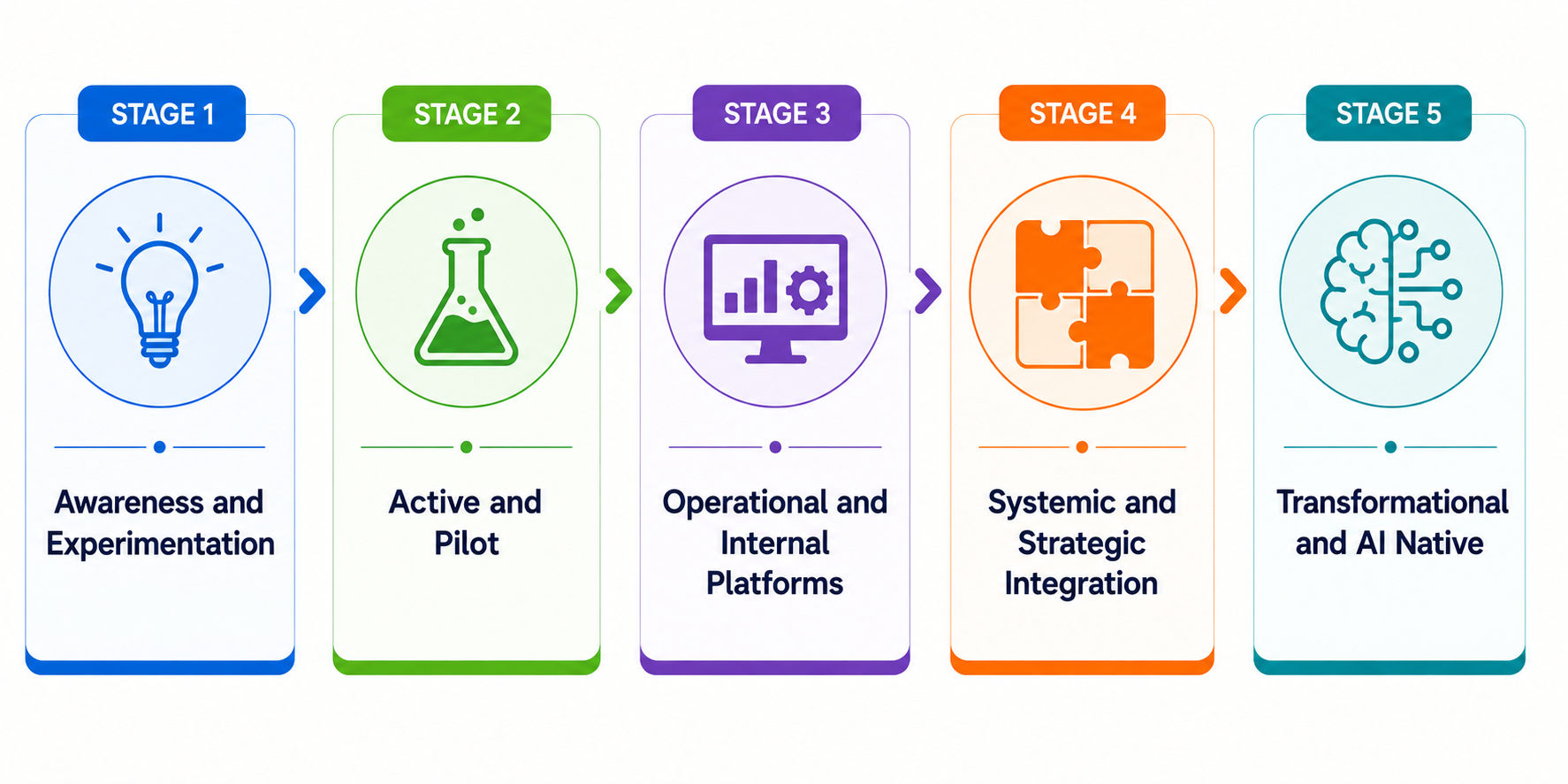
Stage 1: Awareness and Experimentation
By now, the various teams have started to realize what AI is capable of.
Organizations may:
- Experiment with AI tools
- Run small proof of concepts
- Test generative AI applications
- Explore isolated use cases
- Build informal AI knowledge
AI activity is generally decentralised, with only limited governance and a lack of standardisation.
The primary objective is learning; companies are attempting to find out where AI might generate value before committing substantial investments.
Stage 2: Active and Pilot
At this stage organizations go beyond experimentation and start to carry out structured pilots.
Common characteristics include:
- Defined AI use cases
- Formal pilot projects
- Dedicated budgets
- Initial AI teams
- Early governance practices
- Basic success metrics
Stage 3: Operational and Internal Platform
In the third stage, AI ceases to be a set of separate pilots and becomes an operational capability.
Organizations may establish:
- Shared AI platforms
- Standard development processes
- MLOps capabilities
- Centralized governance
- Reusable AI services
- Production monitoring
Stage 4: Systemic and Strategic Integration
At this stage AI becomes an integral part of both the business and technology strategy.
AI is integrated into:
- Core business processes
- Product development
- Customer experiences
- Decision making
- Enterprise platforms
- Strategic planning
Stage 5: Transformational and AI Native
At the highest level there is an organization in which artificial intelligence is deeply incorporated into the design of its products, services, processes, and decisions.
Characteristics may include:
- AI native products
- Continuous AI optimization
- Highly integrated data systems
- Mature AI governance
- Scalable AI operations
- Strong AI culture across teams
Build practical data skills with Data Science Courses with Certification Online and prepare for data driven career opportunities.
Core assessment dimensions of AI maturity
An AI platform maturity model should look at more than just technology; it should assess the organization's capability in supporting AI data preparation through deployment, governance, and business measurement.
1. Data Foundation
Most AI capabilities are based on data.
Assess:
- Data quality
- Data accessibility
- Data integration
- Data governance
- Data availability
- Data ownership
2. Strategy and Governance
AI programs require clear direction and accountability.
Organizations should assess:
- AI strategy
- Governance structures
- Risk policies
- Responsible AI practices
- Decision rights
- Compliance processes
3. Technology and MLOps
Technology maturity refers to the extent to which an organization is able to develop, deploy, operate, and improve AI systems.
Relevant areas include:
- AI infrastructure
- Model deployment
- Monitoring
- Version management
- Testing
- Automation
- Model lifecycle management
4. People and Culture
The level of development of AI is very much based on human beings.
Assess:
- AI expertise
- Data skills
- Engineering capabilities
- Product knowledge
- Leadership support
- Employee adoption
5. Value and ROI
The ultimate requirement of AI maturity is to achieve a connection with business outcomes.
Measure:
- Revenue impact
- Cost savings
- Productivity
- Customer outcomes
- Product adoption
- Risk reduction
- Return on AI investment
Learn How to Evaluate AI Platforms: A Complete Guide for Enterprises and compare platforms based on scalability, security, integration, governance, and cost.
Common challenges in AI platform maturity
Organizations rarely move through an AI platform maturity model without obstacles. The biggest challenges often appear when enterprises try to scale AI across teams, systems, and business functions.
1. Fragmented AI Tools and Infrastructure
Various teams might choose different models, platforms, and development tools.
This can create:
- Duplicate investments
- Inconsistent processes
- Higher operating costs
- Integration problems
- Difficulty enforcing governance
2. Poor Data Quality and Accessibility
AI projects usually have difficulty because the relevant data is either incomplete, inconsistent, out of date, or hard to obtain.
Common problems include:
- Data silos
- Missing information
- Inconsistent definitions
- Limited access
- Weak data governance
3. Scaling AI From Pilots to Production
While many organizations can carry out successful pilot projects they have difficulty in running them on a large scale.
Production challenges may involve:
- Infrastructure
- Security
- Monitoring
- Integration
- Performance
- Cost management
A well-developed platform should make the process of moving from pilot to production more repeatable.
4. Limited AI Governance and Risk Management
The use of AI poses risks concerning privacy, security, bias, model behaviour, and its responsible use.
Without appropriate governance, organizations may struggle to answer:
- What AI systems are approved?
- Who owns the model?
- What kind of data can be used?
- What is the proper way of keeping an eye on AI outputs?
- At what stage is it necessary to have a human review?
5. Skills and Talent Gaps
Enterprise organizations might not have enough people who have experience in the areas of AI, data, engineering, product management, and governance.
The gap can be addressed through:
- Training
- Internal mobility
- Specialist hiring
- Cross functional teams
- Better development frameworks
6. Difficulty Measuring AI Business Value
It is not easy to link AI activity with measurable results.
Organizations may track:
- Number of pilots
- Models deployed
- AI usage
- Project completion
Assess organizational preparedness with an AI Readiness Assessment Framework for Enterprises and identify key areas for successful AI adoption.
Conclusion
An AI platform maturity model helps enterprises assess their progress from AI experimentation to scalable, strategic adoption.
The five stages range from Awareness and Experimentation to Transformational and AI Native, with data, governance, people, technology, and business value shaping maturity at each stage.
Enterprises should assess their current stage, identify capability gaps, and prioritize investments based on AI strategy, business goals, data readiness, and scalability needs.
Contact our upGrad KnowledgeHut experts for personalized guidance on choosing the right course, career path, and certification to achieve your goals.
Frequently Asked Questions (FAQs)
1. How can an enterprise measure AI maturity objectively rather than relying on self assessment?
An AI platform maturity model can be assessed using defined criteria across data, governance, technology, people, and business value. Each area can be measured using clear evidence, such as production deployments, governance processes, and measurable outcomes. This creates a more objective maturity assessment.
2. Can different departments within the same organization be at different AI maturity stages?
Yes. Different departments can progress through an AI platform maturity model at different speeds based on their data, technology, skills, use cases, and investment. One department may operate mature AI systems while another may still be in the experimentation stage.
3. How long does it take to move from one AI maturity stage to the next?
There is no fixed timeline in an AI platform maturity model. Progress depends on data readiness, infrastructure, talent, governance, investment, and the organization's ability to move AI initiatives into production.
4. What should an enterprise prioritize when data maturity is lower than AI technology maturity?
The organization should strengthen its data foundation before expanding AI adoption. Priorities should include data quality, accessibility, integration, ownership, and governance. A strong AI platform maturity model assessment can help identify these gaps.
5. How can enterprises move AI pilots into production and avoid pilot stagnation?
Enterprises should define production requirements early, including security, monitoring, scalability, ownership, and business success metrics. Reusable platforms and standardized deployment processes can help organizations progress through the AI platform maturity model more effectively.
6. Should every enterprise aim to reach the highest stage of AI maturity?
No. The right maturity level depends on business goals, available resources, AI use cases, and risk requirements. An AI platform maturity model should help organizations identify the level that best supports their strategy rather than encourage unnecessary complexity.
7. How does AI maturity affect enterprise AI investment decisions?
AI maturity helps organizations understand where investment is most needed. Organizations with weak foundations may prioritize data and governance, while more mature enterprises may focus on scaling platforms, advanced AI capabilities, and strategic use cases.
8. How can enterprises benchmark their AI maturity against competitors?
Organizations can compare capabilities across data, technology, governance, people, adoption, and business outcomes. Industry benchmarks and public research can provide context, but comparisons should account for differences in company size, strategy, and objectives.
9. What should enterprises do when AI governance maturity lags behind AI adoption?
Governance should be strengthened before expanding AI adoption further. Organizations can establish clearer ownership, approval processes, risk controls, monitoring, data policies, and responsible AI standards to bring governance in line with AI usage.
10. How can enterprises create an AI maturity roadmap after completing an assessment?
Start by identifying the largest gaps between the current and desired maturity levels. Prioritize improvements based on business value, risk, dependencies, and resources, then create milestones across data, technology, governance, people, and AI outcomes.
1639 articles published
KnowledgeHut is an outcome-focused global ed-tech company. We help organizations and professionals unlock excellence through skills development. We offer training solutions under the people and proces...
Get Free Consultation
By submitting, I accept the T&C and
Privacy Policy