
- Home
- Blog
- Data Science
- AI Readiness Assessment Framework for Enterprises
AI Readiness Assessment Framework for Enterprises
Updated on Aug 25, 2026 | 291 views
Share:
Table of Contents
View all
Quick Overview
- An AI Readiness Assessment Framework helps enterprises evaluate whether they have the strategy, data, technology, people, processes, and governance needed for successful AI adoption.
- The core pillars of AI readiness include strategy and leadership, data, technology and infrastructure, governance, people and skills, processes, and AI use cases.
- Organizations can assess AI readiness by defining the scope, collecting baseline data, scoring each dimension, identifying gaps, and prioritizing improvements.
- Common challenges include poor data quality, weak governance, unclear AI use cases, limited executive ownership, and difficulty measuring business value.
- In this guide, you will learn how to assess AI readiness, measure readiness levels, identify key gaps, and create a practical roadmap for enterprise AI adoption.
Build the skills needed to turn AI readiness into real implementation. Explore upGrad KnowledgeHut Advanced AI Masters Program with Microsoft and develop practical AI capabilities for enterprise applications.
What is an AI readiness assessment framework?
An AI Readiness Assessment Framework is an assessment model that is used by companies to assess their readiness for adoption and implementation of AI solutions. It is an assessment of various areas such as strategy, data, technology, governance, workforce skills, and operations within the organization.
A good AI Readiness Assessment Framework gives a clear understanding of areas that are performing well and those that need improvement. With this understanding, a company will be able to identify areas in need of investments for successful development of AI initiatives.
AI readiness involves setting up of AI initiatives according to the business strategies, securing high-quality data, and developing employees' skills to handle the new technological environment.
Core pillars of an AI readiness assessment framework
A well-developed AI Readiness Assessment Framework consists of several essential pillars that evaluate various aspects of the business and give a comprehensive overview of enterprise AI readiness.
Strategy and leadership readiness
This pillar determines the degree to which the leadership understands the capabilities of AI technology. The pillar evaluates the existence of a clear AI strategy of the organization and alignment of goals with practical benefits.
Data readiness
The success of AI implementation is closely related to the quality of input data, and this pillar of the framework assesses whether the enterprise possesses clean, complete, accessible data.
Besides, this pillar evaluates the sources of the data, its ownership, and reliability required for training the machine learning models.
Technology and infrastructure readiness
This pillar evaluates the existing tech stack of the organization. It checks whether the enterprise has enough computational power, proper cloud infrastructure, and necessary tools for deployment and maintenance of AI models.
Governance, security, and responsible AI readiness
This pillar assesses whether the enterprise is ready to adopt responsible AI technologies in terms of regulatory compliance and security controls. Besides, it evaluates whether there are measures aimed at avoiding biases and ensuring explainability of AI-based solutions.
Enterprise AI readiness cannot exist without proper governance, as a failure of an AI project creates legal and reputation risks.
People and skills readiness
This pillar evaluates employees' skills and training needs related to AI. It also assesses whether the culture of the company is conducive to changes introduced by new tools.
Process and operating model readiness
This pillar evaluates the level to which the business processes can incorporate AI solutions. A well-developed AI Readiness Assessment Framework defines areas within business processes where AI tools can be embedded without disruption.
Use case and value readiness
All AI projects do not necessarily result in business value. It is crucial to know which use cases are appropriate. The AI Readiness Assessment Framework helps to identify if organizations have clear AI use cases that are compatible with their strategic objectives.
An effective AI readiness framework helps firms identify which projects are worth undertaking. Prioritizing the right use cases ensures success.
How to conduct AI readiness assessment?
For conducting an AI assessment, it is required to apply a structured approach that will include an evaluation of all key dimensions of the business.
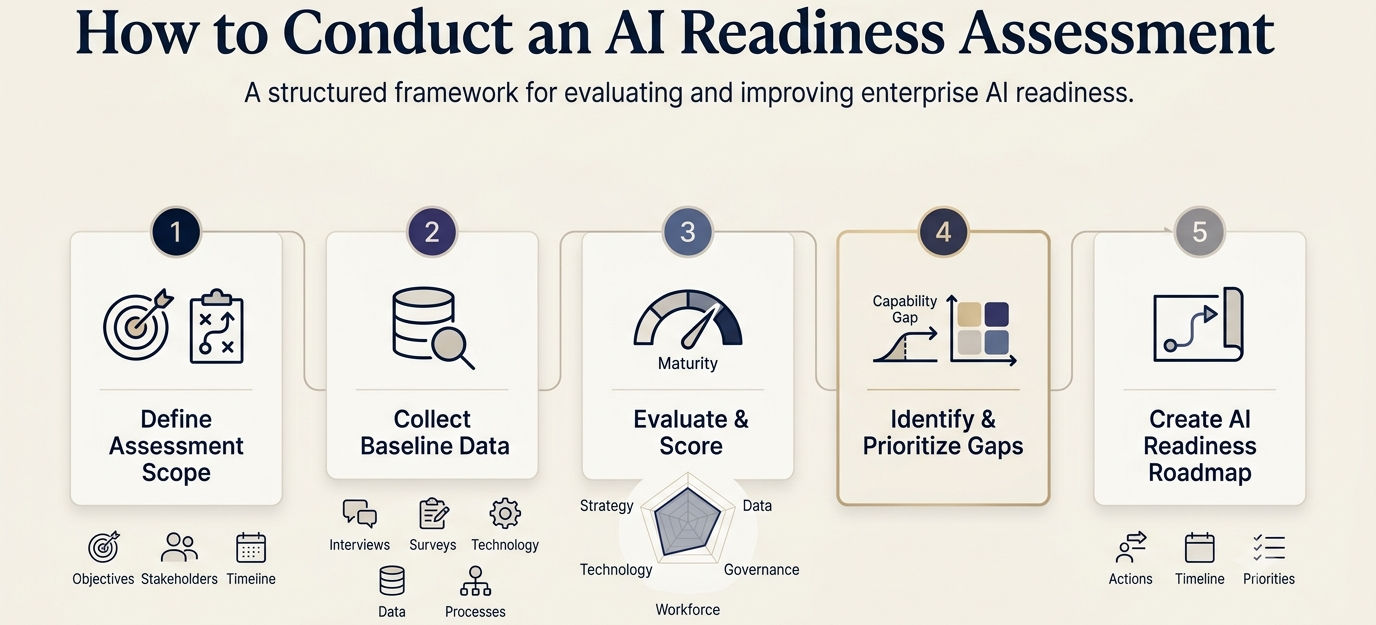
Define the assessment scope
The very first step is identifying what will be included in the scope of the assessment. Some businesses assess a single unit within the company, whereas others cover the whole enterprise.
In order to conduct an AI readiness assessment, you need an AI Readiness Assessment Framework which will help to define objectives, stakeholders, timeline and criteria for evaluation.
Collect baseline data
After determining what will be evaluated, it is important to collect the baseline data. Data collection might be conducted through interviews, surveys, technology audit, data audit and processes evaluation
A successful framework for assessing the readiness to adopt AI solutions is dependent on the accuracy of baseline data. That is why collecting baseline data is crucial for obtaining insights regarding the enterprise AI readiness
Evaluate and score each dimension
After collecting the data, it is possible to evaluate each pillar and score according to pre-defined criteria.
An AI Readiness Assessment Framework usually includes maturity levels to assess the organization's readiness for implementing AI solutions in terms of strategy, technology, data, governance and workforce
Identify and prioritize readiness gaps
At the stage of evaluation, the gaps in organizational capabilities which do not allow to implement AI solutions successfully will be identified.
It is one of the key points of a successful AI readiness assessment framework to identify the capability gaps and determine the priority of improvements needed.
Create the AI readiness roadmap
At the end of assessment, it is required to develop the roadmap which will include actions, timeline and other aspects.
AI Readiness Assessment Framework helps to transform the assessment findings into action plan.
Ready to strengthen your AI and data capabilities? Explore upGrad KnowledgeHut Data Science Courses and build practical skills through courses covering data science, machine learning, AI, and related technologies.
Common challenges companies face in AI readiness
Although the assessment process is conducted professionally and thoroughly, it still does not protect from various issues that hinder AI adoption.
Poor data quality and accessibility
One of the biggest problems faced by companies is low-quality data. It consists of incomplete and outdated data, which significantly affects the effectiveness of AI.
There is a problem with fragmented systems that make it hard to get information. It is one of the main things to take into account when working with AI Readiness Assessment Framework.
Weak governance and risk controls
Without governance, there may appear certain risks such as security or compliance risks.
Businesses that have weak governance are likely to face difficulties in solving such issues as data privacy and regulatory compliance issues. That is why a good framework will help to build appropriate policies and controls.
Difficulty identifying high value AI use cases
Many companies spend money on AI development without knowing how much value it can bring to the company.
This issue may lead to projects that require resources but do not produce any results at all. Improving enterprise AI readiness will require having a process to evaluate potential use cases. Absence of executive ownership and collaboration within the company
Lack of executive ownership and cross functional collaboration
Without it, AI initiatives will not get any further. Poor collaboration between different business units may become an obstacle as well. A framework will define roles and governance structure that will facilitate collaboration.
Unclear ROI and business value
It is important to evaluate the success of AI development, but sometimes it becomes hard because of the absence of the appropriate metrics.
Mature AI readiness framework will help you to determine business objectives and performance metrics.
Conclusion
An AI Readiness Assessment Framework helps enterprises understand whether they are prepared to adopt and scale AI. By assessing strategy, data, technology, governance, skills, processes, and use cases, organizations can identify critical gaps early.
The assessment also helps prioritize investments based on business value, risk, and readiness. With a clear roadmap, enterprises can move from AI experimentation to practical and scalable adoption.
Have A Query? Get in Touch With Our Customer Support | upGrad KnowledgeHut
Frequently Asked Questions (FAQs)
How do you assess AI readiness?
AI readiness is assessed by reviewing an organization’s strategy, data, technology, governance, people, processes, and AI use cases. Each area is evaluated against defined criteria to identify strengths, weaknesses, and capability gaps. The findings help determine whether the organization is ready to adopt or scale AI.
How does data quality affect AI readiness?
Data quality directly affects how reliable and useful AI applications can be. Incomplete, inaccurate, outdated, or inaccessible data can limit AI performance and create unreliable results. Strong data governance, quality controls, ownership, and accessibility are therefore essential for enterprise AI readiness.
What are the dimensions of AI readiness?
The key dimensions typically include strategy and leadership, data, technology and infrastructure, governance, people and skills, processes, and AI use cases. Together, these dimensions provide a broader view of an organization’s ability to adopt and scale AI. Evaluating each dimension helps identify where improvements are needed.
How do you measure AI readiness?
AI readiness can be measured by evaluating each readiness dimension against defined criteria and assigning a maturity score. A simple five-point scale can range from initial capabilities to optimized and scalable capabilities. The results can then be compared with the capabilities required for the organization’s AI goals.
What should an AI readiness assessment include?
An AI readiness assessment should examine business strategy, data quality, technology infrastructure, governance, security, skills, processes, and potential AI use cases. It should also review existing capabilities, risks, gaps, and measurable business objectives. The final assessment should provide clear priorities and recommendations for improving readiness.
What is an AI readiness score?
An AI readiness score is a measure of how prepared an organization is to implement and scale AI. It is usually calculated from scores assigned to different readiness dimensions. The score helps leaders understand overall readiness while highlighting specific areas that require attention.
How do you calculate AI readiness?
A simple approach is to score each readiness dimension on a scale of 1 to 5 and calculate the average. For example, strategy, data, technology, governance, people, processes, and use cases can each receive an individual score. However, critical weaknesses should be reviewed separately because a high average should not hide major risks or blockers.
What are the levels of AI maturity?
AI maturity can be represented through five levels: initial, developing, defined, operational, and optimized. Initial organizations have limited capabilities, while developing organizations may have early pilots and emerging processes. Operational and optimized organizations have repeatable, scalable, governed, and continuously improving AI capabilities.
What security controls are needed before deploying AI?
Organizations should establish access controls, data protection, encryption, privacy safeguards, monitoring, authentication, and secure integration practices. They should also assess model risks, sensitive data exposure, third-party dependencies, and potential misuse. Security requirements should be aligned with the AI use case, business environment, and applicable compliance obligations.
Why should enterprises assess AI readiness before implementing AI?
An AI readiness assessment helps enterprises identify capability gaps before investing heavily in AI projects. It can reveal problems with data, infrastructure, skills, governance, processes, or business alignment that could delay implementation. This allows organizations to address major blockers and prioritize AI investments more effectively.
How can organizations prepare for AI adoption?
Organizations can prepare by defining clear AI goals, improving data foundations, strengthening technology infrastructure, and establishing governance controls. They should also develop employee skills, identify valuable use cases, and prepare business processes for AI integration. Regular readiness assessments can help track progress and keep AI adoption aligned with business objectives.
1639 articles published
KnowledgeHut is an outcome-focused global ed-tech company. We help organizations and professionals unlock excellence through skills development. We offer training solutions under the people and proces...
Get Free Consultation
By submitting, I accept the T&C and
Privacy Policy