
Ethical Hacking Roadmap: A Beginner's Guide
Updated on Apr 23, 2026 | 16 min read | 41.56K+ views
Share:
Table of Contents
View all
Ethical hacking is the practice of legally testing systems, networks, and applications to uncover security weaknesses before they can be exploited. Skilled professionals, often known as white hat hackers, use real-world attack techniques in a controlled and authorized manner to assess vulnerabilities. Their work helps organizations strengthen defenses, reduce the risk of cyber threats, and maintain compliance with evolving security standards.
If you want to build expertise in this field, following a structured learning path can make a significant difference. The Certified Ethical Hacker (CEH® v13) Training Program from upGrad KnowledgeHut provides hands-on experience with tools, techniques, and real-world scenarios used in cybersecurity. You can explore this comprehensive course to begin your journey in ethical hacking.
In this blog, we will also walk through a clear roadmap of ethical hacking, helping you understand the skills, tools, and steps required to build a successful career in this field.
Master the Right Skills & Boost Your Career
Avail your free 1:1 mentorship session
What is Ethical Hacking?
Ethical hacking is the practice of legally testing computer systems, networks, and applications to identify security vulnerabilities before malicious attackers can exploit them. It is carried out by authorized professionals, often called white hat hackers, who use the same techniques as cybercriminals but with permission and a clear objective of improving security.
The goal of ethical hacking is to detect weaknesses, fix them, and strengthen an organization’s overall cybersecurity posture. This process helps prevent data breaches, protect sensitive information, and ensure systems remain secure against evolving threats.
Types of Ethical Hackers
1. Penetration Testers (Pentesters): These professionals are hired to simulate cyberattacks on systems to test their security strength. They use controlled hacking techniques to identify weak points and help organizations fix them before real attackers can exploit them.
2. Red Team Members: These ethical hackers perform advanced, targeted attacks to test an organization's defenses. They try real-world scenarios to assess how well security measures hold up under pressure.
3. Blue Team Members: Unlike red team members, blue team members focus on defending against attacks. They work to improve security protocols, monitor for threats, and respond to incidents.
4. Bug Bounty Hunters: These independent hackers find and report vulnerabilities in exchange for rewards. Many organizations run bug bounty programs to encourage external experts to identify security flaws.
Roadmap of Ethical Hacker
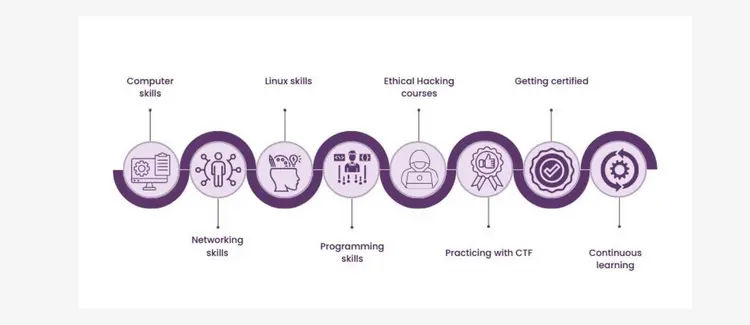
Source: theknowledgeacademy
Becoming an ethical hacker requires a structured pathway, starting from foundational knowledge to advanced skills in cybersecurity. Here’s a detailed ethical hacking roadmap for beginners that walks you through the essential skills, tools, and certifications needed to get started.
Foundation in IT and Networking
- Basic IT Skills: Gain a solid understanding of computer systems, operating systems (Windows, Linux), and software applications.
- Networking Fundamentals: Learn about TCP/IP, DNS, DHCP, and other networking protocols. Understand how data flows through networks.
Learn Programming Languages
- Scripting: Start with scripting languages like Python or Bash, which are important for automation and developing custom tools.
- Web Development: Basic knowledge of HTML, JavaScript, and SQL is important for web app security testing.
Understand Cybersecurity Basics
- Security Fundamentals: learn the basics of cybersecurity, including threat landscapes, types of attacks, and security principles.
Get Hands-On Experience
- Capture The Flag Competitions: Participate in CTF challenges to test your skills in real-world scenarios.
Learn Tools and Techniques
- Kali Linux: Familiarize yourself with this popular penetration testing distribution that includes a wide range of security tools.
- Penetration Testing Tools: Learn to use tools like Nmap, Metasploit, Wireshark, Burp Suite, and OWASP ZAP.
Gain Professional Experience
One of the most important stages in any ethical hacker road map is gaining practical experience through real-world roles and community involvement.
- Internships and Entry-Level Jobs: Find opportunities to work as a security analyst, junior penetration tester, or in a related role.
- Continuous Learning: Be updated with the latest trends, tools, and techniques in cybersecurity through online courses, webinars, and conferences.
Contribute to the Community
- Bug Bounty Programs: Participate in bug bounty programs to identify and report security vulnerabilities for rewards.
- Open Source Projects: Contribute to open source security projects and tools to gain experience and recognition in the community.
Tips to Become an Ethical Hacker
To make the most of your ethical hacking roadmap, follow these practical tips to accelerate your learning and stand out in the field.
- Practice Regularly: Regularly practice your skills on platforms like Hack The Box, TryHackMe, and other ethical hacking labs.
- Read Cybersecurity Books and Blogs: Stay informed by reading authoritative books and following blogs by experienced hackers and cybersecurity experts.
- Learn From Open Source Projects: Contribute to and study open source security tools and projects to deepen your understanding.
- Understand the Legal Boundaries: Always ensure your activities are legal. Ethical hacking should always have the proper authorization and comply with laws and regulations.
- Develop Soft Skills: Communication and problem-solving skills are essential for explaining vulnerabilities to non-technical stakeholders and collaborating with team members.
Once you’ve understood the ethical hacking learning roadmap, it’s important to adopt daily habits and tools that reinforce your skills.
What is the Attraction of an Ethical Hacking Career?
Ethical hacking is a fascinating career, and following a structured road map for ethical hacking can help technical professionals break into this fast-growing industry with clarity and confidence. The field is challenging with new projects and tightly secured networks to crack. So, it will be a new challenge every day that will keep your interest in the work alive. There will never be a dull moment or monotony. Moreover, if you work for the best organization, you will get additional perks along with an attractive salary.
Let us discuss the reasons to build a career in Ethical Hacking.
| 1. | Growing Opportunities | Regardless of the niche, every organization plans to switch to cloud networks. While some have already started working on the cloud, others will join the wagon. So, you can expect a sudden spike in job opportunities in this industry. If you have the expertise level required by the organizations, you will never see a lack of options. |
| 2. | Attractive Salary | It is a high-paying profession where you can expect to earn around ₹10 LPA at the entry level in India, with salaries rising significantly as you gain experience and expertise. Globally, ethical hackers are in high demand, with average annual salaries ranging from $90,000 to $120,000 in the USA, £45,000 to £70,000 in the UK, AUD 95,000 to 135,000 in Australia, and SGD 75,000 to 110,000 in Singapore. These figures can go even higher for professionals holding advanced certifications or working in specialized sectors. Furthermore, if you land a role in the defense sector or other public or government organizations, you can expect numerous additional perks along with a competitive pay package. |
| 3. | Challenging Industry | There will be new projects and challenges each day, so you will never feel bored or experience monotony at work! In addition, technology changes every day, so you will always have to be on your toes to keep up with the changing trends and deliver the best results. So, if you wish to be active and face new challenges each day, hacking is an ideal option. |
| 4. | Job Security | This industry will only see a rise in demand in the coming years, so choosing ethical hacking can secure your career. Companies will never stop using online networks for improved performance, and they will always need security professionals to help them keep the network safe. There are countless other reasons to join ethical hacking as a career. All you need to do is take up a professional certification course and gain expertise in the field to deliver the best results to every organization. Moreover, as technology and its features are ever-changing, you should stay updated with the latest trends and keep up with the changing dynamics to prove your worth. |
Another highlight of the ethical hacking career is job security. The demand for cyber security and secure networks is high, and it will keep increasing in the coming years. So, if you join the field, you can rest assured that your job and career are secured.
How to Become an Ethical Hacker: About CEH Exam
The CEH exam is often the centerpiece of any ethical hacking certification roadmap, as it validates your skills and opens doors to advanced roles in cybersecurity. To become an ethical hacker, a technical background is essential. Aspiring hackers must clear the Certified Ethical Hacker exam, an industry-grade certification that trains professionals in ethical hacking. CEH teaches the latest techniques to identify and protect against hacker attacks and network vulnerabilities. As technology evolves, the CEH course and exam are regularly updated, ensuring professionals stay current. Achieving this certification is crucial for anyone aiming to excel in the ethical hacking field.
You can join different online cyber security courses with certificates to learn the concepts and qualify to start a professional journey. You will get access to the best study material and training from qualified professionals, and once you have the certificate, you can grab the best opportunities.
Exam Overview
The CEH exam has 125 questions, requiring a 70% score to pass, with a 4-hour duration. Apply online to take the exam. If you fail, you can retake it by emailing the EC Council manager with your previous score and paying the fee again. Maintain certification by renewing it every three years with 120 EC Council continued education credits. This is essential information for anyone planning to take the CEH exam.
Eligibility Criteria for CEH
You need to qualify for the eligibility criteria to be able to take this exam, no matter how fascinated you are with this field. There are two ways to get the certification, one with training and another without any formal course. The eligibility criteria for both these ways are as follows.
To become a Certified Ethical Hacker (CEH), attend an official training program approved by EC Council training partners or have a minimum of two years of information security experience. Enroll in courses like KnowledgeHut's certified Ethical Hacker training to prepare for the CEH exam.
Role of an Ethical Hacker
An ethical hacker is a cyber security professional who has permission to breach the security systems. They keep a close watch on the online network, ensuring no intruders ever get the chance to harm the data or operations. Additionally, they also have the right to intrude into other networks with the intention to identify and fail their attempts to affect them. The perfect example of this is a defense organization. They hire professionals to encode the planning of other organizations and stay prepared for it. Listed below are the roles and responsibilities of an ethical hacker for a better understanding.
- Scanning the network thoroughly to identify any vulnerability that can give intruders a chance to enter the confidential area.
- Prepare a strong, protective layer around the network to fail every cyber attack attempt.
- Engaging in social engineering methodologies and using the right ones in the organizational network.
- Legally access the foreign networks to collect the required information to create effective cyber security plans.
There are many other responsibilities or job roles that an ethical hacker can get. However, the job is to work around the network security world. If all of this seems like an attractive career option to you, refer to this roadmap to ethical hacking and stay prepared to grab the best job opportunities.
Skills Required
Ethical hacking is a field of Information Technology, so it goes without saying that you need to be from a technical background to become a certified ethical hacker. To follow a successful ethical hacker road map, you’ll need to build a strong foundation in both technical and analytical skills. The following skills are crucial at every stage of your ethical hacking learning roadmap, whether you're just starting or looking to specialize.
1. Basic Computer Skills
You need the fundamental computer skills to start the journey. These skills include OS, file management, database storage, MS office, emails, and social media management, and the list is never-ending. In addition, you require familiarity with all the computer operations so that you do not feel like a stranger when you start working on the machine.
2. Computer Networks
Networking skills are mandatory for an ethical hacker. You need to have a thorough knowledge of networks like DHCP, subnetting, host connections, and managing the interconnection of different computers on a single network. So, it is helpful if you have a networking background.
3. Coding Skills
An ethical hacker should have programming skills and a deeper understanding of at least one programming language. Some of the languages that prove significant and helpful for hackers include SQL, Python, C-Programming, JavaScript, Ruby, PHP, and a few more. Moreover, there are tool packages that an aspiring hacker looking for an ethical hacking roadmap on GitHub can use to gain coding expertise.
4. Hardware Knowledge
It is better to understand the hardware well to ensure perfect network connections. In addition, you should know about different parts of your machine and how you can use them in the network setup or security operations. Though you will learn all this during the training program, it is great to have prior knowledge.
5. Database Management
One of the prime reasons for network switches is proper database management. Hence, the skill that you need to learn is database organization and storage. So, sharpen your DBMS skills and be ready to manage the data, keeping it safe from intruder attacks.
6. Problem Solving Skill
The security challenges are intense, and if you do not have problem-solving skills, you may not be able to create your own mark in the industry. So, work on your problem-solving skills, and you will see yourself grow in the field well.
These are the fundamental skills that every aspirant planning to become a qualified hacker should possess. If you lack these skills, you should start preparing for them and gain the expertise level to ensure efficiency in your work. Understand that you get the best opportunities only when you have the required skills and qualifications.
Looking to enhance your IT skills? Explore our ITIL training courses for a unique learning experience. Gain valuable insights and boost your career with our expert-led programs. Join us today and unlock your true potential.
Benefits of Ethical Hacking
Ethical hacking is a much-in-demand and highly-interesting field of IT that benefits individuals and organizations alike. The companies get qualified professionals to deal with the security requirements, and the individuals get attractive salary packages and job security. Some of the benefits of ethical hacking are:
- It helps keep the data and the network secured and safe from intruder attacks.
- You can identify the probable risks well on time and prepare your network to avoid the risks.
- Prepare an effective network strategy to help organizations make a smoother transition to the cloud networks.
- A professional opting for the ethical hacking profession gets job security for a lifetime as this IT field will expectedly grow in the coming future.
- A qualified expert can expect to get attractive salary packages in this profession.
There are countless other benefits that ethical hacking offers. However, you only ripe all these perks if you are a qualified professional or have hired the best hacker with proven expertise. By following a clear road map for ethical hacking, professionals can unlock not just job opportunities, but long-term career growth and security in the cybersecurity space.
Certifications and Training for Ethical Hacking
If you’re aiming to plan your journey, this section can serve as your ethical hacking certification roadmap, outlining top credentials to help you level up.
1. Certified Ethical Hacker (CEH): Offered by EC-Council, CEH is one of the most widely recognized credentials in ethical hacking. It covers key topics like penetration testing, network security, and attack methodologies. upGrad KnowledgeHut offers CEH v13 training with live classes, hands-on labs, and full exam support to help learners succeed on their first attempt.
2. CompTIA Security+: This entry-level certification is ideal for beginners in cybersecurity. It covers foundational topics such as network security, cryptography, and risk management. Security+ is DoD-approved and serves as a stepping stone to more advanced certifications.
3. Offensive Security Certified Professional (OSCP): Known for its practical, hands-on approach, OSCP is designed for professionals who want to prove their penetration testing skills in real-world scenarios. It’s highly regarded in the industry for its difficulty and practical lab-based exam.
Choosing the right certifications at each stage is essential when following a road map for ethical hacking, especially if you're aiming for specialized or leadership roles in cybersecurity.
4. Certified Information Systems Security Professional (CISSP): Ideal for experienced professionals, CISSP focuses on broader security topics like risk management, architecture, and governance. It's best suited for those targeting leadership roles in cybersecurity.
5. GIAC Penetration Tester (GPEN): Offered by GIAC, this certification focuses on penetration testing and ethical hacking techniques. It validates your ability to conduct in-depth assessments and identify system vulnerabilities.
These credentials are key milestones in a complete roadmap for ethical hacking, helping you validate your skills and stand out to employers.
Conclusion
While there are countless training programs and opportunities in cybersecurity, having a structured roadmap to become ethical hacker can help you stay on track and make informed career decisions. The only thing required is a person with proven expertise. So, if you think you have what it takes to be an excellent hacker, CEH is your calling.
We have covered the detailed ethical hacking roadmap that aims at clearing every doubt and confusion around becoming a certified ethical hacker. You can start by joining a professional training program, learning the skills that an ethical hacker requires, and applying for the exam. Give your best, and once you qualify for the exam, there is no looking back! After that, you would only have to keep working on the projects and update your certification every three years to ensure you are well-versed with changing technology trends.
Contact our upGrad KnowledgeHut experts for personalized guidance on choosing the right course, career path, and certification to achieve your goals.
Frequently Asked Questions (FAQs)
What is ethical hacking in cybersecurity?
Ethical hacking is the process of legally testing systems, networks, and applications to find security vulnerabilities before malicious hackers can exploit them. It is performed by authorized professionals known as white hat hackers. They use real world hacking techniques in a controlled way to strengthen security. This helps organizations prevent cyberattacks and protect sensitive data.
What does an ethical hacker do?
An ethical hacker identifies weaknesses in systems and works to fix them before they become a threat. Their responsibilities include penetration testing, vulnerability assessment, and security audits. They also monitor networks, simulate cyberattacks, and suggest improvements. Their role is essential in maintaining strong cybersecurity for organizations.
What are the different types of ethical hackers?
There are several types of ethical hackers based on their roles. Penetration testers simulate attacks to find vulnerabilities, while red team members test overall security defenses. Blue team professionals focus on defense and threat response. Bug bounty hunters independently discover and report security flaws for rewards.
What is the difference between red team and blue team in ethical hacking?
Red team members act like attackers and simulate real world cyber threats to test system defenses. Blue team members focus on protecting systems by monitoring, detecting, and responding to threats. While red teams try to break into systems, blue teams work to stop them. Together, they help improve overall cybersecurity strength.
What is the roadmap to become an ethical hacker?
The roadmap starts with learning basic IT and networking concepts. Next, you should learn programming and cybersecurity fundamentals. After that, gain practical experience using tools and participating in challenges. Finally, pursue certifications and real-world experience to build a successful career.
How can I start a career in ethical hacking?
To start a career in ethical hacking, begin with basic IT and networking knowledge. Learn programming languages like Python and understand cybersecurity fundamentals. Gain hands on experience through labs, internships, and Capture The Flag challenges. Certifications like CEH can further validate your skills and improve job opportunities.
What skills are required to become an ethical hacker?
Key skills include networking knowledge, programming, and understanding of operating systems. You should also have problem solving abilities and knowledge of security tools. Familiarity with databases and hardware can be beneficial. Strong analytical thinking and communication skills are equally important for success.
Which tools are commonly used in ethical hacking?
Ethical hackers use tools like Nmap for network scanning and Metasploit for penetration testing. Other popular tools include Wireshark for traffic analysis and Burp Suite for web application testing. Kali Linux is widely used as it contains many pre-installed security tools. These tools help identify and fix vulnerabilities effectively.
What certifications are best for ethical hacking?
Popular certifications include Certified Ethical Hacker CEH, CompTIA Security+, and Offensive Security Certified Professional OSCP. Advanced professionals may pursue CISSP or GPEN certifications. These certifications validate your skills and increase your chances of getting hired. Choosing the right certification depends on your experience level.
Is ethical hacking a good career option?
Yes, ethical hacking is a highly rewarding and in-demand career. With the rise in cyber threats, organizations need skilled professionals to protect their systems. It offers high salaries, job security, and continuous learning opportunities. The field is dynamic, making it exciting and challenging.
212 articles published
Vitesh Sharma, a distinguished Cyber Security expert with a wealth of experience exceeding 6 years in the Telecom & Networking Industry. Armed with a CCIE and CISA certification, Vitesh possesses expe...
Get Free Consultation
By submitting, I accept the T&C and
Privacy Policy