
Prerequisites For Learning Ethical Hacking
Updated on May 08, 2025 | 12 min read | 18.4K+ views
Share:
We live in a digital world where technology rapidly evolves, leading businesses to store information online, increasing cybersecurity concerns and the demand for ethical hackers. Ethical hacking involves understanding computer systems to assess security and notify at-risk parties. It is essential for protecting online assets, keeping servers and infrastructure secure, and preventing unauthorized access. Ethical hacking skills go beyond stealing data and cracking passwords; it involves scanning for threats and vulnerabilities.
KnowledgeHut offers a CEH Certification course for those interested in this field. Aspiring ethical hackers need specific skills to succeed in this fascinating and critical career.
Master the Right Skills & Boost Your Career
Avail your free 1:1 mentorship session
Prerequisites for Ethical Hacking
Some of the prerequisites for learning Ethical Hacking are as follows:
- Programming Languages
- Linux
- Database Engine Skills
- Problem-Solving and Critical Thinking Skills
- Computer Networking
- Computer Skills
- Basic Knowledge About Hardware
- Reverse Engineering
- Cryptography
- Gain Experience
Programming Languages
In order to become an ethical hacker, you must know and understand the various programming languages available. This is an important skill since it will help you to understand and gain an approach to any software. Being aware of all the programming languages will require you to do a lot of coding. Before writing a code, you must select the best available programming language for your programming. Some of the programming languages that are used by ethical hackers include:
- Perl
- Ruby
- Java
- C++
- PHP
- JavaScript
- C
- SQL
- Python
Programming languages will help you gain access to the software of the company. It will even help you attain a better understanding of the tools that hackers need to develop in order to get into a security system. Getting yourself familiar with the different kinds of hacking tools will help you to create advanced software to conduct penetration testing.
Linux
Linux refers to a community of open-source Unix. This mainly refers to operating systems that are generally based on Linux Kernel. Linux is an open-source and free operating system. The source code in Linux can be distributed and modified to anyone either non-commercially or commercially through the GNU General Public License. One of the main reasons why it is important for you to know prior knowledge about Linux is because it is more secure as compared to other operating systems in terms of security. However, Linux does have some malware but it is considered to be far less vulnerable when compared to other operating systems. Therefore, it does not need any kind of anti-virus software.
Many web servers use Linux since it is one of the safest and most secure operating systems. Hence, gaining knowledge about these operating systems will definitely help you in your journey of becoming an ethical hacker. Without Linux, you may find it difficult to gain access to certain servers and look into any possible breach of security.
Database Engine Skills
DBMS is the main essence of managing and creating all databases. Retrieving a database from where all sensitive information is available can put an organization under threat. A business organization can be under intense threat when illegal hackers get into the security and leak sensitive information. Hence, it is necessary for the database of the company to be highly secured. With the familiarity with different database schemas and engines, you will be able to provide help and advice to business organizations to set up a strong and secured database.
Problem-Solving and Critical Thinking Skills
Having knowledge about all the technical aspects of ethical hacking alone is not sufficient. Adding to this, you will also need problem-solving and critical thinking skills in order to become a successful ethical hacker. There is a lot of information that we receive in today’s world. Illegal hackers are continuously looking for new ways to get this data. Hence, as an ethical hacker, you need to think and formulate a master plan in order to tackle such threats. You must find an effective answer for any problem that comes your way. Apart from this, you must even be willing to learn different ways to solve problems and make sure that all security breaches are checked thoroughly. This process needs a lot of testing on devices.
Computer Networking
Computer networking is one of the most important skills that you need to have in order to become an ethical hacker. Computer networking refers to the interconnection between various devices. These are generally known as Hosts, which are connected using various ways to receive/send any type of media or data. Having knowledge of networks like Subnetting. Supernetting, DHCP, among others will help you explore the different kinds of interconnected computers in networks as an ethical hacker. You will even be able to understand the possible security threats that might be created because of this and learn how to tackle these kinds of threats.
Computer Skills
Computer skills refer to the ability and knowledge that allows you to use computers and other types of technology. Generally, the most basic type of computer skill would involve having knowledge about creating presentations, managing computer files, and processing data. However, on the other hand, the advanced type of computer skills would involve having knowledge about running calculations in spreadsheets, programming, and managing databases. In order to become a successful ethical hacker, you must have basic computer skills. Some of these include Enterprise systems, Web, Social Media, Database Management, Email, Spreadsheets, MS office, and so on. A successful ethical hacker would require to become an expert in computer systems.
Basic Knowledge About Hardware
The physical components of a computer include the motherboard, speakers, sound card, graphics card, computer data storage, keyboard, mouse, monitor, CPU (central processing unit), and so on. In contrast, software refers to a collection of information that can be executed and stored by the hardware. Hence, in order to hack software that is controlled by a computer, you must understand the operation of the machine. After which you must gain access to the computer that operates the machine. The machine will then be able to develop a good software security system. However, you need to keep in mind that illegal hackers do not pay much attention to hardware security. Hence, if the hacker has access, he or she will even have the ability to play with it. Therefore, in order to become an ethical hacker, you must have basic knowledge about hardware. This will not only help you understand hardware, but it will also help you understand how BIOS works together, how CMOS works together, how USBs transfer data, how the motherboard works, and so on.
Reverse Engineering
The process of recovering a product’s function, requirement specifications, and design from an analysis of its code is known as reverse engineering. It creates a program database and uses it to create data. The goal of reverse engineering is to speed up the work of maintenance by improving a system’s understandability and producing the necessary documentation for a legacy system. Reverse engineering is broadly used in software security to ensure that the system is free from any crucial vulnerabilities or security flaws. It contributes to the robustness of a system, hence saving it from any type of spyware and hackers. Some developers will even hack their own system to find certain flaws or vulnerabilities. This type of practice is known as ethical hacking.
Cryptography
The application and study of techniques for dependable communication with a third party witness known as adversaries are known as cryptography. It is concerned with the development and analysis of rules and guidelines that stop third parties from receiving any information through malicious practices. The information provided is shared only between two entities thus adhering to the various aspects of information security. Cryptography refers to the process of changing a normal message or text (plain text) to a complicated form of text (ciphertext) during transmission in order to render it indecipherable to hackers. An ethical hacker must make sure that the communication which takes place within the organization is not compromised.
Gain Experience
You don’t need to have a diploma or a degree in order to become an ethical hacker. However, you will need to gain some sort of experience with computer systems security in order to portray your understanding of ethical hacking. One of the best ways to gain experience is by gaining the CEH certification course or other such programs. Cyber Security best course will help you gain the information and knowledge you need to become a professional ethical hacker.
That’s all for the prerequisites for Ethical Hacking. Now let us see what are the five phases of ethical hacking. Have a look into a detailed guide on ethical hacking.
Understand the 5 Phases of Ethical Hacking
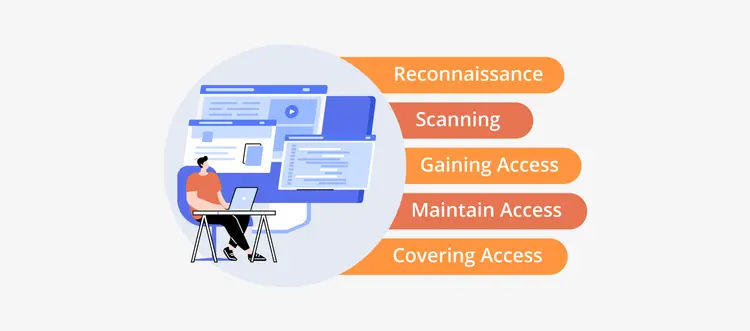
There are certain phases incorporated by ethical hackers to test the network of an organization. An illegal hacker generally uses this process to breach information from the network, whereas an ethical hacker uses the same approach to protect the information. The 5 phases of ethical hacking include:
- Reconnaissance: The hackers gain information regarding the targets and then launch an attack. It is done in phases before exploiting the vulnerabilities of the system.
- Scanning: The hacker figures out a way to get access to the network system and look for privileged information.
- Gain Access: The hacker gets access to the network, applications, and system and grows their user right to take over the systems connected to it.
- Maintain Access: The gain maintains access to the company’s Trojans and Rootkits and uses it to initiate more attacks on the same network.
- Cover Tracks: The hacker tries to cover its tracks after gaining complete access. They try to get away from the security workforce by clearing cooking and cache, closing all open ports, and tampering with the log files.
Unlock Your IT Potential with ITIL V4 Master Course - The Ultimate Guide to Streamline Your Business Operations and Boost Productivity. Discover the Power of ITIL Today!
Conclusion
The need for ethical hackers increases every day as more and more organizations begin to adopt cloud-based system storage. If you want to play an important role in protecting the digital space, then you must consider applying for the KnowledgeHut CEH certification course. Gaining a certification course will even help you understand more about programming, network, and computing. This can be a step ahead for you to meet your career goals.
Frequently Asked Questions (FAQs)
1. Can a beginner learn ethical hacking?
Ethical hacking can be learned by anyone and everyone. Whether you are a beginner or have prior knowledge, with the help of an online course you will easily be able to learn methods and principles of ethical hacking.
2. Does ethical hacking require coding?
Ethical hacking does not necessarily require you to know everything about coding. However, it can be difficult to become a successful hacker without coding. Some tools such as Buffer Overflows and XML injections require you to have some basic knowledge of coding. In order to become a potential ethical hacker, you must know coding.
3. What programming language did Bill Gates develop?
When Bill Gates was a sophomore in 1975 at Harvard University, he began to develop a programming language along with his friend Paul G. Allen. Both of them together developed software to use for the first-ever microcomputer. They developed Altair BASIC as their programming language to work for microcomputers.
212 articles published
Vitesh Sharma, a distinguished Cyber Security expert with a wealth of experience exceeding 6 years in the Telecom & Networking Industry. Armed with a CCIE and CISA certification, Vitesh possesses expe...
Get Free Consultation
By submitting, I accept the T&C and
Privacy Policy